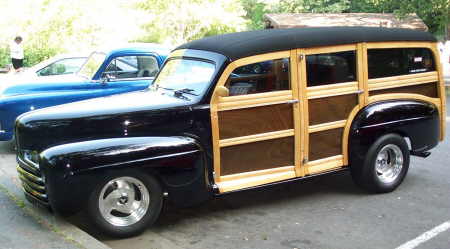
This post could be considered an update to the previous Flashback Friday post. Over at Pure Florida there is a surfer guy who expressed an interest in the woody shown in the background of a couple of the pictures I had posted. Had I known, I would have featured a good photo of the vehicle, so Florida Cracker, this is for you.
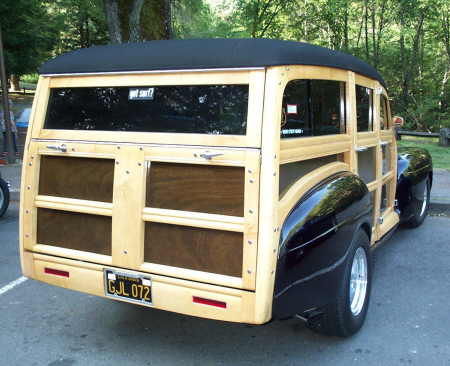
This is a 1946 Ford Super Deluxe Woody Station Wagon. To be more accurate, it is a highly modified 1946 Ford Super Deluxe Woody Station Wagon, unlike what you would have purchased from your local Ford dealer back in 1946. This was one of the finest regularly driven customized woodies I have ever seen.
Prior to the mid 1930’s, wood was a more economical material to use in the fabrication of automobiles than steel. Many vehicles utilized wood in the chassis framework as a structural component, upon which steel body assemblies would be built. Eventually, a small number of automobiles began to shed portions of the steel body in favor of all wood exposed body panels. Besides the material cost considerations, there was another dynamic at work. Prior to common adaptation of the automobile as our standard mode of transportation, this country traveled by horse-drawn carriage. As the automobile gained in affordability and popularity, there were many craftsmen skilled in the methods of woodworking used to manufacture the carriages that lost their livelihood. By transferring their skills to the automobile industry, many regained employment building the wooden body parts for this new breed of vehicle which we now call a woody.
The original derivation of the term station wagon has interesting roots. Prior to World War 2, there was no such thing as common commercial air travel. Substantially all long distance travel in America was done by train. Passengers needed transportation from hotels and private residences to the local train station to embark on their journeys. Cabbies, or hacks, began to alter regular automobiles by rebuilding and extending the rear trunk sections to hold the large amounts of baggage that was being hauled to the train station.  This is where the term “station wagon” comes from. They were also referred to as “depot hacks”, but this term did not stick, so we are left with today’s usage of station wagon.
There is much nostalgia regarding the woody as THE wheels for surfers in America. Contrary to common recollection, the woody was originally chosen by surfers for two simple reasons. First, they were cheap in the late fifties and early sixties. While some authentic wood paneled vehicles were produced after WWII (including this 1946 Ford), it was increasingly more economical to produce vehicles entirely from steel. Since domestic automobile production came to a virtual standstill during the war years, it can be inferred that most woodies were produced prior to 1941. Therefore, by the late fifties and early sixties, most of the wooden autos still in existence were at least 20 years old. If you have ever seen an unmaintained woody, you will understand that in 1960, prior to their nostalgia induced popularity, a woody could be purchased for a paltry sum of money.
The second reason that the woody became popular amongst surfers was the space available in the rear to transport their surfboards. For those familiar with the surf culture, you will know that surfing is a nomadic sport, in the sense that gung-ho surfers are always venturing to different spots seeking the “perfect wave”. It is not uncommon for a surfer to start his surfing day at one location, and through the course of the day, travel up and down the coast searching for the most challenging wave sets to tackle (and the prettiest surfer girls to flirt with). The large space in the rear of the woody station wagon was perfectly suited to the task of hauling surfboards. The flip up tailgates associated with the woodies allow the surfer to quickly throw many boards in the back of the vehicle and travel to the next venue. It is interesting to note that the second most popular surfer vehicle of the past was the Volkswagen bus, for just the same reasons; they were inexpensive and they could hold many surfboards easily.
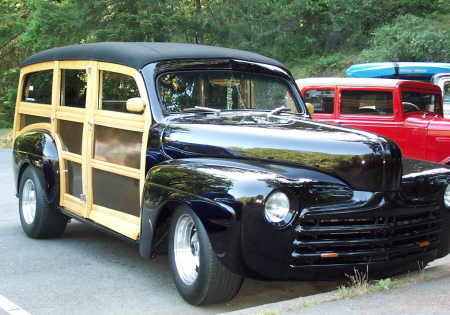
It is just a guess, but from my observations along the California coastline during the course of many years, it would seem that very few woodies are still being used by surfers. The nostalgic popularity of these vehicles has probably made the cost of a classic woody prohibitive to most surfers today.

This post could be considered an update to the previous Flashback Friday post. Over at Pure Florida there is a surfer guy who expressed an interest in the woody shown in the background of a couple of the pictures I had posted. Had I known, I would have featured a good photo of the vehicle, so Florida Cracker, this is for you.
This is a 1946 Ford Super Deluxe Woody Station Wagon. To be more accurate, it is a highly modified 1946 Ford Super Deluxe Woody Station Wagon, unlike what you would have purchased from your local Ford dealer back in 1946. This was one of the finest regularly driven customized woodies I have ever seen.
Prior to the mid 1930’s, wood was a more economical material to use in the fabrication of automobiles than steel. Many vehicles utilized wood in the chassis framework as a structural component, upon which steel body assemblies would be built. Eventually, a small number of automobiles began to shed portions of the steel body in favor of all wood exposed body panels. Besides the material cost considerations, there was another dynamic at work. Prior to common adaptation of the automobile as our standard mode of transportation, this country traveled by horse-drawn carriage. As the automobile gained in affordability and popularity, there were many craftsmen skilled in the methods of woodworking used to manufacture the carriages that lost their livelihood. By transferring their skills to the automobile industry, many regained employment building the wooden body parts for this new breed of vehicle which we now call a woody.
The original derivation of the term station wagon has interesting roots. Prior to World War 2, there was no such thing as common commercial air travel. Substantially all long distance travel in America was done by train. Passengers needed transportation from hotels and private residences to the local train station to embark on their journeys. Cabbies, or hacks, began to alter regular automobiles by rebuilding and extending the rear trunk sections to hold the large amounts of baggage that was being hauled to the train station.  This is where the term “station wagon” comes from. They were also referred to as “depot hacks”, but this term did not stick, so we are left with today’s usage of station wagon.
There is much nostalgia regarding the woody as THE wheels for surfers in America. Contrary to common recollection, the woody was originally chosen by surfers for two simple reasons. First, they were cheap in the late fifties and early sixties. While some authentic wood paneled vehicles were produced after WWII (including this 1946 Ford), it was increasingly more economical to produce vehicles entirely from steel. Since domestic automobile production came to a virtual standstill during the war years, it can be inferred that most woodies were produced prior to 1941. Therefore, by the late fifties and early sixties, most of the wooden autos still in existence were at least 20 years old. If you have ever seen an unmaintained woody, you will understand that in 1960, prior to their nostalgia induced popularity, a woody could be purchased for a paltry sum of money.
The second reason that the woody became popular amongst surfers was the space available in the rear to transport their surfboards. For those familiar with the surf culture, you will know that surfing is a nomadic sport, in the sense that gung-ho surfers are always venturing to different spots seeking the “perfect wave”. It is not uncommon for a surfer to start his surfing day at one location, and through the course of the day, travel up and down the coast searching for the most challenging wave sets to tackle (and the prettiest surfer girls to flirt with). The large space in the rear of the woody station wagon was perfectly suited to the task of hauling surfboards. The flip up tailgates associated with the woodies allow the surfer to quickly throw many boards in the back of the vehicle and travel to the next venue. It is interesting to note that the second most popular surfer vehicle of the past was the Volkswagen bus, for just the same reasons; they were inexpensive and they could hold many surfboards easily.
It is just a guess, but from my observations along the California coastline during the course of many years, it would seem that very few woodies are still being used by surfers. The nostalgic popularity of these vehicles has probably made the cost of a classic woody prohibitive to most surfers today.
{"id":278,"date":"2006-05-21T14:05:34","date_gmt":"2006-05-21T20:05:34","guid":{"rendered":"http:\/\/www.mitzenmacher.net\/blog\/?p=278"},"modified":"2006-05-21T14:07:42","modified_gmt":"2006-05-21T20:07:44","slug":"the-first-sport-utility-vehicles","status":"publish","type":"post","link":"https:\/\/www.mitzenmacher.net\/blog\/?p=278","title":{"rendered":"The First Sport Utility Vehicles"},"content":{"rendered":"","protected":false},"excerpt":{"rendered":"","protected":false},"author":1,"featured_media":0,"comment_status":"open","ping_status":"open","sticky":false,"template":"","format":"standard","meta":{"_jetpack_newsletter_access":"","_jetpack_dont_email_post_to_subs":false,"_jetpack_newsletter_tier_id":0,"_jetpack_memberships_contains_paywalled_content":false,"_jetpack_feature_clip_id":0,"_jetpack_memberships_contains_paid_content":false,"footnotes":"","jetpack_publicize_message":"","jetpack_publicize_feature_enabled":true,"jetpack_social_post_already_shared":false,"jetpack_social_options":{"image_generator_settings":{"template":"highway","default_image_id":0,"font":"","enabled":false},"version":2},"jetpack_post_was_ever_published":false},"categories":[7],"tags":[],"class_list":["post-278","post","type-post","status-publish","format-standard","hentry","category-flashbacks-in-time"],"jetpack_publicize_connections":[],"jetpack_sharing_enabled":true,"jetpack_shortlink":"https:\/\/wp.me\/p8xyVp-4u","jetpack_likes_enabled":true,"jetpack_featured_media_url":"","_links":{"self":[{"href":"https:\/\/www.mitzenmacher.net\/blog\/index.php?rest_route=\/wp\/v2\/posts\/278","targetHints":{"allow":["GET"]}}],"collection":[{"href":"https:\/\/www.mitzenmacher.net\/blog\/index.php?rest_route=\/wp\/v2\/posts"}],"about":[{"href":"https:\/\/www.mitzenmacher.net\/blog\/index.php?rest_route=\/wp\/v2\/types\/post"}],"author":[{"embeddable":true,"href":"https:\/\/www.mitzenmacher.net\/blog\/index.php?rest_route=\/wp\/v2\/users\/1"}],"replies":[{"embeddable":true,"href":"https:\/\/www.mitzenmacher.net\/blog\/index.php?rest_route=%2Fwp%2Fv2%2Fcomments&post=278"}],"version-history":[{"count":0,"href":"https:\/\/www.mitzenmacher.net\/blog\/index.php?rest_route=\/wp\/v2\/posts\/278\/revisions"}],"wp:attachment":[{"href":"https:\/\/www.mitzenmacher.net\/blog\/index.php?rest_route=%2Fwp%2Fv2%2Fmedia&parent=278"}],"wp:term":[{"taxonomy":"category","embeddable":true,"href":"https:\/\/www.mitzenmacher.net\/blog\/index.php?rest_route=%2Fwp%2Fv2%2Fcategories&post=278"},{"taxonomy":"post_tag","embeddable":true,"href":"https:\/\/www.mitzenmacher.net\/blog\/index.php?rest_route=%2Fwp%2Fv2%2Ftags&post=278"}],"curies":[{"name":"wp","href":"https:\/\/api.w.org\/{rel}","templated":true}]}}