This is the second in a small series of posts in which I share my “landscaping secrets”. I have put the term landscaping in quotes because I don’t do landscaping. Landscaping involves much work, some knowledge about plant life, physical labor, a planning ability, exertion of effort, and patience. Oh, did I mention the amount of work involved? I included the word secrets in the quotation marks because if this stuff were secret, I certainly wouldn’t post it on the Internet.
Installment 1 of the series dealt with the Dwarf Sumac that I have allowed to establish itself in selected locations among my fields. This post is about a grove of Silver Poplars that we have growing along a creek bed in the northern portion of our property, which we call The Terraces.
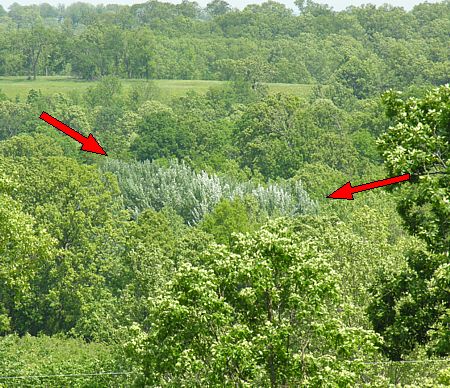
As you drive along the unpaved road on our property that leads to the house and barn areas, you can see over the treetops of some of our woods, as shown in the picture above. Notice that where the red arrows are pointing there appear to be trees with leaves that are lighter in color than the surrounding trees. What you are seeing is a grove of Silver Poplars that inhabit a small section of bottom land along an intermittent creek. When the District Forester from the Arkansas Department of Forestry visited the ranch to consult with us on various conservation and renovation projects we had in mind, he was surprised to find a large grove of these trees on the property. The forester could not recall ever seeing poplars growing naturally in the forests of the area that he had responsibility over, and so he surmised that this large grove of Silver Poplars had been planted long ago by a homesteader who must have resided here in days past. A closer look at the poplar grove can be seen in the following photograph-
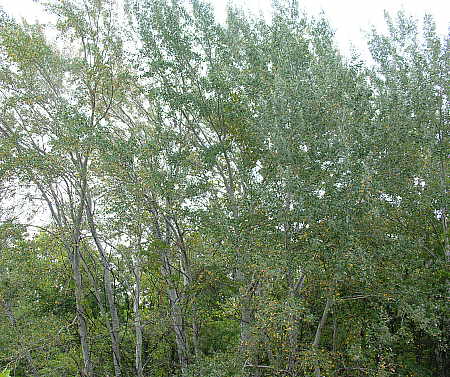
The Silver Poplar is a beautiful tree with a white bark trunk and small, roundish leaves. The name “silver” reflects the color of the underside of some leaves, as well as the bole of the tree. The Silver Poplar is also called a White Poplar. It is closely related to the Quaking Aspen. The influence of the Aspen on the Silver Poplar is evident by the shimmering, quaking look of the leaves as they flutter in the breeze.
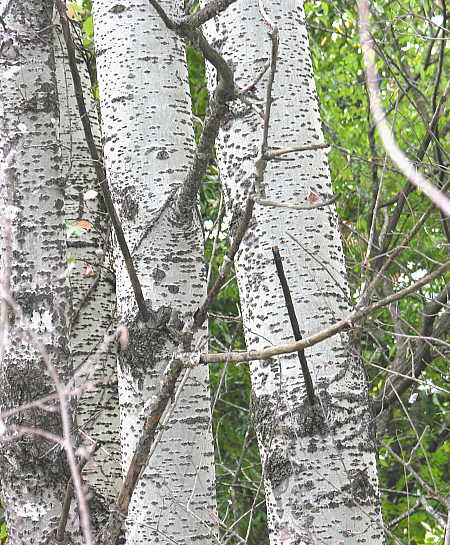
The picture above shows the beautiful texture of the white bark on the trunk of the Silver Poplar. The distinctive coloration and texture of the bark, as well as the quaking of the leaves, help to make the Silver Poplar easy for non-botanists like myself to identify.
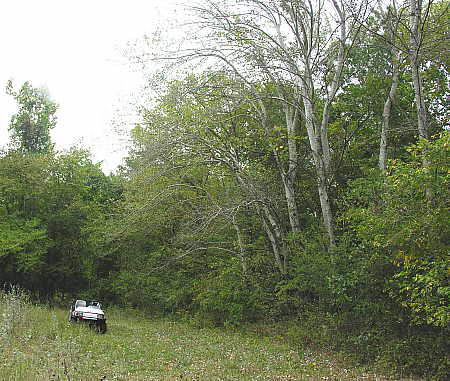
In the photograph above, the utility vehicle gives some indication of the size of these stately trees, which reach 100 feet tall at maturity. The tree will propagate through the scattering of seed, as well as by suckers that emanate from the root system of the tree. The following photograph shows 6 month old suckers that have sprung up from the ground near the poplar grove-
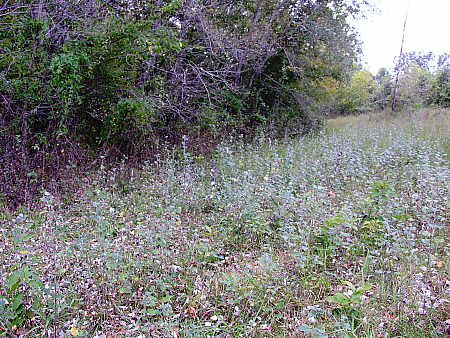
By now you may be asking yourself what part I have played in this post entitled Landscaping, My Way. When we purchased this property, the portion of the property that the Silver Poplars inhabited was primarily cleared, bush-hogged, cattle grazing land. Because a good portion of this 40 acres consists of fairly steep slopes, we decided to rethink the bush-hogging plans for this area. Since I am not trying to squeeze every last bit of grazing space out of our acreage, there is no point to my bush-hogging steep, dangerous slopes, as my predecessors had. Instead, I decided to cut only those areas around the Silver Poplars that was somewhat level, thereby creating an area that we now call the Terraces. There are about forty acres in this area that now consist of numerous flat, near level bush-hogged meadows, surrounded by newly growing woods.Â
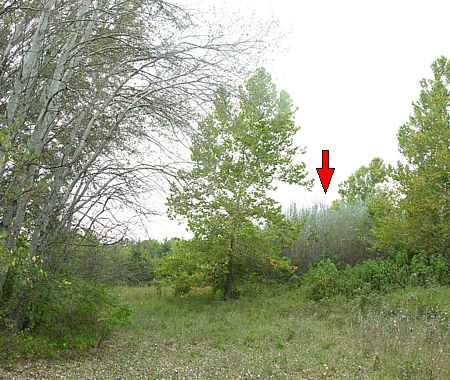
In order to keep the Silver Poplars from taking over the area, I have been bush-hogging the suckers that emanate from the Poplars twice a year. But there are some area where I have wanted the Poplars to spread, so that when I encountered poplar suckers in those areas, I refrained from cutting them. The result of this strategy can be seen in the following photo, where the red arrow points to some of the young Silver Poplars that I have allowed to grow unmolested (notice the mature, parent poplars on the left).  This is but a small sample of the Silver Poplars that I have allowed to grow along the terraces.
The Silver Poplar is a quick growing tree, which has made it an ideal candidate for this reforestation project.  I did not realize just how quickly they would grow, but the following photograph shows the size of the young poplars after just four years-
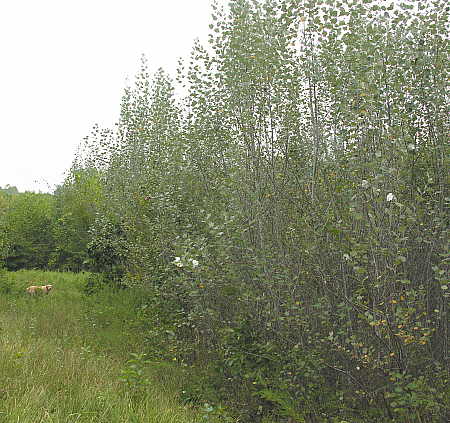
For a good indication of the size of these four-year old Silver Poplars, compare their height to that of George, our full-grown Lab, as he waits for me in the middle of the trail. The growth rate of the Silver Poplar is quite impressive, and will apparently allow us to enjoy these new additions to our woods in a relatively short time.

This is the second in a small series of posts in which I share my “landscaping secrets”. I have put the term landscaping in quotes because I don’t do landscaping. Landscaping involves much work, some knowledge about plant life, physical labor, a planning ability, exertion of effort, and patience. Oh, did I mention the amount of work involved? I included the word secrets in the quotation marks because if this stuff were secret, I certainly wouldn’t post it on the Internet.
Installment 1 of the series dealt with the Dwarf Sumac that I have allowed to establish itself in selected locations among my fields. This post is about a grove of Silver Poplars that we have growing along a creek bed in the northern portion of our property, which we call The Terraces.
As you drive along the unpaved road on our property that leads to the house and barn areas, you can see over the treetops of some of our woods, as shown in the picture above. Notice that where the red arrows are pointing there appear to be trees with leaves that are lighter in color than the surrounding trees. What you are seeing is a grove of Silver Poplars that inhabit a small section of bottom land along an intermittent creek. When the District Forester from the Arkansas Department of Forestry visited the ranch to consult with us on various conservation and renovation projects we had in mind, he was surprised to find a large grove of these trees on the property. The forester could not recall ever seeing poplars growing naturally in the forests of the area that he had responsibility over, and so he surmised that this large grove of Silver Poplars had been planted long ago by a homesteader who must have resided here in days past. A closer look at the poplar grove can be seen in the following photograph-
The Silver Poplar is a beautiful tree with a white bark trunk and small, roundish leaves. The name “silver” reflects the color of the underside of some leaves, as well as the bole of the tree. The Silver Poplar is also called a White Poplar. It is closely related to the Quaking Aspen. The influence of the Aspen on the Silver Poplar is evident by the shimmering, quaking look of the leaves as they flutter in the breeze.
The picture above shows the beautiful texture of the white bark on the trunk of the Silver Poplar. The distinctive coloration and texture of the bark, as well as the quaking of the leaves, help to make the Silver Poplar easy for non-botanists like myself to identify.
In the photograph above, the utility vehicle gives some indication of the size of these stately trees, which reach 100 feet tall at maturity. The tree will propagate through the scattering of seed, as well as by suckers that emanate from the root system of the tree. The following photograph shows 6 month old suckers that have sprung up from the ground near the poplar grove-
By now you may be asking yourself what part I have played in this post entitled Landscaping, My Way. When we purchased this property, the portion of the property that the Silver Poplars inhabited was primarily cleared, bush-hogged, cattle grazing land. Because a good portion of this 40 acres consists of fairly steep slopes, we decided to rethink the bush-hogging plans for this area. Since I am not trying to squeeze every last bit of grazing space out of our acreage, there is no point to my bush-hogging steep, dangerous slopes, as my predecessors had. Instead, I decided to cut only those areas around the Silver Poplars that was somewhat level, thereby creating an area that we now call the Terraces. There are about forty acres in this area that now consist of numerous flat, near level bush-hogged meadows, surrounded by newly growing woods.Â
In order to keep the Silver Poplars from taking over the area, I have been bush-hogging the suckers that emanate from the Poplars twice a year. But there are some area where I have wanted the Poplars to spread, so that when I encountered poplar suckers in those areas, I refrained from cutting them. The result of this strategy can be seen in the following photo, where the red arrow points to some of the young Silver Poplars that I have allowed to grow unmolested (notice the mature, parent poplars on the left).  This is but a small sample of the Silver Poplars that I have allowed to grow along the terraces.
The Silver Poplar is a quick growing tree, which has made it an ideal candidate for this reforestation project.  I did not realize just how quickly they would grow, but the following photograph shows the size of the young poplars after just four years-
For a good indication of the size of these four-year old Silver Poplars, compare their height to that of George, our full-grown Lab, as he waits for me in the middle of the trail. The growth rate of the Silver Poplar is quite impressive, and will apparently allow us to enjoy these new additions to our woods in a relatively short time.
{"id":541,"date":"2006-09-17T15:08:33","date_gmt":"2006-09-17T20:08:33","guid":{"rendered":"http:\/\/www.mitzenmacher.net\/blog\/?p=541"},"modified":"2006-09-17T15:25:36","modified_gmt":"2006-09-17T20:25:38","slug":"landscaping-my-way-installment-2","status":"publish","type":"post","link":"https:\/\/www.mitzenmacher.net\/blog\/?p=541","title":{"rendered":"Landscaping, My Way – Installment 2"},"content":{"rendered":"","protected":false},"excerpt":{"rendered":"","protected":false},"author":1,"featured_media":0,"comment_status":"open","ping_status":"open","sticky":false,"template":"","format":"standard","meta":{"_jetpack_newsletter_access":"","_jetpack_dont_email_post_to_subs":false,"_jetpack_newsletter_tier_id":0,"_jetpack_memberships_contains_paywalled_content":false,"_jetpack_feature_clip_id":0,"_jetpack_memberships_contains_paid_content":false,"footnotes":"","jetpack_publicize_message":"","jetpack_publicize_feature_enabled":true,"jetpack_social_post_already_shared":false,"jetpack_social_options":{"image_generator_settings":{"template":"highway","default_image_id":0,"font":"","enabled":false},"version":2},"jetpack_post_was_ever_published":false},"categories":[5],"tags":[],"class_list":["post-541","post","type-post","status-publish","format-standard","hentry","category-ranchers-ramblins"],"jetpack_publicize_connections":[],"jetpack_sharing_enabled":true,"jetpack_shortlink":"https:\/\/wp.me\/p8xyVp-8J","jetpack_likes_enabled":true,"jetpack_featured_media_url":"","_links":{"self":[{"href":"https:\/\/www.mitzenmacher.net\/blog\/index.php?rest_route=\/wp\/v2\/posts\/541","targetHints":{"allow":["GET"]}}],"collection":[{"href":"https:\/\/www.mitzenmacher.net\/blog\/index.php?rest_route=\/wp\/v2\/posts"}],"about":[{"href":"https:\/\/www.mitzenmacher.net\/blog\/index.php?rest_route=\/wp\/v2\/types\/post"}],"author":[{"embeddable":true,"href":"https:\/\/www.mitzenmacher.net\/blog\/index.php?rest_route=\/wp\/v2\/users\/1"}],"replies":[{"embeddable":true,"href":"https:\/\/www.mitzenmacher.net\/blog\/index.php?rest_route=%2Fwp%2Fv2%2Fcomments&post=541"}],"version-history":[{"count":0,"href":"https:\/\/www.mitzenmacher.net\/blog\/index.php?rest_route=\/wp\/v2\/posts\/541\/revisions"}],"wp:attachment":[{"href":"https:\/\/www.mitzenmacher.net\/blog\/index.php?rest_route=%2Fwp%2Fv2%2Fmedia&parent=541"}],"wp:term":[{"taxonomy":"category","embeddable":true,"href":"https:\/\/www.mitzenmacher.net\/blog\/index.php?rest_route=%2Fwp%2Fv2%2Fcategories&post=541"},{"taxonomy":"post_tag","embeddable":true,"href":"https:\/\/www.mitzenmacher.net\/blog\/index.php?rest_route=%2Fwp%2Fv2%2Ftags&post=541"}],"curies":[{"name":"wp","href":"https:\/\/api.w.org\/{rel}","templated":true}]}}