This post assumes the reader has a basic understanding of the role bees play in the reproductive process of plant life on Earth. For those who do not possess this knowledge, I suggest it is time to have “that talk” with your parents. Those readers who do have an understanding of the functioning of bees in the biology of plants may be aware of just how important bees are to our agricultural industry.
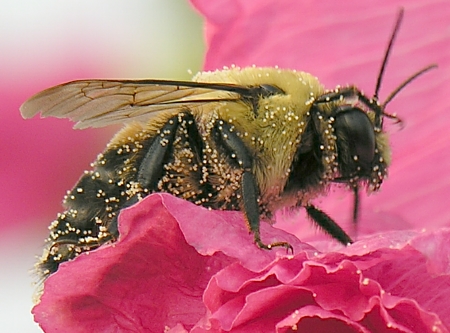
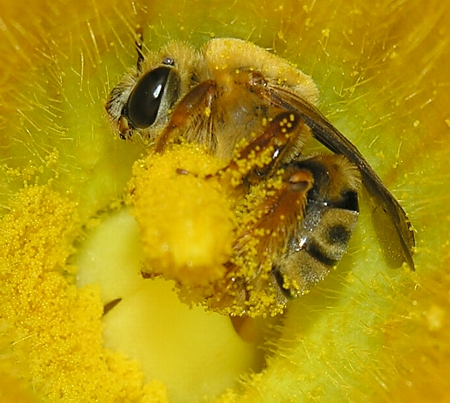
The two photographs shown above (courtesy of Retta) clearly show how pollens attach themselves to the body of the bee as the bee makes it’s rounds gathering nectar for the hive. The pollens thus are transferred from plant to plant by the foraging bees, cross-pollinating the flowers and allowing the reproductive cycle of the plant to proceed. Soon, the farmer will be able to harvest the fruits of this biological process, and we eventually are presented with the wonderful produce we have come to expect at our local grocery store.
In the wild, bees make their home in the hollows of trees, as fans of Winnie the Pooh will surely recall. As farms grew from small subsistence plots to large industrial agricultural operations however, a problem arose. The large farms required large fields, which necessitated the clearing of vast tracts of land.  This ultimately led to agricultural regions which were essentially devoid of trees suitable for bees to establish their hives.
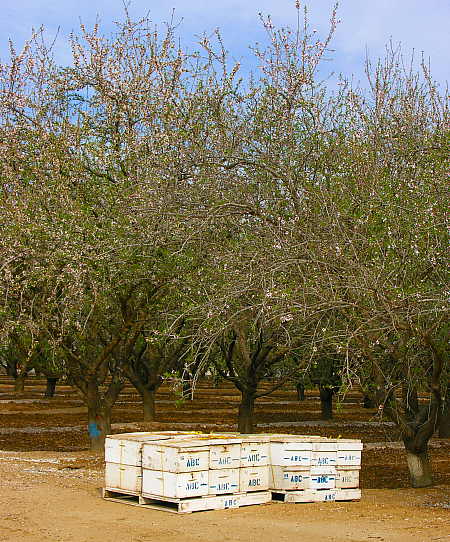
To solve this problem farmers have turned to the services of commercial beekeepers.  The photograph above shows an orchard that is in bloom. You can see that the grower has placed 2 dozen hives in the vicinity of the fruit trees. Hive clusters such as this are rented from commercial beekeepers at the appropriate time of the year and scattered throughout the orchard, thus ensuring that the vital process of pollination will occur.
This year, a strange thing has been occurring, the significance of which has yet to be determined. When commercial beekeepers across the country began opening their hives in order to grade them in preparation for the upcoming season, many discovered that the hives were empty! No bees at all! The hives had honeycombs and the honeycombs contained honey, but the bees had disappeared. And I mean COMPLETELY disappeared. Not even any bee carcases remained in or around the hives.  No one really understands what has happened yet, nor the extent of the problem. Commercial beekeepers have been reporting the same type of disappearance across 20 states now, and the problem appears to be ongoing.
This would not be the first time that a massive die-off off honeybees has occurred. The last major die-off that occurred was a result of parasitic mites that infested the bee hives. In past events, however, the bees left behind evidence of the culprit which led to their demise. Bee carcases could be found in and around the hive, and it was relatively simple for biologists to determine the cause of the reduction in the bee population. Because of the lack of forensic evidence, entomologists have been unable to pinpoint what has transpired with this ongoing event.
Because there are no bodies left behind, there has been speculation about what types of problems could create this scenario. One line of investigation revolves around the theory that some type of pesticide is having an effect on the neurological functioning of the bees, debilitating the amazingly complex navigational functions that the bee uses to located the hive. Under this line of reasoning, the bees simply leave the hive on their usual rounds, but find themselves unable to navigate back to the hive. But this would explain the plight of the worker bees, and does not adequately explain the absence of queens and drones from the hives.
There is much research underway to try and determine the cause and extent of this problem, which appears to be ongoing, serious, and wide spread. One stumbling block to diagnosing the problem stems from the lack of data regarding the scope of the die-off. Most commercial beekeepers are aware of the situation, and have reported their losses to appropriate agencies for investigation. Commercial beekeepers comprise a small minority of the beekeeping universe, however. The vast majority of beekeepers are individual hobbyists who might not be tapped in to the agencies and resources that are attempting to solve this mystery. To be helpful, anyone who maintains one or more bee hives is encouraged to log on to the following web site to complete a survey at the following link: National Bee Loss Survey

This post assumes the reader has a basic understanding of the role bees play in the reproductive process of plant life on Earth. For those who do not possess this knowledge, I suggest it is time to have “that talk” with your parents. Those readers who do have an understanding of the functioning of bees in the biology of plants may be aware of just how important bees are to our agricultural industry.
The two photographs shown above (courtesy of Retta) clearly show how pollens attach themselves to the body of the bee as the bee makes it’s rounds gathering nectar for the hive. The pollens thus are transferred from plant to plant by the foraging bees, cross-pollinating the flowers and allowing the reproductive cycle of the plant to proceed. Soon, the farmer will be able to harvest the fruits of this biological process, and we eventually are presented with the wonderful produce we have come to expect at our local grocery store.
In the wild, bees make their home in the hollows of trees, as fans of Winnie the Pooh will surely recall. As farms grew from small subsistence plots to large industrial agricultural operations however, a problem arose. The large farms required large fields, which necessitated the clearing of vast tracts of land.  This ultimately led to agricultural regions which were essentially devoid of trees suitable for bees to establish their hives.
To solve this problem farmers have turned to the services of commercial beekeepers.  The photograph above shows an orchard that is in bloom. You can see that the grower has placed 2 dozen hives in the vicinity of the fruit trees. Hive clusters such as this are rented from commercial beekeepers at the appropriate time of the year and scattered throughout the orchard, thus ensuring that the vital process of pollination will occur.
This year, a strange thing has been occurring, the significance of which has yet to be determined. When commercial beekeepers across the country began opening their hives in order to grade them in preparation for the upcoming season, many discovered that the hives were empty! No bees at all! The hives had honeycombs and the honeycombs contained honey, but the bees had disappeared. And I mean COMPLETELY disappeared. Not even any bee carcases remained in or around the hives.  No one really understands what has happened yet, nor the extent of the problem. Commercial beekeepers have been reporting the same type of disappearance across 20 states now, and the problem appears to be ongoing.
This would not be the first time that a massive die-off off honeybees has occurred. The last major die-off that occurred was a result of parasitic mites that infested the bee hives. In past events, however, the bees left behind evidence of the culprit which led to their demise. Bee carcases could be found in and around the hive, and it was relatively simple for biologists to determine the cause of the reduction in the bee population. Because of the lack of forensic evidence, entomologists have been unable to pinpoint what has transpired with this ongoing event.
Because there are no bodies left behind, there has been speculation about what types of problems could create this scenario. One line of investigation revolves around the theory that some type of pesticide is having an effect on the neurological functioning of the bees, debilitating the amazingly complex navigational functions that the bee uses to located the hive. Under this line of reasoning, the bees simply leave the hive on their usual rounds, but find themselves unable to navigate back to the hive. But this would explain the plight of the worker bees, and does not adequately explain the absence of queens and drones from the hives.
There is much research underway to try and determine the cause and extent of this problem, which appears to be ongoing, serious, and wide spread. One stumbling block to diagnosing the problem stems from the lack of data regarding the scope of the die-off. Most commercial beekeepers are aware of the situation, and have reported their losses to appropriate agencies for investigation. Commercial beekeepers comprise a small minority of the beekeeping universe, however. The vast majority of beekeepers are individual hobbyists who might not be tapped in to the agencies and resources that are attempting to solve this mystery. To be helpful, anyone who maintains one or more bee hives is encouraged to log on to the following web site to complete a survey at the following link: National Bee Loss Survey
{"id":726,"date":"2007-03-13T09:00:45","date_gmt":"2007-03-13T14:00:45","guid":{"rendered":"http:\/\/www.mitzenmacher.net\/blog\/?p=726"},"modified":"2007-03-13T09:49:45","modified_gmt":"2007-03-13T14:49:45","slug":"the-case-of-the-missing-bees","status":"publish","type":"post","link":"https:\/\/www.mitzenmacher.net\/blog\/?p=726","title":{"rendered":"The Case of the Missing Bees"},"content":{"rendered":"","protected":false},"excerpt":{"rendered":"","protected":false},"author":1,"featured_media":0,"comment_status":"open","ping_status":"open","sticky":false,"template":"","format":"standard","meta":{"_jetpack_newsletter_access":"","_jetpack_dont_email_post_to_subs":false,"_jetpack_newsletter_tier_id":0,"_jetpack_memberships_contains_paywalled_content":false,"_jetpack_feature_clip_id":0,"_jetpack_memberships_contains_paid_content":false,"footnotes":"","jetpack_publicize_message":"","jetpack_publicize_feature_enabled":true,"jetpack_social_post_already_shared":false,"jetpack_social_options":{"image_generator_settings":{"template":"highway","default_image_id":0,"font":"","enabled":false},"version":2},"jetpack_post_was_ever_published":false},"categories":[5],"tags":[],"class_list":["post-726","post","type-post","status-publish","format-standard","hentry","category-ranchers-ramblins"],"jetpack_publicize_connections":[],"jetpack_sharing_enabled":true,"jetpack_shortlink":"https:\/\/wp.me\/p8xyVp-bI","jetpack_likes_enabled":true,"jetpack_featured_media_url":"","_links":{"self":[{"href":"https:\/\/www.mitzenmacher.net\/blog\/index.php?rest_route=\/wp\/v2\/posts\/726","targetHints":{"allow":["GET"]}}],"collection":[{"href":"https:\/\/www.mitzenmacher.net\/blog\/index.php?rest_route=\/wp\/v2\/posts"}],"about":[{"href":"https:\/\/www.mitzenmacher.net\/blog\/index.php?rest_route=\/wp\/v2\/types\/post"}],"author":[{"embeddable":true,"href":"https:\/\/www.mitzenmacher.net\/blog\/index.php?rest_route=\/wp\/v2\/users\/1"}],"replies":[{"embeddable":true,"href":"https:\/\/www.mitzenmacher.net\/blog\/index.php?rest_route=%2Fwp%2Fv2%2Fcomments&post=726"}],"version-history":[{"count":0,"href":"https:\/\/www.mitzenmacher.net\/blog\/index.php?rest_route=\/wp\/v2\/posts\/726\/revisions"}],"wp:attachment":[{"href":"https:\/\/www.mitzenmacher.net\/blog\/index.php?rest_route=%2Fwp%2Fv2%2Fmedia&parent=726"}],"wp:term":[{"taxonomy":"category","embeddable":true,"href":"https:\/\/www.mitzenmacher.net\/blog\/index.php?rest_route=%2Fwp%2Fv2%2Fcategories&post=726"},{"taxonomy":"post_tag","embeddable":true,"href":"https:\/\/www.mitzenmacher.net\/blog\/index.php?rest_route=%2Fwp%2Fv2%2Ftags&post=726"}],"curies":[{"name":"wp","href":"https:\/\/api.w.org\/{rel}","templated":true}]}}