Example #1 – Foiling the Rats
Perhaps you recall from a previous post (entitled In This Corner…) that over the past several years I have been engaged in an on-going battle of wits with a rat in my equipment barn.   This rat had found a good nesting spot in the engine compartment or behind the dash of our tractor, and in the course of his day to day activities, took to chewing up the wiring harnesses that are located in these spots.
This became more than an annoyance, as the tractor would have to be trucked over to the local New Holland dealer for repairs, which became very expensive, very quickly. I ultimately decided to try and discourage the rat from nesting in my tractor by placing rubber snakes at various points in the barn and on the tractor.
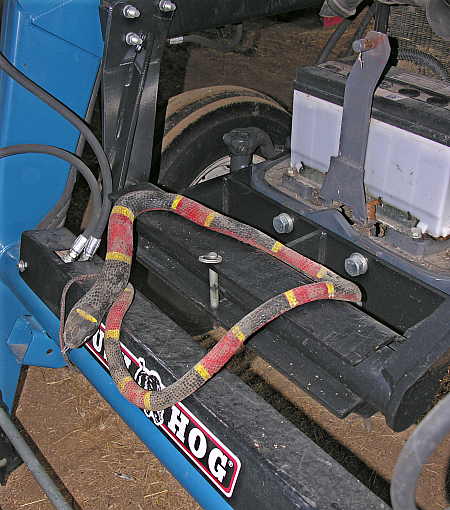
After using the tractor, I store it in the barn with the engine hood opened up, and I place this rubber snake in plain sight to deter any pesky varmint from finding a warm, protected nesting spot within the confines of the diesel engine.
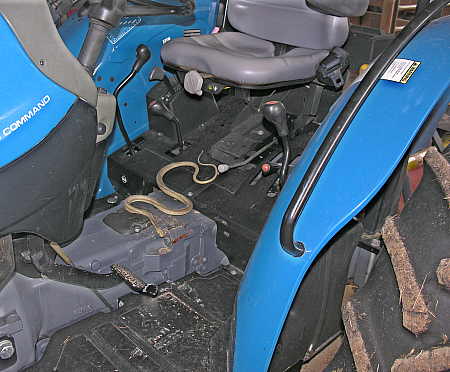
This is a rubber snake that I place on the floor of the cab when I am finished using the tractor. The purpose of putting the snake here is to deter any pests from climbing up into the dashboard of the tractor, where a massive tangle of electrical wires is located.
I purchased these rubber snakes in September of 2005. Since that time, which has been nearly two years now, I have not had any repeats of the incidents like those referred to in the post entitled In This Corner…Â
If you are interested in purchasing rubber snakes, there is a large selection available from the Nature Pavilion on-line store at reasonable prices. This trick has worked for me for two years now, and maybe it can work for you too.
Example #2 – Foiling the Locust Thorns
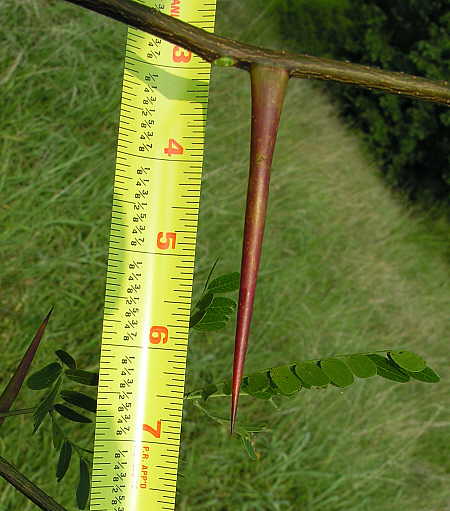
If you have locust trees on your property, you will undoubtedly recognize this thorn as being the weapon of choice for these wicked trees. And if you drive any kind of vehicle around where these trees are situated, you will most certainly have experienced the woe of having a perfectly good tire run flat due to a puncture from a locust thorn.
I battled frequent flat tires on my tractor due to these thorns for a few years before finding a solution to the problem. My local tractor dealer was no help. They insisted that I should be running my tractor with fluid filled tires that utilized inner-tubes. The purpose of filling the tires partially with fluid is to provide increased traction and a lower center of gravity for the tractor. To prevent the fluid (water) from freezing in the winter, a solution is formed by adding either alcohol, ethylene glycol, or calcium chloride to the water.
So my tractor had great traction, and was less likely to roll over due to the lower center of gravity caused by the fluid filled tires, but was a major headache when the inevitable encounter with a locust thorn occurred. To repair such a tire, it was necessary to call for a mobile tire truck to visit the farm, where the technician would pump the fluid out of the tire, dismount the tire, patch the tire and put in a new inner tube. The tire would then be remounted, and the inner tube refilled with the fluid solution that was previously pumped out. About $100 later, the tractor tire would be good as new, but with flat tires coming about frequently, this became rather expensive.
As a possible solution, I investigated the use of foam-filled tires. These are tires that have been filled with a poly foam filling and cured,  creating a puncture-proof tire. This is a technique that is often used on military vehicles, where tire performance is critical.
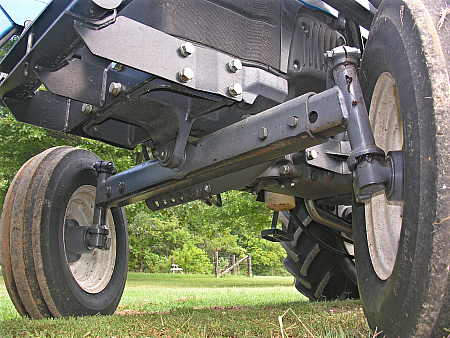
The problem with this solution is that the foam-filled tire is not very forgiving to the vehicle operator when traveling over rough terrain. As you can clearly see from the photograph above, my tractor (and most every other tractor in existence) does not have any kind of sprung suspension between the wheels and the chassis. In effect, the only shock absorbers are the tires themselves, and of course, the adjustable suspension seat found in the cab of the tractor. If the tires are foam-filled, then the ride of the tractor would quickly take it’s toll on the operator’s back.
My local tire dealers all told me that this is just the way it is in the Ozarks – you live with frequent flat tires due to locust thorns and briers, and just have to get used to it! I believed them too, that is, until I got to listening to two gray-haired, coverall clad old farmers talking to one another. Without knowing it, they had divulged the secret to flat-free farm equipment in the Ozarks.
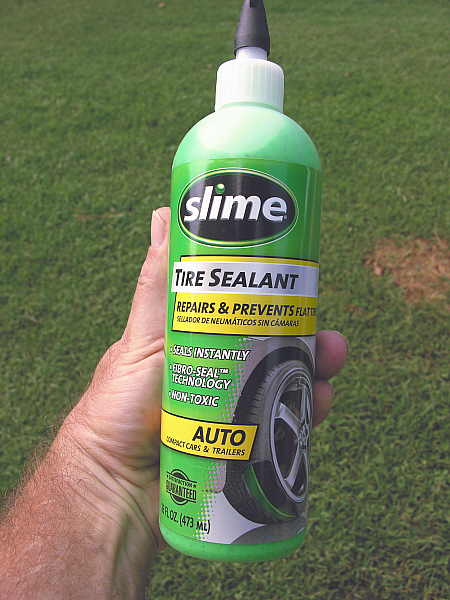
The trick was simple enough – ignore the tractor dealers, and ignore the tire dealers. Instead of using fluid-filled tubed tires, as they suggested, switch to a tubeless agricultural tire and put a sufficient quantity of tire sealant into the tire.
Since making the change, as the old experienced farmers had talked about, I have not experienced one flat tire on the tractor as a result of a puncture.
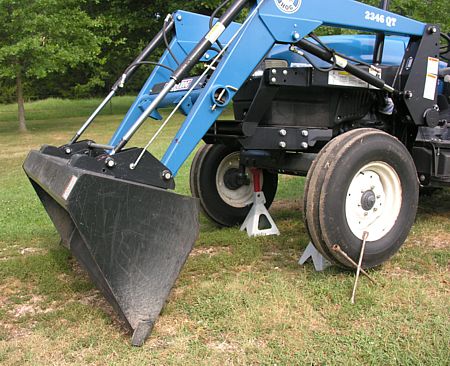
So if this works so well, why am I removing the front tires from my tractor, as seen above?
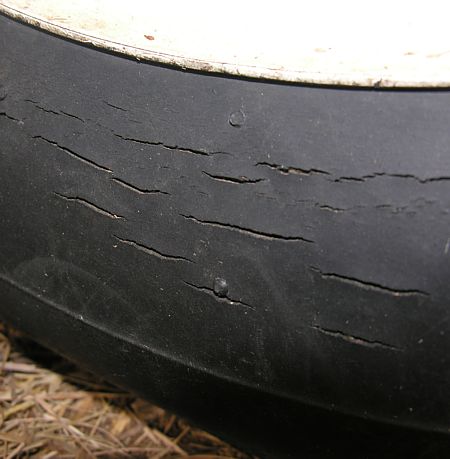
Even though the tires have not been affected by punctures, the sidewall will still tend to crack over time, as you can see here.
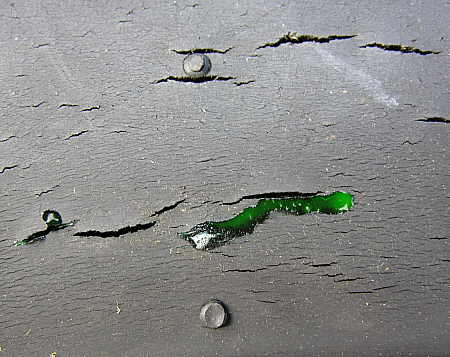
Eventually, the cracks will progress to the point that the sealant will no longer perform its intended task, as it begins to leak out of the sidewall cracks. When this happens, the tire will no longer hold pressure, and it is time to replace the tire. But at least the tire has provided service for a decent amount of time, without the expense and hassle of constant thorn-induced flats.
My thanks to the anonymous old farmers who inadvertently let me in on the secret to tire longevity here in the Ozarks.

Example #1 – Foiling the Rats
Perhaps you recall from a previous post (entitled In This Corner…) that over the past several years I have been engaged in an on-going battle of wits with a rat in my equipment barn.   This rat had found a good nesting spot in the engine compartment or behind the dash of our tractor, and in the course of his day to day activities, took to chewing up the wiring harnesses that are located in these spots.
This became more than an annoyance, as the tractor would have to be trucked over to the local New Holland dealer for repairs, which became very expensive, very quickly. I ultimately decided to try and discourage the rat from nesting in my tractor by placing rubber snakes at various points in the barn and on the tractor.
After using the tractor, I store it in the barn with the engine hood opened up, and I place this rubber snake in plain sight to deter any pesky varmint from finding a warm, protected nesting spot within the confines of the diesel engine.
This is a rubber snake that I place on the floor of the cab when I am finished using the tractor. The purpose of putting the snake here is to deter any pests from climbing up into the dashboard of the tractor, where a massive tangle of electrical wires is located.
I purchased these rubber snakes in September of 2005. Since that time, which has been nearly two years now, I have not had any repeats of the incidents like those referred to in the post entitled In This Corner…Â
If you are interested in purchasing rubber snakes, there is a large selection available from the Nature Pavilion on-line store at reasonable prices. This trick has worked for me for two years now, and maybe it can work for you too.
Example #2 – Foiling the Locust Thorns
If you have locust trees on your property, you will undoubtedly recognize this thorn as being the weapon of choice for these wicked trees. And if you drive any kind of vehicle around where these trees are situated, you will most certainly have experienced the woe of having a perfectly good tire run flat due to a puncture from a locust thorn.
I battled frequent flat tires on my tractor due to these thorns for a few years before finding a solution to the problem. My local tractor dealer was no help. They insisted that I should be running my tractor with fluid filled tires that utilized inner-tubes. The purpose of filling the tires partially with fluid is to provide increased traction and a lower center of gravity for the tractor. To prevent the fluid (water) from freezing in the winter, a solution is formed by adding either alcohol, ethylene glycol, or calcium chloride to the water.
So my tractor had great traction, and was less likely to roll over due to the lower center of gravity caused by the fluid filled tires, but was a major headache when the inevitable encounter with a locust thorn occurred. To repair such a tire, it was necessary to call for a mobile tire truck to visit the farm, where the technician would pump the fluid out of the tire, dismount the tire, patch the tire and put in a new inner tube. The tire would then be remounted, and the inner tube refilled with the fluid solution that was previously pumped out. About $100 later, the tractor tire would be good as new, but with flat tires coming about frequently, this became rather expensive.
As a possible solution, I investigated the use of foam-filled tires. These are tires that have been filled with a poly foam filling and cured,  creating a puncture-proof tire. This is a technique that is often used on military vehicles, where tire performance is critical.
The problem with this solution is that the foam-filled tire is not very forgiving to the vehicle operator when traveling over rough terrain. As you can clearly see from the photograph above, my tractor (and most every other tractor in existence) does not have any kind of sprung suspension between the wheels and the chassis. In effect, the only shock absorbers are the tires themselves, and of course, the adjustable suspension seat found in the cab of the tractor. If the tires are foam-filled, then the ride of the tractor would quickly take it’s toll on the operator’s back.
My local tire dealers all told me that this is just the way it is in the Ozarks – you live with frequent flat tires due to locust thorns and briers, and just have to get used to it! I believed them too, that is, until I got to listening to two gray-haired, coverall clad old farmers talking to one another. Without knowing it, they had divulged the secret to flat-free farm equipment in the Ozarks.
The trick was simple enough – ignore the tractor dealers, and ignore the tire dealers. Instead of using fluid-filled tubed tires, as they suggested, switch to a tubeless agricultural tire and put a sufficient quantity of tire sealant into the tire.
Since making the change, as the old experienced farmers had talked about, I have not experienced one flat tire on the tractor as a result of a puncture.
So if this works so well, why am I removing the front tires from my tractor, as seen above?
Even though the tires have not been affected by punctures, the sidewall will still tend to crack over time, as you can see here.
Eventually, the cracks will progress to the point that the sealant will no longer perform its intended task, as it begins to leak out of the sidewall cracks. When this happens, the tire will no longer hold pressure, and it is time to replace the tire. But at least the tire has provided service for a decent amount of time, without the expense and hassle of constant thorn-induced flats.
My thanks to the anonymous old farmers who inadvertently let me in on the secret to tire longevity here in the Ozarks.
{"id":939,"date":"2007-08-06T15:50:23","date_gmt":"2007-08-06T20:50:23","guid":{"rendered":"http:\/\/www.mitzenmacher.net\/blog\/?p=939"},"modified":"2007-08-06T17:27:53","modified_gmt":"2007-08-06T22:27:53","slug":"trial-and-error-sometimes-works","status":"publish","type":"post","link":"https:\/\/www.mitzenmacher.net\/blog\/?p=939","title":{"rendered":"Trial and Error Sometimes Works"},"content":{"rendered":"","protected":false},"excerpt":{"rendered":"","protected":false},"author":1,"featured_media":0,"comment_status":"open","ping_status":"open","sticky":false,"template":"","format":"standard","meta":{"_jetpack_newsletter_access":"","_jetpack_dont_email_post_to_subs":false,"_jetpack_newsletter_tier_id":0,"_jetpack_memberships_contains_paywalled_content":false,"_jetpack_feature_clip_id":0,"_jetpack_memberships_contains_paid_content":false,"footnotes":"","jetpack_publicize_message":"","jetpack_publicize_feature_enabled":true,"jetpack_social_post_already_shared":false,"jetpack_social_options":{"image_generator_settings":{"template":"highway","default_image_id":0,"font":"","enabled":false},"version":2},"jetpack_post_was_ever_published":false},"categories":[5],"tags":[],"class_list":["post-939","post","type-post","status-publish","format-standard","hentry","category-ranchers-ramblins"],"jetpack_publicize_connections":[],"jetpack_sharing_enabled":true,"jetpack_shortlink":"https:\/\/wp.me\/p8xyVp-f9","jetpack_likes_enabled":true,"jetpack_featured_media_url":"","_links":{"self":[{"href":"https:\/\/www.mitzenmacher.net\/blog\/index.php?rest_route=\/wp\/v2\/posts\/939","targetHints":{"allow":["GET"]}}],"collection":[{"href":"https:\/\/www.mitzenmacher.net\/blog\/index.php?rest_route=\/wp\/v2\/posts"}],"about":[{"href":"https:\/\/www.mitzenmacher.net\/blog\/index.php?rest_route=\/wp\/v2\/types\/post"}],"author":[{"embeddable":true,"href":"https:\/\/www.mitzenmacher.net\/blog\/index.php?rest_route=\/wp\/v2\/users\/1"}],"replies":[{"embeddable":true,"href":"https:\/\/www.mitzenmacher.net\/blog\/index.php?rest_route=%2Fwp%2Fv2%2Fcomments&post=939"}],"version-history":[{"count":0,"href":"https:\/\/www.mitzenmacher.net\/blog\/index.php?rest_route=\/wp\/v2\/posts\/939\/revisions"}],"wp:attachment":[{"href":"https:\/\/www.mitzenmacher.net\/blog\/index.php?rest_route=%2Fwp%2Fv2%2Fmedia&parent=939"}],"wp:term":[{"taxonomy":"category","embeddable":true,"href":"https:\/\/www.mitzenmacher.net\/blog\/index.php?rest_route=%2Fwp%2Fv2%2Fcategories&post=939"},{"taxonomy":"post_tag","embeddable":true,"href":"https:\/\/www.mitzenmacher.net\/blog\/index.php?rest_route=%2Fwp%2Fv2%2Ftags&post=939"}],"curies":[{"name":"wp","href":"https:\/\/api.w.org\/{rel}","templated":true}]}}