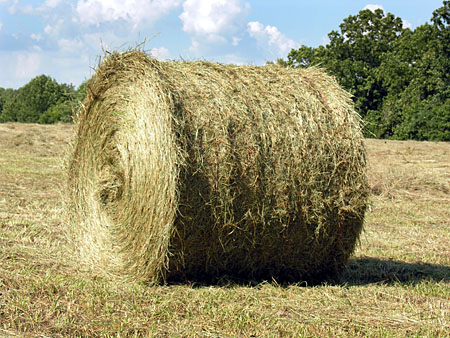
Remember a previous post on this blog (It’s Time for Another Try) wherein I lamented a mere .500 success rate in getting our hay fields cut and baled over six growing seasons? Well, the average has just been upped to .571 (four full cuttings over the past seven seasons). Our neighbor Bill, along with his sons Craig and Matt, have been out here over the past several days cutting, raking and baling several of our hay fields, and will probably be continuing their activities here for the next few days. I thought I would take this opportunity to briefly show how the process occurs here in the Ozarks, for those of you who may have never seen grass being converted to bales of hay.
The first step in the baling process is to cut the grass near it’s base. There are several choices the farmer has in a mower. Some use a sickle-bar mower, which resembles a giant hedge trimmer adapted to cutting grass. Others use a hay mower/conditioner, which not only cuts, but also crimps the crop for faster drying, while still other farmers use a  forage macerator  to complete the cutting.
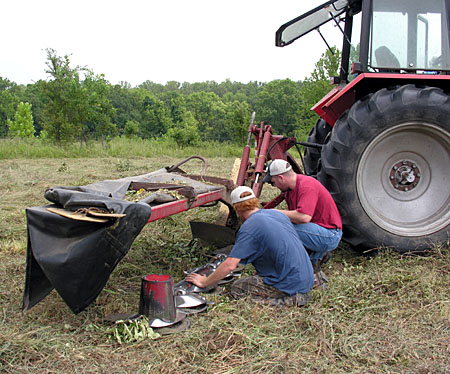
Craig and Matt are using an implement called a disk mower to cut the grass in preparation for baling. It consists of a series of small rotary disks, each with two pivoting cutting blades attached to the disk via a shoulder bolt.
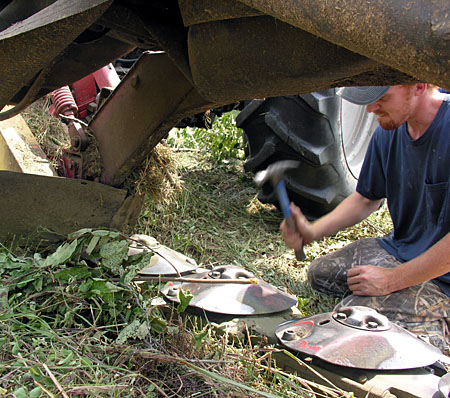
Unfortunately, besides hay, we also grow rocks prolifically here in the Ozarks, as you may remember from an old post (Dang Rocks). In the photograph above, you can see Craig applying a little “persuasion” to a bent cutting blade, the result of an encounter with a rock that probably wasn’t there last year!
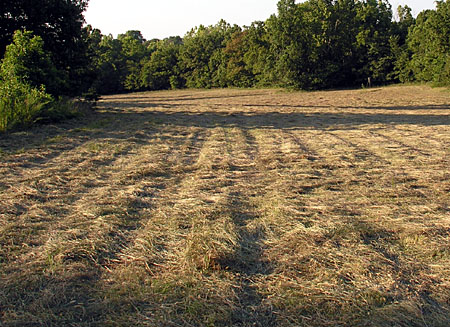
When the hay is cut, it is allowed to dry in the field prior to being put up into bales. The drying time is affected by many variables, including the type of forage crop, humidity and temperature levels, and procedures used in the baling process. If a mower/conditioner or forage macerator has been used to cut the crop, drying time will be shortened. Alternatively, a hay tedder can be used to turn the hay over in the field and fluff it up, thus allowing the hay to dry quickly.
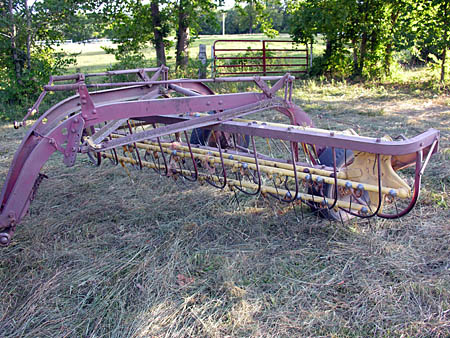
When the hay is sufficiently dry, Â a side-rake such as the one seen above is used to sweep the cut crop into wind rows, in preparation for the actual baling.
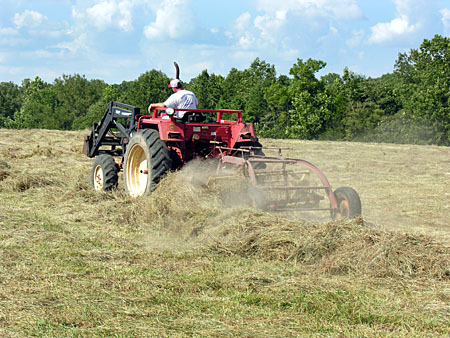
In the photograph above you can see Bill pulling the side rake through the field. First traveling in one direction, and then turning around and repeating the process from the other side produces a nice wind row of grass.
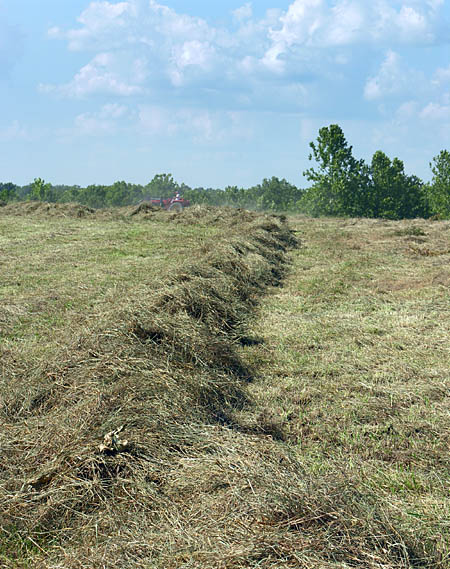
This is what the wind row looks like after two passes of the side rake. It is now ready to be swept up by the baling machine.
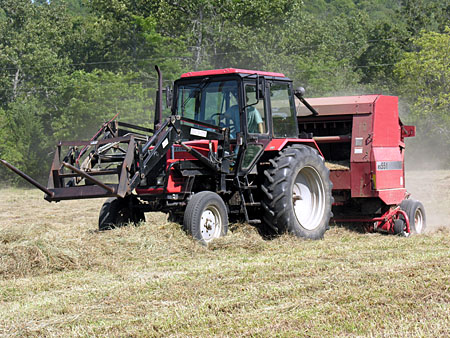
In this photograph you see Craig operating a tractor pulling a large round baler over the previously wind-rowed forage. The baler gathers the hay and rolls it into a tight, uniformly sized dense round bale, and when the bale capacity is reached, the baler wraps the round bale with a continuous spiral of baling twine.
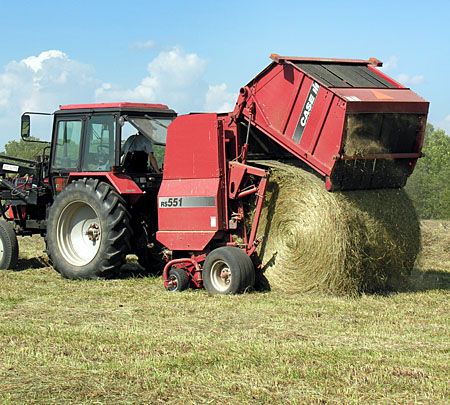
After securing the integrity of the bale with twine, the baler opens up to eject the finished bale from the rear of the machine, then closes back up again in order to repeat the process once again.
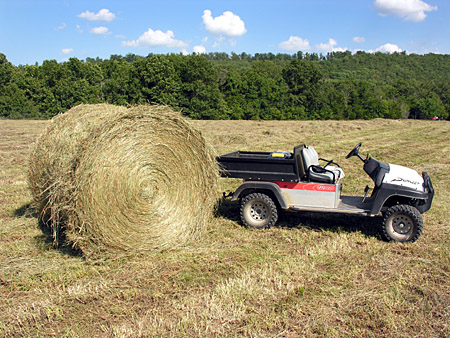
I included this photograph to illustrate the size of the bales that are being produced by this particular round baler. This is a 5′ X 5′ bale. Depending upon the crop the weight of each bale can range from about 1200-1600 pounds. As you can imagine, it take special equipment to be able to handle these large round bales.
The next step in the process is to gather the bales of hay to transport them to their final destination, which, along with a final tally of this year’s hay production will be the subject of a future post.

Remember a previous post on this blog (It’s Time for Another Try) wherein I lamented a mere .500 success rate in getting our hay fields cut and baled over six growing seasons? Well, the average has just been upped to .571 (four full cuttings over the past seven seasons). Our neighbor Bill, along with his sons Craig and Matt, have been out here over the past several days cutting, raking and baling several of our hay fields, and will probably be continuing their activities here for the next few days. I thought I would take this opportunity to briefly show how the process occurs here in the Ozarks, for those of you who may have never seen grass being converted to bales of hay.
The first step in the baling process is to cut the grass near it’s base. There are several choices the farmer has in a mower. Some use a sickle-bar mower, which resembles a giant hedge trimmer adapted to cutting grass. Others use a hay mower/conditioner, which not only cuts, but also crimps the crop for faster drying, while still other farmers use a  forage macerator  to complete the cutting.
Craig and Matt are using an implement called a disk mower to cut the grass in preparation for baling. It consists of a series of small rotary disks, each with two pivoting cutting blades attached to the disk via a shoulder bolt.
Unfortunately, besides hay, we also grow rocks prolifically here in the Ozarks, as you may remember from an old post (Dang Rocks). In the photograph above, you can see Craig applying a little “persuasion” to a bent cutting blade, the result of an encounter with a rock that probably wasn’t there last year!
When the hay is cut, it is allowed to dry in the field prior to being put up into bales. The drying time is affected by many variables, including the type of forage crop, humidity and temperature levels, and procedures used in the baling process. If a mower/conditioner or forage macerator has been used to cut the crop, drying time will be shortened. Alternatively, a hay tedder can be used to turn the hay over in the field and fluff it up, thus allowing the hay to dry quickly.
When the hay is sufficiently dry, Â a side-rake such as the one seen above is used to sweep the cut crop into wind rows, in preparation for the actual baling.
In the photograph above you can see Bill pulling the side rake through the field. First traveling in one direction, and then turning around and repeating the process from the other side produces a nice wind row of grass.
This is what the wind row looks like after two passes of the side rake. It is now ready to be swept up by the baling machine.
In this photograph you see Craig operating a tractor pulling a large round baler over the previously wind-rowed forage. The baler gathers the hay and rolls it into a tight, uniformly sized dense round bale, and when the bale capacity is reached, the baler wraps the round bale with a continuous spiral of baling twine.
After securing the integrity of the bale with twine, the baler opens up to eject the finished bale from the rear of the machine, then closes back up again in order to repeat the process once again.
I included this photograph to illustrate the size of the bales that are being produced by this particular round baler. This is a 5′ X 5′ bale. Depending upon the crop the weight of each bale can range from about 1200-1600 pounds. As you can imagine, it take special equipment to be able to handle these large round bales.
The next step in the process is to gather the bales of hay to transport them to their final destination, which, along with a final tally of this year’s hay production will be the subject of a future post.
{"id":949,"date":"2007-08-09T12:19:07","date_gmt":"2007-08-09T17:19:07","guid":{"rendered":"http:\/\/www.mitzenmacher.net\/blog\/?p=949"},"modified":"2007-08-09T12:19:07","modified_gmt":"2007-08-09T17:19:07","slug":"boosting-the-average","status":"publish","type":"post","link":"https:\/\/www.mitzenmacher.net\/blog\/?p=949","title":{"rendered":"Boosting the Average"},"content":{"rendered":"","protected":false},"excerpt":{"rendered":"","protected":false},"author":1,"featured_media":0,"comment_status":"open","ping_status":"open","sticky":false,"template":"","format":"standard","meta":{"_jetpack_newsletter_access":"","_jetpack_dont_email_post_to_subs":false,"_jetpack_newsletter_tier_id":0,"_jetpack_memberships_contains_paywalled_content":false,"_jetpack_feature_clip_id":0,"_jetpack_memberships_contains_paid_content":false,"footnotes":"","jetpack_publicize_message":"","jetpack_publicize_feature_enabled":true,"jetpack_social_post_already_shared":false,"jetpack_social_options":{"image_generator_settings":{"template":"highway","default_image_id":0,"font":"","enabled":false},"version":2},"jetpack_post_was_ever_published":false},"categories":[5],"tags":[],"class_list":["post-949","post","type-post","status-publish","format-standard","hentry","category-ranchers-ramblins"],"jetpack_publicize_connections":[],"jetpack_sharing_enabled":true,"jetpack_shortlink":"https:\/\/wp.me\/p8xyVp-fj","jetpack_likes_enabled":true,"jetpack_featured_media_url":"","_links":{"self":[{"href":"https:\/\/www.mitzenmacher.net\/blog\/index.php?rest_route=\/wp\/v2\/posts\/949","targetHints":{"allow":["GET"]}}],"collection":[{"href":"https:\/\/www.mitzenmacher.net\/blog\/index.php?rest_route=\/wp\/v2\/posts"}],"about":[{"href":"https:\/\/www.mitzenmacher.net\/blog\/index.php?rest_route=\/wp\/v2\/types\/post"}],"author":[{"embeddable":true,"href":"https:\/\/www.mitzenmacher.net\/blog\/index.php?rest_route=\/wp\/v2\/users\/1"}],"replies":[{"embeddable":true,"href":"https:\/\/www.mitzenmacher.net\/blog\/index.php?rest_route=%2Fwp%2Fv2%2Fcomments&post=949"}],"version-history":[{"count":0,"href":"https:\/\/www.mitzenmacher.net\/blog\/index.php?rest_route=\/wp\/v2\/posts\/949\/revisions"}],"wp:attachment":[{"href":"https:\/\/www.mitzenmacher.net\/blog\/index.php?rest_route=%2Fwp%2Fv2%2Fmedia&parent=949"}],"wp:term":[{"taxonomy":"category","embeddable":true,"href":"https:\/\/www.mitzenmacher.net\/blog\/index.php?rest_route=%2Fwp%2Fv2%2Fcategories&post=949"},{"taxonomy":"post_tag","embeddable":true,"href":"https:\/\/www.mitzenmacher.net\/blog\/index.php?rest_route=%2Fwp%2Fv2%2Ftags&post=949"}],"curies":[{"name":"wp","href":"https:\/\/api.w.org\/{rel}","templated":true}]}}