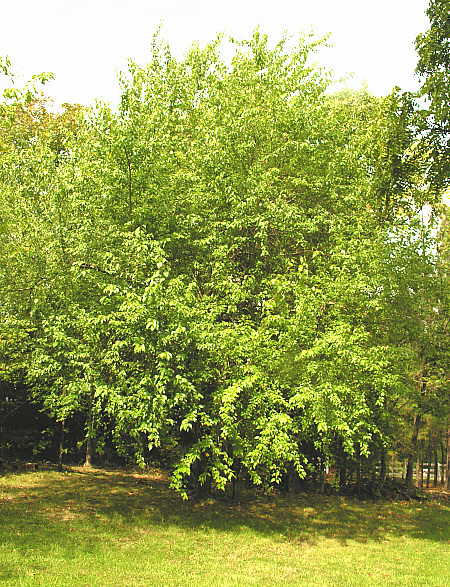
This is a tree with various names. Some refer to it as the bois d’arc (pronounced “bodark”), which is french for “bow wood.”  It is also referred to as an Osage orange tree, hedge apple tree, and horse apple tree. All of these monikers have a basis in the properties of the tree, as we shall see in the following paragraphs. Some people dislike these trees, while others adore them, depending upon their perspectives.
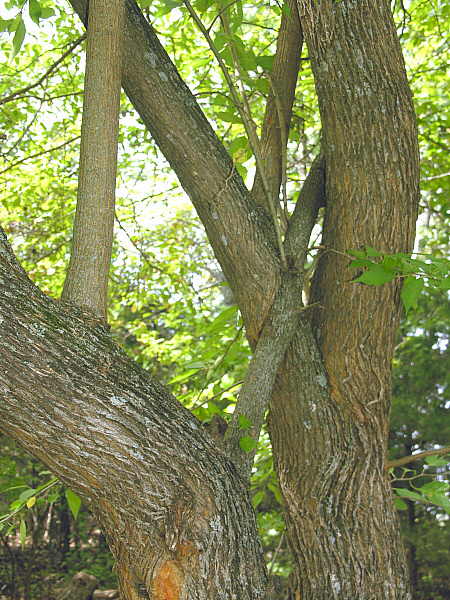
The picture above is a trunk of a bois d’arc tree. The wood of this tree is extremely hard and tough, which makes it a sought after tree for cutting into fence posts. But if you intend to cut one of these trees, you had better arm yourself with plenty of sharp chains on your chainsaw, as the tough, yellowish wood of the bois d’arc will dull the chain rapidly. It is also advisable to wear long sleeves made of thick fabric, as the spines on the branches can cause painful lacerations if you are not careful.
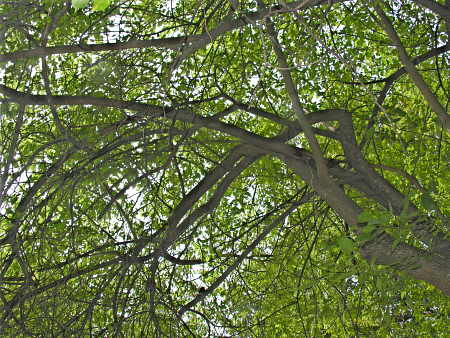
The canopy of the bois d’arc forms a tangled mass of branches, which are armed with stout, flesh-piercing barbs. Because of the dense mass of resilient, barbed and tough wood that the tree produces, it was planted with tight spacing as a hedge row in times prior to the invention of barbed wire. It is referred to as being “horse high, bull strong, and hog tight,” an ideal specification for a farmstead hedge row. Because of the toughness and decay resistance of the wood, combined with the long, straight, resilient branches that this tree produces, it was prized as a source of wood in which to construct bows in the past, hence it’s name bois d’arc tree, or bow wood tree.
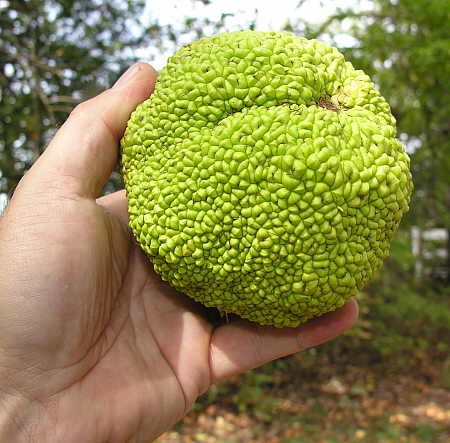
This is the fruit produced by the bois d’arc. Some call this the Osage orange, possibly because the skin emits a citrus-like scent when it begins to rot. Because the trees were often grown as a hedge, the fruit has been called a “hedge apple” by some. Because the fruit is consumed by horses, it is termed a “horse apple” by others. Osage orange, hedge apple, or horse apple, it remains that humans do not consume this fruit. But, as just mentioned, horses eat the fruit of the bois d’arc tree, as well as squirrels and cattle.
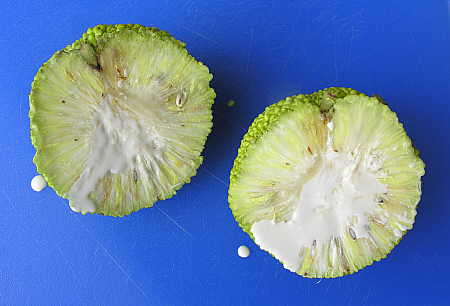
If you slice the fruit in half, which requires a stout knife, as the fruit is quit hard until it begins to rot, you will find that after a minute or two the fruit begins to “weep”, as you can see in the photograph above. Only the female tree produces the fruit, which propagates the tree through the germination of the approximately 200 seeds contained within the fruit. In the fall, the fruit begins to drop from the limbs of the tree, and when they do, watch out, as it hurts to be struck by the falling, heavy, hard fruit of the Osage orange, or bois d’arc tree.


JR – Thanks for the info. I love smoked meats and sausages, but I am always leary of using a type of wood that I have no experience with, as some woods can impart a very bitter flavor to the food. Since you have been successful with this wood for smoking, I just might give it a try.
Thank you for the very thorough info. My children and I found some of the “apples” on a walk. However we were unable to find the fruit pictured in any of our nature guides in order to identify the tree.
I live in arkansas my whole life and people around here calls them deer apples because we see deers eating them. And heads up while being under this tree the apple can knock you out if you get hit in the head with one. Thanks for the article I really never knew the offical name of these trees.
Osage Orange, Hedge, Ironwood, and Bois d’Arc. The last one is new to me but hedge trees grow all over Illinois. If I only knew it was somewhat exotic and was used to make duck calls I’d have collected more and burned less of it.
We use them for target shooting in the fall.They explode very nicely when hit with a rifle bullet..
A friend of mine asked a farmer what was better for fencing, to which the farmer replied, “Well, for the first hundred years, steel t-posts are better but after that Bois D ‘Arc. : )
The fruits are also called Monkeyballs.
I’ve been collecting these to feed to my horses and donkey recently. I’d surely like to know more about their nutritional value and caloric content! ;D
Pingback: A very late Friday Five « An Unfinished Symphony
When I was a kid, my brother and I used to throw horse apples at each other. They leave a big bruise! My late husband and I had 2 wood stoves in our home. That was our heat source. We learned that although bois ‘d arc burns too hot to use as a main source in your fire, you can put 1 small bois ‘d arc log next to (not directly ON) your other logs before you go to bed. In the morning, stir the embers and lay your oak logs, (or ash, or whatever wood you use) on top and very shortly, you will have a nice fire going.
They grow in all the wind breaks here in western Oklahoma, there are horse apples, literally by the thousands, in the tree rows. The wood, which is extremely hard and heavy, will make coals that are hotter than most other wood’s flames. It’s not really suitable for open fires because it pops, and sends embers flying, but for stoves and furnaces it can’t be beat.
I have many of these trees and have studied them for years. Everything about this tree is amazing. Pioneers would cut the horse apples in half in fill a barrel and then add water to top off the barrel. When homesteaders would find their parcel of land they would scratch a groove in the dirt and fill it with the horseapples. This predates barbed wire for being “horse high, hog tight” and full of thorns. The heartwood is stronger than carbon fiber. Best to use a carbide tipped chainsaw blade. Matt
Please search: Bois D’Arc Kingdom for more information and to chat with other friends who champion this tree.