Microsoft Surface Studio – Abundant Potential with a Beautiful Design


Microsoft will begin shipping the new Surface Studio computer in early 2017. From what I see in the promotional materials and specifications, this could well be a game changer for photographic editing, particularly if Adobe gets on board by tweaking it’s editing lineup to take advantage of the surface disk that Microsoft offers.

This is one gorgeously designed piece of hardware, something that you could easily imagine Apple having concocted.  One key to the success of the Surface Studio will be Microsoft’s commitment to evolving this product over time to meet the needs of graphic artists and photographers. If Microsoft takes this seriously, they could well replace Apple as the hardware of choice for graphic artists, as Apple seems to be much more focused on smartphones and music sales than computers these days.

Microsoft has posted an informational page on the Surface Studio here, with specifications, features, and pre-ordering available.

Problems Plague Previously Prolific Poster!

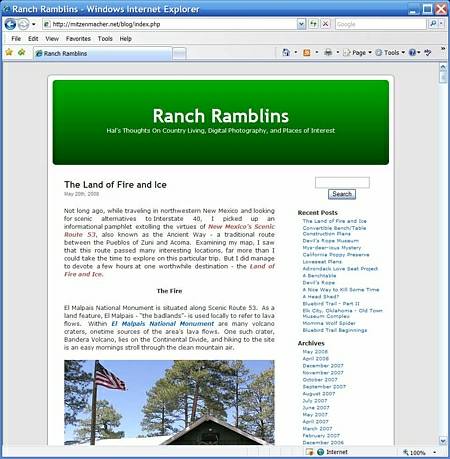
Help! I need your input to try and debug a misbehaving blog.  Here is the problem.  When I surf on over to my blog URL, I should see a web page that looks like the screen capture seen here –

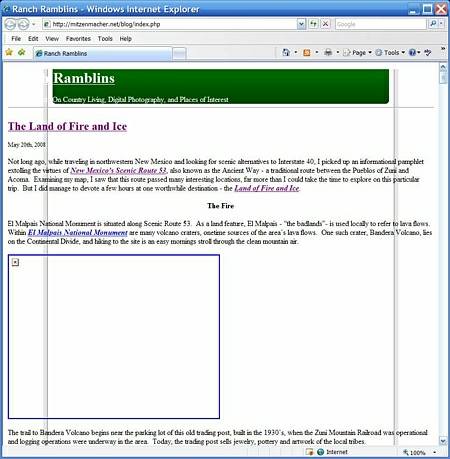
Unfortunately, that is not what is showing up on my screen.   Here is the page that I usually see these days-

The page does not appear to recognize any formating - the header does not line up correctly, the side-bar has been pushed down to the bottom of the page, the background has disappeared, and the photographs have failed to load.

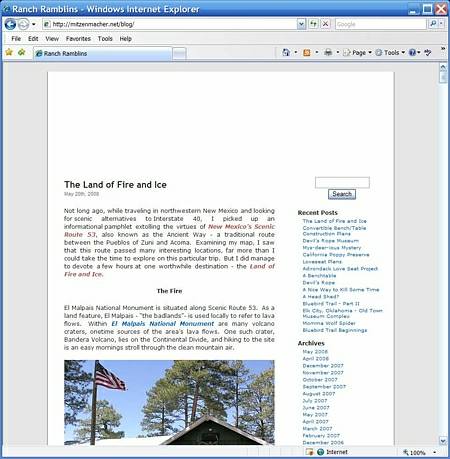
If I hit the refresh button on my browser, after a few iterations I might get some of the pictures to load, but the header remains missing-in-action, as seen above.

Sometimes, several of the photographs will load correctly, but others will not, as seen in the screen capture above.

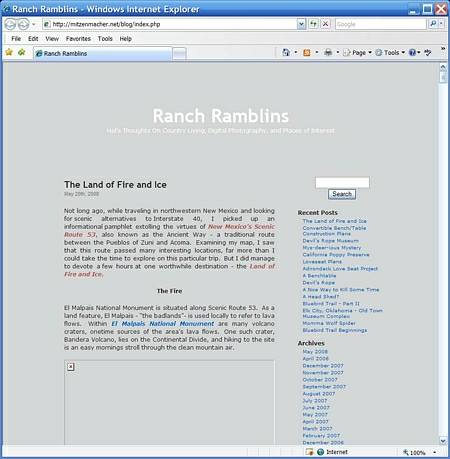
And at yet other times, I see a partial header, with no photographs loading, while some of the page formating remains in tact.

I need to try and isolate the problem, but since I have no other computer access beyond my home network, I cannot see what my blog looks like to other readers.   Here is where I need your help.  If you have stumbled across this page by any chance, please leave a comment telling me if the page is formated correctly for you, or whether it is messed up on your screen.

This problem occurs on my computer using either Internet Explorer or Firefox, so I don’t think it is a browser problem.

I am using the standard default Wordpress Kubrick theme, using only a few of the standard sidebar widgets, with no modifications, so I doubt that the Wordpress theme is the culprit.  Also, with enough browser refreshes, the page will eventually load correctly, so this seem to indicate that the problem lies outside the theme templates.

My trouble shooting instincts are telling me that this is somehow related to my web host, and that I will have to deal with their tech resources to solve the problem, but before I embark on that path, I want to try and eliminate the possibility that my satellite Internet provider is not somehow to blame (you would be surprised how many things satellite Internet service screws up)!

PS – It occurs to me that if you are experiencing the same problems with this web page as I am, than the screen captures above might not show up – ain’t technology fun? ;)

Signing Your Blog Post

I recently ran across an article which explains how one can incorporate an automatic signature line at the end of all WordPress posts.  I created this post to test the functionality of the WordPress plugin that is used to accomplish this task, and to provide the links that are necessary if you would like to add a signature to your own WordPress blog posts.

An explanation of the procedure involved can be found at Lorelle on WordPress, which is a most impressive and thoughtful blog about blogging in general, and WordPress specifically as a blogging tool.

Now, let’s press the publish button to see if this works the way it is supposed to.

Wildblue Satellite Broadband Update

I have had a number of comments inquiring about my experience with Wildblue Broadband Satellite Internet access, so I thought I would write a post pertaining to my experiences with this service.  The original installation occurred in January of 2006, and the post regarding the installation and subsequent comments can be found here.

Wildblue Satellite dish

Wildblue Satellite Broadband is one of several satellite Internet service providers.  Wildblue has targeted the rural areas of the country in it’s marketing, and has teamed up with rural electric cooperatives and small telecommunications companies to provide installation and support.  Wildblue offers three levels of access to consumers as follows:

  1. $49.95/month  -  512Kpbs/download, 128Kbps/upload
  2. $69.95/month  -  1.0 Mbps/download, 200Kbps/upload
  3. $79.95/month  -  1.5 Mpbs/download, 256Kpbs/upload

All subscribers will have to buy their equipment, which consists of the satellite dish, a dedicated satellite modem, and a surge suppressor for both the power and coaxial leads. The cost of the equipment package is currently $299.   Wildblue seems to have a perpetual promotion which offers free standard installation.  If a special type of installation is required, you will have to pay your local installer for the additional parts and labor.

Wildblue maintains a web based BBS type forum for the benefit of subscribers, which can be found here.

My background with Internet access is fairly limited.  For years I was saddled with dial-up access, which as you probably know, leaves much to be desired.  After moving to this rural property, we opted for ISDN (Integrated Services Digital Network) service, which was made available to us through Northern Arkansas Regional Telephone Company (NATCO).  ISDN is a dedicated telephone line to each subscribing household, and offers the convenience of always-on service with speeds up to 128Kbps.  The ISDN line can be used for telephone service simultaneous with web browsing or faxing.  Wanting faster download speed than ISDN could provide, I was quick to jump at the opportunity to move up to satellite broadband when it became available in my area.  Using NATCO as the agent for Wildblue, I subscribed to the fastest service available (1.5Mbps/256Kpbs) at $79.95 per month.

My experience with Wildblue has been varied.  In terms of speed, the advertised 1.5Mbps that I am paying for is usually achieved.  Using the on-line testing available at Testmy.net, my service has consistently fallen in the range of 1.5Mbps-1.6Mbps, just as I would expect.  Occasionally, download speeds will fall to 1.0Mbps, but this has only rarely occurred.   Although download speeds occur as expected, upload speed is a distressing 48Kbps, which is a far cry from the 256Kbps that I am paying for.  In reviewing the postings on the Wildblue Forums, I find that my experience in this regard is pretty wide spread. Complaints about slow upload speeds (relative to advertised upload speeds) are common in the forums.

The other aspect of Wildblue service that has to be examined is service reliability.  In this regard, Wildblue has fallen far short of my (and other subscribers) expectations.  Wildblue satellite Internet access is supposed to be an “always on” service, much like DSL or cable Internet access.  However, with Wildblue, you can expect to find that you have no service from time to time.  It is not unusual to have the modem lose contact with the satellite while you are in the middle of some computing activity.  If you happen to be in the middle of a banking transaction, or in the process of making an on-line purchase, this can be a disconcerting situation.  On some days, this might happen a dozen times throughout the day.  On other days, satellite contact is never lost.  Sometimes you may go for days at a time without loss of service, while at other times, service loss occurs day in and day out, for weeks at a time.

Unfortunately, Wildblue does not seem to be on the ball in providing accurate, timely information to it’s customer base.  Communications with the company, both through it’s website, and by telephone support, seems to be a one-way street.  The bulk of complaints that appear in the Wildblue forums do not seem to ever be addressed by the staff of Wildblue.  My impression is that there are many dissatisfied customers, who would appreciate better service and communication from Wildblue, but who are trapped in a one-sided contract with Wildblue, and have no practical alternatives to the poor service (short of switching back to dial-up service).

The following message from the Wildblue forums sums up one customer’s dissatisfaction:

http://www.wildblue.cc/wbforums/showthread.php?t=2769

It is a must read for anyone considering Wildblue service now, or in the future.

The other issue that must be raised with satellite Internet access, via Wildblue or any of the other vendors, is the issue of latency.  I am not knowledgeable about computer networking, network infrastructures, or any other aspect of the Internet’s inner workings.  I only know what I have come to expect when I “click” on a link on a web page. 

My experience with dial-up and ISDN service takes the following form:

Click on a link – wait a fraction of a second, and the page begins to load, albeit slowly.

Start a download of a large file – wait a fraction of a second, and the file begins to download, albeit slowly.

My experience with satellite Internet access takes the following form:

Click on a link – wait SEVERAL seconds, and the page loads instantly.

Start a download of a large file – wait SEVERAL seconds, and the file begins to download, albeit very rapidly.

The obvious question is, would I recommend Wildblue Satellite Broadband Internet access base upon my own experiences?  One indicator of my answer is that I do not plan to cancel my Wildblue service anytime soon.  Although the latency issue can be maddening at times, and the upload speeds are dreadful, and the inconsistency of reliable service can disrupt important on-line business activities, the alternatives are just too painful to bear.  Would I jump ship at the first opportunity to subscribe to DSL or cable Internet access?  You bet I would, and I would never look back to my days as a satellite subscriber.  Much like a passenger on a crowded bus, you get the feeling that, yes, it is uncomfortable, but it sure beats walking to your destination.

AFTERNOON UPDATE:

Wouldn’t you know it, but as I tried to publish this post today, the Wildblue system went into a tizzy.  Long load times for the pages, several attempts necessary to save pages to my server, etc.  I performed on-line broadband speed tests from testmy.net and cnet.com, and the results for download speed varied from .536Mbps to .640Mbps, which is about 1/3 the 1.5Mbps speed that I am paying for.

A worse problem occurs when I perform some ping tests.  Issuing the following command at the command prompt:

        C:>ping yahoo.com -n 20

results in some horrible statistics, notably latency in the range of 800ms-1200ms.  Worse yet, the timeouts and lost packets are horrendous.  Out of 20 packets sent, 5 packets were lost.

I have looked at some recent posts on the Wildblue forums, and it seems that I am not alone in these results.  It seems that beam 35 (which is the spot beam for my area) is experiencing a multitude of problems at this time.  I will post the results of further speed and ping tests as updates to this post over the next several days, just to see whether or not there is any improvement.

2nd AFTERNOON UPDATE:

As I went to save the first afternoon update, my Wildblue satellite modem lost connection with the satellite.  The connection was down for the past two hours, and I am hoping to finish this update before it goes out again.  This seems to be the type of service that is occuring throughout the Wildblue system, so if you can live within these constraints, the service is acceptable.

3rd AFTERNOON UPDATE:

After the Wildblue satellite modem automatically reconnected with the Wildblue satellite, I am now achieving download speeds of 1.55Mbps, which is the speed to which I am subscribed.  A C:>ping yahoo.com -n 20 command now results in an average latency of 670ms, with zero dropped packets.

So for the time being, it is all systems go!

___________________________________________________

TUESDAY UPDATE

Noon Tuesday:

Download speed is .881Mbps, or roughly 1/2 of what it should be.

Ping test results in 1 lost packet out of 20 sent.


8:00pm Tuesday:

Download speed has dropped to .550Mbps, or 1/3 of what it should be.

Ping test results in 8 lost packets out of 20 sent.

Browsing web pages becomes painfully slow, with many retries required to load a page.

_____________________________________________

WEDNESDAY UPDATE


7:30am Wednesday

Download speed is 1.57Mpbs, which is what I am subscribed for.

C:>ping yahoo.com -n 20 command results in zero packets lost in twenty attempts.


11:00am Wednesday

Download speed is down to .63Mbps from the 1.57Mbps of earlier this morning.

C:>ping yahoo.com -n 20 results in 5 out of 20 packets being lost.

C:>ping southshore.cc -n 20 results in 7 out of 20 packets being lost.


7:00pm Wednesday

Download speed is now down to .42Mbps, less than 1/3 of subscribed speed.

C:>ping southshore.cc -n 20 results in 10 out of 20 packets being lost.


8:30pm Wednesday

Download speed has dropped to .32Mbps, or approximately 1/5 of subscribed speed.

The performance of Wildblue satellite service has been totally unacceptable today.  Tomorrow I will contact NRTC (my local telephone company who is an agent for Wildblue) technical support to see if this can be resolved.  It is possible that there is a problem with the dish alignment, the TRIA (transmit/receive unit at dish), the satellite modem or the dish grounding that is the offending culprit.

____________________________________________

THURSDAY UPDATE

I did not have the time to deal with tech support today, so just a recap of Wildblue performance for the day.

Download speed I pay for is 1.5Mbps

9:00am – Download speed is 1.57Mbps – right where it’s supposed to be.

2:30pm – Dowload speed is .76Mbps – 1/2 of subscribed speed.

5:30pm – Download speed is 1.79Mbps – higher than subscribed for.

5:35pm – Modem lost connection with satellite.

8:00pm – Modem has finally reconnected with satellite, but speed is .74Mbps, or half of subscribed speed.


What Is This Creature?

I found this curious looking creature nesting in the back recesses of a little used file cabinet in the basement.  I know what it is, but can you identify it?

Mystery creature

(Hint: it never caught on, and is now extinct)

UPDATE WITH SOLUTION

The item above, as pointed out by David, is known as a :Cue:Cat.  This device was produced by a company called DigitalConvergence.:Com Inc.  The idea was to provide every computer with this modified bar code reader, and convince business partners to include special :Cue codes in various printed matter which would then lead to a specific web page on the internet.  The :Cue:Cat was distributed by Radio Shack stores for free, and in the year 2000, Radio Shack supplied their Master Catalog with the special :Cue barcodes, as shown here –

Radio Shack catalog page

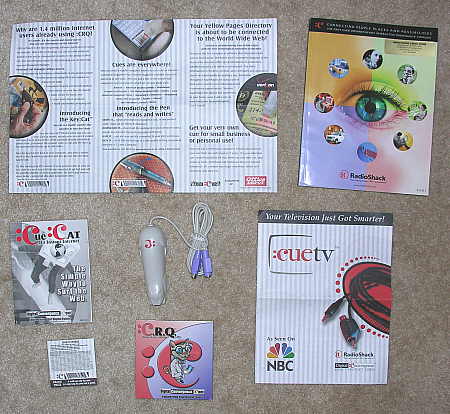
The entire installation and promotion kit that was distributed by Radio Shack stores is pictured below, which included various teaser promises of wonderful applications to come.

:Cue:Cat promotional package

Three of the more noteworthy uses that DigitalConvergence was hoping to implement with this device were 1) a link between television and the computer using a special :CueTV cable.  This was an audio cable with a RCA type pass-through connector at the television end, and sound card connector at the other end.  When properly configured, the audio system on the TV was supposed to feed web-page links directly to a connected computer, via specially encoded transmissions contained in the audio signal.  So, while watching TV, one could theoretically view unlimited program information simultaneously on the computer screen.  Instead of the hard-wired connection, one could also opt to purchase a Wireless Audio-Link from Radio Shack.  2) a web-based, consumer accessible UPC code database linked directly to a unique web-page for each UPC code in existence.  The idea behind this was simple – by simply scanning the bar-code from any commonly available product, one would be instantly transported to a web-page relevant to the individual product.  3)  a personal :CueCode available to any consumer who wanted to register for one.  This would allow any individual the ability to direct someone to their personal web site by including the personal :CueCode on business cards, letterheads, invitions, etc.  The personal :CueCode was to be marketed exclusively by Office Depot stores.

For those people on the go, DigitalConvergence had two mobile solutions as well, one in the form of a keychain fob code reader and the other in the form of a Cross pen with a built in reader.  Each of these readers could store up to 300 :Cue:Codes, and by simply touching the reader to a device called an OptiLink (sold seperately), the information would be uploaded to the computer.

My own experience with the :Cue:Cat was not quit as rosy as DigialConvergence would have had me believe.  After installing the driver software and hardware, I took the Radio Shack catalog and tested some of the links I found within it.  Most of the links returned a 404 File not found) error message.  Of the links that worked, I found that most of them simply parroted the information I had before me on the printed page.  Similarly, when attempting to scan the UPC code of various products, I experienced mostly failure.  It might well be that this was a result of rushing the concept to market before all of the required pieces were in place.  Regardless as to the reasons, it left such a poor impression on me that I uninstalled the software, and all of the materials that you see here have sat dormant in the recesses of my file cabinet until now.

What to Title This Post?

First, I thought of something like “Paranoia Run Amok”.  Why?  The purpose of this post originally was to serve to clarify what my opinions are (at the moment, anyhow) regarding the origin of spam and computer viruses.  In a previous post I raised the issue that possible blog comment spam might have originated from the “Word Cloud phenomena that propagated (memed?) through the blogosphere a few months ago.  In the comments that ensued from this post, I expressed a pretty strong opinion about the relationship between spam/viruses and the companies that profit from defeating the same.  Here is what I wrote:

 In my more paranoid moments, I can’t help but think that there is a connection between the growth of spamming, and the companies that profit from “defeating” it. If my paranoiac reasoning is correct, than there never has to be any sales closures for the product being hawked, as this is not the motive for the spam in the first place, but merely a pretext for the sale of anti-spam products.

Similarly, I sometimes feel the same paranoid suspicions regarding the source and motivations behind virus outbreaks. It seems that if one wanted to “follow the money trail” of these activities, one should not overlook the fact that many companies have built their entire business model on selling annual subscriptions to products and services designed to “defeat” these ever-growing threats.

Microsoft has built an empire on a simple premise: Provide a product that every computer owner perceives that they need (Windows), and then create a managed version update program to get these same owners to upgrade to the latest, greatest OS (witness Windows, Win95, Win98, WinMe, WinXP, and Vista, not to mention all the flavors of WinNT that have come down the pike). If companies such as Symantec, McAfee and others can persuade everyone that they must not only buy their products, but also constantly renew their subscriptions, than they will have effectively “one-upped” the Microsoft business model. I guess only time will tell if I am being paranoid, or if I am simply being prescient.

As I thought about this comment, I began to feel as if I might have been overreacting, even though I had so clearly peppered my remarks with words like paranoid, suspicious, and paranoiac.  And so my original intent was to somehow soften the tone of my opinion on this issue a little bit with this post.  And then something happened.

I read a computer magazine which referenced an article titled “The Antispyware Conspiracy“, which addressed a portion of this issue in a direct manner.  After reading this article, I began to feel that maybe I wasn’t being so paranoid after all.  But the author of the article began with the following statement:

“Since the release of the first antivirus products many people have believed in a conspiracy theory where antivirus companies generate their own market by paying virus writers to develop and release viruses. I don’t subscribe to that theory and trust the major security vendors, but recent trends show that there’s a fuzzy line between second-tier antispyware vendors and the malware they clean.”

This article seems to point a finger at some second-tier antispyware vendors, but is quick to absolve the major security vendors of any complicity.  And as I thought about this more, one thing kept popping to mind – maybe the major players ARE paying virus writers to develop and release viruses!  Not directly, of course.  I am not suggesting that executives within Symantec or McAfee direct any campaign to unleash viruses on the computing world.  In fact, I would be the first to suggest that the executives within these companies realize that any involvement in such schemes would be fatal to their own best interests, and I further believe that the intentions and motivations of these executives are pure.

This apparent contradiction on my part can be explained by considering the following simple observation.  Name any other industry that contains this unique dynamic – any individual employee within the “malware prevention industry” can guarantee his very own job security by propagating the malware they are hired to defeat.  Imagine this employee spending just 1 hour per week developing his malware, and you can imagine the havoc he/she could inflict.  Now multiply this dynamic by the number of employees in this industry (hundreds? thousands? tens-of-thousands?).

If you think I am too suspicious, let me tell you a true story.  Some years ago, I was called upon to render a professional opinion regarding a computer system and associated software programming for a client who owned a chain of glass companies.  The logo of this company was a little boy at play.  If you looked closely at the logo, you would see that the little boy had a slingshot hanging from his back pocket.  I asked my client about this, and he replied with the following tale.  He (I’ll call him Mr.X) began his career as an employee of a glass company.  In 1971 Southern California experienced a large earthquake, and there was more glass replacement business to go around than anyone could handle.  Mr.X decided to go into business for himself, and for a while, all was good.  Eventually, the earthquake damage in the area was repaired, and Mr.X found himself wanting for business.  Arming his son with a slingshot, ammunition, and instructions to shoot up windows in a neighborhood, Mr.X would than saturate the same neighborhood with fliers advertising his glass repair company.  No wonder I am now suspicious of business by nature!

So I now face three questions –

A) Are there any other industries that contain the same dynamics that are at play with the malware industry?

B) Am I being overly paranoid with respect to the malware industry?

C) What should I have entitled this post?

Emoticons and Smileys…. Pro, Con or Neutral?

On a recent comment to a recent post that appeared on these pages, I noticed that the commenter ended a tongue-in-cheek sentence with this smiley ;).   Like everyone else who has used a computer lately, I have seen an array of these little faces everywhere on the internet that I visit.   But I was totally surprised to find this little fella living in my blog comments 8-O.   I thought that the person who left that comment must be super-cool (which he is, of course) 8).   Although I know that it is a sin, I couldn’t help but be green with envy over this person’s computing skills :mrgreen:.  

Not long after seeing that a smiley had taken up residence in my blog, I happened to end a sentence with an old-school “;)”, when, much to my chagrin :? this little guy appeared instead ;).   “What the heck is going on here?” I asked myself (as no one else happened to be in the room at the time) :roll:.   And then it dawned on me that Wordpress might be involved in some way :idea:.  It made me very sad that I had no knowledge about the care and feeding of these smiley creatures, so off I went, searching the Wordpress documentation for clues about this feature :(.   The documentation indicated that Wordpress does include a feature that translates old-school emoticons into these little smileys.  This made me very happy indeed :D.

Now that I had learned Wordpress supported smileys, I needed to find a listing of the smileys available for my use.  Off I went to search the internet for answers :arrow:.   A search on “emoticons” eventually led me to a blog with a post regarding emoticons.  The individual who wrote this post was very angry with computer users who use the services of the smiley critters :x.   In the comments that followed this post, there was a very intelligent discussion among the participants involving the use of emoticons in general, and smileys specifically.  Some considered the smileys to be evil :evil:  twisted creatures :twisted: undeserving of life itself.  Others found the smileys to be cute and helpful in expressing nuances of feeling that are hard to put into words.  Some even expressed disdain for anyone who would consider using smileys :P.  And here I was, doing research to find out how to use these little animated dots.  It was almost enough to make me cry :cry:. 

Like many other things that I don’t think about when I’m not thinking, I never thought that emoticons and smileys could arouse so many emotions in so many people:!:   So now I am perplexed as to what to do – utilize smileys, or ignore them and hope that they go away. 

What is your opinion?

Giving Credit Where Credit Is Due

In this day and age, when it sometimes seems as if the business community is out of touch with the customers upon whom they depend,  it is refreshing to see one company respond quickly and politely to a customer’s concern over a potential problem.  I am referring to the good people at snapshirts.com, who have earned my respect and praise for their response to my concerns, and more important, for their response to the blogging community at large.

Here is a little background.  If you are a frequent visitor to blogs of any genre, you may remember a period of time earlier in the year when suddenly, it seemed as if every blog in existence posted an image of what is called a “word cloud”.  The clouds that were posted on these blogs were primarily generated from the snapshirts.com website mentioned above.  From comments on the blogs at the time, it became apparent that word clouds were very well accepted by bloggers and their readership.  This generated a lot of traffic at snapshirts.com, who is in the business of selling products utilizing the word cloud concept.

Recently, one of the blogs that I regularly read indicated that there had been a marked increase in comment spam, and the author wondered what could have caused the sudden increase.  As I thought about this, for unknown reasons my mind flashed back to the word cloud I had seen on that site.  Could this be the culprit, I wondered?  By performing a search on “word cloud”, I was able to locate numerous blogs that had posted their own version of a word cloud.  By than searching those blog’s archives for “spam”, it soon became apparent that many of those blogs had also experienced an increase in spam.  Could the increase in comment spam have been caused by the submission of their URLs to the snapshirts.com site?  I am not well versed in this type of thing.  I can’t fathom why spam even exists in the first place, let alone figure out how it is accomplished.  So I thought, “why not ask snapshirts.com directly?”  Here is the correspondence that ensued:

On 5/2/06, Hal Mitzenmacher wrote:

There are many people in the blogging community who have noticed a marked increase in comment spam on their blogs since submitting their URLs to Snapshirts.  Is there more going on here than meets the eye?  If you were to perform a web search on snapshirts + spam, and then examine the result, you will see what I am referring to.  Would you please address this issue on your blog for those of us who may feel doubts about continuing the use of your services?

Thank you.


Response from snapshirts.com:

Mr. Mitzenmacher,

First, I want to thank you.  You have brought a flaw in our old fulfillment methodology to our attention.  Upon receiving your message we immediately took what steps we could to rectify the situation.  In the past, we had included the weblog URL on the T-shirt’s order page to ensure customers received the T-shirt that was directly linked to their blog.  This inadvertently made those URLs available on the Internet for persons with malicious intent.  We have subsequently updated our fulfillment technology to allow instant T-shirt generation and purchase, so we no longer publish any information beyond the image.  After receiving your message yesterday and realized what had likely occurred, we immediately removed all pages from the Internet that were generated using our older methodology.  Those pages are no longer accessible over the Internet.

Second, I assure you that I have NO direct affiliation with ‘sploggers’, comment spammers or spam providers of any sort.  If you want to call, my cellphone number is xxx-xxx-xxxx and if I could afford a ticket to the Ozarks I’d fly out so you could look me in the eye on this one.  Weblog producers are our sole customers and we are very sensitive to the highest standards of customer service that must be maintained in serving this community.  We were taken advantage of but in no way did we collude with anyone to produce this unfortunate result.

Third, you mention other bloggers experiencing this effect and commenting on it.  I searched the “snapshirts + spam” combination on Google, Google Blog Search, IceRocket, Bloglines and Technorati but was unable to find another blog post on this issue.  If you are aware of other blog posts or bloggers with this issue I’d appreciate any link so that I can address this issue personally with them as well. Last, but most certainly not least, I want to apologize for any inconvenience this has caused you.  I will be posting a notice on our blog today with this information and links to free tools and add-ons for various weblog systems which can be installed to combat comment spam.  For wordpress, I use Spam Karma, which has a 100% record on my personal blog for catching comment spam and permitting actual comments.

Sincerely,

Jonah Keegan

snapshirts.com


My reply to snapshirts.com:

Mr. Keegan, 

As I read the original email that I submitted to you, specifically, 

“There are many people in the blogging community who have noticed a marked increase in comment spam on their blogs since submitting their URLs to Snapshirts”  

I can see that I might have been a little vague regarding other bloggers experiences.  I did not mean to imply by this statement that other bloggers necessarily made a connection between the increase in spam they were experiencing and the submitting of their URLs to Snapshirts.  I am the one who made this connection when, while visiting many differing types of blogs on a regular basis, I began to notice a pattern.  There was a short period of time when it seemed as if  every blogger in cyberspace was posting their own word clouds.  Here is a comment I made on one blog’s Word Cloud post:

“A Google search of “word cloud” now produces over 11,200,000 hits, mostly from bloggers! I wonder how many t-shirts Snapshirt will sell? And how long before a Wordpress “Word Cloud” plugin appears?” 

Shortly thereafter, many of these same blogs began reporting an increase (sometimes dramatic) in the volume of comment spam they received.  This can probably best be seen by using the same methodology as I did.  Perform a search to find blogs that posted their word clouds, and then, from within each individual blog, perform a blog search of posts pertaining to comment spam.  When I saw the results obtained with this methodology, my suspicions became aroused.  Whether there is a cause-and-effect relationship, I don’t know, as I know little about comment spam (other than the fact that it is obnoxious and annoying).  It might well be that this same methodology would yield statistically identical results by searching these very same blogs for “sun spots”, for example.  I just do not know.  Which is exactly why I contacted you to inform you of my suspicions.

The tone and speed of your reply indicates your sincerity about this issue.  No need for you to travel out to the Ozarks so I can “look you in the eye”,  however, should you ever get the chance, I’m certain you would find the area a delightful place to visit.

Hal Mitzenmacher


Snapshirts.com response:

Thank you.  I can tell you our sales are far less than 11.2 million, wouldn’t that be something…  :)  We are very grateful to the blogging community however, for providing us such a uniformly positive reception and sending us a steady stream of visitors.

I can also tell you we are working to develop a free word cloud plugin for wordpress or any blog, with some features we hope will appeal to bloggers as much as our t-shirts do.

Thanks again for bringing this to my attention.

Sincerely,

Jonah Keegan


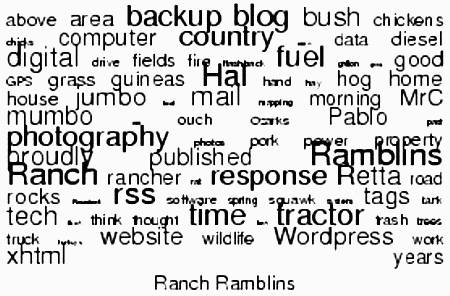
I have checked the snapshirts.com website today and I have found that they have, indeed been hard at work addressing this issue (see post here).  And as a showing of confidence, here is the word cloud that I have just produced from the snapshirts.com website:

Ranch Ramblins word cloud

If They Can Do It, So Can I

Back in 2001, the local telephone company in our area (Northern Arkansas Telephone Co) undertook a project whereby each and every telephone pole was identified and mapped using GPS technology.  To accomplish this task, a small group of NATCO employees were equipped with ATVs and GPS units.  After spending each day following the telephone lines and entering each pole as a way point on their GPS units, the team would then upload this information into the NATCO computers, and thus an accurate survey of NATCO’s telephone poles was completed.

When the NATCO ATV showed up on our ranch to survey our poles, I took the opportunity to talk to the technician, and I became intrigued by the notion of mapping out the features of our ranch.  I saw that the equipment that he used was fairly simple stuff, which gave me the necessary impetus to undertake a mapping project of my own.

Back when Retta and I were cruising among the Channel Islands off the California coastline, GPS navigation was a necessity, so I was quite familiar with GPS units and their capabilities.  Our GPS unit was tied in to our laptop computer.  The end result was that we could do our chart work in real-time, with the location of our vessel accurately depicted on our electronic maritime charts.  When we sold the vessel, the GPS unit went with it, but now, here was my excuse to justify the purchase of an inexpensive hand-held GPS unit (I confess to a personal weakness that prompts me to try and find any justification for acquiring new technological gadgets).  So I purchased a Magellan GPS device, and soon had it wired to my laptop computer.  I also needed some type of mapping software, and settled on Delorme 3-D TopoQuads.  This software is fairly full-featured and inexpensive, and while it is accomplishing all that I want it to do, it seems somewhat cumbersome to use, as if it were designed in a prior software era.  Now, all I had to do was tie this all together into a package that could actually be used on the ranch. Here is what eventually evolved from my efforts.

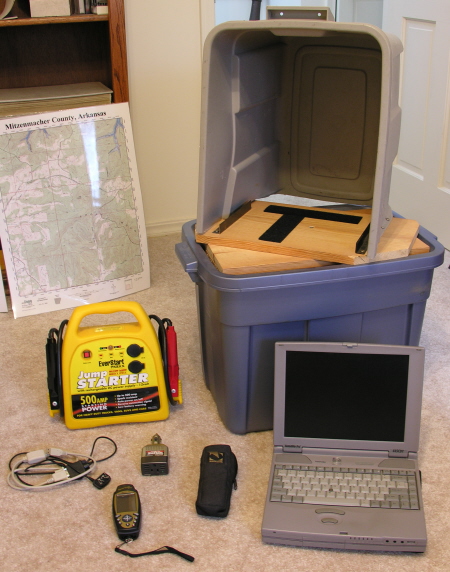
Mapping System Components

Notice the following features of my “super-duper, multi-purpose, portable cartographic data collection machine”  (SDMPPCDCM).

A) High-tech Rubbermaid containers are utilized to house the necessary components, as well as providing sun-shading capabilities for daytime use.  These are inexpensive, readily available, and coincidentally, just the right dimensions to fit snugly into our utility vehicle.

B) This application for a laptop computer consumes lots of power.  The computer cannot use any power saving modes while mapping, the screen must be set for full power to be visible in the daylight, and the hard disk drive and CDrom are always busy performing mapping chores. Rather than trying to create a properly conditioned power supply from the utility vehicle’s electrical system, which would have been a project unto itself, I opted to power the system with an automotive rechargeable booster pack, available (of course) from our local Wal-Mart.  By adding a simple and inexpensive power inverter, this system can be operated at full power for a lot more hours than I care to work in a day.

C) The laptop is affixed to the turntable by a pair of stabilizing rails on the side of the turntable, and secured with industrial Velcro attached to the bottom of the computer.  The turntable swivels on a simple pivot, allowing me to easily adjust the viewing angle.  The entire package is secured to the vehicle with a heavy duty bungee cord.

D) The GPS unit, which feeds data to the computer via a data cable, is mounted on the dashboard of the vehicle with a quick-release mount built especially for this particular GPS unit.  This allows for excellent visibility while driving, and allows me to easily pop off the GPS and use it on foot when necessary.

When mounted in the utility vehicle, the entire contraption appears as below:

Mapping system in place

An example of the results obtained with this system can be seen in the following map printout, which is a screen shot from the Delorme mapping software.  This particular map layer that is pictured shows the trail network as it exists on the ranch.  There are unlimited layers available, and I have used them for many purposes.

Mapping results

You may ask, “Hal, what prompts you to spend so much time rambling on about computerized mapping systems and such?”   Pablo, editor of the Roundrock Journal, a fine and highly popular Missouri blog, recently mused about solitary shag bark hickory and walnut trees on his property.  The question arose as to weather solitary trees of this type would produce nuts.  I suppose a normal person who is motivated to find an answer to this question would, with a few well-defined queries to Google, come up with an answer in short order.  But I am (thankfully) not normal!

Three years ago, I began a long-term project of mapping the approximately 150 black walnut trees that exist on the ranch.  Each year, I use my GPS data to locate each of these trees, and I note their status as being either “nut-bearing” or not, as the case may be.  I then use this data to plan my bush-hogging schedule, so that the trees are accessible to my friend Jasper when he comes around in the fall to gather our black walnuts.  It is my thought that I can utilize the data that I am collecting to answer the pressing question of solitary nut trees (if I should be fortunate to live long enough to collect a meaningful amount of data).  I am also attempting to see if I can find any direct correlation between nut production and weather patterns.  This may be grist for a future post (if I can find any results worth posting).

DRM Rears Its’ Ugly Head Once Again

I cannot resist ranting about Digital Rights Management (or other copy protection schemes) whenever I run across negative issues associated with them.  When will the holders of intellectual property rights ever learn the basic lessons that seem to arise again and again?

Recently, Sony Music and other music publishers tried to institute a boneheaded copy protection scheme that met with such resounding protests that they immediately backed off on its’ implementation.  This scheme relied on a technique that utilizes what is known as a “root kit” to do its’ duties.  When copying music from these CDs onto your computer, bits of coding would insinuate itself deep into your computers file system.  If you are at all familiar with Unix, Linux, or any of their derivatives, you will recognize that any user that has what is known as “root access” has virtually total control over the machine in question.  Granting root access is thus a potentially dangerous situation.  Root access techniques have become the “method de jour” for modern day hacking, and is a major security issue, particularly as employees shuttle laptops back and forth between home and office networks.  No wonder there was an immediate and loud outcry about this technique (see previous post here).

Today, I ran across this article from cdfreaks.com (I love the monikers you run across on the web)   “Tests find DRM shortens player battery life by up to ~25%” .

Basic lesson that is ignored at the publishers peril – “Do NO HARM unto those who legitimately purchase a license to utilize your intellectual property.”  The revenue stream of any publisher depends entirely on the continued purchases made by these customers.  Cripple them in any way, deprive them of the full use of the media that they have legitimately paid for, and they will abandon you at their very first opportunity.  History proves me right on this issue (although we seem to be in a period where the lessons of history are often ignored).  The pirates who blatantly disregard intellectual property rights always find a way to circumvent copy protection schemes anyhow, so why risk alienating your proven (and hopefully loyal) customer base.  Your financial future depends upon them.

End of rant (for the moment).