Words, Words, Words

A post on this blog usually includes a picture every few sentences, perhaps because I feel I can tell a story better with graphic, rather than verbal imagery.  But it seems that my camera has up and left me, taking a much deserved vacation (along with Retta, of course).

 If I had my camera you would probably see a photo narrative about the most recent fire that threatened the area for three days.  Eventually, the Arkansas Department of Forestry extinguished the blaze, in the same efficient manner that they always do, but not before the fire caused some concern for myself and a good neighbor of ours. Thanks, ADF.

If I had my camera you would probably see what it looks like when a front suspension A-arm assembly on a utility vehicle snaps in two, and what it takes to remove the part in order to transport it to the local welding shop.  Perhaps you would also see the blue streak that emanated from my lips when I discovered that disassembling the suspension required a specialty tool that my tool chest lacked.  A sixty mile round trip into town solved that problem, which allowed me to extract the recalcitrant part.  Another sixty mile round trip back into town, and the broken part was now in the hands of a competent welder.  Tomorrow, another sixty mile round trip into town to pick up the part from the welding shop, and I can then put the utility vehicle back together.

If I had my camera you would probably see pictures of what a heat pump looks like when it malfunctions, causing the equipment to freeze up into a solid block of ice.  And what the basement utility room floor looks like when said block of ice melts!

If I had my camera you would probably see pictures of the lawn surrounding the house, which now looks more like a jungle than a lawn, due to the fact that a spindle assembly on my trusty lawn mower chose to commit hare kari the other day.  This will entail another sixty mile round trip into town.

But best of all, if I had my camera you probably would have seen pictures of the beautiful way in which early spring is expressing itself here in the heart of the Ozarks.  It is truly a joy to behold, but you will just have to take my word for it, as my camera has gone on vacation.

I guess it’s finally time for Retta and I to become a two camera family, so I had better start doing some serious research to find just the right camera to buy.  Easy to use, pocket sized, quick focusing, 6 mega pixel (or greater) resolution, and superior macro capabilities are called for - any suggestions out there?

A Sure Sign of Spring in the Ozarks

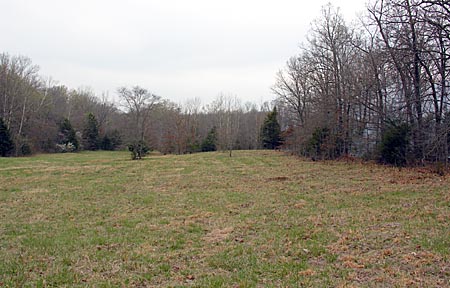
Clearing in early spring

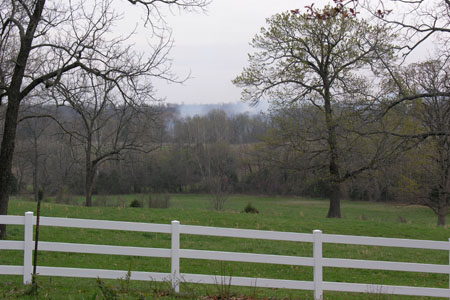
This photo was taken today, March 23, just a couple of days into the spring season.  Within this picture, can you see a sure sign that spring has arrived?  If you peer very close to the left side of the clearing, you may be able to discern a redbud tree and a service berry in their early spring bloom.

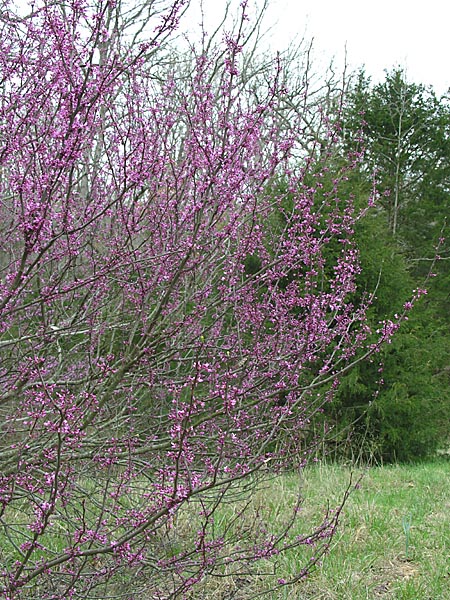
Redbuds are beginning to bloom

This is a closer view of the blooming redbud tree.  One of the first trees in our area to come into bloom, the redbud is indeed a harbinger of spring in the Ozarks.  But this is not the sure omen of spring that I am alluding to here.

Look closely again at the first photograph.  Does anything else catch your eye that might possibly serve as an omen of spring in the Ozarks?  Can you see the smoke hugging the ground in the woods on the right-hand side of the picture?

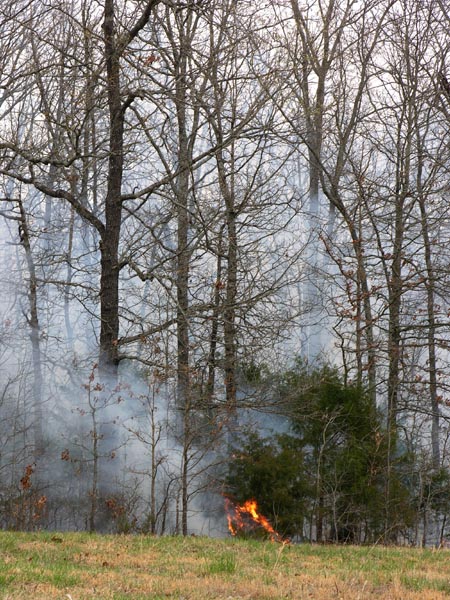
The woods are on fire again

Here is a closer view of the smoke, and the fire within the wooded area that is creating the smoke.  Once again, as those familiar with this blog may already know, we are faced with a neighbor’s intentional burn that has run amok,  burning uncontrolled on our property.

It has gotten to the point that one could safely mark their calendar in anticipation of the fires that mysteriously appear this same time each spring.

In years past, our first reaction to this situation would be to call the local volunteer fire department.  And I am sure (as they have proven repeatedly in the past) that they would have responded in the same efficient manner as they have in the past.

This time, we are taking a wait-and-see approach to this fire.  When we have reported previous fires, the local volunteer fire department responds initially, and then proceeds to call for the assistance of the Arkansas Forestry Department.   The Forestry Department will send bulldozers and fire fighting personnel to our property to contain the fire.  Which entails heavy equipment driving through our pastures and fields, bulldozers cutting new fire breaks, and the probable cutting of our barbed wire fencing to enable access to adjacent burning areas.  All in all, the lasting and destructive effects of the suppression efforts are generally more onerous than if we were to just let the fire run it’s course.

Still some distance from the house

This photo shows the proximity of the fire to our home.  At the moment, the fire is approximately 1/2 mile from any of our structures.  We will continue to monitor the fire’s movement, and call for assistance if necessary, but it is probable that this is a fire that we will allow to burn itself out.  

And thus, spring arrives for us out here in the Ozarks.

The Case of the Missing Bees

A honeybee gathering nector

This post assumes the reader has a basic understanding of the role bees play in the reproductive process of plant life on Earth.  For those who do not possess this knowledge, I suggest it is time to have “that talk” with your parents.  Those readers who do have an understanding of the functioning of bees in the biology of plants may be aware of just how important bees are to our agricultural industry.

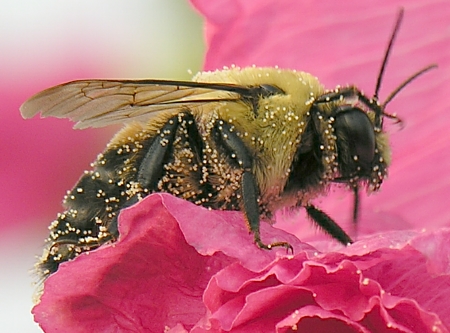
Honeybee transfering pollen

The two photographs shown above (courtesy of Retta) clearly show how pollens attach themselves to the body of the bee as the bee makes it’s rounds gathering nectar for the hive.  The pollens thus are transferred from plant to plant by the foraging bees, cross-pollinating the flowers and allowing the reproductive cycle of the plant to proceed.  Soon, the farmer will be able to harvest the fruits of this biological process, and we eventually are presented with the wonderful produce we have come to expect at our local grocery store.

In the wild, bees make their home in the hollows of trees, as fans of Winnie the Pooh will surely recall.  As farms grew from small subsistence plots to large industrial agricultural operations however, a problem arose.  The large farms required large fields, which necessitated the clearing of vast tracts of land.   This ultimately led to agricultural regions which were essentially devoid of trees suitable for bees to establish their hives.

Rental hives

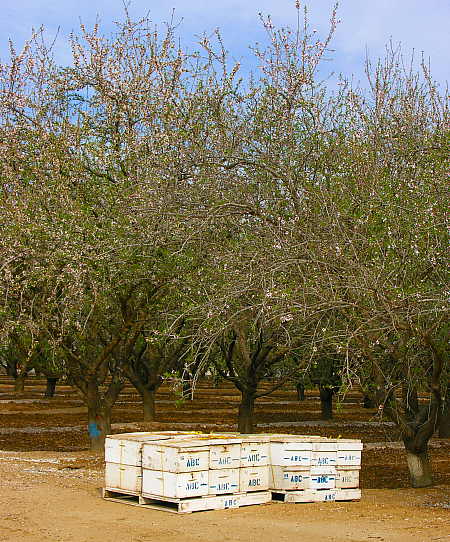
To solve this problem farmers have turned to the services of commercial beekeepers.  The photograph above shows an orchard that is in bloom.  You can see that the grower has placed 2 dozen hives in the vicinity of the fruit trees.  Hive clusters such as this are rented from commercial beekeepers at the appropriate time of the year and scattered throughout the orchard, thus ensuring that the vital process of pollination will occur.

This year, a strange thing has been occurring, the significance of which has yet to be determined.  When commercial beekeepers across the country began opening their hives in order to grade them in preparation for the upcoming season, many discovered that the hives were empty!  No bees at all!  The hives had honeycombs and the honeycombs contained honey, but the bees had disappeared.  And I mean COMPLETELY disappeared.  Not even any bee carcases remained in or around the hives.  No one really understands what has happened yet, nor the extent of the problem.  Commercial beekeepers have been reporting the same type of disappearance across 20 states now, and the problem appears to be ongoing.

This would not be the first time that a massive die-off off honeybees has occurred.  The last major die-off that occurred was a result of parasitic mites that infested the bee hives.  In past events, however, the bees left behind evidence of the culprit which led to their demise.  Bee carcases could be found in and around the hive, and it was relatively simple for biologists to determine the cause of the reduction in the bee population.  Because of the lack of forensic evidence, entomologists have been unable to pinpoint what has transpired with this ongoing event.

Because there are no bodies left behind, there has been speculation about what types of problems could create this scenario.  One line of investigation revolves around the theory that some type of pesticide is having an effect on the neurological functioning of the bees, debilitating the amazingly complex navigational functions that the bee uses to located the hive.  Under this line of reasoning, the bees simply leave the hive on their usual rounds, but find themselves unable to navigate back to the hive.  But this would explain the plight of the worker bees, and does not adequately explain the absence of queens and drones from the hives.

There is much research underway to try and determine the cause and extent of this problem, which appears to be ongoing, serious, and wide spread.  One stumbling block to diagnosing the problem stems from the lack of data regarding the scope of the die-off.  Most commercial beekeepers are aware of the situation, and have reported their losses to appropriate agencies for investigation.  Commercial beekeepers comprise a small minority of the beekeeping universe, however.  The vast majority of beekeepers are individual hobbyists who might not be tapped in to the agencies and resources that are attempting to solve this mystery.  To be helpful, anyone who maintains one or more bee hives is encouraged to log on to the following web site to complete a survey at the following link:  National Bee Loss Survey

What In the Heck Is This?

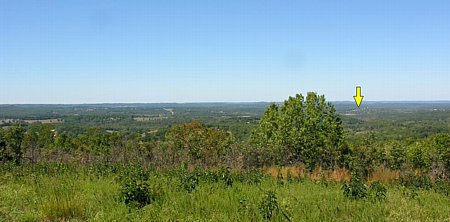
What town?

When gazing off toward the western horizon from the vantage point offered by our mountaintop (talk about making a mountain out of a molehill!), my eyes will usually come to rest at the location that is beneath the yellow arrow in the photograph displayed above.

Can you see what it is that I feel compelled to look at?

No?  It’s only 4.2 miles away, as the crow flies (which raises the question -what’s with that saying?  The crows I see around here never fly directly from one spot to another.  But I digress).

OK, OK.  I’ll show you a picture taken from the same spot, but at an earlier date and zoomed in to a larger magnification this time:
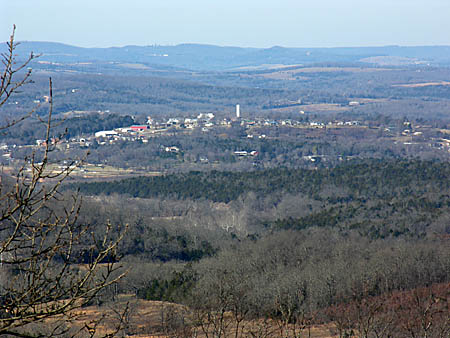
Here it is!

 Now you can see what is underneath the yellow arrow in the first photograph.  It is the town closest to our land, with a population of approximately 270 people.  It takes about 10 minutes to drive over to this little town from our house.  By contrast, it takes about 35 minutes to drive to the “city” closest to us (pop. 11,000+).

What might you find in our little town?  At one end sits a full-fledged post office facility, located next to a bank, where you can conduct some of your business.  Around the curve there are two diners, one of which serves only breakfast and lunch (their pies would probably win many county fair competitions).

Across the street are a couple of flea market type shops, perhaps with a rusty old 1949 Farmall C tractor in need of some TLC sitting out front.  There is a barber shop, a pizza shop, and a grassy parkway containing a small covered bandstand (donated and built by local volunteers).  The City Hall is located here, and it is open for business one day per week (I think on Mondays, but you might want to call ahead to be certain) .

The local telephone company maintains a small substation/maintenance office in town, and our volunteer fire department is housed in a nice facility in the center of town.  Further down the road, you will come to the town park, which is located next to the local Saddle Club facility, which includes a lighted riding arena, spectator stands, concession stand, and other equestrian facilities.  Who knows, maybe your neighbor might just be crowned Little Miss Rodeo Queen?

Little Miss Rodeo

As you continue down the road, you pass a couple of small businesses, including a new fitness center (a fitness center in a town of 270?)

The far end of town is where the local school district operates their only educational facility, serving grades K-12.  The district is tiny, with a total enrollment of 427 students in 2005.  Along the roadsides leading into town from both directions are the numerous churches which dot the landscape.

Now, finally, after all this lengthy babbling on about this little town, I get to the subject of this post, which is about where the true heart of this little community seems to centered.

Do you think that the heart of the community (H of C) resides at the school grounds?  After all, the school has athletic fields, a multi-purpose room, a new gymnasium, and is the place to be seen Friday nights during football season.  I don’t think so, because there are many empty-nesters and childless residents in the area.  They aren’t likely to be seen at school sponsored activities.

What about the churches?  Surely churches play a large part in the role of H of C out here, don’t they?  Well, yes and no.  Undoubtedly, a church provides a central role in the lives of area residents, especially in a bible belt region such as the Ozarks.  But because there are so many churches dispersed around this little town, each one only services a small fraction of the total population.  While serving an important function in the community, no single congregation can legitimately claim to be the H of C of this little town.

The Saddle Club, which hosts numerous events throughout the year, and is host to a great weekly “Family Fun” night during the warmer months, only serves the needs of the local equestrian community.  If you aren’t a horse person, you would have no reason to frequent this facility.

How about the local diners?  Doesn’t everybody eat out from time to time?  Couldn’t these places thus serve as the H of C?  Maybe, except that one diner is only open through lunchtime (the one with the great pies), and has a small dining room, thus could never serve as a crossroads for the town.  And the remaining diner, while providing a decent meal, is somewhat pricey for this neck of the woods, thereby limiting it’s potential to be the popular spot an H of C must be.

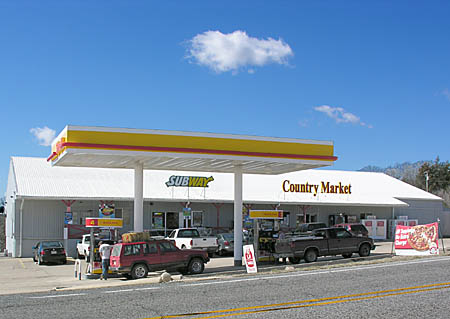
Rather than continuing to eliminate one candidate after another in my quest to arrive at the true heart of the community, I will cut to the chase and present my nomination:
The hub of the community

The Country Market.  Every small town aught to have a place like this in it’s midst.  More than just a spot where you can fill up the tank with gasoline or diesel fuel, you can also replenish your propane tanks and pump kerosene for your shop heater in the winter.

Do you need groceries?  This little store is amazing in the selection of goods that are offered.  From fresh produce to meats and dairy, canned and frozen goods to spices and ice cream, it seems to have most of the things you might happen to need between trips to the city for larger-scale shopping.

Are you hungry now?  This little place is a franchise for Hunt Brothers Pizza – 2 pizzas, $12.99, all toppings included.  It also sells Chester’s Fried Chicken, which is excellent (if nothing else, you can trust an Ozarker to know good fried chicken).  The lunch counter will fix you up with a burger and fries, catfish, and other items that vary from day to day.   If your preference is for something a little healthier, there is a Subway franchise located within the store also.  To help alleviate your sweet tooth, you can purchase Krispy Kreme dough nuts (provided they haven’t sold out of the day’s supply).

Have you come to the area to try your hand at some of the superb fishing that Bull Shoals Lake provides?  The Country Market can outfit you with fishing tackle, as well as bait and license.  With over 1000 miles of shoreline (that’s right, one thousand), there are plenty of opportunities for camping.  The Country Market has you covered as well.  Propane, charcoal, white gas, and miscellaneous camping supplies are sold here to replenish your supplies.

With all that this store offers, it is not surprising that everybody who lives anywhere near this town utilizes the Country Market on a regular basis.  It is the one spot in town that is regularly in touch with the pulse of the community.  Want to know who’s in town or out?  Ask at the market.  Is Betty recuperating well from her surgery?  Are there any farms for sale up the road?  Did you hear about the Smith’s new grandchild?  There isn’t anything you can’t find out about at the Country Market, if you just hang out long enough!

Therefore, considering the arguments presented, I offer the Country Market as my pick for the Heart of the Community designation.

Anyone disagree?

The Good, the Bad, the Ugly

THE GOOD

County maintained road

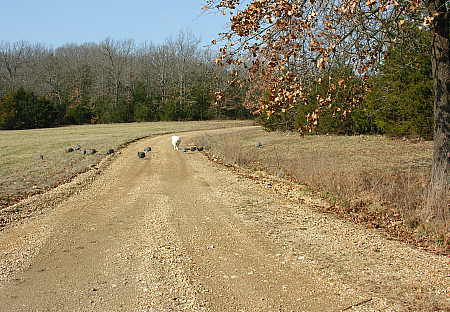
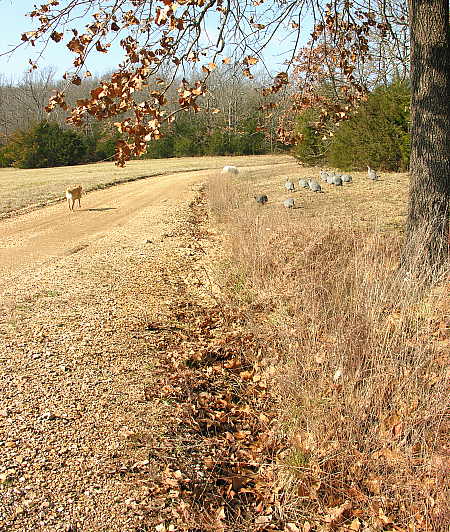
In this photograph you can see our Great Pyrenees Gracie herding several guineas back toward the safety of our barn area.  They are walking along a stretch of the two mile unpaved road which leads from the paved state highway to our home.   About 3/4 mile of this dirt road lies entirely within the boundaries of our property, and is our means of egress when it is necessary to interact in person with the outside world.

You can see from the photo that the road is in pretty decent shape, and you might conclude that Hal must keep himself busy with the tractor to keep the road in such good condition.  If this was your conclusion, then you would be wrong!  For some reason that predates our residence at this location, the county took this road into the county road system, and as a result, they are responsible for keeping the road in proper maintenance.

There really is no good reason for the county to keep this road in their inventory, as it serves no compelling public need.  We are the only residents that this road serves, yet we get the benefit of having the county absorb the maintenance expenses that inevitably arise.  And that is the good news about having a county road run into your property.  You don’t have to fund a road maintenance budget.  Having said that, I must admit that there is bad news, too.

THE BAD

There are some negative consequences that come about as a result of the county road running into the property.  First, we can’t install an entry gate at the point where the road comes into the property.  A county road must have access for all, so a gate is out of the question.  Because of the public access issue, you may need to be prepared for occasional “lookie-loos” to come driving into your land.  Second, the property owner who is served by a county road is at the mercy of the county when it comes to the quality of maintenance that is provided, and the responsiveness of the county government in handling issues that might arise with the road, as the following example illustrates.

Unpaved roads leading into ranch property

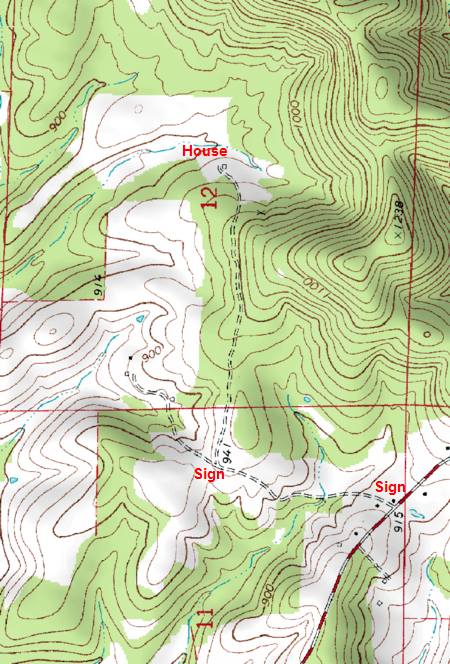
Notice on this topographic map that our house is located at the end of an unpaved road, as denoted near the top of the map.  Notice also that there are two street signs that designate the names of the county roads shown on the map, one of which is located at the intersection of the dirt road and the paved highway.  Without this sign, passersby would have no way of knowing that this is a county road, nor what the name of the road is.  In the event of an emergency, sheriff, fire department, and ambulance personnel dispatched to our house would be unable to locate our premises.

In January 2006, a careless driver managed to knock down the street sign while turning from the paved highway onto the dirt road.  Fearful of what would happen in an emergency, I temporarily duct taped the street sign onto my mailbox so that it would be visible to emergency vehicles, and proceeded to call the county road department to repair the sign.  To make a long story short, nine months later, after numerous phone calls and  correspondence with the County Judge, the county road department fixed the sign in September, 2006. 

On New Years Day, 2007,  a vandal saw fit to steal this very same street sign, thereby leaving us in a vulnerable state once again.  The county managed to replace the missing sign after only seven weeks this time, as opposed to 9 months last time, so I suppose things are improving!  But the point remains – a county road means you are stuck dealing with (sometimes) inept, or uncaring, or overburdened county officials to get anything accomplished.  Sometimes you can’t get anything accomplished at all, as the next example illustrates.

THE UGLY

Location of former drainage ditch

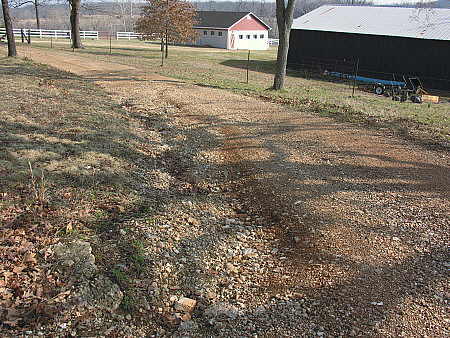
The photograph above shows what remains of a drainage ditch that used to exist along the northern edge of the road, as it descends a hill toward our buildings.  I say “used to exist” because, as you can plainly see, it isn’t there anymore!  The road crews in this county aren’t trained to do anything other than windrow the surface of the road off to each side when operating the road grader.  Any existing drainage ditches soon disappear under these circumstances, ours included.

Site of buried drainage culvert

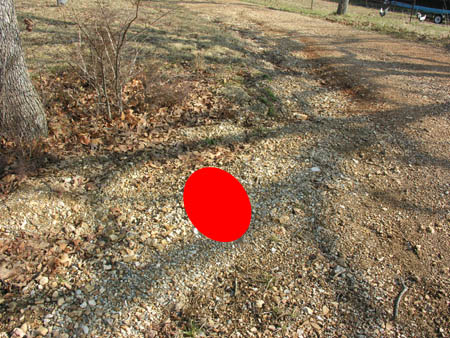
The red ellipse in this picture shows the location of a (now buried) inlet to a drainage culvert that is installed under the roadway at the bottom of the hill.  Because the culvert has been covered up by the road graders as they windrow the road surface, it can no longer serve it’s intended purpose – to carry the water flow underneath the roadway to a creek located at the base of the hill.

Water flow patterns

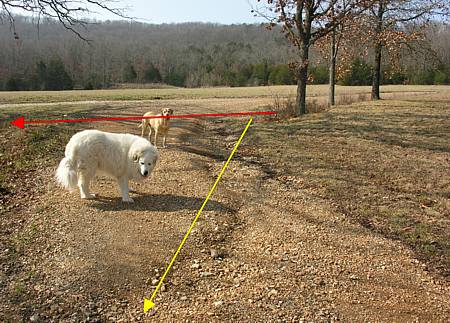
The red arrow indicates the location and one-time flow of the now useless drainage culvert buried beneath the roadbed.  The yellow arrow indicates (as does the erosion evident in the photo) the present water flow pattern, given that the drainage ditch and culvert are now non-operational.

Ultimate destination of flowing water

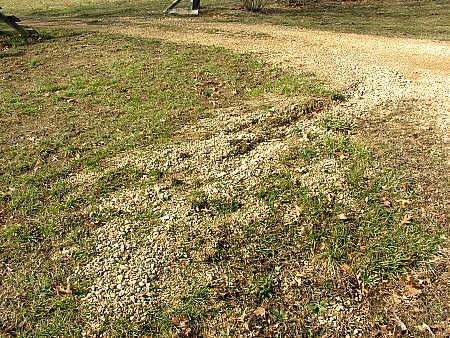
Unfortunately, the new flow pattern now channels the water directly into our barn and paddock area, as the photograph above shows.  Besides the erosion and resulting rough roadway that this situation creates, any repairs I attempt to make to the road are immediately washed away with the next rainfall, as you can see in the following photograph. 

Gravel deposited on lawn

The chances of an under-funded county government repairing the drainage system for this road and maintaining it properly in the future, given that it only serves one family, are slim-to-none.  There is no point in my re-establishing the drainage ditch and culvert system, since the county road crew will invariably fill it in once again.

So, as in all things in life, there are trade offs.  In this case, having a county maintained road means no monetary outlay on my part, the trade off being the substandard water flow maintenance that is provided by the county.  If the drainage problem continues to deteriorate, than perhaps I could petition the county to abandon their current road easement (a request they probably would be glad to grant), but then I would have to be prepared to absorb all future road maintenance costs myself.

Hmmm….. decisions, decisions, decisions.

Is Anyone Out There?

Fragile links to the outside world

You might understandably mistake our house for a S.E.T.I. affiliated site, based on the number of antennae mounted to the roof.  Unfortunately, when an old roof needs replacement the existing satellite dishes require remounting and realigning in order to work properly.  And thus we found ourselves suddenly disconnected from the outside world when our roofer called to say his crew would arrive the following day to begin our much needed re roofing project.  After the roof was completed, we patiently waited for the satellite technician to make a service call to put us back in touch with the world.  So here we are now,  snug as a bug in a rug with our new roof, and once again in communication with the denizens of cyberspace.

There hasn’t been very much interesting activity going on around here these past couple of months (at least nothing that I would blog about), mainly because I have used the winter as an excuse to vegetate around the house rather than perform any useful work.  Now that the temperatures are starting to rise I cannot use the weather as a slothful crutch, so expect some new postings about various projects and activities I am engaged in around the property.

For now though, I have to go and check out the source of smoke emanating from the north boundary of our ranch.  It looks, much to my dismay, as if coping with fire is going to be a permanent aspect of living out here in the country.

PS – Thanks for all the concern that some readers of this blog have expressed over my absence from the blogosphere – it is sincerely appreciated!

Omen of the Coming Winter in the Ozarks

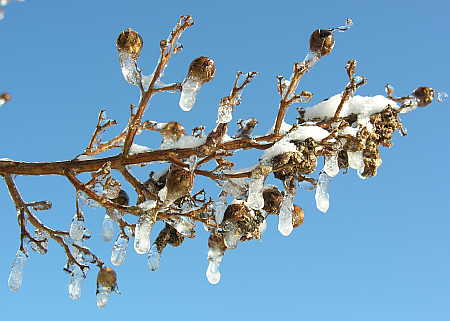
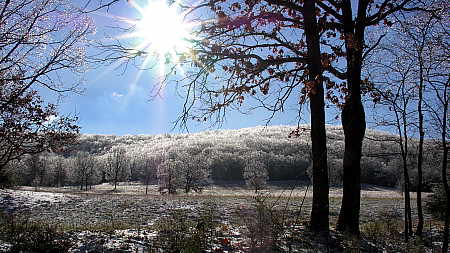
Icy beads form on the trees

The storm system that recently passed through this area dropped about 5 inches of rainfall before the cold Canadian air mass dropped down from the north, bringing with it sub-freezing temperatures and a paltry 1″ of snow.  However, the interplay of the moisture and temperature caused icy crystals and frozen water droplets to form on trees and grasses around the ranch.

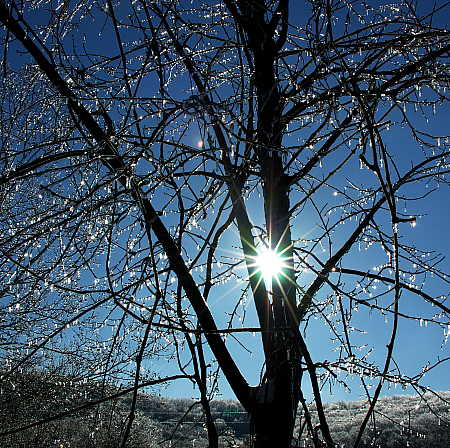
Sunshine and ice create sparkling glow

Sensing a golden photo opportunity was at hand, I grabbed the camera and headed outside to take a walk in the frigid morning hours.  For about a one hour duration, the sun and the ice conspired to bring a surreal, almost magical quality to the scenery surrounding me.

Ralph's pasture bathed in ice crystals

Heading along one of the main pathways on the property, I came to the area we call Ralph’s pasture (due to cousin Ralph’s fondness for this scenic locale), and hiked along it’s trails to shoot some pictures.

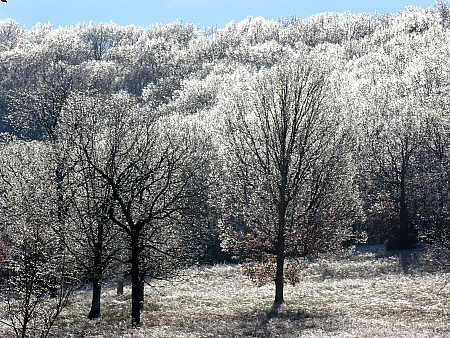
All the trees are shimmering

The trees were all covered with frozen water droplets, which shimmered in the sunlight.  The frozen water on the stems would crack and shatter in the soft breeze, creating a lovely high-pitched noise (not unlike a crystal wind chime) that only added to the allure of this magical morning.

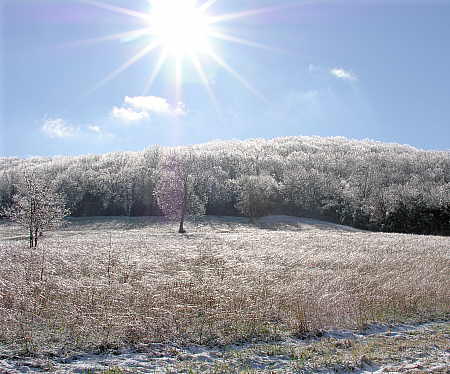
More icy tree limbs and grass glow in the sunshine

Even the fescue grass in this clearing, which I have left un-cut for the benefit of the wildlife this winter, harbored it’s share of icy beauty, shimmering and singing out it’s melody as it swayed in the gentle breeze.

The fall color change ended a month ago, but the picturesque beauty of the area remains, only this time it takes on a different appearance.

Purple Martin Housing Maintenance

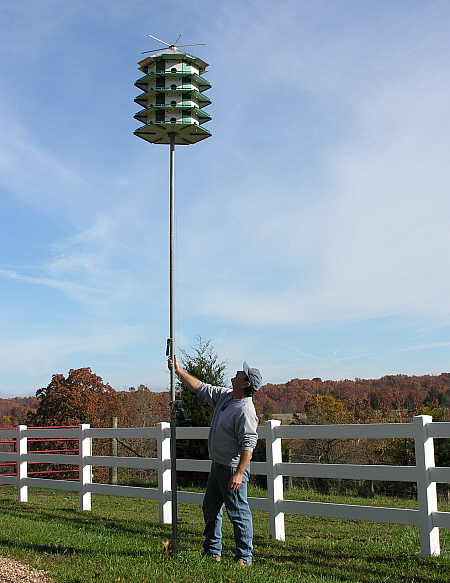
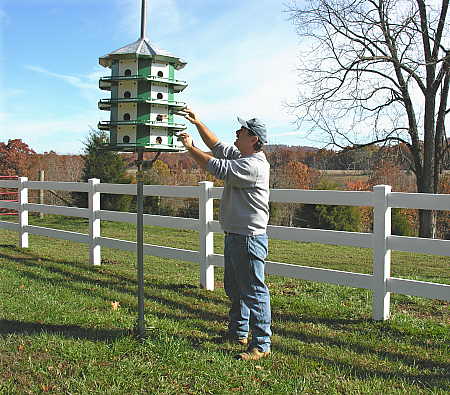
Martin condo at full height

You may recall from a previous post entitle Purple Martin Scouts Have Arrived that the spring season is the time when we open our martin condo for the in-migrating birds to take up residence.  Now that the martins have departed the area in favor of warmer climes, it is time for us to clean out the nesting cavities of the condo and seal them off until next spring.  But how do I reach the martin house, which is at the top of a very tall pole?  The sharp eyed among you may notice that the pole is equipped with a crank and pulley mechanism, which make it simple to lower the unit for periodic maintenance.

Martin house lowered for cleaning

Once the unit is in the lowered position, I proceed to clean out the nesting materials that the birds have placed inside the cavities.  Each cavity has a hinged opening, which facilitates cleaning.

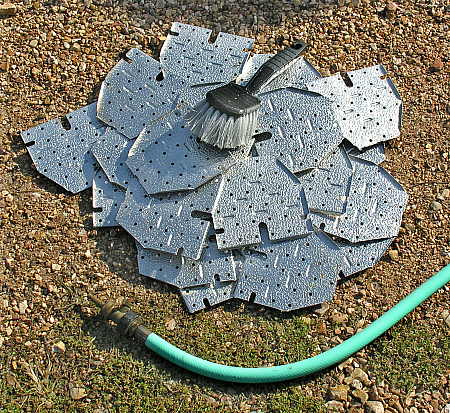
Aluminum floor plates

The martin condo that we have installed comes with removable aluminum floor plates.  The plates elevate the nest off of the condo floor, allowing for air circulation which helps to prevent molds and fungi from developing within the nesting materials.  As you may well imagine, the floor plates accumulate quite a bit of debris during the course of the season, so that it is imperative to scrub them clean before closing up the house for the winter.  A scrub brush and some high pressure water makes them look like new, as you can see from the photograph above.

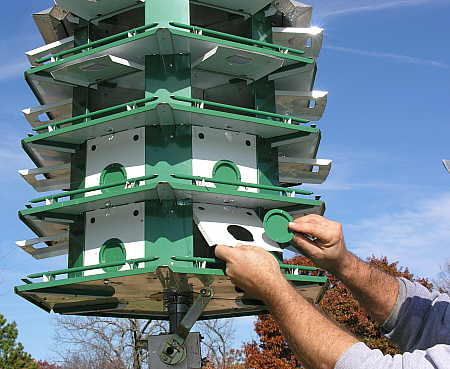
Plugging the condo openings

After making certain that the insides of the condo cavities are sparkling clean, the floor plates are replaced, and then it is time to affix the plugs into the cavity holes.  This will prevent nuisance birds from taking up residence in the condo, which is designated for “purple martins only” (read the lease documents, you darn sparrows and cowbirds).

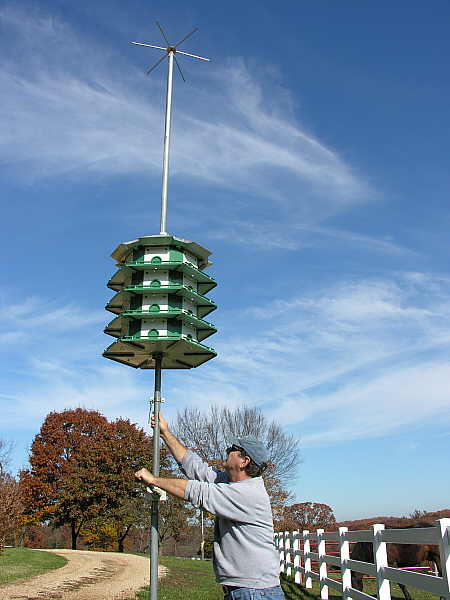
Cranking the martin condo back up the pole

Now it is an easy task to crank the martin house back to the top of the pole, where it will remain idle until the martins return to the area next spring.

This season we experienced mixed results with this particular martin house.  I installed this condo on the site of a previously successful, but smaller martin house (this condo has 24 cavities, the previous house had 12).  I relocated the smaller martin house in another location, about 300-400 feet away from this spot, and it has attracted martins this season.  This spring saw a few cavities with martin activity in the new unit, but far fewer than we had hoped for.  There may be two possible reasons for this.  First, notice the fence in the background of these photographs.  This section of fencing was under construction at the very time that the martins would have been establishing their nests this past spring.  The close proximity of the condo to the construction activity may have deterred the martins from nesting in the condo unit.  Second, we now have three cats in residence, and while they do not seem to have intimidated any of the other birds that frequent our yard, they just might make the martins a tad nervous.

Although this martin condo was not filled to capacity this spring and summer, do not think that we did not see purple martins.  To the contrary, martins were a regular sight to behold this past summer.  The natural habitat of purple martins are dead trees, and because we have an abundance of dead trees around our acreage (see post entitled Seeing Things In a New Light), many martins continue to call this spot their summer home, despite the fact that they did not utilize the condo to the extent we would have liked.  We shall be persistent, and I believe the purple martins will eventually book this condo to capacity each and every spring – at least, that is our hope.


Off topic aside:  This is the time of year that I am very busy with tractor work, getting my fields, clearings, and pastures in order.  And don’t forget the billions of leaves that fall off the trees, some of which must be picked up by this stickler for a neat lawn.  Because of these, and other projects that I have been undertaking, I have found less time to devote to writing blog posts than I would like.  Soon, I will be caught up with my work, and my posting (for better or worse) will be more frequent.  Thanks for continuing to check in regularly, I really do appreciate it.


Was This the Peak?

The colors are probably at their peak in this photo

I took this photograph of the woods behind the house last Wednesday, November 1.  If I were to have parked myself at this location continuously for several days in a row, shooting as many photographs as I possible could, using as many different exposure techniques as I could conjure up, I would end up with a vast collection of images.

I suppose that collectively, you and I could sit down with the images, and reach some kind of conclusion as to which photograph best represented the peak of the seasonal color changes that occur in Autumn here in the Ozarks.  We could then look at the EXIF header embedded in the digital image file to see when the photograph was taken, and thus determine with precision the exact date and time of the color peak.  Or is it so easy?

Look at just a few of the variables that can affect the outcome of an Autumn photograph, and with it, the judgements that are made with reliance upon our photographic evidence.  The weather conditions, along with the time of day greatly affect the natural lighting that we rely on to capture landscape photographs.  The film used in the photograph, such as Fuji Velvia 50 or Kodak Kodachrome 100 (or in the case of digital images, the ISO setting and white balance controls of the camera), have a direct affect on the color saturation within the image.  The concept of “reciprocity” shows that the combination of f-stop and shutter speeds also play a role in determining the colors that appear in an image.

With these, and many other variables to play with, who is to say that any given photograph represents the peak of fall colors?  Perhaps a photograph taken prior to the color peak, but with excellent weather and technique, looks visually superior to a later photograph taken under poor lighting conditions, or with inferior technique.  Does that mean that the color peak actually occurred at the time of the superior photograph?  No, it doesn’t, and for that reason, we can never really be exactly sure of the exact moment that the Autumn colors have peaked.

Having said all that, I think the colors peaked here last Wednesday, as shown in the photograph above.  The photo below was taken one day earlier, on Tuesday, October 31 (and no, for any who may be interested, we did not get any Trick ‘r Treaters).

 Photo from a day before the local peak of color

Since these photographs were taken, we have had a couple of sub-freezing nights, and some rainy, overcast skies.  Definitely not the conditions that are favorable for continued color development of the leaves.  The red, purple and yellow leaves are quickly turning to shades of brown and rust, or are simply committing “‘leaficide” and leaping from the limbs to their ultimate demise upon the ground below (it is a horrible sight indeed, to see their flattened bodies on the ground, shriveling up and drying out right before your very eyes)….

Better To Be Safe Than Sorry

Last month, in a post entitled There’s Gold In Them Thar Hills, I pointed out that lead ore mining had occurred to some extent on this property in the past.  The ever-observant Florida Cracker over at Pure Florida asked in a comment whether we tested our well water for the presence of lead.  We do test our water for lead, as well as other possible contaminants, using the WaterSafe home drinking water test kit.

WaterSafe drinking water test kit

This home testing kit is easy to use and tests for the presence of the most common contaminants found in drinking water.  The directions for use are complete and easy to understand, and all of the tests (except for E.coli) provide results within minutes.  The E.coli bacteria test is a simple test, but it requires 48 hours to produce results.

The test kit is available for purchase on-line from the manufacturer, Silver Lake Research, at the following website:

                        WaterSafe Home Testing Kits

Each test kit costs $16.99, with a nominal shipping charge added to the price at checkout.  I bought two kits on my last order, and the shipping and handling totaled $4.00.

For less than $20.00 you can buy yourself quite a bit of peace of mind, which is an excellent deal in my book.  And if your well water does not pass the tests, wouldn’t you rather know what the problems may be, rather than bury your head in the sand?