Is That You I’m Seeing Over There?

When people talk of the Ozarks, oft times you will hear them referring to the landscape of the area as “hills and hollers.”  If you visit a local real estate brokerage and mention that you are looking for some acreage to buy, odds are that the agent will ask if you are looking for a hill, or if you prefer a holler.  We are very fortunate to have both a hill and a holler on our land.  About half of this property consists of a kidney bean shaped valley (holler), which is where our house and outbuildings, hay fields, some woods, many pastures, and most of our water sources exist.  Most all of the photographs that you may have seen on this website have been taken somewhere or another within our holler.

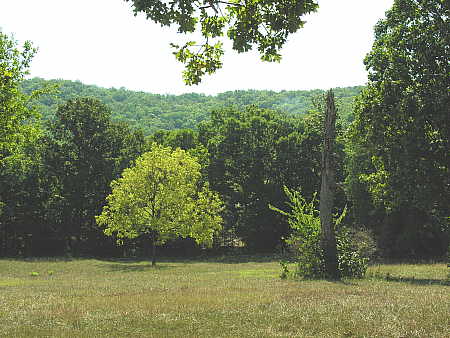
Today, I plan to introduce you to our hill.  For lack of a better name, we refer to this hill as the “mountain”, although that term is probably a little pretentious, as the maximum elevation of our mountain (hill, really) is only 1238′ above sea level.  There are currently no structures of any kind on the mountain, except for two gates at the base of the fire lanes that lead up the hill.  The gates (one of which is pictured below) are there to deter any intruders who might seek to disturb the peace and tranquility of the mountain in any way.
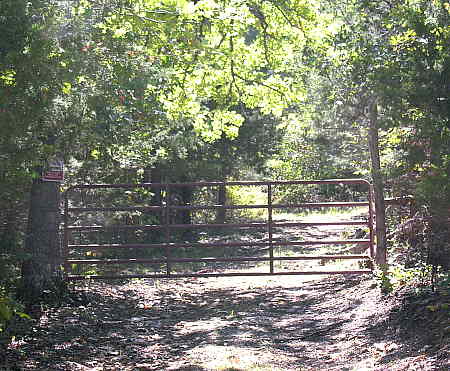
Fire lane gate

Approximately half-way up the mountain there exists a large, crescent-shaped pasture area of about 20 acres.  Additionally, the remains of an old lead-ore mining extraction operation can be found (which will be the subject of a future post).  There are a few seasonal streams to be found on the mountain, as well as two wildlife ponds (one of which is dry).

The primary value of the mountain to us is twofold.  First, it provides us with a buffer zone and sound shield against the vehicle noise that is generated along the paved road that lies about two miles from our ranch.  And second, it provides us with a wonderful location where we can relax and enjoy a grand view of the surrounding countryside.

Click here to view a large panoramic photograph of the view from atop the mountain.   (This is a 800kb file – it might take a minute to load – be sure to view it full-sized in your browser window.  It should fill the entire height of the window.)

If you take the time to load the panorama view from the mountain top, you will see that the view is too lovely to waste, so Retta and I have decided to build some type of recreational structure up at the apex of the peak.  We have not settled upon any particular plans as of yet, but we are leaning towards a large covered deck, perhaps with an outdoor fireplace and built-in stone BBQ.

Anybody out there with any other ideas?

Landscaping, My Way – Installment 2

This is the second in a small series of posts in which I share my “landscaping secrets”. I have put the term landscaping in quotes because I don’t do landscaping. Landscaping involves much work, some knowledge about plant life, physical labor, a planning ability, exertion of effort, and patience. Oh, did I mention the amount of work involved?  I included the word secrets in the quotation marks because if this stuff were secret, I certainly wouldn’t post it on the Internet.
Installment 1 of the series dealt with the Dwarf Sumac that I have allowed to establish itself in selected locations among my fields.  This post is about a grove of Silver Poplars that we have growing along a creek bed in the northern portion of our property, which we call The Terraces.

Grey Poplars viewed from above

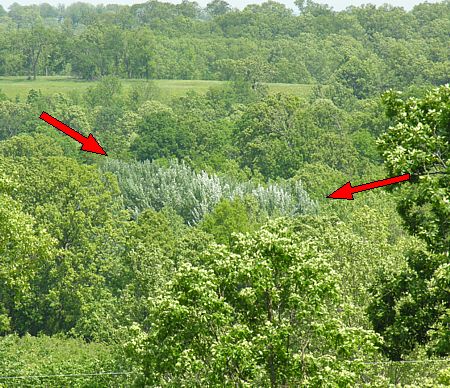
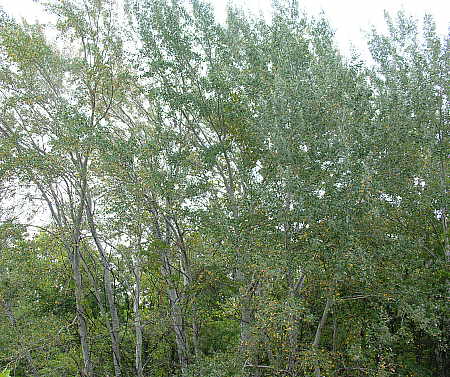
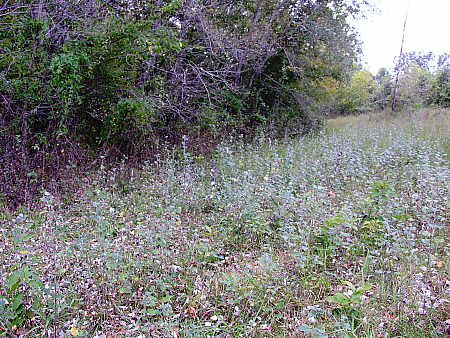
As you drive along the unpaved road on our property that leads to the house and barn areas, you can see over the treetops of some of our woods, as shown in the picture above.  Notice that where the red arrows are pointing there appear to be trees with leaves that are lighter in color than the surrounding trees.  What you are seeing is a grove of Silver Poplars that inhabit a small section of bottom land along an intermittent creek.  When the District Forester from the Arkansas Department of Forestry visited the ranch to consult with us on various conservation and renovation projects we had in mind, he was surprised to find a large grove of these trees on the property.  The forester could not recall ever seeing poplars growing naturally in the forests of the area that he had responsibility over, and so he surmised that this large grove of Silver Poplars had been planted long ago by a homesteader who must have resided here in days past.  A closer look at the poplar grove can be seen in the following photograph-

Grey Poplar grove

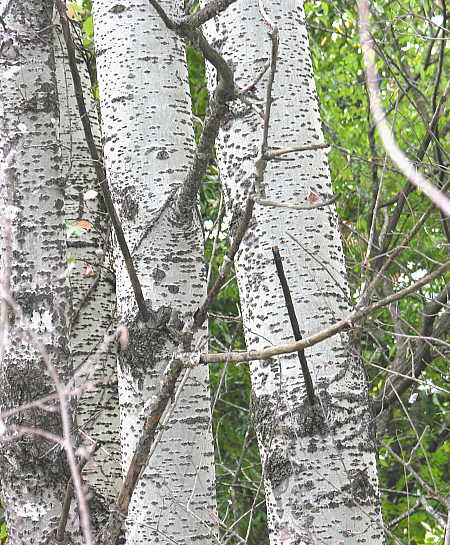
The Silver Poplar is a beautiful tree with a white bark trunk and small, roundish leaves.  The name “silver” reflects the color of the underside of some leaves, as well as the bole of the tree. The Silver Poplar is also called a White Poplar.  It is closely related to the Quaking Aspen.  The influence of the Aspen on the Silver Poplar is evident by the shimmering, quaking look of the leaves as they flutter in the breeze.

Beautiful white textured bark of the Silver Poplar

The picture above shows the beautiful texture of the white bark on the trunk of the Silver Poplar.  The distinctive coloration and texture of the bark, as well as the quaking of the leaves, help to make the Silver Poplar easy for non-botanists like myself to identify.

Grey Poplar grove

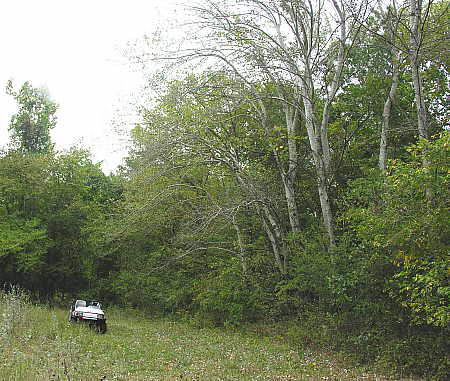
In the photograph above, the utility vehicle gives some indication of the size of these stately trees, which reach 100 feet tall at maturity.  The tree will propagate through the scattering of seed, as well as by suckers that emanate from the root system of the tree.  The following photograph shows 6 month old suckers that have sprung up from the ground near the poplar grove-

Suckers pushing up out of the ground

By now you may be asking yourself what part I have played in this post entitled Landscaping, My Way.  When we purchased this property, the portion of the property that the Silver Poplars inhabited was primarily cleared, bush-hogged, cattle grazing land.  Because a good portion of this 40 acres consists of fairly steep slopes, we decided to rethink the bush-hogging plans for this area.  Since I am not trying to squeeze every last bit of grazing space out of our acreage, there is no point to my bush-hogging steep, dangerous slopes, as my predecessors had.  Instead, I decided to cut only those areas around the Silver Poplars that was somewhat level, thereby creating an area that we now call the Terraces.  There are about forty acres in this area that now consist of numerous flat, near level bush-hogged meadows, surrounded by newly growing woods. 

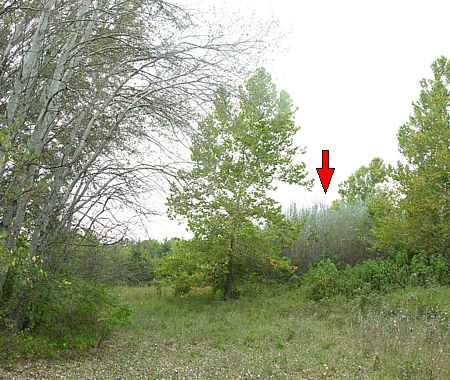
In order to keep the Silver Poplars from taking over the area, I have been bush-hogging the suckers that emanate from the Poplars twice a year.  But there are some area where I have wanted the Poplars to spread, so that when I encountered poplar suckers in those areas, I refrained from cutting them.  The result of this strategy can be seen in the following photo, where the red arrow points to some of the young Silver Poplars that I have allowed to grow unmolested (notice the mature, parent poplars on the left).   This is but a small sample of the Silver Poplars that I have allowed to grow along the terraces.

Spreading Silver Poplar grove

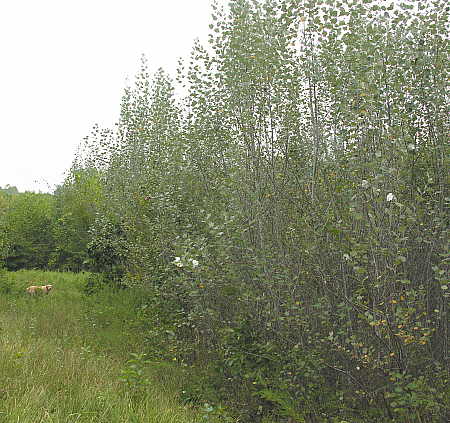
The Silver Poplar is a quick growing tree, which has made it an ideal candidate for this reforestation project.  I did not realize just how quickly they would grow, but the following photograph shows the size of the young poplars after just four years-

Four-year old Silver Poplars

For a good indication of the size of these four-year old Silver Poplars, compare their height to that of George, our full-grown Lab, as he waits for me in the middle of the trail.  The growth rate of the Silver Poplar is quite impressive, and will apparently allow us to enjoy these new additions to our woods in a relatively short time.

A Bad Location For A Trail?

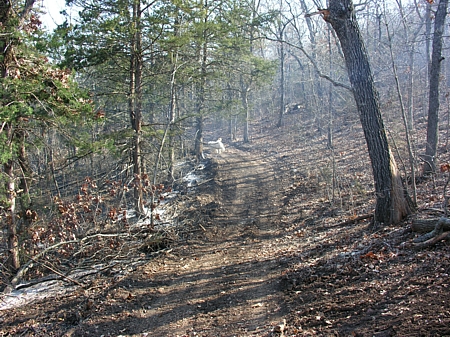
If you have been following this blog you might recall the following photograph from a previous post entitled Another Day In The Ozarks…Not!, which chronicled one of the many wildfires we have experienced on our property.  As I was frantically searching for the source of smoke emanating from somewhere on our land, I was impeded in my progress along one of our fire trails by a tree which had fallen as a result of a lightning strike.

Lightning destroyed this tree

Not long after that incident, but before I had a chance to muster up the chain saw to cut up and remove the fallen tree seen above, we were unfortunate enough to experience yet another fire on our property.  The photograph that follows may also look familiar to you, as it is from a previous post entitled To Quote Yogi Berra “It Feels Like Deja Vu All Over Again”, in which I recounted another in our series of fires.  This second photograph was taken after the second fire burned through the area where the fallen tree had lain, and you can see that the fire succeeded in burning up any trace of the tree.

Downed tree is now gone

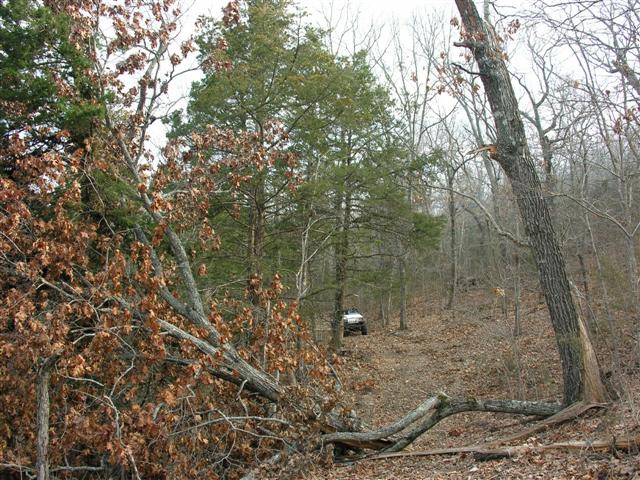
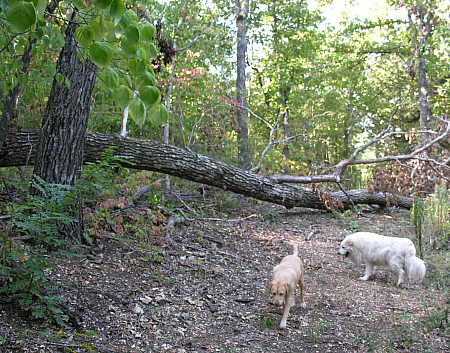
Today Retta and I took our dogs walking, and we decided to stroll along the same trail that is shown in the pictures above.  When we arrived at the location where the former tree had previously fallen, and than been consumed by flames, we were greeted by the sight of another, larger tree blocking our fire lane.  The following photograph shows this second fallen tree, which you will notice is located right next to the remains of the lightning-struck tree trunk from the earlier incident (which is on the left in this photo, as we approached the tree from the opposite direction as in the first two photos).

Another tree bites the dust

My first thought when I saw the downed tree was to wonder if lightning caused the destruction.  Could lightning really strike the same place twice?  It would be quite a coincidence if two adjacent trees were downed by lightning in the span of 7 months.  The second thought to enter my mind was, darn, that’s going to be a big job cutting up and removing that tree from our fire lane.

A good chain saw project

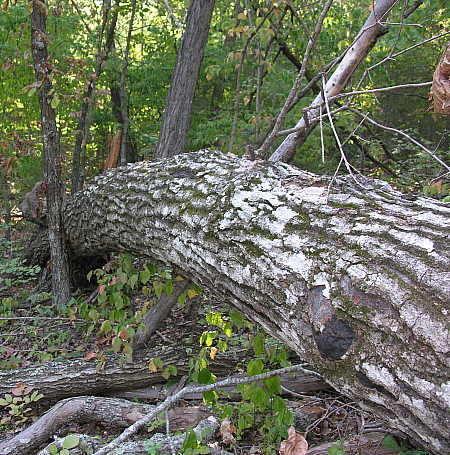
The trunk is probably over 24″ in diameter at the point where it crosses over the fire lane.  While I am not inexperienced in the use of a chain saw (I usually have the local farm store sharpen about 30 chains for me each season), I am no Paul Bunyan either.  I thought that this particular tree might be too large a job to tackle by myself, so maybe I would recruit (or hire) someone more experienced than myself to undertake this job.

As I scrambled up the slope to get a closer view of the tree, the cause of it’s demise became apparent.

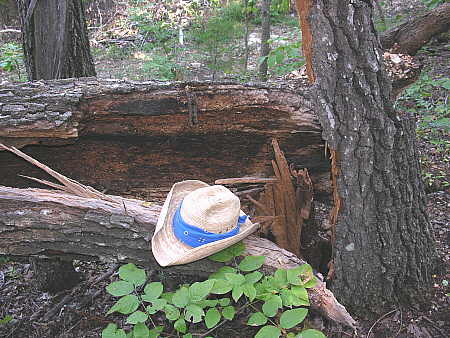
Hollow tree trunk

From the opposite side of the tree you can see that this tree was hollow.  Not dead, as there were fully leafed branches, but severely weakened by the structure of it’s hollow trunk.  It was probably knocked over recently by gusty wind conditions that often accompany the frequent thunderstorms that spawn in the Ozarks.  So now I am not certain if I will hire someone or not.  If I can determine that the trunk is hollow at the points that I would have to cut it for removal, than I will go ahead and do it myself, otherwise, I’ll start looking for help.

Mineral Lickin’ Good

Feeder Number 2

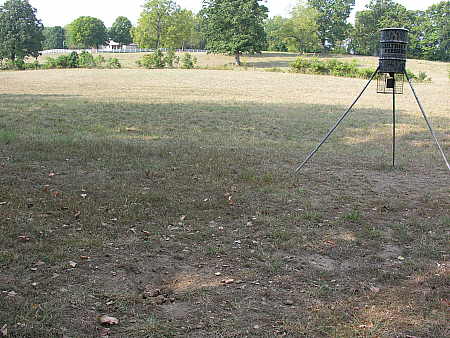
The picture above shows one of the two wildlife feeding stations we have set up along a creek in a field below our house.  We have created these sites so that the abundant game that inhabit the area will be attracted to areas where we can see them as we go about our daily routines.  The other feeding station, for anyone interested, can be seen in a previous post entitled Birds Of A Feather.  You may notice that in the lower left corner of the photo there appears to be a patch of ground that is rock strewn and has been vigorously disturbed in some manner.  This is one of the mineral licks that I have established near our feeders. 

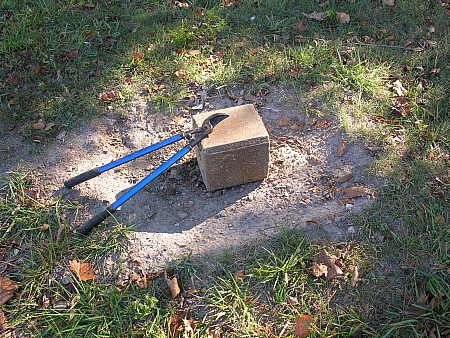
Year old mineral lick

Creating a mineral lick is a simple endeavor.  What I like to do after I find a suitable location for the lick is to gather up some downed limbs and build a small bonfire, which clears the area down to bare soil.  Then I place a commercially prepared dear and wild game mineral block directly on the soil.  Over time, the block will become eroded.  Some erosion will have occurred by direct consumption from the area wildlife, but a good portion of the block will simply weather into the ground where it sits.  Not to worry – the deer will actually lick the soil in order to get the minerals they crave.

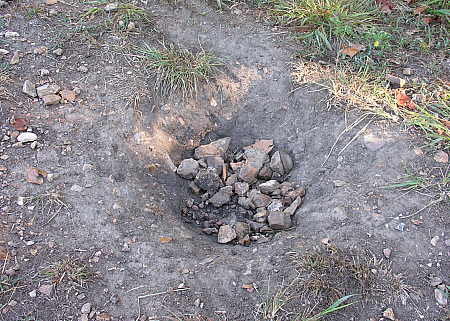
Four year old mineral lick

This is what will happen over time.  This particular mineral lick was established four years ago.  I have decided against filling in the hole each year.  Instead, I intend to keep replenishing this site with new mineral block periodically, and observe how large the mineral rich “crater” will grow (it sure beats sitting around watching the grass grow).    The deer have pawed at the ground with their hooves in order to loosen the mineral rich soils, leaving only the Ozarks rocks behind in their wake. 

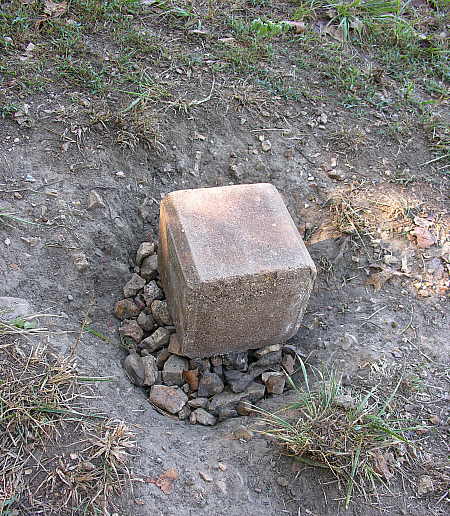
Replenishing the minerals

The picture above shows how simple it is to replenish the lick.  All that is required is to unwrap and toss a new mineral block on top of the pile of rocks that have accumulated in the pit. 

The mineral blocks contain a variety of essential minerals for deer.  Here are some of the ingredients in the blocks I use – salt, magnesium limestone, calcium carbonate, soft rock phosphate (phosphorus), calcium iodate, cobalt carbonate, sodium selenite, ferrous carbonate, ferrous sulfate, iron oxide, manganous oxide, copper sulfate, zinc oxide and lignin sulfonate.

If that weren’t enough to whet the appetite of wild game, the blocks also contain cane molasses and natural apple flavoring.  But the real question is this: do these mineral licks do anything for the deer, or am I just spinning my wheels in undertaking this activity?  Research seems to indicate that robust antler growth requires a minimum amount of certain minerals, particularly calcium and phosphorus, in the proper ratios (see Mineral Supplementation – Necessity or Never Mind?, by Brad Howard and Brian Murphy).  The commercial mineral blocks that are available in any farm supply or feed store are concocted of minerals designed to maximize the potential for antler growth in bucks by supplying the key minerals required for that purpose.  In many areas, the soil composition presents sufficient mineral content such that mineral supplements are unnecessary, while in other areas, the soil is lacking in some critical component.  To be on the safe side, I have opted to provide supplements for “my” game, just as I also opt to take a multi-vitimin for myself each day.

The fall and winter seasons are the time of year to begin to establish a mineral lick.  By establishing the lick at this time, it will be ready and available for use in the spring and summer, when the deer will make the most use of it.  And Retta and I will be sitting around, watching the deer take their daily dose of minerals.

In Memorium

September 11, 2001

On the morning of September 11, 2001, an anonymous amateur photographer began posting on the Internet photographs he was taking of the horror that was unfolding before his eyes.  This photographer released the photos into the public domain, believing that the benefit to the public outweighed his exclusive rights to his creations.  The photo above is just one of the many he/she posted at the time.

There are many thoughts and emotions that run through my mind as I contemplate the events of 9/11/2001, and the subsequent actions that these events have led us to, but there is one in particular that I will comment about on this rural-oriented blog.  And the thought that comes to mind is the profound difference in the fear mindset that must be occurring between residents of highly populated metropolitan areas, such as the photographer above, who obviously lives in the New York area, and residents in sparsely populated areas, such as myself.

The anonymous photographer above witnessed the initial moments of the World Trade Center catastrophe from the window of his residence.  Grabbing his camera, he began taking pictures of what he was seeing.  He felt compelled to leave the safety of his home, and with camera in hand, began a photographic journey into the heart of lower Manhattan Island.  As I contemplate this, I cannot help but wonder if this person re-lives all of those awful, gut-wrenching pangs he must have felt on that day, each and every time he looks out the window, every time he walks down those streets, and every time he commutes into the city from his home.

I would imagine that people such as this photographer, who live in densely populated areas, encountering locations and situations where the threat of terrorist events are very real, must have a constant awareness (even if only in the back of their minds) that they are in a potentially risky environment.  Particularly when the public is bombarded by the near constant reminders that terrorism exists, and surrounded by some politicians who would exploit that fact to their own political ends, it seems that a person who lives in a “likely” terrorist attack setting might tend to become fixated on the potential threats around them.  At the extreme, they may become immobilized by the fear of becoming a victim in a future attack.

Living in a sparsely populated rural area does not seem to invoke the same type of fears that might flourish in an urban environment.  Terrorism relies on mass, random killing to promote the fear it seeks to create.  And by definition, a sparse population generally presents little opportunity for the “mass” portion of the definition to emerge.  What likely target exists in a hamlet where the sign at the edge of town reads “Population – 735?”  None, I would surmise.  Therefore, those who live in these areas, who travel the back roads and conduct their business in one-horse towns have little to remind them of terrorist activities on a day-to-day basis.

I suspect few, if any, rural people are paralyzed in their fear of terrorist attacks, while many urban dwellers might be.  Perhaps urbanites should consider the possibility of frequent “therapeutic” visits to bucolic rural areas, in order to relieve the pent-up stress caused by the constant reminders of their vulnerability.  And perhaps rural folk might consider an occasional foray into the “belly of the beast,” so as not to forget that there is still a very real threat to many people out there.

The County Transfer Station

“I understand that it is illegal to burn household wastes these days.  What do we do with our trash?”,  I asked the realtor who was showing us the property.  “Well,” he replied, “most folk out here just burn it anyways, those who don’t call M…n Sanitation, who will pick it up at the paved highway weekly.”

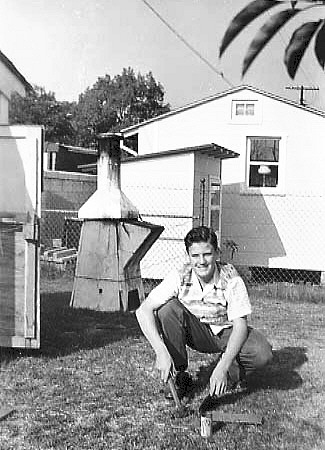
I thought back to the earliest days of my youth, and I remembered an appliance that was a common sight in suburban neighborhoods at the time, called a backyard incinerator.  You can see an incinerator behind my cousin, Reed, in the photograph below. 

Backyard incinerator

Backyard incinerators were banned in urban areas long ago, due to air-pollution concerns.  Today, residential incinerators and their rural counterparts, the burn-barrel, are prohibited from burning household waste materials in all areas.  So, regardless of what others may do, I dismissed the possibility of burning my trash.  Besides, who wants to breathe in all those toxins anyway?

Another method of trash disposal that I have seen employed on rural acreages is a self-built landfill.  Using a backhoe, a large notch is carved out of the side of a hill.  A layer of trash is piled into the notch, then a layer of soil, another layer of trash and so forth until the notch is filled, at which time another would be dug.  Besides being illegal, under many authorities and for many reasons, I would not want to be the one relying on my well for pure, drinkable water with a home-made landfill on the premises. 

Needless to say, we opted to call M…n Sanitation, and for $18/month they put me on their weekly trash route.  We were allowed up to 4 bags of trash per week, which had to be placed at the junction of the paved highway and the dirt road leading into our property. 

Trash pickup site

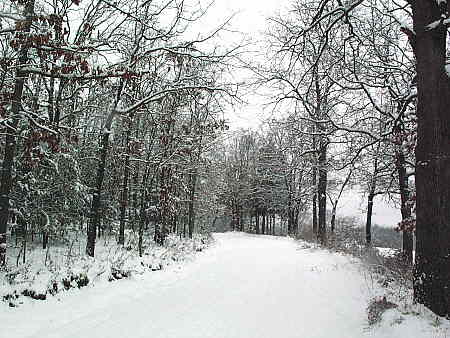
On each side of the dirt road, where it meets the highway, are houses with small yards.  There is no reasonable place for me to place a permanent trash collection bin, so I had to leave my trash at the highway in plastic trash bags.  Each Tuesday morning, prior to 7:30AM, I hauled my trash over the two miles of dirt road to the highway, even when the dirt was covered with snow in the wintertime, as shown below-

Access road in winter

I followed this routine for about 2-3 years until, much to my dismay, a neighbor’s dogs discovered that there was a nice supply of trash about a quarter mile down the road from them, and if they waited until about 7:35AM, they would be in for a treat of one sort or another. After a few weeks of my having to pick up trash strewn up and down the highway after the dogs got into it, I decided to sit guard, in my truck, until the sanitation truck came to pick up the bags.  This routine grew old after the first two or three times that the trash truck ran late, forcing me to sit, like an idiot, in my truck guarding my trash!  Enough of this nonsense – I needed to find a better way.

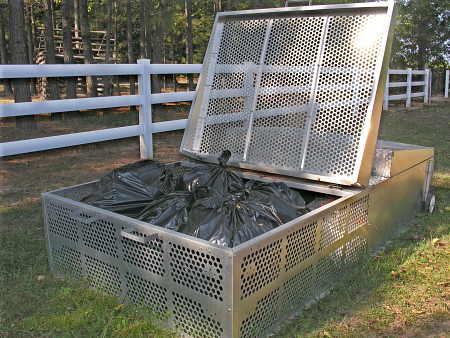
You might remember from a previous post, entitled A Tractor For Chickens?, that I was using a metal chicken tractor for storing trash.  You can see it in use in the following photograph-

Trash bin

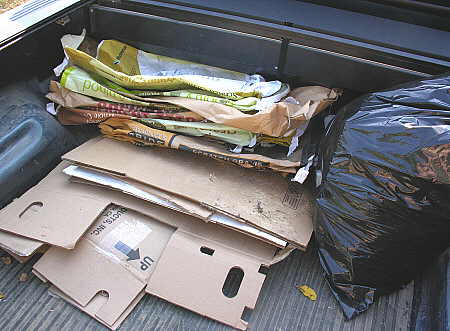
It just happened to work out that when the chicken tractor gets full, it creates a perfectly sized load for the bed of my pickup truck.  Beginning with the lightweight recyclables, such as the cardboard and feed bags shown below, I load the truck in layers, with the heaviest items on top.

Recyclables loaded first

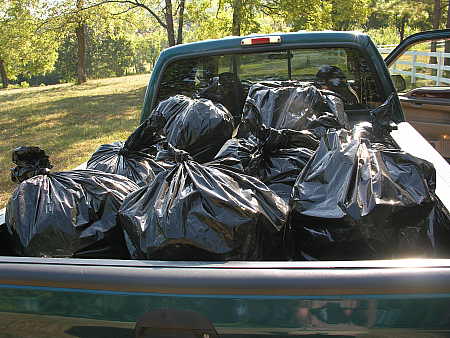
When all of the bags have been loaded into the truck, it forms a tight load, and because of the weight, nothing blows away.  When the loading is finished, the truck looks like this-

Loaded trash truck

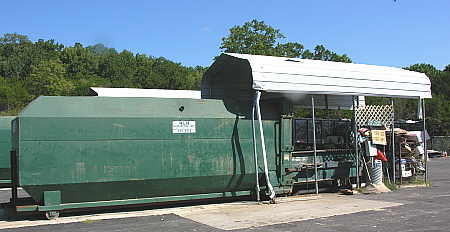
With the truck now loaded with the trash and recyclables accumulated over a couple of months, it is a simple matter to drive the 30 miles to the County Transfer Station, where the trash is deposited into the massive, industrial-sized compactor you see below.

Industrial trash compactor

The Transfer Station also acts as the county recycling center, where selected items are collected for recycling.  Additionally, every spring and every fall, the Transfer Station hosts a countywide cleanup for the benefit of our area.  For the duration of one week, residents are allowed to drop off one truckload per day of trash, construction materials, and other landfill-permitted items, and old appliances.

There is no provision at the Transfer Station for the recycling of electronic equipment, which is very harmful to the environment if disposed of in a landfill.  But all is not lost, as there is a wonderful, FREE program for the recycling of electronics available to residents of Arkansas and other states, that can be found in a previous post entitled Project Green-Fed E-Cycling, in which they send you shipping boxes and materials that you fill with old electronics, and call for a free Fed-Ex pickup from your home.

On our next outing, I might take you with me to Tom-Barr Industries, where I periodically drop off a truck-load of scrap metals and old barbed-wire for recycling.  Remember to bring your gloves, if you want to help me.


Flashback Friday #14: Why You Don’t Catch Me Fishing Too Often

Top ten reasons you seldom find me fishing anymore-

10)  No matter how many times I’ve done it, the task of baiting the hook never gets any more pleasant for me.  Sometimes it’s the critter that is being used for bait that I find distasteful, such as worms.  Now, I’m the first to admit that earthworms are our friends.  I recognize the valuable services that they provide in bringing good things to life.  But I will never get used to the sensation of impaling the helpless creatures with the barb of my hook, while I hold their wriggly, slimy bodies in the proper position so as not to pierce my finger as well.  Sometimes it’s the cruelty of the concept that I find distasteful to my sensibilities.  As in deep-sea fishing, where a hook is carefully inserted into the live bait-fish body, via the gills, in order to allow the live bait-fish the opportunity to swim around, tethered like a puppy, enticing the legions of game fish the angler is targeting.

9)  Removing the hook from a successful catch is another unpleasantness that I prefer to avoid.  Holding on to a thrashing, scaly fish, perhaps armed with sharp barbels or spines, and undoubtedly with razor-sharp teeth, while trying to dislodge a barbed hook from the gullet of the mullet is not my idea of fun anymore.

8)  Still, the task of baiting the hook never gets any more pleasant for me. 

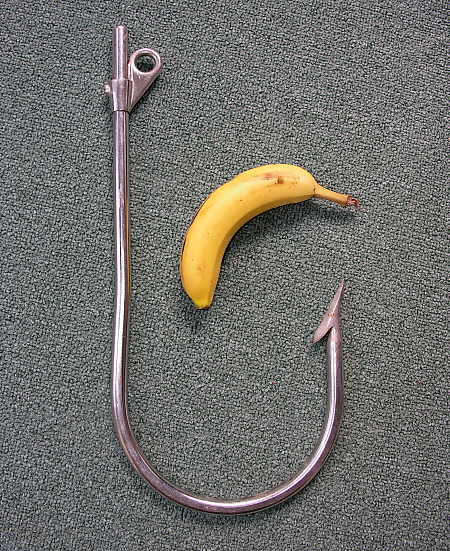
7)  The equipment just keeps getting more and more elaborate and expensive.  Trying to keep up with the latest fishing techniques is challenging enough, but look at the new tackle and bait that I just bought.  I was assured that this was the latest, greatest setup for catching “tropical” fish.  Hooks this size don’t come cheap!

Rig for

6)  Still, the task of baiting the hook never gets any more pleasant for me. 

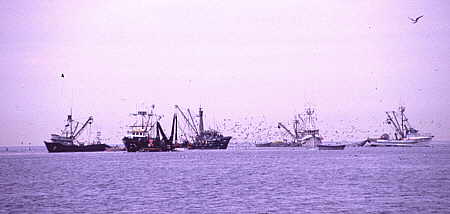
5)  There are already enough fishermen in the world, without my adding one more person to the fray.  Not only are there plenty of fishermen in existence, but they are incredibly efficient in bringing in the catch,  all too often to the point that serial depletion of species is the norm for the fishing industry.  When Retta and I lived on a trawler cruising the Channel Islands, it was very disheartening to frequently witness the following carnage that takes place in our oceans on a regular basis.

The fishermen and their incredible fishing machines

4)  Still unchanged, the task of baiting the hook never gets any more pleasant for me. 

3)  Catch and release, the politically correct fishing method de jour, strikes me as a cruel sport.  I’ve been told by fishermen, sometimes repeatedly, that the act of setting a hook deep into the mouth of a fish does not cause a fish to feel pain.  Nor does the act of removing the hook from the innards of the fish cause distress in the fish.  Having never been a fish, I can offer no first-hand knowledge of the pain/distress capabilities of fish, but if they don’t experience distress from these acts, I certainly do!

2)  Catching fish for personal consumption offers up the daunting task of cleaning the fish.  Some people have no problem eviscerating and cleaning a fish.  I suppose I might be more “squeamish” than most, but I confess to finding the entire fish cleaning process disgusting.  Which is why I am willing to pay others (seafood restaurants and fish markets, for example) to do this bit of dirty work for me.

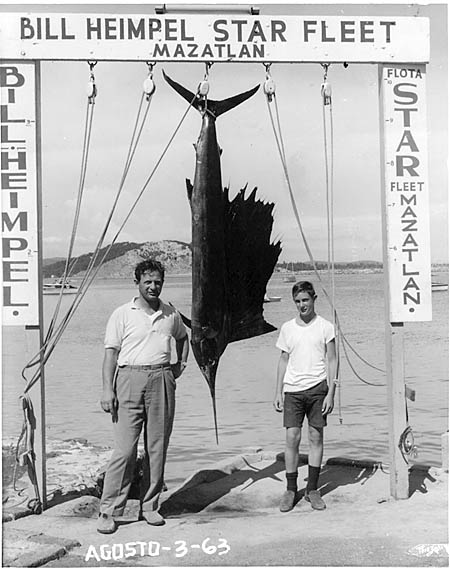
1)  The number one reason you won’t find me hanging around the tackle box much anymore is more psychological than anything else.  When I was a young lad of 11 1/2 years (1/2 years were VERY important to my as an eleven year old), Dad took my on a deep-sea fishing trip while we were on summer vacation in Mazatlan, Mexico.  Many miles offshore, while I was taking a turn strapped into the fighting chair at the stern of the chartered sport fishing boat,  the live-bait on my line was struck by a sailfish.  Immediately, a crew member ran over to help me set the hook.  After about 15 exhausting minutes of fighting this sailfish (with the help of the experienced crew), I turned the rig over to my Dad, who spent the next half-hour or so strapped into the chair as he reeled in the giant fish.  As a naive 11 1/2-year old, I was horrified when the fish was brought alongside the boat, where a crewman proceeded to bash the sailfish’s head repeatedly with a baseball bat, until the fish succumbed to the brutal treatment.  But, despite witnessing this treatment of the sailfish, I was always proud of my little role in the catching of a sailfish, which my Dad had beautifully mounted to adorn the family room wall in our home as I grew up.

Successful catch of a sailfish

But I guess the real reason I don’t fish much anymore is that, once you have caught a fish such as this, anything else might be a little anti-climatic ;)

Black Walnuts On My Mind

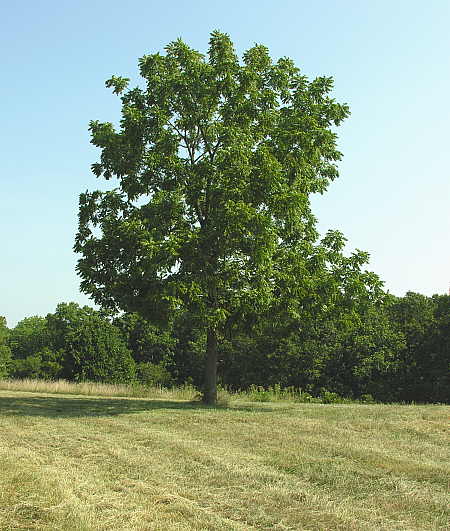
Here it is, Labor Day weekend in the Ozarks, and this morning I am found to be doing the very thing one would expect an Ozarker to be doing on a holiday weekend – surveying trees.  Not just any trees, but Black Walnut trees, which thrive in this part of the Ozarks.  The Black Walnut produces a nut that is used in cooking, and the shell and hull of the Black Walnut have commercial uses as well.  Every fall, Hammons Products Company sets up 250 collection stations across 12 states, where the Black Walnuts are purchased from the local collectors.  The following photograph shows a Black Walnut tree as it appeared in early August.

Black Walnut Tree

You will see from the photo above that the Black Walnut tree is not particularly distinct from a distance in the middle of summer.  They are easy to identify up close, but from far away they look much like many other trees that commonly grow here.  One of the things that I have noticed about the Black Walnut is that it is one of the last trees to leaf out in the spring, and it is the first of our local trees to drop it’s leaves at the end of summer.

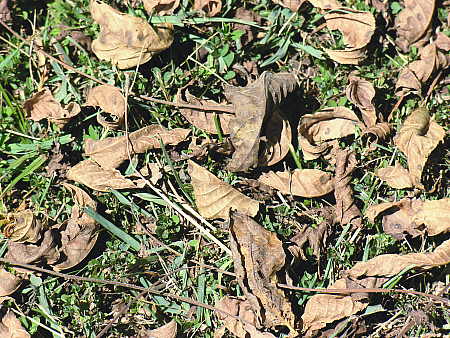
The leaves are falling off the walnuts

The leaves that appear on the ground in the photo above are from a Black Walnut tree.  The picture was taken this morning, September 3.  No other trees in my area are shedding leaves yet, however there is a brown carpet of leaves below the Black Walnuts.  The leaves that remain on the tree itself have now turned either yellow or lime green.  So why, you may ask, do I care so much that the leaves of the Black Walnut are the first ones to change color and drop in the fall?  Because when the Walnut trees are the only ones in the forest that exhibit this coloration, they become easy to spot from a distance.  In fact, as the following photograph shows, the Black Walnut trees stand out like a beacon in the night, they are so distinct.

Changing color of leaves

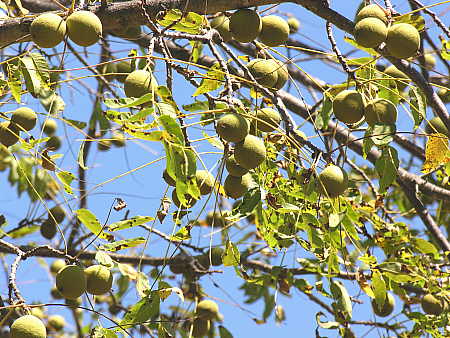
Now that the Black Walnut trees are easy for a non-botanist like myself to identify from a distance, I can proceed to make the preparations that will facilitate a successful harvest of Black Walnuts from our property.  The first step is to map all of the Walnut trees on our property that are currently bearing nuts.  Regular readers of this blog might recall a previous post entitled If They Can Do It, So Can I, in which I introduced you to my “super-duper, multi-purpose, portable cartographic data collection machine”  (SDMPPCDCM).  Using this device, I can easily drive around the property locating the Black Walnut trees that now stand out like a sore thumb, and examine each tree to see whether or not it is bearing nuts this season.  The following photograph shows a Black Walnut tree that is currently loaded with walnuts.

Loaded with black walnuts

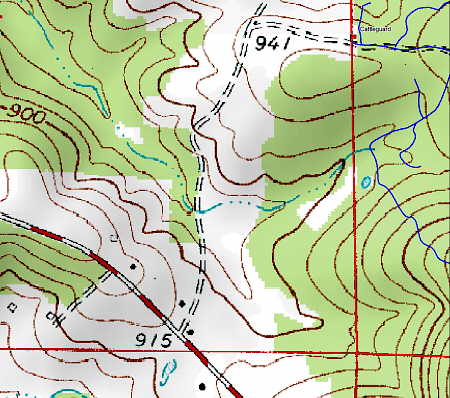
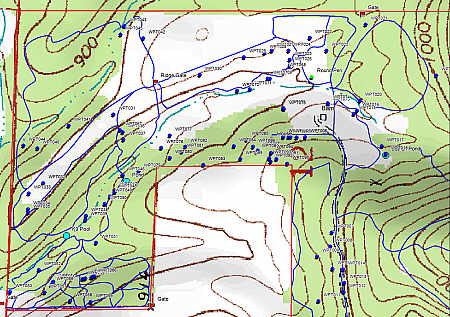
When I find a Black Walnut tree that has produced nuts, such as the tree above, I record the tree as a way-point in my GPS mapping system.  After pinpointing the coordinates of all the nut bearing trees, it is a simple matter to plot this data on a topographic map of the property.  The results are shown in the following screen capture from my mapping program.  The data layer that is selected below shows the results of this little exercise.  The location of all the nut bearing trees are clearly shown on the map (as blue way-points).

Nut bearing trees plotted on topographic map

I do not know how many Black Walnut trees we have on our property.  My best estimate is between 200-300 trees.  This season I located 94 Black Walnut trees that are bearing nuts in a prolific manner. 

Step two of the Black Walnut harvest will be for me to get out the tractor and bush-hog the areas surrounding all of the nut bearing trees.  The goal will be to ensure easy access to the trees by Jasper Smith, my octogenarian friend who collects the Black Walnuts from our ranch each fall.  You may recognize Jasper Smith as the same friend who also keeps and courses bees as an avocation (Jasper, and photos of a “bee tree hunt” can be found here).  Jasper is an amazing man with amazing stories.  I will save my comments about him for a future post, when he comes around to gather the fallen walnuts. which will be step three of the Black Walnut harvest here.  Stand by for future posts on the subject.

What Someone Will Do For A Bite Of Barbeque

Having spent the better part of the past decade being a one car family, Retta and I decided that it was time to acquire a second vehicle, one that would be smaller and more fuel-sensible than the diesel powered uber-truck that we presently rely on for all our transportation needs.  When I read that many manufacturers were offering excellent incentives on remaining new 2006 vehicles, I investigated the offerings and settled on the vehicle in the following photograph.

The new vehicle

We selected this vehicle due to the fuel economy it offered, it’s styling and creature comforts, performance and reliability, and the fact that Ford was offering super financing (0%-APR for up to 72 months, no cash required – great terms for a cheapskate like me). 

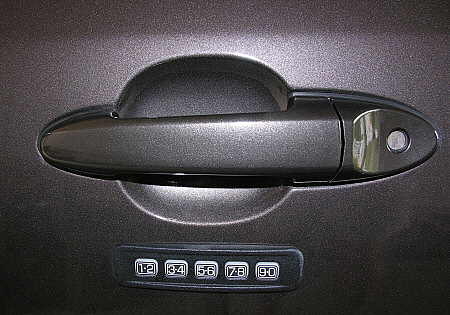
When I checked the inventory at my local dealer, I found they were out of stock on this model.  I proceeded to check the manufacturer’s web site in order to search for this vehicle on-line.  While Retta had color preferences, we really only had 2 “must-have” options for the model we had selected; side-curtain airbags, and 4-wheel drive (a necessity for us in the winter).  Our search led us to three frustrating conclusions:

1) Because it is the end of the 2006 model year, and this is a popular vehicle, the pickings are pretty slim at the present time.

2) Side-curtain air bags are an option that dealers do not think is important to order for their stock vehicles.  Most all of the vehicles we tracked down omitted this option.  People are apparently willing to spend $1000 for a moon-roof, but not $500 for an option which just might save the life of a loved one.

3) The time-honored method of automobile marketing which revolves around the local dealership needs to be revamped to coincide with the advent of web-literate consumers. 

Picture this scenario – Ford has shed tens of thousands of jobs this year alone.  The company has stopped production of vehicles for the remainder of the year due to bloated inventories at the dealership level.  Ford Motor Credit Corporation is financing vehicles at 0% APR for up to 72 months in order to shrink inventories.

Now add to this scenario a customer who wants to buy a specific Ford model, equipped with side-curtain air bags and 4-wheel drive.  This customer is willing to buy from any dealer in the continental United States.  The customer requests from Ford (via their Personal Consultant service) a list of dealers in the United States who possess such a vehicle, so that the customer can purchase said vehicle.  Ford cannot produce such a list.  Or should I say, Ford will not provide such a list.  I know they can produce it, probably quicker than I can type this sentence.  Because Ford would not provide a list of stocking dealers, I was confronted with only one option if I wanted this vehicle – search each and every individual dealers’ websites to check their stock.  This meant searching over 5000 websites, one at a time, to find our vehicle.

I think most people would give up at this point, but not us.  Retta, having test driven the vehicle, fell in love with it, and because I have owned and loved many Ford vehicles over the years, we decided to devote the next several days to searching dealer inventories via the Internet.  I was bound and determined to buy this Ford product, despite Ford’s best efforts to keep me from it!

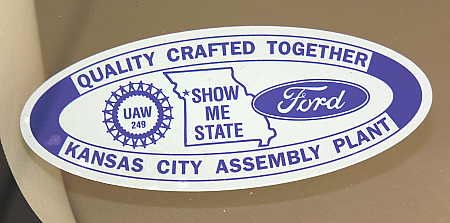
After a long and frustrating search, we located potential vehicles in Seattle, Washington and Raleigh North Carolina.  After several telephone calls with each dealer, we finally made a deal with the dealer in Raleigh, NC.  And thus we were to be the owners of a new vehicle, and proud supporters of the workers in Kansas City, Missouri (a state reported to exist somewhere north of Arkansas).

Buying American

Now we faced only one remaining problem – how to get the vehicle from Raleigh to our place here in the heart of the Ozarks.  After receiving quotes from several vehicle transport companies, I decided that I could fly to Raleigh and drive the new vehicle home for much less than the cost of trucking it home.

It wasn’t until I looked at the map to determine the mileage I would have to drive, that it dawned on me – I would be traveling through one of the BBQ meccas of the world, North Carolina and Tennessee.  What could possibly be better for a dyed-in-the-wool BBQ fanatic such as myself?  So, stocking my travel kit with plenty of TUMS, I mapped out all the BBQ joints along my route (182 within 5 miles of my planned route).

I will spare you all the gastronomic details, but let it be noted that I consumed, among other things, scrumptious hickory-smoked pulled pork, course-chopped pork with lots of “brownies”, pork spareribs, beef ribs, cole slaw, hush puppies, beans, stuffed jalapenos, pickled green tomatoes, and fluffy biscuits.  I had my fair share of Eastern NC style BBQ, which is pulled pork, highlighted with a tangy, mostly vinegar sauce.  I also managed to get my fill of Western NC (Lexington) style BBQ, which is also pulled pork, but the sauce tends to the more western style sweet tomato base, and the cole slaw not quite as tangy.

Not only was the food delectable along the way, but the trip allowed my to drive through some of the most beautiful countryside you can hope to see.  Driving through the Blue Ridge Mountains and the Great Smoky Mountains is a wonderfully scenic experience.  The western portion of North Carolina and the eastern portion of Tennessee consists of lush green forest, combined with rugged rock outcroppings, offering superb vistas at every turn.  It is well worth taking the drive if you have the opportunity.  And don’t forget to sample the BBQ ;)

Another Steamy Ozarks Morning Sunrise

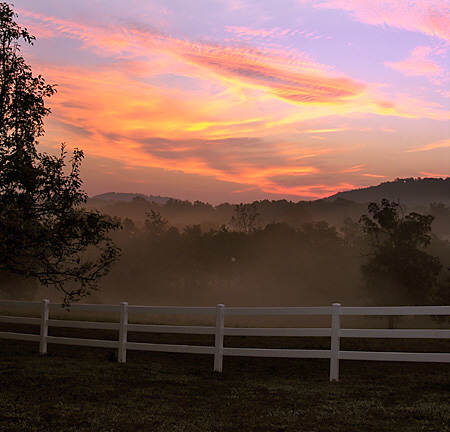
Steamy Ozarks sunrise

Retta took this photograph at 5:41am this past Wednesday morning, after rising with the sun to let the dogs out of the house.  Having recently returned from an unexpected trip to congested southern California to pay my respects due to the passing of a dear loved one, this photo serves to remind us of the beauty that we are fortunate to wake up to each and every day.  For this, we feel truly blessed.