On This Memorial Day

The symbol of who we are and what we stand for

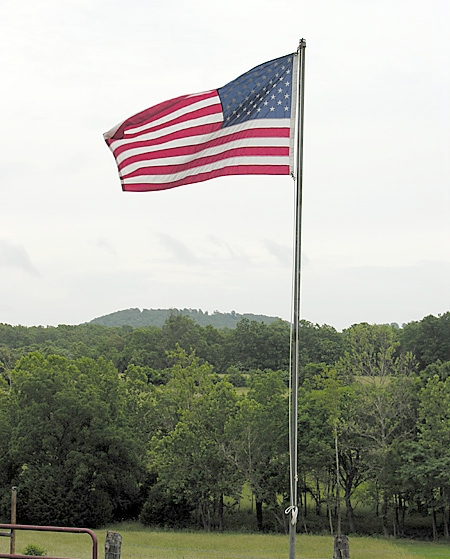
There are times in a persons life when dreams of the future are formed and nourished.  Hopefully, with honest work, persistence in the face of life’s ever-present obstacles, and a good dose of luck, a persons dream may eventually be realized.  I feel blessed in the fact that Retta and I are able to lead the life that we do, as this lifestyle has been a long time dream for the both of us.  Because we could not have arrived at the place we find ourselves in today without the freedom to make and implement our plans along the way, I am always cognizant of the benefits that living in a free country has bestowed on me.  And that is one of the many reasons that we proudly fly the Stars and Stripes on a daily basis.

When I look out the window in the morning as I sip my AM cup of coffee, I see our flag.  As I putter around the front yard, doing this or that, I see our flag.  As I drive back and forth across fields and pastures doing my tractor work, I can see our flag from various vantage points.  When I pull back into the barn to put the tractor away, I see our flag.  And walking back to the house from the barn/paddock area takes me right by the flag, so I see it again.  And every time that I see our Stars and Stripes, I am reminded that the opportunity to live my lifestyle, and enjoy the freedoms that I do, is because of the environment created in a free society.

Today is the special day for us to stop and pay our respects to all of those brave, and yes, the not so brave, men and women who payed the ultimate price so that you and I may exercise our freedom of choice.  Retta and I tip our hats to you all, and thank you for the sacrifice that you and your loved ones have endured to make life better for all of the rest of us.

Thank you.

An Interesting Website

Retta was searching for solutions to the problem of squirrels consuming the pears off our pear tree, when she ran across a website entitled “All Squirrels Must Die – the official homepage of the Squirrel Defamation League”.  This site is tongue-in-cheek, and it had me in stitches.  A good place to start your visit would be with the following essay.

Dr. Squirrelove or: How I Learned to Stop Worrying and Love the Squirrels

It is well worth a click to check out this funny website.

The Catfish Pond

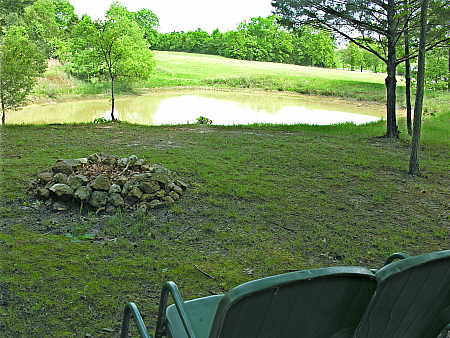
Catfish pond at back of pasture 

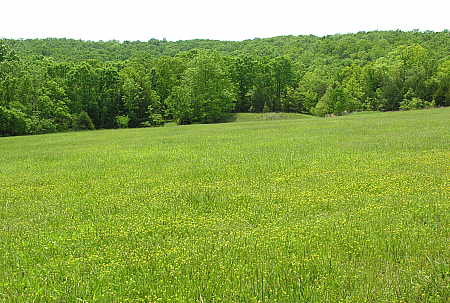
We have several ponds here at the ranch, each with it’s own character, and each with it’s own set of problems and pleasures. This post is about our small catfish pond, which is located in a margin between grassland and woods. In the picture above you can see the berm which creates one bank of the pond, at the far end of this field.

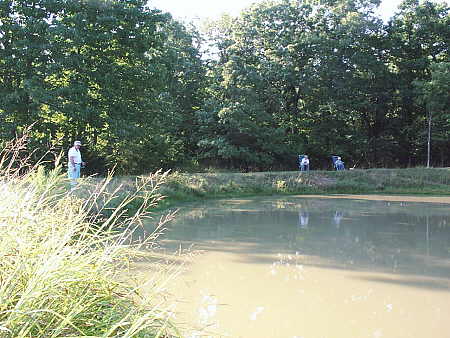
Catfish pond view from berm

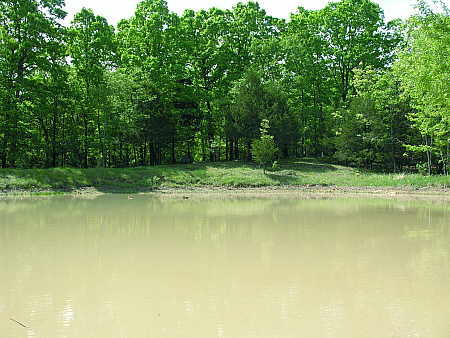
This is what the pond looks like, viewed from the berm which was constructed to contain the pond water.  Across the pond, in the woods, is an area I cleared of brush and set up a fire ring and glider.  It has become an area where Retta and I like to sit and contemplate the world around us, and sometimes have a picnic.  This is what the area looks like –

Picnic area

When seated at the picnic area, the view looks across the field towards our barns and paddock facilities.  It is a lovely spot, and I always like to sit here to take a little break during my work day, surveying my little domain and enjoying the peace and quiet (country quiet, which is sometimes not all that quiet, but I digress).

View from picnic area

As you can plainly see from the pictures, this is not a clear pond.  It is designed to catch the runoff from a clay based gully which drains about a forty acre watershed.  Every time it rains, clay is washed into the pond along with the rain water.  From the time we first acquired this property, I have been dissatisfied with the lack of water clarity in this pond.  I mentioned this problem to an employee of the local farm store, and he told me he had just the solution.  He sold me a gallon container of a liquid, which I proceeded to apply to the pond per the directions.  I should have done more homework than I had, because this is what I ended up with –

Oh my!  What happened here?

Now, I don’t know about you, but I prefer the natural silty brown over this obviously artificial looking turquoise dyed pond.  Fortunately, the pond returned to it’s former natural state after a few rains.  Unfortunately, the pond was bright turquoise when NASA flew over us on their latest photography mission.  In the space imagery that was produced from this mission, our pond color stands out like a beacon in the night.  I even received a comment about this from the Arkansas Forestry Commission forester who came out to assess our property.  He said he had to stop and scratch his head a few times trying to figure out what that bright turquoise spot was on the image!

I have since been told that there is some kind of chemical product that can be added to the water that affects the ionization of the suspended particulate matter, causing it to sink to the bottom of the pond.  I have not been able to locate any such product, except for certain solutions meant to be used in tiny backyard ponds.  And if I can find this product, I suppose that it would have to be used whenever the rains washed more clay silt into the pond.  So I will instead try to accept the pond as it is.  After all, there are plenty of healthy catfish and minnows living in it, so why should I care?  And most important, guests who come to visit us here at the ranch always seem to enjoy throwing in a line, even if the water is silty.

Out at the fishing hole

How Can This Happen?

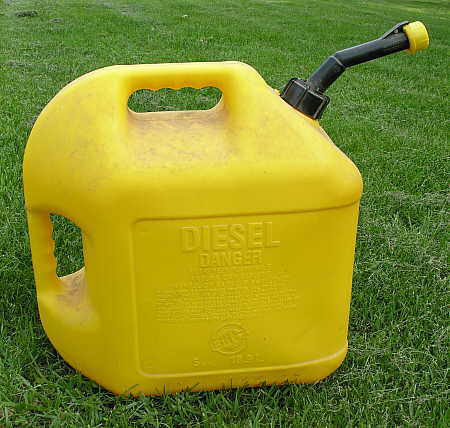
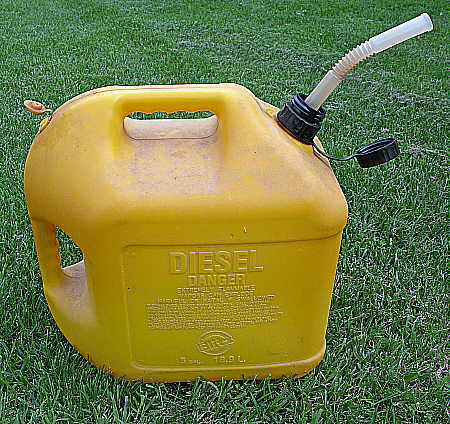
Original fuel canister

This is a picture of a five gallon diesel fuel canister that was purchased from Wal-Mart in 2001.  There is nothing particularly special about this container, except for the fact that it is a mature and fairly well evolved product that has been sold across the continent for many years.  You have probably used a canister like this one, or perhaps it’s red gasoline sibling, many times in the past.  It is a useful and inexpensive product that has stood the test of time.  When I open the spout assembly and begin pouring the fuel into my tractor’s fuel tank, it sounds something like this:

GLUB gla GLUB,  GLUB gla GLUB,  GLUB gla GLUB,  GLUB gla GLUB,  GLUB gla GLUB,  GLUB gla GLUB,  GLUB gla GLUB,  GLUB gla GLUB,  GLUB gla GLUB ……..

….. and so-on and so-forth until the canister is empty, which takes slightly less than two minutes.

Perhaps you remember a past post entitled The “Ouch” Factor that dealt with seeking an improved method of fueling my tractor, so as to minimize back strain.  In that post, you can see a picture of this author fueling the tractor with a similar fuel container. 

Redesigned fuel canister

It is similar, but not identical to the canister in the first picture.  If you compare the two containers, you will see that the second canister, purchased from the same Wal-Mart store in 2005, lacks a vent on the upper left-hand side of the container body.  When I lift this container up and try to fill the tractor’s fuel tank, this is what I hear:

GLUB gla GLUB,  GLUB gla GLUB, GLUB gla …. silence!

Remove the container from the filler neck, turn the canister upright to allow air back into the container to equalize the air pressure, lift the container back up to the filler neck, and begin the fueling operation:

GLUB gla GLUB,  GLUB gla GLUB, GLUB gla …. silence!

Remove the container from the filler neck, turn the canister upright to allow air back into the container to equalize the air pressure, lift the container back up to the filler neck, and begin the fueling operation:

GLUB gla GLUB,  GLUB gla GLUB, GLUB gla …. silence!

Remove the container from the filler neck, turn the canister upright to allow air back into the container to equalize the air pressure, lift the container back up to the filler neck, and begin the fueling operation:

You get the idea by now I hope!

It now takes me over 7 minutes to drain one of these new fuel containers, but worse than the time involved is the fact that I have to lift/lower the heavy fuel container repeatedly in order to accomplish this formerly simple task.

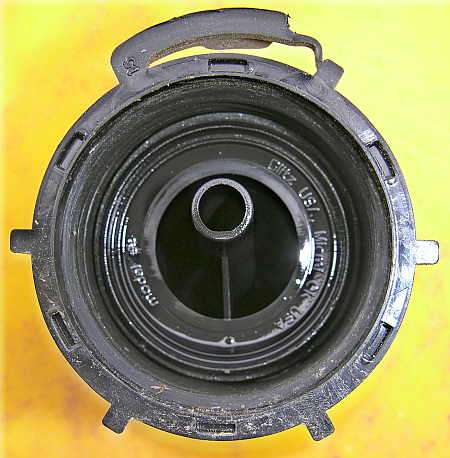
When I first used this fuel container and noticed that it wasn’t working the way I thought it should, my initial reaction was that the company must have inadvertently neglected to install a vent in the container’s body, as was included in the previous style.   But upon further examination I discovered the cause of the problem to be an ill-conceived and poorly executed attempt at including the vent mechanism within the actual spout itself.  The following photo shows the underside of the new style spout:
Underside view of spout

In this photo you can clearly see a small vent tube molded within the larger fuel spout opening.  I do not claim to have any special knowledge of hydrodynamics or hydraulic engineering, but it seems contrary to my intuition that this could possibly work.  How can the fuel flowing through this spout possibly be offset by an equal airflow through a vent tube 1/5 the size of the fuel opening, particularly when the fuel surrounds the vent (top and bottom) while it is flowing?

Let us assume for a moment, just for the sake of argument, that the designer of this spout assembly drafted the concept in a CAD program, calculated the appropriate calculations necessary to arrive at a workable design that resembled what we see here.  Wouldn’t somebody in the design team have looked at this and had the same intuitive sense about this design that I had, and nixed the design as unworkable, or at least ordered a prototype to be produced to test the concept?  And if they had tested this hypothetical prototype, wouldn’t they have gotten the same results as I did?

Let us now move on to manufacturing.  The tool and die makers create the molds necessary to produce the spout assemble, which they pass on to the shop floor.  The molds are installed on an injection molding machine, and out pop spout assemblies by the score.  At some point, doesn’t the shop foreman, his/her supervisor, the product manager, or the plant manager think to fill a container with water and see if the new spout assembly works?  Are there no curious souls left?  Does anybody care enough about the product they produce to try it out?

The factory, content in the fact that they have the injection moulding machines now spitting out spouts (no pun intended), provide samples and specifications to the marketing department, so now the ball is in their court.  Marketing is tasked to sell, and sell they do (obviously, as I purchased this canister at Wal-Mart).  Did the marketing manager at this company, after spending long hours dreaming up wonderful prose extolling the virtues of this new fuel can model, ever have the desire to fill up one of these containers with an actual liquid, and try out the “New & Improved” spout?  And how about the sales representative who flew to Bentonville, Arkansas to speak with the automotive buyer at Wal-Mart, carrying with him samples of his companies new fuel cans?  This was the man/woman charged with the responsibility of knowing everything there is to know about his product, in order to accurately inform and educate the buyer about this item.  Shouldn’t this person have once thought to actually put the fuel can through it’s paces?

The fact that I purchased this fuel canister at Wal-Mart indicates that the item passed whatever product screening the Wal-Mart buyers thought necessary for inclusion in the automotive department of the store.  The operational specifications for a fuel container of this type should be fairly simple and straightforward.  One should be able to fill it with liquid, and one should be able to pour out the liquid.  Nothing should happen in between these two events.  It is really that simple.  Didn’t anyone on the buying staff at Wal-Mart think to perform even the simplest test of this item, particularly since they were aware of the re-design of the spout assembly?

Last, but not least in this unfortunate chain of neglect is the owner of the company that produced this fuel canister.  I believe that Mr. Gates has an obligation to himself and his company to sit down in front of a Windows computer and use the software his company produces.  Similarly, I believe that Mr. Ford has a duty to get behind the wheel of the automobiles that bear his family’s name.  Along the same line of reasoning, I believe that it is also the responsibility of the owner of the fuel canister company that produced this item to have actually tried to use it, if even once.


A Decal That Could Save Your Life

AirEvac Lifeteam window decal 

I generally avoid recommending any specific product or service to others.  I will offer my personal experiences with a product, whether good or bad, and let the listener judge for themselves as to the suitability of a particular product for their specific use.  But in the case of AirEvac Lifeteam, I will not hesitate to urge anyone who happens to live in the state of Missouri, Arkansas, Oklahoma, Kansas, Tennessee, Mississippi, Illinois, Kentucky, Iowa, Alabama, Indiana or Texas to click on the following link to see whether AirEvac Lifeteam operates in your area, or in areas that you frequently visit.

AirEvac Lifeteam

Living in rural America has a great many advantages over life in the big city.  Speed of emergency medical response time is not one of them.  When confronted with the prospect of accidental injury or a medical emergency in remote rural areas, we must do all within our powers to stack the deck in our favor any way we can.  Perhaps you do not live in a rural area, but travel through rural areas often.  If so, then there is always the terrible possibility that emergency medical transportation may become necessary due to an automobile accident.  AirEvac Lifeteam is an organization with a fleet of Medivac helicoptors stationed in strategic rural points to address these needs.  Hopefully, the need will never arise for their services, but if it should be required, then the modest annual dues would seem a trivial expense ($50 self, $55 self + spouse, $60 household of 3+ persons).

From the AirEvac Lifeteam website –

Air Evac Lifeteam was founded in 1985 in West Plains, Missouri by a group of private citizens who wanted to give the people in their community better access to emergency medical care. West Plains had a population of less than 9000, and the closest major hospital was more than 100 miles away by ground transport. The road system in this hilly, remote region of the Ozarks often made it difficult to reach people in a timely manner.

At that time, air ambulances typically were based in metropolitan areas. The company founders believed that the people who need air ambulance transport the most are the ones who live far away from a hospital. They thought that having a helicopter based in West Plains could be of great benefit to patients requiring transport during critical situations. Their goal was to provide a quality service that was affordable to the public.

They knew that for the service to survive in this rural area, they would need other sources of funding, besides traditional fee-for-service billing. They discovered the REGA Foundation in Switzerland, which supported a nationwide air ambulance system by a membership program, similar to the ground ambulance and rural fire department programs here in the United States. After meeting with the head of REGA, Air Evac Lifeteam adopted this idea, and became the first air ambulance service in the United States to offer a membership program.

Air Evac EMS, Inc. was incorporated in June of 1985, and placed its first helicopter into service at Ozarks Medical Center in August of that year. During the following year, more than 5,000 area residents became members, and Air Evac Lifeteam flew hundreds of patients during their times of critical need.

Company founders knew that other rural areas would benefit from air ambulance care, and began expanding the concept. Air Evac Lifeteam’s network of bases now extends throughout the central United States. Air Evac is licensed as an air ambulance provider in Missouri, Arkansas, Oklahoma, Kansas, Tennessee, Mississippi, Illinois, Kentucky, Iowa, Alabama, Indiana and Texas.

In addition, Air Evac Lifeteam operates Regional Offices, with maintenance and fueling centers in Oklahoma City, Nashville, St. Louis and West Plains, Missouri.

My Boots

Any person who has spent an appreciable amount of time hiking through the hills and hollers of the Ozarks undoubtedly owns and loves a favorite pair of boots.  It does not matter how many pairs of boots one may own, nor for what purpose, there will always be one favored pair among them.  I own few shoes.  But I own many boots.  When your activities revolve around the outdoors, you tend to get that way.  And indeed, I do have a favorite pair of boots.  I just call them “my boots”.

Now in the winter, just after 6″ of snow has fallen and it is 10 degrees outside, I would probably choose to put on my insulated high-top hunting style boots to tromp around in the woods.  If the snow conditions happened to be just right, and I had the energy, and if my back weren’t hurting from lugging diesel fuel, then I might elect to lace up my cross country ski boots, step into my cross country skis, grab the ski poles and pretend that I were still young enough to do these sort of things.  Afterwards, I would probably want to lounge around a warm fire in the fireplace, which means that I would have to trek through the snow to get firewood.  This would call for my lightweight, zip-up insulated snow boots, which are perfectly matched to this task.

When a more formal occasion presents itself, such as an anniversary or birthday dinner at a sit-down restaurant, then the footwear of choice would be a pair of western boots (cowboys wear cowboy boots, and I’m not a cowboy – hence, western boots).  When a less formal occasion presents itself, such as manure management in the paddock, then mucking boots are called for and nothing less will do (note to self: never economize on mucking boots …yuck).

Now that it is springtime, and the spring rains have (fortunately) begun in earnest, the boot I might select during a prolonged rainy period might be my pull-on high top waterproof work boots.  They will keep my feet dry, they have good traction and fair ankle support, but best of all, they can be slipped on and off easily and quickly (a godsend when a chore involves going in and out of the house repeatedly with muddy boots).

In the summertime, I usually reach for my light weight, waterproof lace-up work boots, which are an excellent choice as a general purpose boot, and due to their sturdiness and light weight, perform very well for a hiking boot.

All of the boots that I have just mentioned are specialized boots of one sort or another.  To recap, there were insulated high-top hunting boots, cross country ski boots, insulated snow boots, western boots, mucking boots, high top pull-on work boots, and lightweight waterproof lace-up work boots.  In total, I might wear these boots for a combined total of ten percent of my shod time.

The other ninety percent of the time I simply wear “my boots”.

The final resting place for a good pair of boots

Feeling Kittenish?

Just as I clicked on the “publish” button for my last post, Retta pulled up the driveway, back from visiting her parents in Ozark, Missouri.  Along the way home, just off the highway, she noticed what looked to be two tiny kittens.  Not one to look the other way when situations such as this occur, Retta stopped the truck and investigated.  She found the two little kittens, but found no evidence of any siblings or mother cat.  Apparently, these two marvelous creatures were abandoned along the side of the road by some sick, heartless individual who could not think of any other way to handle a new litter of kittens.

Retta did what most caring, nurturing people would do under the circumstances – she gathered the kittens up and brought them home.  So it looks as if we shall now be a three cat family.  And this is what they look like:

Unnamed kitten #1

Unnamed kitten #2

Hopefully we can teach them to get along with the other cat, the dogs, the horses, the guineas, the chickens, the wild birds and the squirrels.  Anything else is fair game.

I Don’t Care Who You Are, This Is A Pretty Sight…

Where's the pot of gold?

The WildBlue satellite spot beam 35 was out for most of the day, so I have not had access to the internet until this afternoon.  So this photo is being posted a day later than I would have liked.

We were fortunate enough to receive 2 inches of rain Friday and into Saturday.  With the 2 1/2 inches we received the prior week, it looks as if our pastures and fields will be growing like gangbusters.  Once dry creeks are now flowing again, and the catfish pond will regain it’s previous glorious fullness soon, which is a big relief to me (not to mention the catfish).

After the rain stopped, we were again fortunate enough to be presented with a superbly brilliant rainbow.  I figured that, no matter how you happened upon this page, you would appreciate a moment to enjoy a beautiful rainbow with us.

PS – In case you were wondering, I raced over to this pasture to find the pot of gold, but somebody must have beat me to it!

The “Ouch” Factor

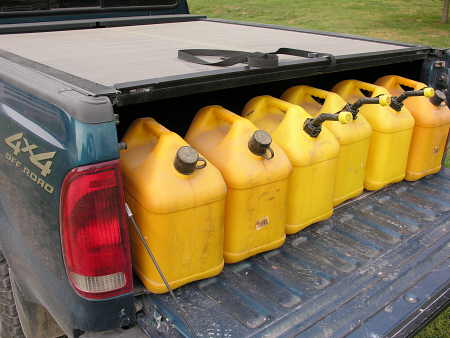
Diesel fuel containers

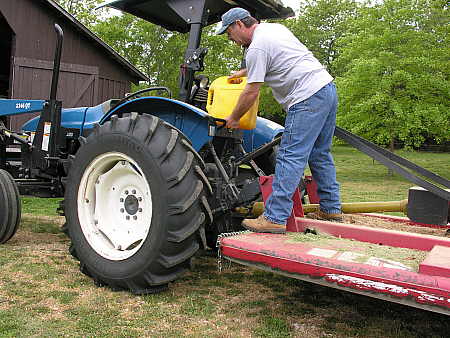
The photo above shows how we obtain our off-road diesel fuel to supply the needs of our tractor.  In order to purchase off-road diesel (which is devoid of state road taxes), we must travel 16 miles each way to the nearest supplier.  Safe fuel handling practices dictate that fuel containers be removed from the bed of the truck before filling, so we place the cans on the ground to pump fuel into them.  The containers are then lifted back into the bed of the truck for the journey home, where they are off-loaded from the truck and carried into the barn for storage.  When it is time to fuel the tractor, a container is carried from the barn out to the tractor, where it is emptied by hand into the tractor’s fuel tank. If I were to attempt this feat while standing on the ground, then the fuel filler neck would be at eye-level, which is not a particularly safe way to fill a tank with hazardous liquids!  As you can see from the photo below, by elevating the bush-hog into the uppermost position, I can accomplish the refueling from a position that affords eye safety.  On the other hand, it isn’t a position that is easy on the back!   Ouch!!!

Fueling the tractor

Now let us do some math.  Ouch!!!  Okay, I’ll do the math, you just follow along with my reasoning.  This tractor burns 1 gallon of fuel per hour.  According to the tractor’s hour meter, I have run the tractor for a total of 1200 hours in the past 5 years.  That amounts to 1200 gallons of diesel fuel.  There seems to be some controversy over the weight of diesel fuel, but assuming a conservative 7 pounds per gallon as the factor, that translates into 8400 pounds of diesel fuel that the tractor has consumed.  Each gallon of fuel had to be handled several times; 1) loaded onto the truck for the ride home, 2) transferred from the truck to the barn 3) carried from the barn to the tractor 4) lifted and poured into the tractor’s fuel tank.  So now we have determined that I have handled a total of 33,600 pounds, or nearly 17 TONS of fuel!  Ouch!!!  No wonder my back sometimes hurts.

Now for some more math.  Ouch!!!  As you can see from the first photo, I fill 6 fuel cans at a time, because that is the number that will fit across the back of the pickup bed, affording lateral stability as I wind my way around the Ozarks landscape on my way to the filling station.  I fill each container with 4.5 gallons of fuel, therefore each round trip to the station yields 27 gallons of fuel (4.5 X 6).  We know from the paragraph above that we have used a total of 1200 gallons of diesel fuel, therefore we can conclude that there has been a total of 44 round trips made to obtain this fuel (1200/27=44.44).  Now if we multiply the 44 round trips by 32 miles, we obtain 1408 miles traveled to fetch diesel fuel.  Dividing by the abysmal 16 miles/gallon that my truck manages to achieve (he admits, covering his face in shame), and then multiplying by an average fuel price of, say, $2.00/gallon, we can determine that I have spent close to $200 just to fetch the fuel!  Ouch!!!  No wonder my wallet sometimes hurts.

As an aside, well, I’m almost too embarrassed to share it with you, but here goes.  Over the years, I have been purchasing off-road diesel fuel for use in my tractor.  As mentioned previously, off-road diesel fuel is devoid of road taxes.  Sometime in the past (I don’t know when), the state legislature decided that off-road diesel should be subject to the state sales tax of 7%.  So now, using today’s fuel prices, the calculus (ouch!!!) goes something like this:

Off-road diesel (16 miles away)= $2.65/gal + 7% sales tax = $2.84/gallon

On-road diesel (available locally) = $2.79/gallon

Price of my embarrassment = ???   Ouch!!! 

But I digress.

My father used to frequently say “Son, the legs go first!”  But then, he spent the better part of his life running a factory.  He put many miles on the soles of his shoes, so one would expect the legs to go first.  While I do lots of hiking around the property here, I find that I am called upon to perform heavy lifting much more than I recall doing since my younger days.  And so I would have to say “Dad, the back goes first!”

So the question that nags at me is this – is there a better way to accomplish this task of fueling the tractor, which, while seeming to be a trivial task, can wreak havoc on the backs of those of us who don’t feel as young as we once were?

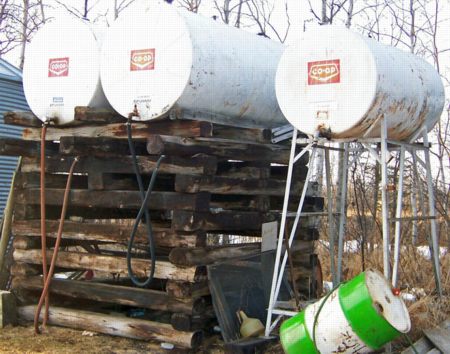
One popular option that many farmers turn to involves the installation of an elevated, above-ground fuel storage tank, which is periodically replenished by a local fuel distributor.  These systems are gravity driven, which is both a blessing and a bane.  A blessing, because pumping equipment is not required.  A bane, because gravity cannot be shut off.  There are many potential points of leakage in a fueling system.  With gravity continuously at work, any leakage, no matter how slight, will eventually empty the tank.  There was an incident that occurred about 5 years ago in an area around Beaver Lake, about 75 miles away.  A fishing resort owner had a 300 gallon elevated tank installed for the convenience of his guests.  The tank valve developed a leak sometime during the night, and approximately 200 gallons of fuel seeped into the water table.  To make a long story short, 5 years later there are about 100 households with contaminated wells.  Their water has to be delivered weekly by truck and pumped into plastic holding tanks placed on their property.  The owners of the resort had to declare bankruptcy when their insurance policy reached the limit of the insurance company’s contracted liability.  Ouch!!! 

And this scenario, with some slight variations, is played out repeatedly across the country.  As I was driving down the road this winter, I saw these tanks on a neighbors  farm, so I stopped to take a picture.  To me, this looks like a disaster waiting to happen. 

Elevated fuel tank

Were I to install a fuel tank, it would have to be built of quality parts.  I would have to keep the tank, fittings, hose, valve and nozzle in tip-top condition.  And the entire assembly would have have a seepage-proof containment system with capacity at least equal to the capacity of the tank.  All-in-all, this would be a safe and effective system, which would certainly relieve the pains in my back, but man, would it be costly!

So it’s off to the station to fill those darn fuel cans.  Ouch!!!  Ouch!!!  Ouch!!!

Pedro

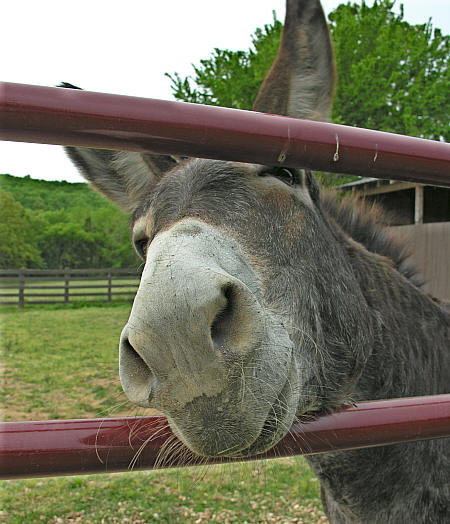
Hello everybody, I'm Pedro.  Who are you?  Will you please leave a comment for me?

This fine looking fellow is Pedro.  Pedro dropped by this morning for a visit.  Pedro didn’t tell our neighbors next door that he was going out for a walk.  He just found a way out of his pasture, and wandered on over to chat with our horses, Chipper and Tojo.  Pedro’s owners will be mad at him for misbehaving.  Retta would like to keep him.  Hmmm, maybe I can broker some kind of deal…..