Hello World (Again)!

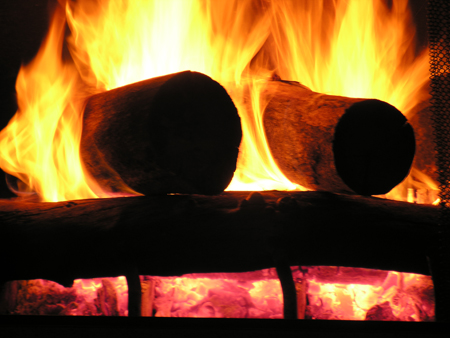
Hearth Fire

It’s hard to believe that it has been a year-and-a-half since I last posted on this blog.  Now that winter is here in full-force, I intend to resurrect Ranch Ramblins with more frequent posts (some of which may actually be interesting).  Also, I have recently been talked into creating a personal Facebook page (how passe) – I’ll post a link to that page as soon as I figure out how the heck Facebook works!

There is a lot that has transpired in the last 18 months, so I will post some of the more noteworthy events as I can.

This Year’s Hay Production – Part I

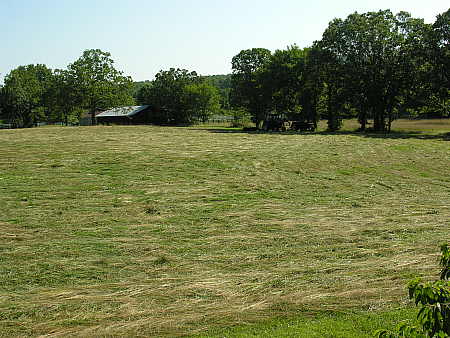
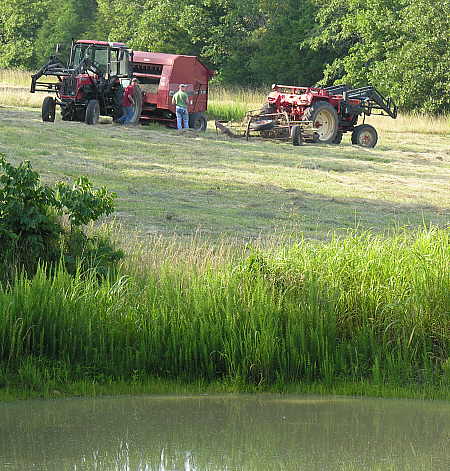
This is one of our hay fields immediately prior to cutting, the first of four steps in our hay production for this year.

The freshly cut fescue grass, seen above, is allowed to dry in the sun for a few days until the moisture content is low enough to permit safe baling of the hay.

When the grass has dried to the point that it is ready to be formed into bales of hay, it will look different from when it was newly cut, as is evident from the photograph above.

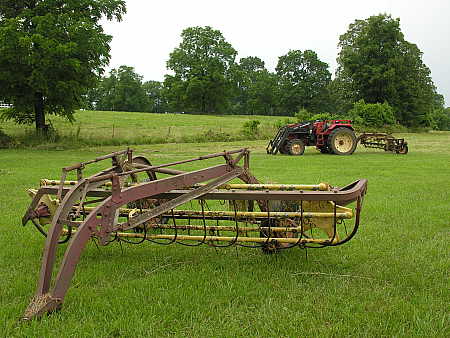
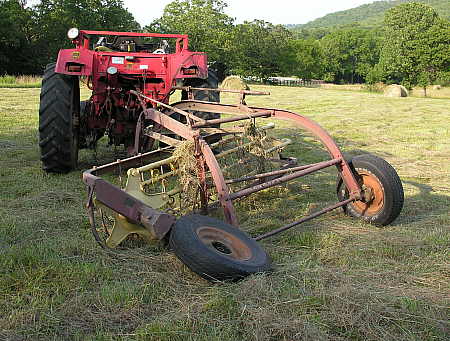
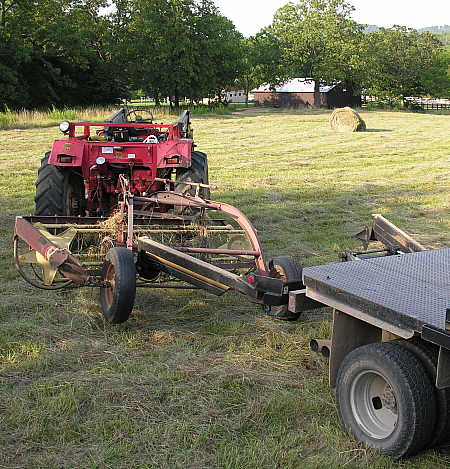
At this point, the dried fescue is ready to be raked into windrows in preparation for mechanical baling.  The photograph above shows the two rakes that are being used to wind-row the grass laying in the fields.

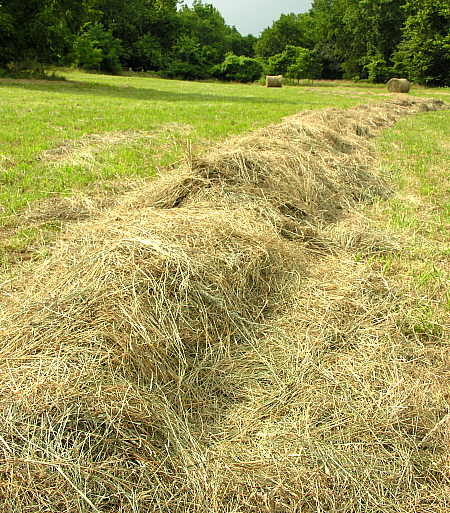
This is the end product of cutting and wind-rowing in the field.  The grass is now ready for the baling machine to arrive and perform it’s magic (the topic of last year’s post Boosting The Average).

But what’s this?  Something seems to be haywire out in one of the hay fields.  You may recall from last year’s Boosting The Average post that one of the rotary cutters used to cut the fescue broke, requiring repairs in the field in order to proceed with the hay production.

 As you can see, this year’s problem involves one of the hay rakes.  It seems a wheel decided to fall off!

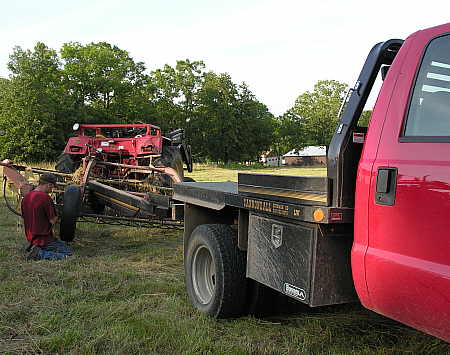
As Craig knelt down to figure out what would be required to fix the broken wheel, another problem came to mind.  How to lift the very  heavy implement in order to re-attach the wheel?


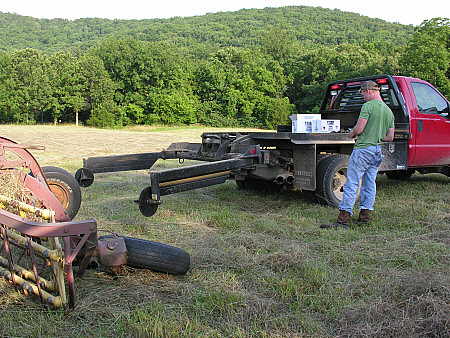
 Fortunately, Craig had his hay hauling truck “Cannonball” with him, and as you can see, this truck is fitted with a hydraulic bale lift on the bed of the truck.  With a little bit of care, the lift could be used to elevate the heavy hay rake for the repairs it required.  

With the hay rake elevated, Craig had no problem fixing the broken wheel (with a little help from a few hardware items found in my shop parts bins).

And as you can see, the hay rake is now as good as new – well, almost good as new, considering that it is probably as old as I am!

Part II (and perhaps a Part III) of our hay baling shenanigans will most likely be forthcoming in the near future.  I’ll bet you can’t wait, can you?

Keets ‘n Such

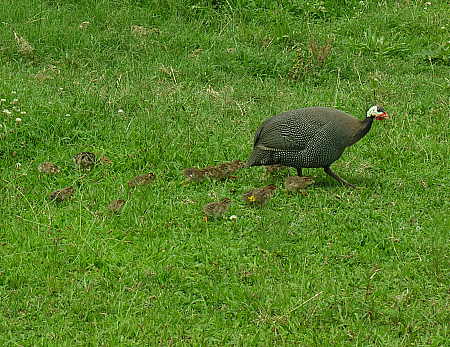
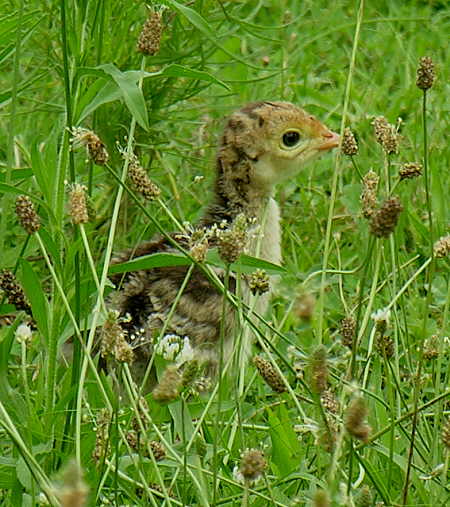
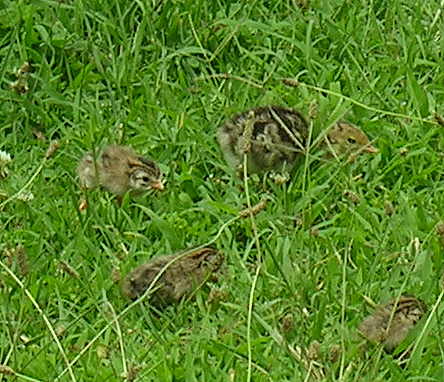
Retta spotted one of our guinea hens foraging in a pasture the other day, accompanied by a brood of newborn guinea keets, as seen in the following photograph..

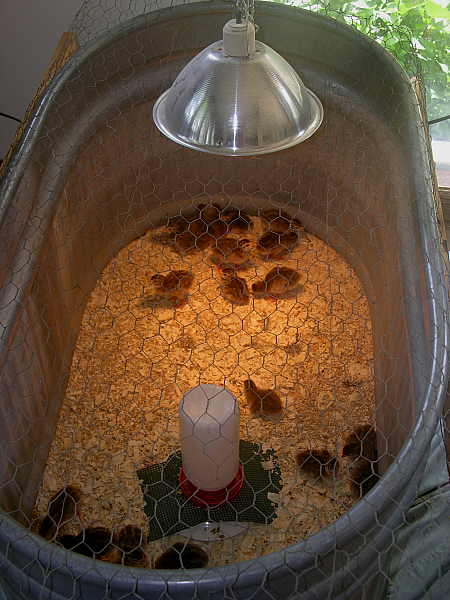
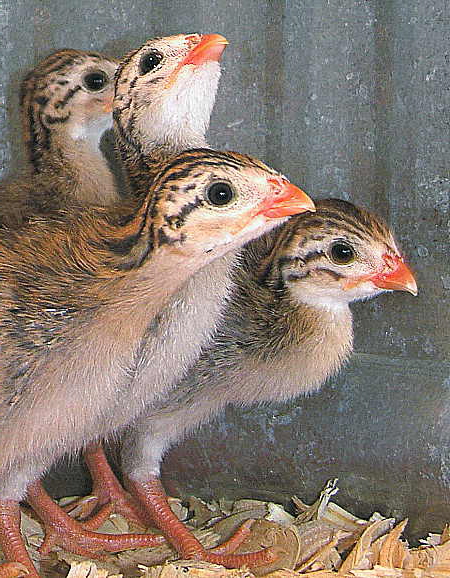
We were excited to see this, because up until now most of our guineas were raised in captivity by Retta in a setup like you see below.

It is a fair amount of work raising keets in this manner, so Retta and I are hoping that our flock of guineas have finally reached the  “critical mass” necessary to be considered a self-sustaining population.  After all, as long as there are ticks in this world, you can never have too many guineas roaming around your property.

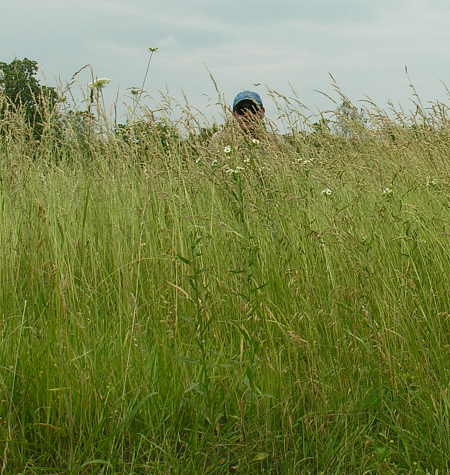
Now, if you peer again very closely at the first photograph (at the top of this post), do you notice anything unusual?  Nothing?

I’ve taken the liberty to enlarge a portion of that photo slightly, for the benefit of those of you who, like me, are afflicted with middle-aged eyes.  Now do you see what I see?  Give up?

Look closely at this fella.  He does not look the same as the other keets.  I believe that this is either a very deformed guinea keet, or else a turkey chick somehow joined the flock ;)

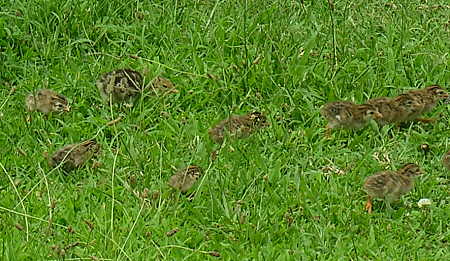
If you don’t believe me, compare him to the guinea keets we raised in captivity, pictured below.

I surmise that the wild turkey chick wandered off with the guineas as they passed by, and then lost his directions back home.  Sadly, the chick did not survive.

UPDATED at 6:13 PM

I think this side-by-side photo of the guinea keets standing with the turkey chick highlights the differences in their stature and coloration.

Visitors

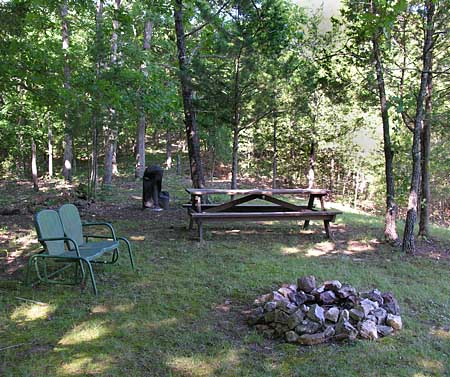
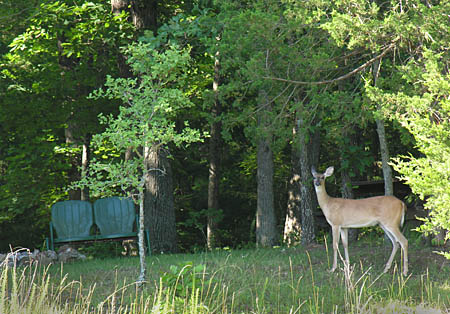
Remember this shaded picnic area from a previous post entitled The Catfish Pond ?  I was headed over to that spot the other day to do some maintenance work, when I was greeted by this gal ….

Apparently, Retta and I are not the only ones who like to frequent this cool, quiet spot.  The doe, whom I presume didn’t want to disturb my intended work schedule, loped off into the woods, leaving me to enjoy the peaceful setting as I went about my tasks.

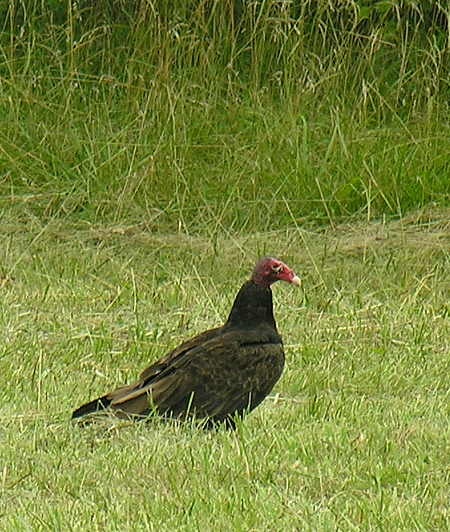
Chores finished for the morning, I set off back to the house, when I noticed one of the buzzards that seems to have made it’s home in the trees near the catfish pond circling overhead.  Perhaps I was standing a little too still as I observed the bird gracefully tracing figure eights in the sky, because the vulture soon swooped down toward my position, landing only yards from my location.  Maybe a meal was at hand, he might have reckoned, only to have his hopes dashed as I snapped several photographs and quickly departed.

When one weighs the pros and cons of country life, encounters such as these certainly bubble up to the top of the list of positive factors.  Don’t you agree?

The Name Game

If you were to scan each of the posts that have appeared on this humble blog, you might notice something odd (O.K., I’ll admit it, this entire blog is a little odd, but that’s another story!).  What I’m getting at is this – in none of the posts will you find a NAME attached to our little home here in the Ozarks.  Because Retta and I have not settled on a name for this bit of heaven on Earth, you will find references within this Ranch Ramblins blog such as: the property, the land, the farm, the ranch, etc.  But no specific name is ever cited.

Perhaps it is time for this deplorable situation to change.  This farm/ranch/preserve/recreation area we call our home really should have a proper name that we can refer to in passing.  It would make the place seem, well, more rooted, more permanent, and somehow, more personal.

When we purchased this tract of land, we had the Abstract of Title brought up to date, and we were provided a copy for our records.  As a result, I can trace the ownership, as well as past mining leases back to the original land deeds created immediately following the Louisiana Purchase.  But those records say nothing about the names that past owners have dubbed this land.  I have, however, discovered the following bits of information.

When this property was developed into it’s present configuration in 1980, the owners (who had just retired from an agricultural advisory career in Latin America) dubbed it La Esperanza.  In Spanish, this translates (roughly) into The Hope, or The Aspiration.  I have gleaned this information from the following two sources –
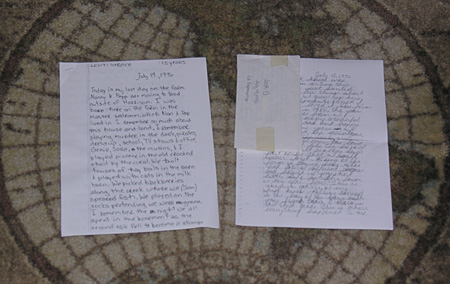
First, long time readers may recall from a past post entitled Lay, Lady, Lay  that shortly after moving into this house, we discovered very touching farewell letters (pictured above) written by grandchildren of the aforementioned former owners of the property.  The envelope of one of the letters has La Esperanza written across the front.
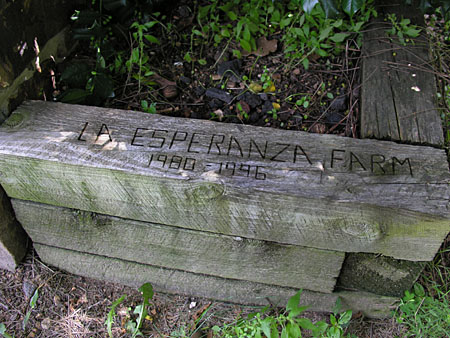
The second (less subtle) clue was found after clearing out one of the landscape planters located along the side of the house.  I have used the “magic” of digital image manipulation to enhance the carved lettering found along the top of the planter, which clearly reads La Esperanza Farm, 1980-1996.
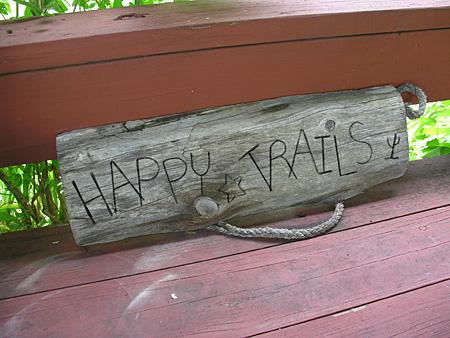
In the years that intervened between 1996, when La Esperanza’s creators sold the farm, until early 2001, when we bought the property, it was owned by two other families in rapid succession.  One of those families must have re-dubbed La Esperanza to Happy Trails, as evidenced by the sign above, which we found hanging by the property entrance in 2001.

Two issues are involved here – the first being the appropriateness of re-christening a farm or ranch.  As you may know, at one point in the past, Retta and I lived aboard a boat named Lorelei (siren of the Rhine River).  After purchasing the vessel, we debated changing the name to one of our own choosing.  We opted to retain the name Lorelei.  Apart from the expense involved to repaint a new name across the transom, there is a substantial body of myth/lore/superstition surrounding the supposed “dire consequences” that would befall those who would dare re-christen a ship from it’s original name (however, to be fair, there is an authority who claims his special renaming ceremony  works like a charm).

While I’m not one who clings to superstitions, when one goes out onto the vast untamed sea in a relatively tiny 20 year old vessel, it’s best not to “tempt” fate.  We never ran aground, never sank, never capsized, and never foundered in five years of frequent cruising, so there just might be something to the “renaming” superstition.  In any event, I do not know whether the “renaming curse” also applies to farm and ranch names, but it is something we must consider, if only to be on the safe side.

Second, assuming that we were to decide to adopt our own name for this property, what would we call it?  La Esperanza, while a good name, seems so out of place in this part of the Ozarks, where the year 2000 census indicated a Hispanic population of 0.8 %  (8/10ths of 1 percent) of the county’s total population.  Retta and I would be two among only a handful of people in the entire county who would know what La Esperanza means.

My first choice for a name for this property might be the following …
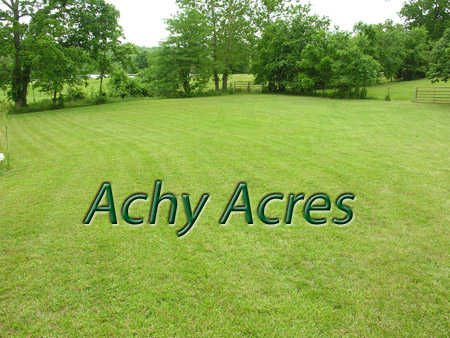
… because, with all the mowing, tractor work, sawing, toting, etc. to be done around here, there is  always some part of the body that experiences aches and pains.

Retta, on the other hand, who is more involved with gardening, poultry, and the other farm animals, came up with this whimsical name …
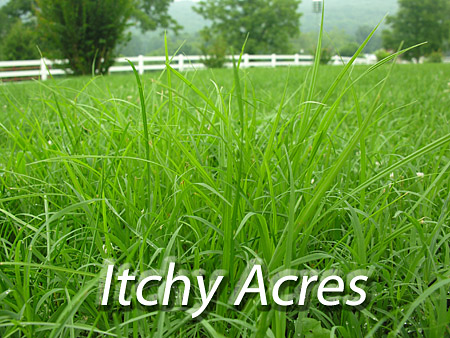
Due to the shear volume of ticks and chiggers that call this farm home, this would also be a very appropriate name, were we to adopt it for our farm.

On the other hand, either of the previous two suggestions might get others to dub us …
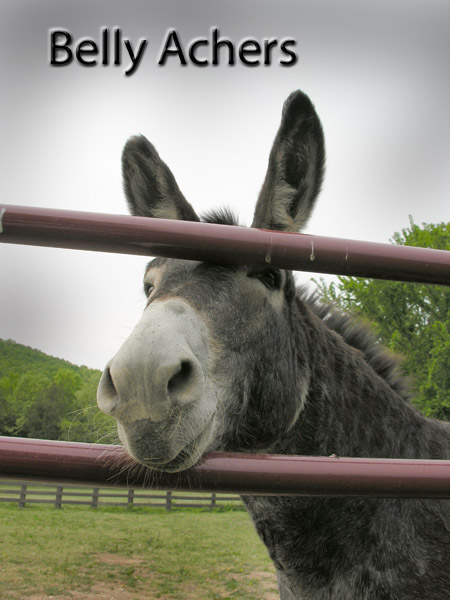
That would be no good now, would it?

Reflections

Yesterday

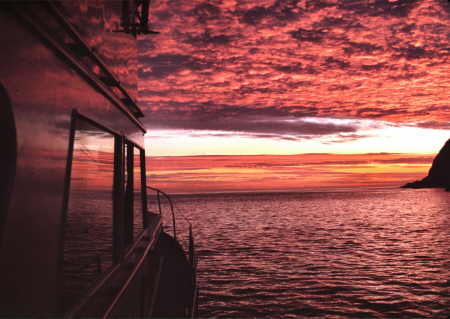
There used to be a time, years ago, when I lived aboard a vessel and called places like the one seen in the photograph above my home.

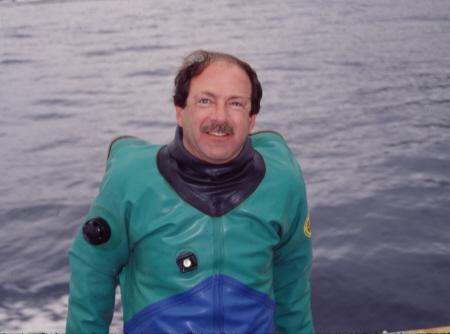
In those days, I would dress up in a funny rubber suit and jump into the water …..

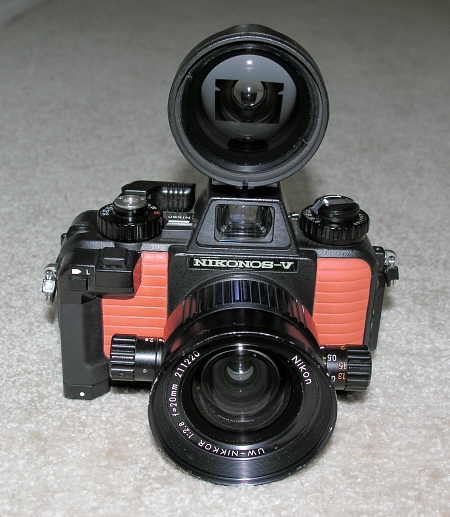
… armed with this Nikonos underwater camera.  Hopefully, I would happen upon some interesting subject,

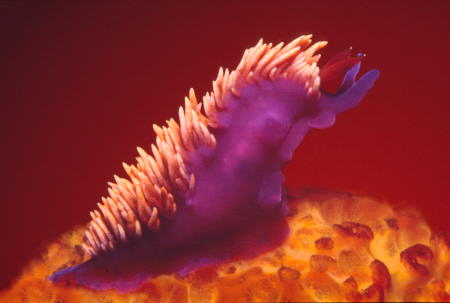
such as this Spanish Shawl nudibranch, to take a photograph that might end up worthy of display.

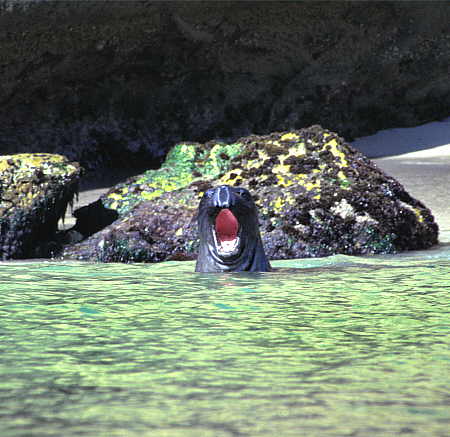
Other times I might stalk creatures while on the ocean’s surface, and be fortunate enough to get a picture like the one of this elephant seal at San Miguel Island.

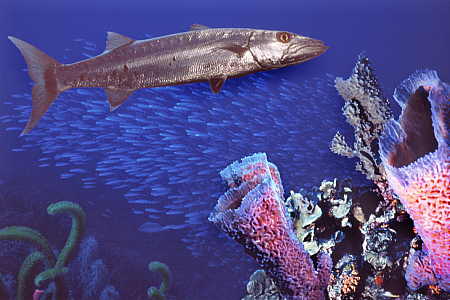
On those occasions when I was fortunate enough to be able to travel to tropical destinations, I would, with a little luck, be able to find subject matter such as that seen above.

Those of you who know me understand just how much the ocean, SCUBA diving, and underwater photography have meant to me over the years.  Alas, those days are past, as I have finally come to recognize.  So it is with bittersweet ambivalence that I have created the following listing on eBay:

http://cgi.ebay.com/ws/eBayISAPI.dll?ViewItem&item=330247395306&indexURL=0#ebayphotohosting

Today

I live in the place pictured above, hundreds of miles from the closest ocean.

Today, my photographic tool of choice is this camera ….

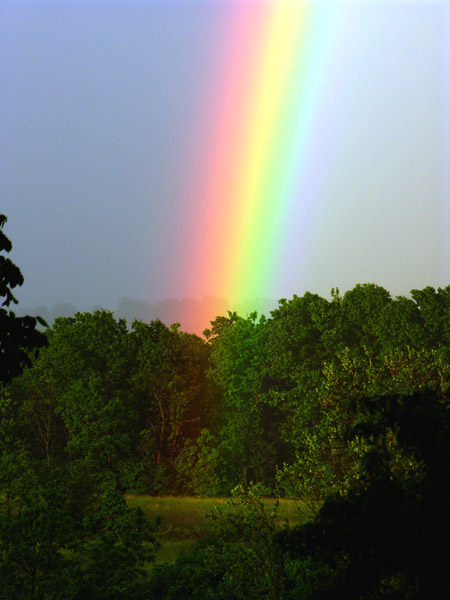
… with which I try to find interesting inland photographic opportunities, such as this rainbow …

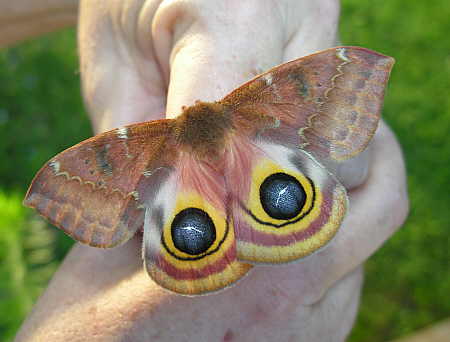
or this beautiful moth.

It’s still good – just not the same.

No Hay Today

The NWS forecast calls for thunderstorms in this area today, with strong chances for additional thunderstorm activity later in the week.  So it doesn’t look like we will see any activity on the hay production front for the next several days. 

Meanwhile, the timing of the abundant rain we have experienced this Spring seems to have suited the black walnut trees just fine.  The walnuts are nearing golf ball size, and unlike last year, our productive trees appear to be prolific this year.

Hmmm…. it just occurred to me that I neglected to post anything about last year’s black walnut harvest.  In fact, I had not even reported the results of the 2006 harvest.  Well, better late then never, so here goes.

You may recall that in 2006, our friend Jasper was Hoping to Top His Previous Record Harvest, which stood at about 400,000 walnuts.  He ended up having a great year, but fell just a little short of his previous record.

In 2007, outside of one or two consistently outstanding producers, most of our black walnut trees were barren.  Even with all the farms Jasper includes in his rounds, he could not even locate enough walnuts to make up one full truck load.  So 2007 was a bust, but from the looks of our trees, 2008 should be a very productive year.

When the time comes to bale the hay, I’ll post some photographs of this year’s harvest.

So What’s Hal Up To Now?

It’s June, so he’s up to his neck in fescue – that’s what!

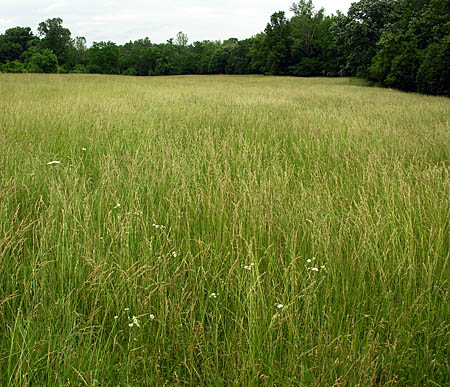
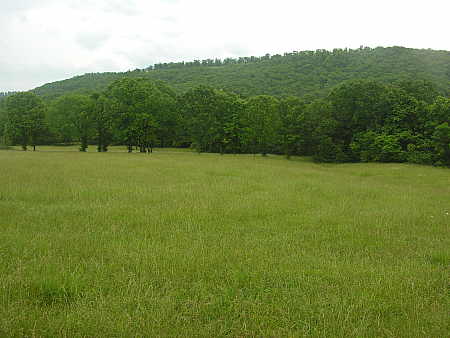
Once again, the season for hay production is upon us.  As you can see from the photograph above, the fescue/clover fields are ready for baling.  The grass is tall and rich with nutrients, and weeds haven’t had much of a chance to develop within the fields. 

This part of the Ozarks has seen abundant rain this Spring (at least 10″ ABOVE average), and the temperature has remained relatively mild.  It has been ideal conditions for the tall fescue that dominates our region.

For the past several years I have taken pains to get several additional pastures groomed and readied for hay production, in addition to our regular hay fields.  They now appear to be ready for harvest.

We have a couple of reliable and ambitious neighbors who are motivated to do the cutting and baling.  The price of all cattle feed matter (hays, grains, protein supplements, etc.) has risen dramatically in recent months, so they would like to utilize as much of our grass as possible.

Thus, my hopes are high that all of these factors will combine to make this year a banner year for hay production on this property.

UNLESS ……..

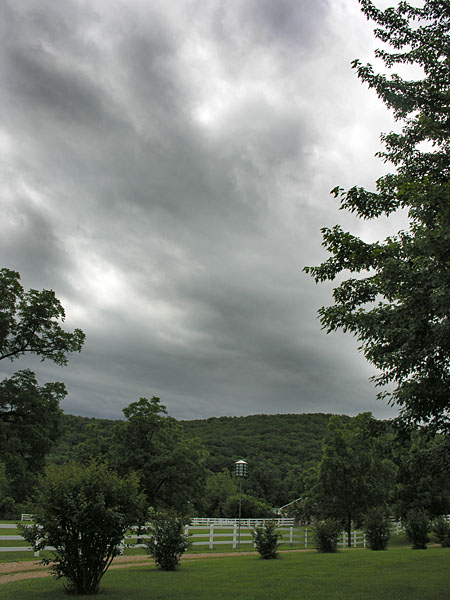
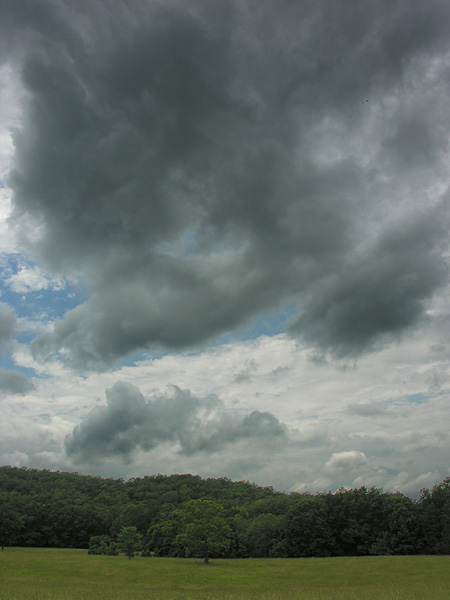
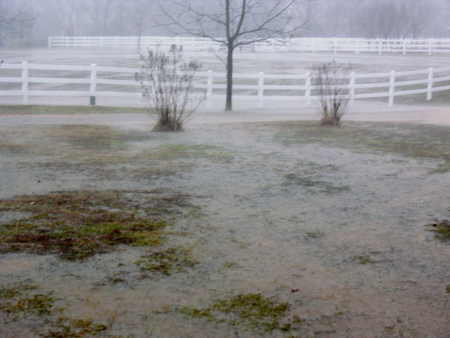
The skies that looked like this at 12:40 PM

And then look like this at 1:15 PM

Turn into a downpour like this!  Then all bets are off…

The Cattle Guard

It’s the time of the season for our neighbor to start baling our hay.  As you can see, the fields are lush and green this time of year.  And very tempting for the cattle grazing in adjacent pastures.  You may recall a post entitled Invasion of the Corn Snatchers from last year, wherein I recounted the destruction of one of our wildlife feeders by a marauding herd of hungry cattle that breached our fencing.

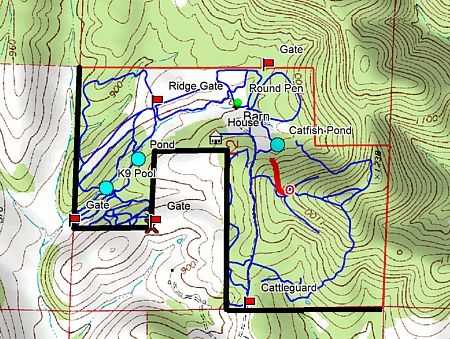
When we find neighboring cattle on our land, it can usually be traced to a failure of the barbed wire fencing which surrounds the property.  The black line on the topographic map above depicts 2.25 miles of barbed wire fencing that separates our property from the land of neighbors who run cattle.  Fallen trees or old, brittle fence wire usually account for the intrusions.

Yesterday, we had a different problem.  A few cattle were roaming along our entry road, but there were no breaks in the fencing.  How were they getting in?

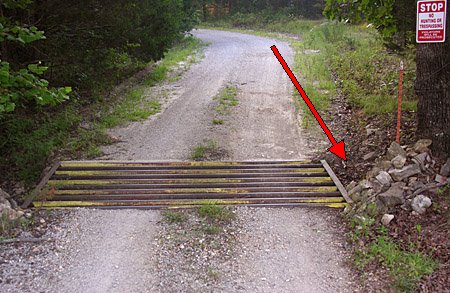
This photo shows the (not so) Grand Entrance to our property.  It is a county road, protected by a pipe cattle guard.  The red arrow that I have added to the photo points to the corner of the cattle guard that neighboring cattle were jumping over in order to reach our tempting hay fields.  There clearly needed to be an obstruction added to this side of the cattle guard, to prevent the cattle from hopping the guard with impunity.

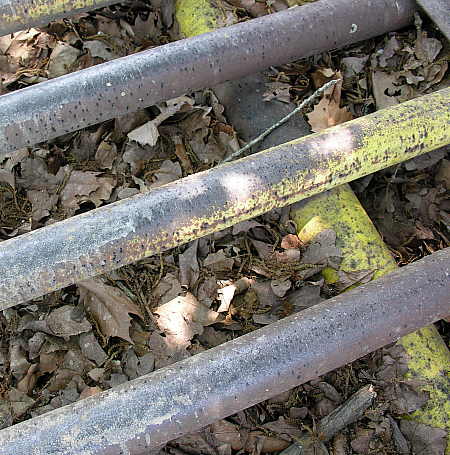
Additionally, when I inspected the guard itself, I noticed that years of accumulated leaves and debris clogged the underside of the guard.  The cattle guard is supposed to present itself as a deep, dark, mysterious place to the cattle that make an approach.  The buildup of debris under the guard spoils the effect, and the cattle are no longer spooked by the device.  It needed cleaning, pronto!

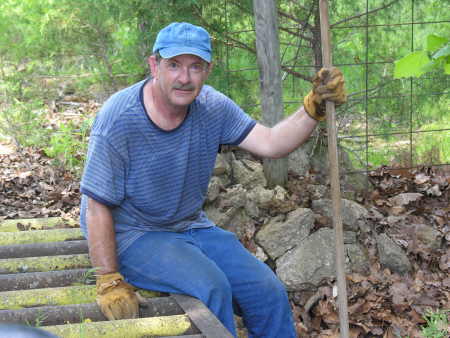
With shovels and rakes, and after much sweat and toil on the part of Retta and myself,  the job of clearing out the underside of the cattle guard was finally completed.  Now, to address the problem of insufficient side barriers.  What could we use to block the side of the cattle guard?

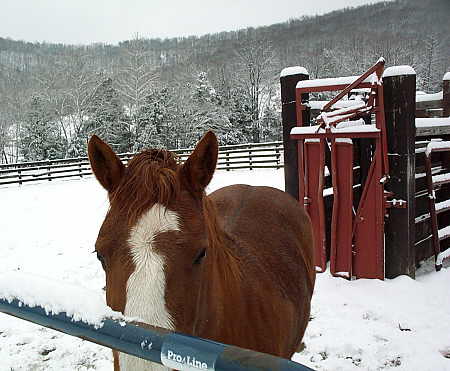
Here is a photograph taken 7 years ago in our paddock area, back in the time when we still had a cattle squeeze chute installed.  Notice at the front of the chute there is a red head gate in place.  The head gate is used to hold the head of the cow still, thus immobilizing the animal (usually for veterinary work).  When we removed the squeeze chute from the paddock, we retained the old head gate, just in case we needed it for something in the future (you just never know when a cattle head gate will come in handy)!

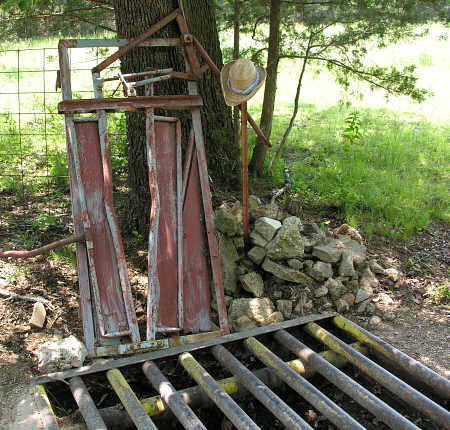
Well, the head gate finally came in handy!  By propping it up against the tree, we have eliminated the easy path that the neighboring cattle had used to hop across the cattle guard.  Notice, also, how the underside of the guard is empty and clean – and once again spooky to the cattle.

It isn’t a pretty solution, but it does have a rustic, yard-art type of feel to it, especially knowing that it was once a necessary piece of equipment used here at the ranch.

Convertible Bench/Table Construction Plans

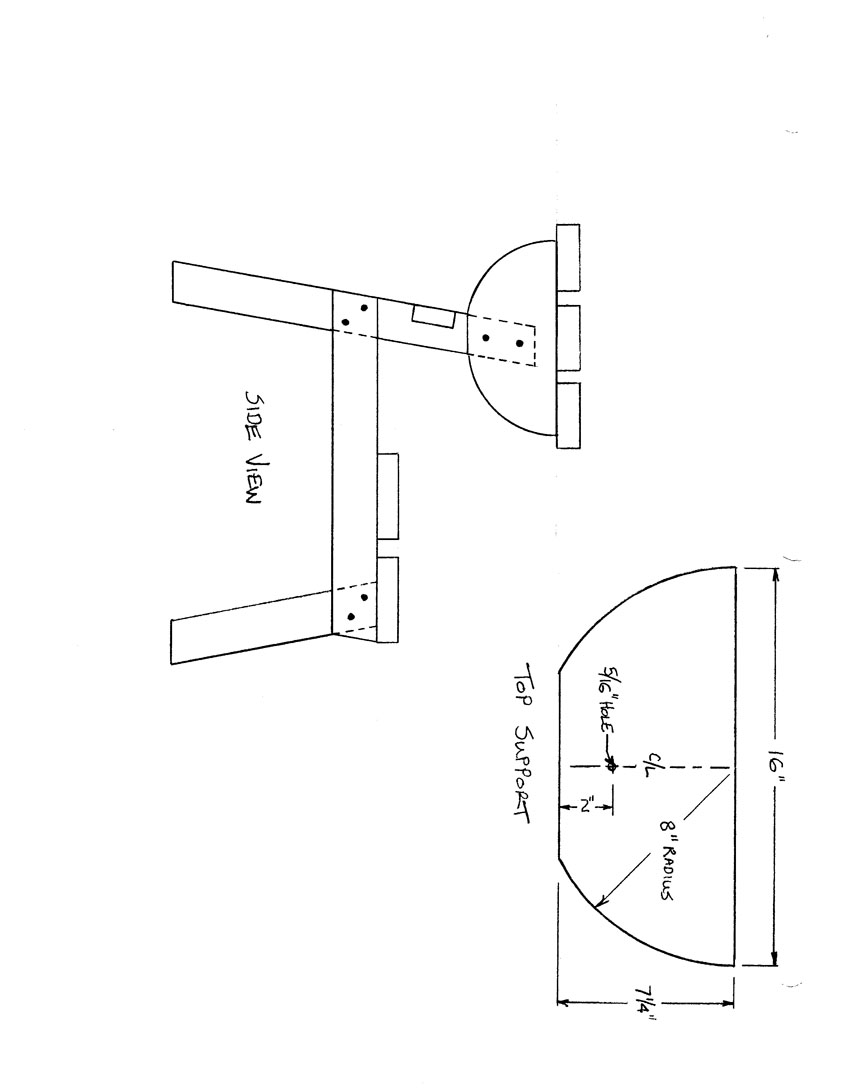
In a previous post entitled A Benchtable  (October, 2007), I showed photographs of a convertible bench/table that I had built in my workshop.  Since then, Karl, Kostas, and Sylvia have requested plans for this indispensable piece of outdoor furniture.  I have tweaked the design a little bit since the first prototype, and have built a few for testing in the field (literally, in a field).


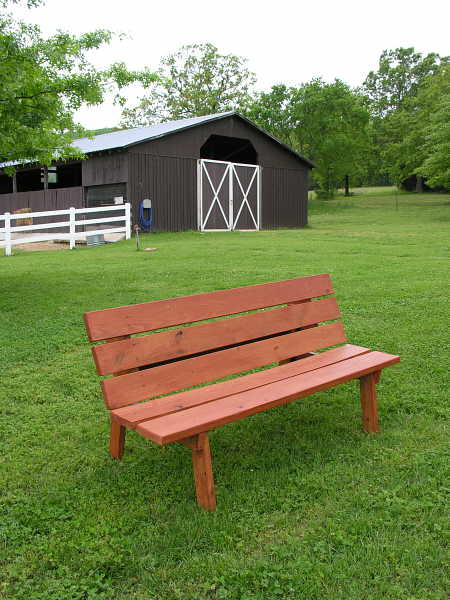
The photograph above shows a recently completed benchtable.  From the front, the new design looks the same as the past iteration.

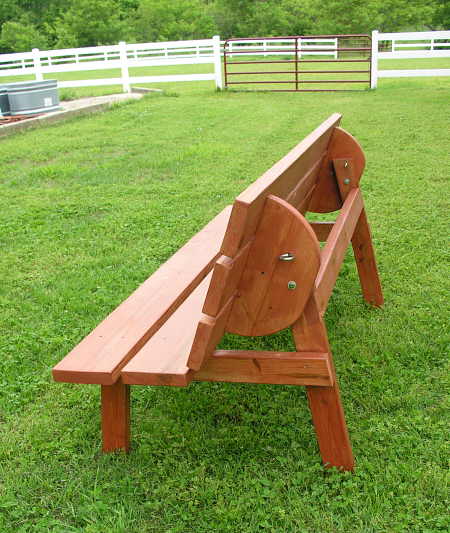
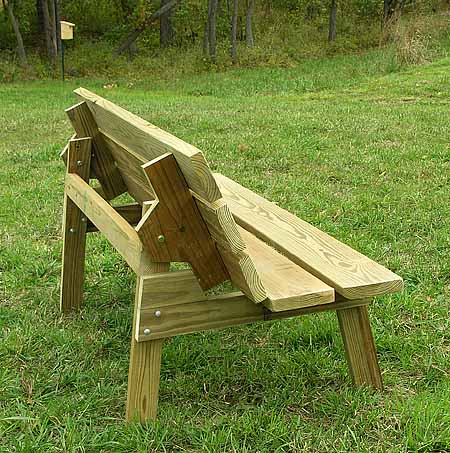
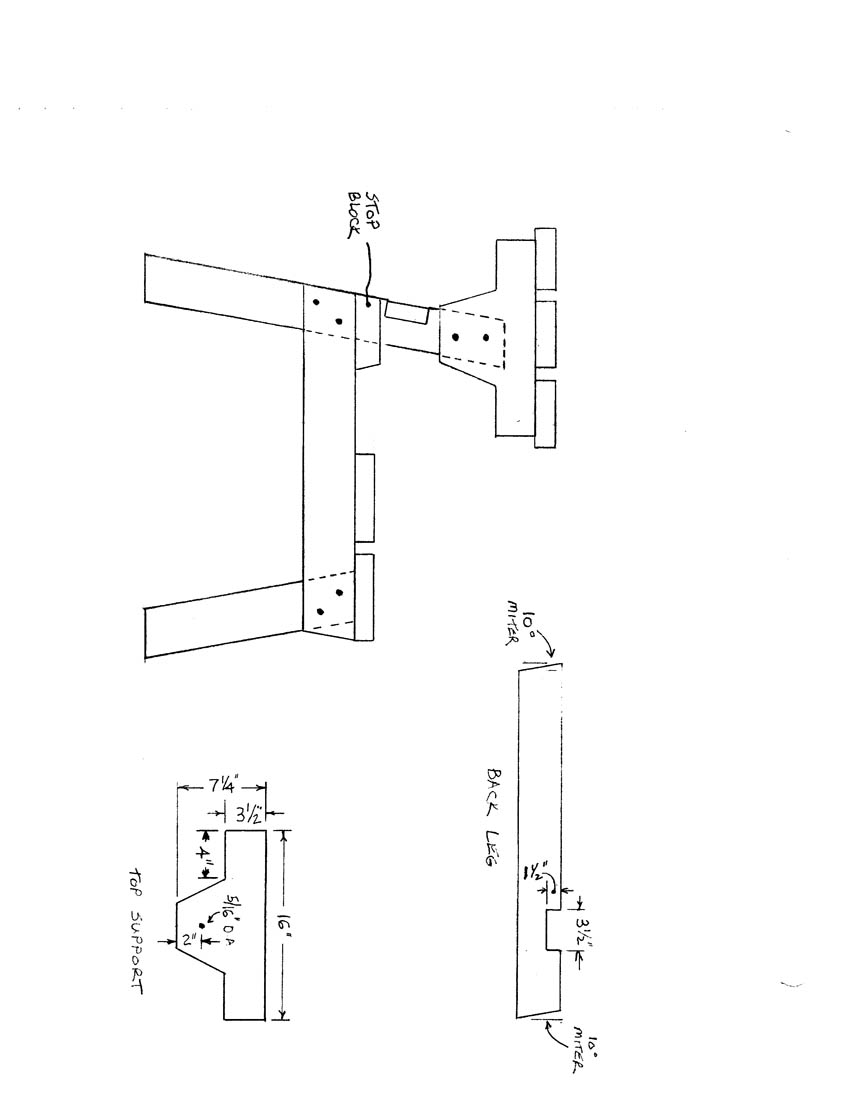
The change is visible when viewing the benchtable from the side or back.  Compare the rounded seat back/table top supports in this new design to the old design in the following photograph:

In this old design, the supports were built with straight lines and sharp angles.  The old design also employed the use of stop blocks on each side to lock the back support in it’s seating position.  The new design provides a more pleasing look, and is locked in place by  5/16″ eye bolts (that also serve to lock the top into position when used as a picnic table).

.

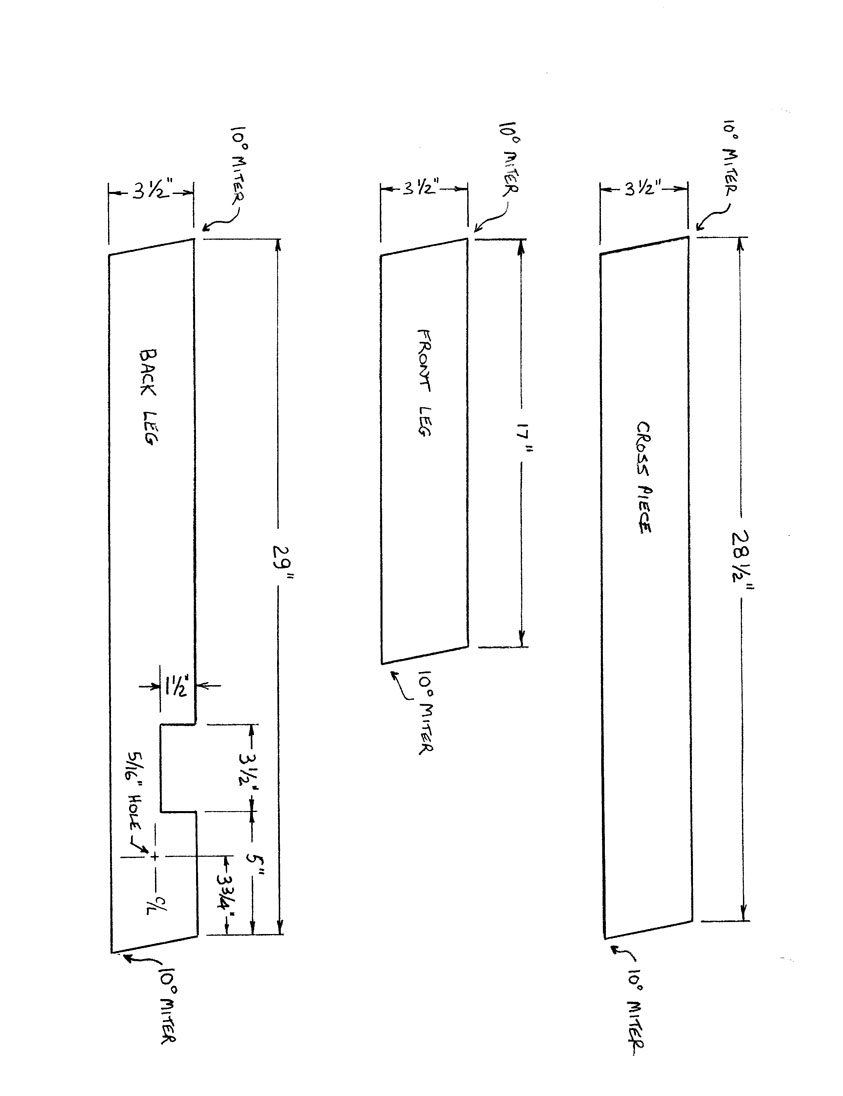
Click on each of the three thumbnails above for a full-sized mechanical drawing, which can then be printed for your use during construction.

Materials List

  • Lumber             -   2″ x 4″ x 8’        (3 pieces)
  • Lumber             -   2″ x 6″ x 8’        (3 pieces)
  • Lumber             -   2″ x 8″ x 8’        (2 pieces)
  • Carriage bolts   – 5/16″ x 3 1/2″    (8 pieces + nuts and washers)
  • Hex bolt           -   5/16″ x 4″         (2 pieces + nuts and washers)
  • Eye bolts          -    3/8″ x 6″          (2 pieces)
  • Deck screws     -  #8 x 2 1/2″        (32 pieces)
  • Carpenters glue
  • Sealer (or finish of choice)

Cutting List

  • 1 each    -   leg stretcher     2″ x 4″ x 53″
  • 2 each    -   seat slats          2″ x 8″ x 72″
  • 3 each    -   table top slats   2″ x 6″ x 72″
  • 2 each    -   top supports     (per drawing)
  • 2 each    -   front legs          (per drawing)
  • 2 each    -   back legs          (per drawing)
  • 2 each    -   cross pieces      (per drawing)

Assembly Instructions

A)   Cut all parts per cutting list.

B)   Place one rear leg in front of you.  Line up a front leg on top of the rear leg, aligning the bottoms of the legs.  Use the shorter front leg to scribe a mark onto the rear leg, along the top of the shorter leg.  This mark will be used to locate the crosspiece in the next step.

C)  Position a cross piece on top of the front and rear legs (as shown in drawing #2).  When you are certain you have positioned the parts correctly, fasten the cross piece to the legs, using glue and carriage bolts.

D)  Repeat step C for the opposite side, being careful to realize that the sides will NOT be identical, but are a mirror image of each other.

E)  Attach the leg stretcher to the leg assemblies, using glue and deck screws.

F)  Center the seat slats on the cross pieces.  The front seat slat should be flush with the cross piece (as shown in the drawing), with a 1″ gap separating the two seat slats.  Attach with glue and deck screws.

G)  Attach top supports to the rear legs, using hex bolts.  Use a carpenters level to level each support, and tighten the hex bolts.

H)  Center the table top slats on the top supports, leaving a 3/4″ gap between the slats.  Fasten with glue and deck screws.

I)  Double check to be certain that the table top is still level.  Using a 3/8″ drill, drill a hole through each top support, continuing to drill the hole though the rear leg, as well.  These are the holes that the eye bolts will pass through to support the top in the picnic table position.

J)  Now, move the table top to the bench position.  Experiment until you find the back angle that feels comfortable for you, and use clamps to lock the seat back into this position.  Using the upper 3/8″ hole in the rear legs that you drilled in the previous step as a guide, drill a 3/8″ hole into each back support.  Place the 3/8″ eye bolts into these holes to lock the back into the bench position.

K)  Apply a finish of your choosing, and enjoy your new benchtable!Â