
We all know that we should backup our important data. We know we should do it on a regular basis. And yet, the vast majority of computer hobbyists either ignore, or put off this important task. Now, more than ever, we must recognize the importance of maintaining a reliable backup system. The use that we put our computers to today eclipses the uses of the past. Who can imagine communicating with only a telephone and snail-mail anymore? How many of us do all (or most) of our banking, investing, and bill paying on-line today? Many of us even maintain a quasi social life via computer. Not to mention the hundreds, if not thousands of valuable photographs that exist only as bits on our hard drive.
Computer backup has generally been performed in the context of commercial, scientific, and governmental data processing. Reliable backup hardware and software has been available for some time for these large data processing entities, and the cost associated with these reliable systems is low relative to the enormous costs of the “big iron” that is being protected.
The situation with respect to home computer users has been entirely different. Small tape backup systems, while available, have never become commonplace among home users. The sequential nature of these systems, along with the associated complications this casts upon the backup process, make tape backup systems an appropriate tool mostly for large DP operations. The home user has been left with a few (not so great) options. In earlier days, floppy disk backup was commonly utilized, due to the low cost involved, and the fact that floppy drives were standard on home computers. But as hard disk drives grew in size, the time involved in shuffling enough floppies to create a backup became prohibitive. To help alleviate this problem, backup software began to implement compression schemes, most of which attempted to pack all of a users computer files into one large, compressed backup volume. This solution has evolved to use CD and DVD disks as the medium, which have increased capacity over floppies, but still suffer the same limitations. A user must still be on hand to swap disks in and out of drives, compressed backup volumes are utilized, and special software must be used to restore these compressed files to your hard disk. Additionally, to ease and speed up the backup process, incremental backup methods are employed. But anyone who has ever used these backup tools, and needed to restore their lost data after a disk crash will attest to their inherant unreliability. There is nothing quite so exasperating in the computing world as believing you have a reliable backup in hand, only to have your backup software choke in the midst of a restoration procedure (an all too frequent occurance).
But there is a new breed of device out there that has solved these problems, and in a most simple, but elegant way. I am refering to dedicated, external backup drives, engineered specifically to perform the important task of data backup.
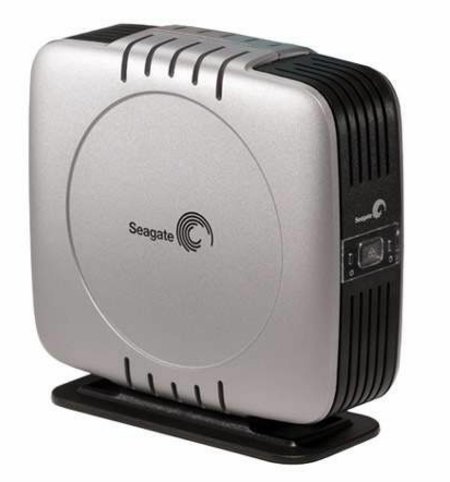
Unlike previous hard drive solutions to data integrity, such as the various incarnations of RAID (Redundant Array of Inexpensive Disks), which are expensive for the average user to implement and require special disk controller cards and empty drive bays, these drives are the epitome of “Plug and Play”. Inexpensive to purchase, simple to install, highly portable, and very reliable, these backup drives should be high on your list of computer hardware upgrades.
The Seagate backup drive (pictured above) has both USB and Firewire connectivity. Capacities range from 200GB to 400GB. BounceBack software is included in the price, and couldn’t be simpler to use. There are two modes of operation, manually initiated backup, and/or scheduled backup. To perform a manual backup at any time, just push the power button on the front of the drive. This launches BounceBack Express, which performs a file-by-file backup of your hard drive onto the Seagate drive. After the initial backup, which copies the entire drive to the backup device, subsequent iterations of the backup copies any new or altered files. The files will be uncompressed, exact duplicates of the files on your computer’s hard drive – accessable via plain-vanilla Windows applications and Windows Explorer. Backup can also be on a scheduled basis, simply by entering your desired time and frequency in the BounceBack software interface.
I now rest a little easier, knowing that at 2:00AM every morning, all of my important (and not so important) backed-up data is safe, secure, and current.