A Tractor for Chickens?

Prior to buying the ranch we are at, Retta and I took the opportunity to visit the property several times, doing the due-diligence inspections all property purchasers should undertake (including, I should note, the all important survey).  During these visits, we noticed, behind the former milking barn, an odd looking contraption, half-buried amongst the odds and ends that always seems to accumulate behind old milking barns. As neither of us recognized what this object was, it soon disappeared into the deepest recesses of our memory banks.  On our last visit prior to closing escrow, while watching television at the Comfort Inn we were staying at, we saw an episode of the P. Allen Smith gardening show.  One particular segment of the show featured something called a chicken tractor.  And what the show portrayed on the screen looked very similar to the contraption sitting behind the milking barn.  Now we knew what that thing was – a chicken tractor.  I had previously heard of lawn tractors, garden tractors, farm tractors, and even tractor-trailers, but I had never heard of a chicken tractor! 

When Retta and I found that we had become the proud owners of chickens (see previous post), we faced the problem of deciding where to house them, and we needed to learn the basics of caring for them.  While looking for information at the local farm store, we ran across a book entitled “Chicken Tractor – The Permaculture Guide to Happy Hens and Healthy Soil”.  That caught my attention instantly, as I never want to be accused of having unhealthy soil, and heaven forbid, unhappy chickens!  Consequently, I purchased that book and learned everything one could possibly know about chicken tractors.  Everything.  Including the information I shall now share with you.  First, here is what one chicken tractor looks like:
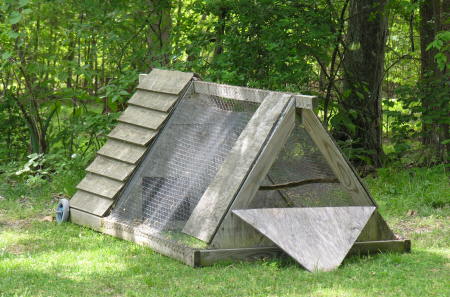
Chicken tractor from behind the milking barn

From this picture you can see that this tractor has an enclosed shelter area, which includes a nesting box elevated off the ground.  There is also an outside pen.  Both areas of the tractor are exposed to the ground.  Here is how the chicken tractor is operated.  Put the chickens inside.  Close the door.  Feed and water the chickens daily.  Move the tractor daily.  Clean out the nesting box periodically.  And that is all there is to it.

There are several advantages to utilizing a chicken tractor to house your fowl.  Because the chickens have access to your lawn at all times, they will help control insect populations.  The chicken droppings will help fertilize the lawn.  Most important, the chicken tractor should protect your birds from predators.

There are disadvantages to the chicken tractor as well.  The tractor has to be heavy enough to stay put in heavy winds. The weight makes it difficult to move unless it is designed with an efficient wheel mechanism (which the one above does not have).  In the photograph below, you can see another type of chicken tractor.  This is a commercial chicken tractor, manufactured in Missouri, that is designed to be both lightweight and strong.
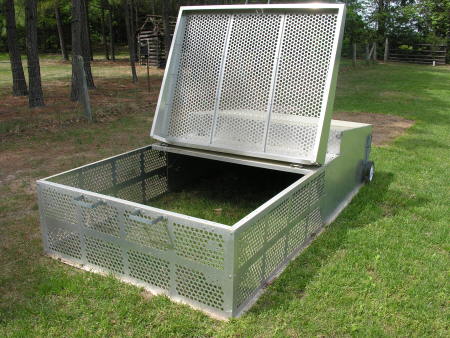
Aluminum chicken tractor

In this style of chicken tractor, the lighter weight is offset by the improved stability that the low, wide profile provides.  Varmints cannot overturn a tractor of this type, and it’s light weight make it fairly easy to move around your lawn.  In the following photograph, you can see the design of the three nesting boxes that are a part of this tractor.  The boxes have exterior lids, making it easy to collect eggs and add litter.  The slide-out floor at the bottom allows for easy litter removal.
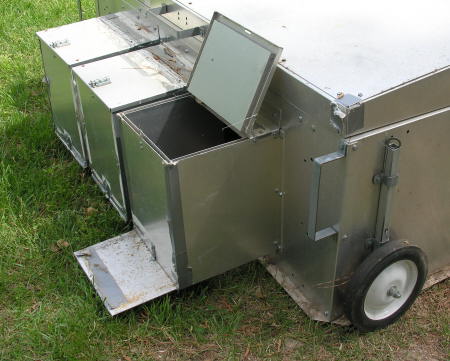
Well designed nesting boxes

Now for the bad news about chicken tractors.  The biggest drawback to the use of a chicken tractor is that, no matter how heavy and sturdy you construct it, varmints can burrow into it easily, simply by digging a hole in the ground anywhere along it’s sides.  We once lost a whole batch of chickens in one night alone, after some unknown critter dug its way underneath the sides of the tractor.

We now utilize permanent coops for our fowl, with concrete footings at the base.  This prevents critters from taking the underground route to our birds.  And what has become of our two chicken tractors?  The wooden tractor has become an infirmary and isolation ward for any bird that might happen to need that type of TLC.  And the aluminum chicken tractor is just the right size to store a pickup-truck size load of trash.  When it fills up with trash bags, I load the truck and take it over to the county transfer station to dispose of it.  But that is another story.

Dang Rocks!

Some people have all the luck. Take Pablo at Roundrock Journal, for instance.  Not only does Pablo have cute, cuddly, nameable rocks at Roundrock, such as Stoneman, he is also blessed with the good fortune to possess other memorable specimens.  Specimens with names like “Craters o’the Moon” and “Orange Rock”.  It almost makes you want to go out and adopt the first piece of orphaned schist you can find.  Don’t do it!

Rocks are evil. Evil, I tell you.  And how do I know this to be true?  Ladies and gentlemen, I grow rocks.  Real rocks.  Big rocks.  And I harvest these rocks.  Before you click away from this page, muttering something like “I know rocks, and Hal must be off of his”, let me tell you a little (true) anecdote.

During our first season of owning this place we call home, I spent a great deal of time picking up rocks from our various pastures and fields.  In two fields next to the house, I took extra pains to be certain I picked up all of the rocks, because I intended to add these fields into hay production, and hay equipment and rocks don’t mix.  Using the front-end loader on the tractor, a rock bar, and lots of stoop-labor, I eventually managed to strip these two fields clean of any rocks.

Winter came and went, then spring arrived, and the grass was growing tall.  When June rolled around the grass was just about in it’s prime to be baled.  Now it doesn’t make economic sense for me to cut and bale my own hay, so I usually have a neighbor do it for me on a share basis.  In this particular year, a neighbor named Boots came around with his tractor to cut the hay.  After just a short time cutting grass – BANG.  The sickle-bar mower had hit a rock, damaging several of it’s cutting teeth.  Boots replaced the damaged parts and began cutting again, when another loud BANG could be heard.  More damage to the sickle-bar mower.  And more time spent repairing the mower.  When this happened a third time, Boots came over to have a talk with me.

Boots:  “I thought ya said ya picked up all them rocks”

Hal:       “I did.  I picked up every rock in sight for nearly a month last summer” 

Boots:   “Yeah, but yer field growed more of them rocks this winter”   

Hal:        “My field grew WHAT this winter?”

Boots:    “It growed more rocks.   Didn’t ya harvest ’em this spring?”

Hal:        “Harvest WHAT?”

Boots:    “The rocks.  Ya gotta harvest ’em each spring”.

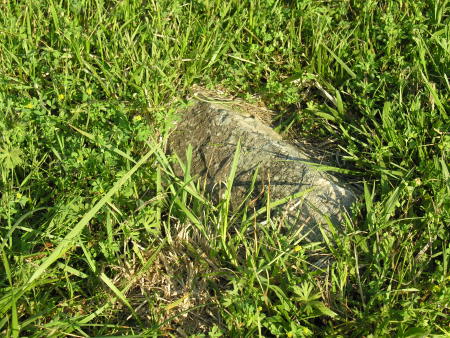
Now I thought that old Boots had been out in the sun too long or something, but you know what?  He was absolutely right.  These fields do grow rocks.  It is apparently part of a geological process that is normal in the Ozarks.  The best way that I can explain the process that is going on in my fields is to have you picture a batch of chocolate-chip cookie dough spread out in a pan.  This would represent my field – an amalgam of soil and rock.  If you were to pick out all of the chips that appear on the surface of the dough, leaving no more chips visible, that would be analogous to my picking up the rocks in my field during the summertime.  Whenever the soil expands and contracts, such as in a freeze/thaw cycle, or a wet/dry cycle, the resulting dynamics that ensue create an up-force to the rocks below the surface.  Eventually, they will rise to the surface, waiting for just the right moment to inflict their havoc on the unsuspecting, as seen here:

Lurking, always lurking!

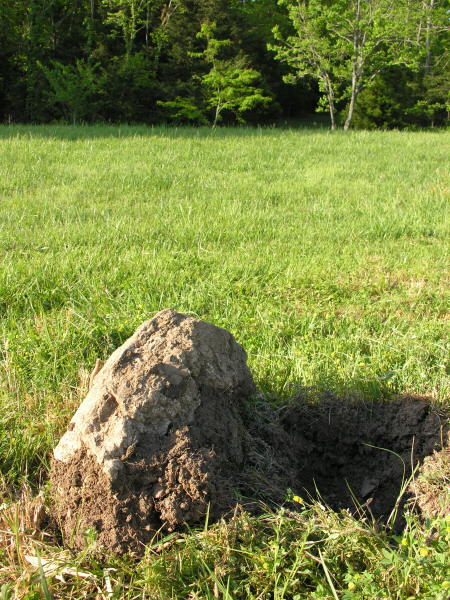
If you recall from a previous post, we suffer the loss of chickens and guineas due mostly to daytime predation.  In an effort to stem the tide of such losses, Retta and I have decided to take these two fields (closest to the house) out of hay production.  We intend to keep the grass short this year in these areas, in the hope that our fowl will stand a better chance of survival.  To that end, I was busy with the tractor this morning cutting the grass in these fields, when – BANG – the bush-hog hit a rock.  It was a sneaky rock, hiding like the one in the previous photo, barely above the surface of the soil, but extending out just enough to get snagged by the corner of my bush-hog:

Gotcha!!

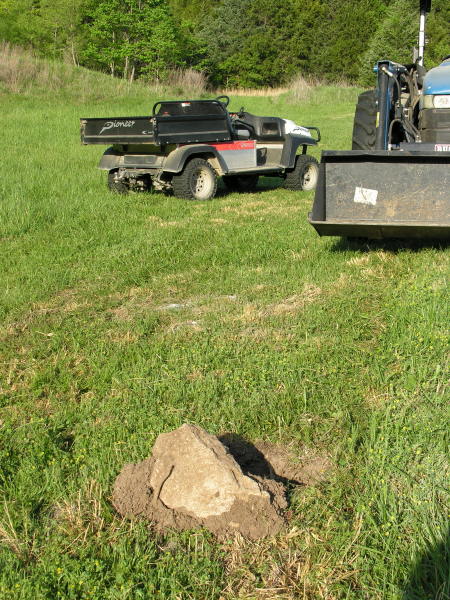
And here you see that, in addition to finishing up the mowing, Hal now has to haul away a big rock, fill in and compact a big hole, and fix the broken blade on the bush-hog:

DANG ROCKS !!!  DANG ROCKS !!!

These are the kind of evil, good-for-nothing rocks I have to deal with out here.  None that are cute, none that are cuddly – just DANG ROCKS!


Flashback Friday #1

Since this is the first installment of Flashback Friday, I thought it would be fitting to search for something to post that also related to a first of some kind.  When I came across these photos, my searching immediately ended.

Some years ago,  my daughter expressed an interest in learning to scuba dive.  Having a few dives under my weight-belt, I was totally thrilled at the news.  Sara enrolled in a basic open-water certification course (taught by her cousin Bruce), and after thorough training involving classroom work, pool training, beach dives, and open-water dives off of a commercial dive boat, she proudly had her C-card in hand.  Retta and I were living on a boat at that time, a trawler named Lorelei, so we said “Hey Sara, how about going out to the Channel Islands with us for some diving?”  “Sure”, she replied.  And so we did.

Gearing up for a dive

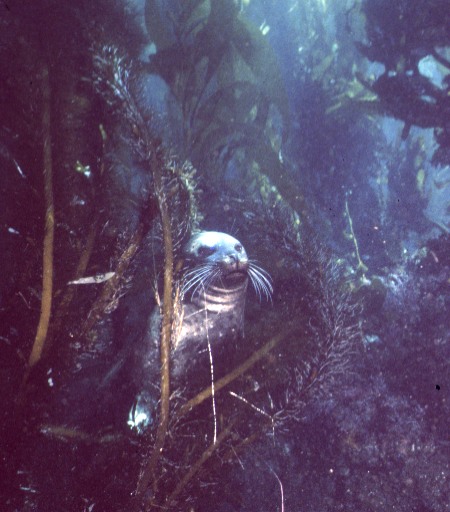
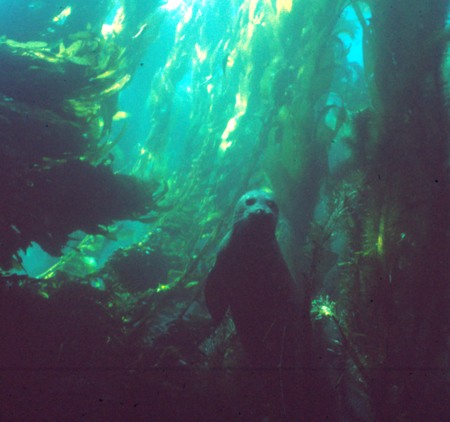
While we were gearing up for a dive along a shallow reef in the vicinity of the sea lion rookery on the south side of Anacapa Island, we spotted a harbor seal peeking out from the floating kelp fronds, apparently spying on us.

Who just dropped an anchor on my fin?

After finishing the ritual of gearing up and performing buddy checks on each other, Sara and I took turns entering the cool waters of the Pacific ocean with the finest back-rolls off the starboard bulwark that we could muster up.

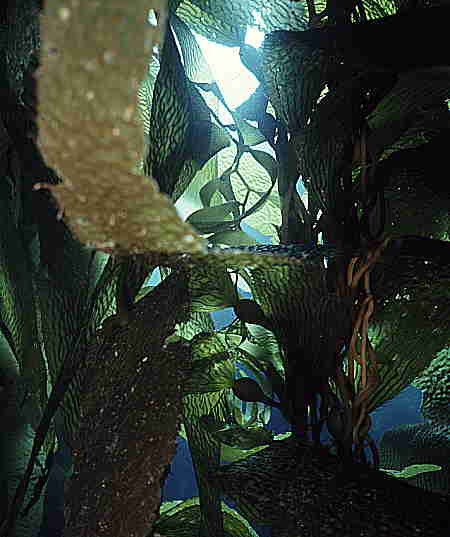
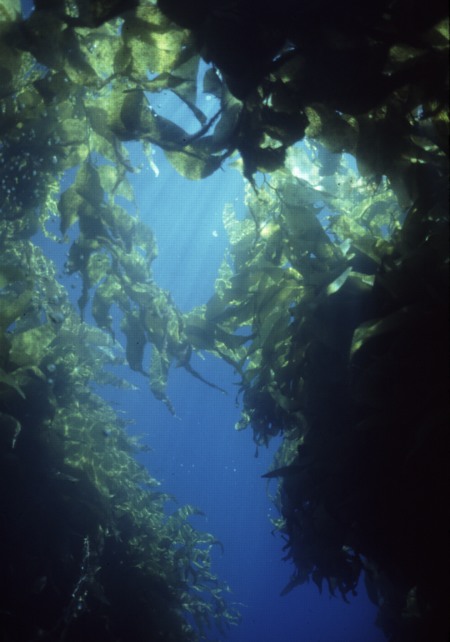
As we descended down the water column, we could not help but be entranced by the sight of the giant kelp, which sways to and fro in the gentle surge of the sea.

Descending into the kelp forest

As we continue our descent to the bottom, so that I can check to be certain that the anchor is securely set, we both continue to admire the surreal seascape that unfolds before our eyes.

The kelp forest is enchanting

As you gaze up at the sight of the sunlight, watching as the rays dance between kelp fronds, you can become so entranced with the moment that you don’t notice other things that surround you.  Like the harbor seal that Sara and I saw from the deck of the boat.

Who dropped an anchor on my fin? I want to know who dropped that anchor?

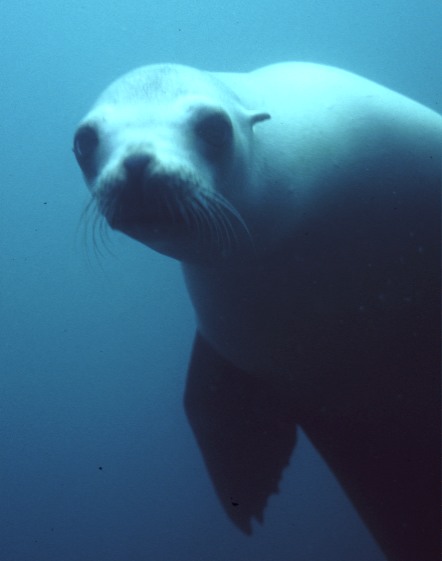
Because we had been so intent in our focus on the kelp, this harbor seal felt secure enough to approach us.  After spending a little while with us, the seal lazily swam off into the kelp forest.  Sara and I continued our dive, examining the various creatures that one is likely to encounter in the area, including a curious California sea lion.

Did someone mention an anchor?  There's one down to the left.

They say that all good things must come to an end, and so it was with this dive.  Sara and I made our way back towards the boat.  Locating our anchor line, we were about to begin our ascent when we spotted another harbor seal, apparently their to bid us adieu!

Please come back - but leave your anchor at home next time!

Slowly ascending along the anchor chain, we made a safety decompression stop at a depth of 15 feet.  When the required time had elapsed, we both made our way over to the swim platform, where we boarded Lorelei and stripped off our gear.  This had turned out to be a wonderful day.  The sun was shining.  The seas were calm.  The visibility underwater was excellent.  The marine life had been exceptionally cooperative.  But most important, Sara’s maiden dive as a certified diver turned out to be a great one!

Congratulations Sara - a job well done!

And Sara’s papa was proud.

A Little Tweaking Here and There

After three months of blogging, I thought it was time to pause and assess this site.  This has pretty much been a play-it-by-ear endeavor.  Since I had not planned on having a blog (see new page – “A Little About This Blog“), it stands to reason that I also did not have a clue as to what direction this blog should take.  I still don’t.  But no matter, I’ll press on anyway.  I have decided to make a few minor changes.

First, I have eliminated the category “Media Center Ramblins”.  I still like Windows XP Media Center, and I still use it daily.  But now that Microsoft has decided to incorporate the Media Center functionality into the upcoming Vista OS, I don’t think I will have too much to be saying about it in the future.  If I do, it will be included in “Computer Ramblins”.

Second, I will be increasing the frequency of posts in the “Photography Ramblins” category.  Having had dozens of cameras over the years, and photographic images numbering in the thousands (both terrestrial and underwater), I think that I can find something to say on the subject.
Third, I have included a new category entitled “Flashbacks in Time”.  Included in this category will be those things that I might have included in a blog 10, 20, or 30 years ago, had the technology existed at that time.

The fourth, and most significant change is the addition of a new feature, which I shall call “Flashback Fridays”.  Friday will be the designated day that I post items into the “Flashbacks in Time” category.  These posts will draw on my photographic collection, and will undoubtedly be quite varied in nature.

Considering my expectation was that I would be the only person reading my words and looking at my pictures, I am pleased to see that my web host reports the following:

Average successful requests per day: 2,660
Now if only I knew what that statistic means!

Now, What Was I Saying Before I Became Distracted?

Oh yeah, I remember.  I was out smoking a pork butt yesterday, thinking about what I might write about in Ranch Ramblins, when I was so pleasantly distracted by those turkeys (see previous post).  When an opportunity like that presents itself, you run with it.  So the turkeys became the subject of the post.  Which left me wondering afterwards, as I again basted the pork and added wood to the fire, “what should I write about tomorrow?”  And then it struck me – write about dinner.  Not just any dinner, but one of my favorites.  Smoked pulled-pork sandwiches, a traditional southeastern BBQ staple, but with an Arkansas twist to it.

Start with a pork butt (also called a pork shoulder) roast, about an 8-10 pounder will do.  Thoroughly massage your favorite BBQ rub into the meat.  Cover and refrigerate overnight, giving the rub time to permeate the roast.

Make a batch of cole slaw, using your own favorite recipe.  If you like it tangy, make it tangy.  If you want it creamy, then by all means, make it creamy – after all, you are the one who will be eatin’ the sandwich, so it’s your choice!  Cover and refrigerate overnight, to give the cole slaw a chance to season (“fester” is what I usually say, but Retta thinks that’s gross).
Early the next morning, preheat whatever type of smoker system you use, and allow the meat to come to room temperature.  Use any of the common smoking woods you prefer.  I like a strong smokey flavor to this dish, so I use mesquite, but it is equally good with any of the others, such as hickory or oak.  Some people swear by peach wood for smoked pork.  The point is, whatever your preference, do it!  You’re eatin’ the sandwich, so it’s your choice. 

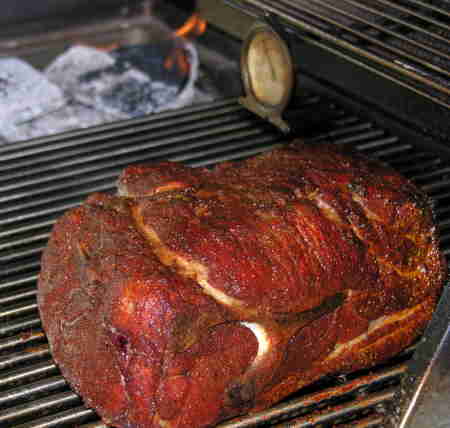
Maintain a smoker temperature between 240-260 degrees.  Place the pork butt (with fat cap facing up) in the smoker.   Smoke until a meat thermometer reads 190 degrees.  Spray the meat occasionally with your favorite basting liquid.  I use apple cider mixed with a little cider vinegar.  You use what you want, because……  you’re the one who will be eatin’ the sandwich, so it’s your choice!  After about 12-14 hours of TLC, it should look something like this –

Pork butt smokin' away!

Be careful removing the pork from the grill, because it’ll tend to want to fall apart.  That’s how tender it should be.  After the pork butt rests for a while, pull it apart with a couple of forks.  Try not to eat it all while you are shredding it apart!

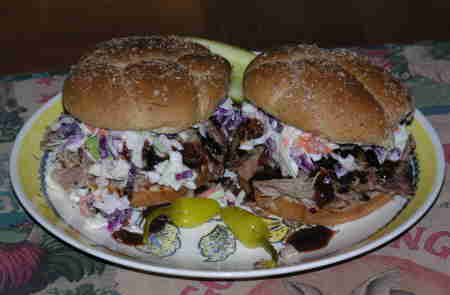
Place a heaping mound of the shredded pork on a bun of your choice.  I like cracked wheat buns, but use what you want, because……  you’re the one who will be eatin’ the sandwich, so it’s your choice!  Drizzle your favorite BBQ sauce over the shredded pork – careful, not too much.  I like to experiment with all different kinds of BBQ sauces, because, like snowflakes, no two are alike.

Now, for the Arkansas twist.  Take a generous portion of cole slaw, and pile it on top of the shredded pork.  Serve the pulled-pork sandwich with a dill pickle spear and some hot peppers, and you’ve got yourself some good eatin’!

Yummy!

A Pleasant Distraction

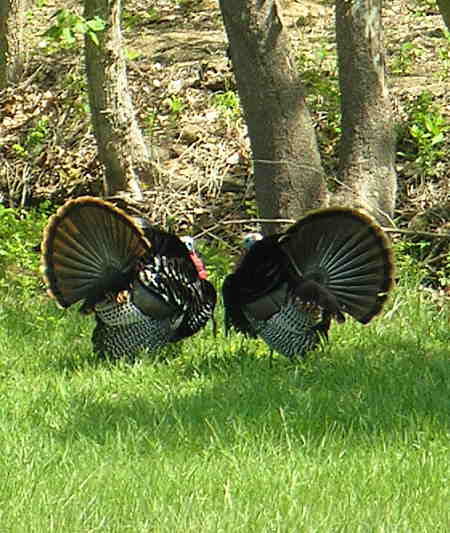
Around noon today, as I was feeding mesquite chunks into the firebox of the smoker and wondering what I might post in Ranch Ramblins today,  I heard the unmistakable sound of a gobbler in the distance.  Springing into action, I grabbed the spray bottle and quickly gave the pork butt a liberal basting of apple cider to keep it moist.  Striding into the house, I grabbed the camera and went out front, and there I saw these two guys.

Struttin' their stuff

These wild tom turkeys were in the process of courting a hen, who was situated across the creek.  It is always a joy to watch their antics, as they try to outdo one another in their quest to attract the hen.  Much like teenagers.

Things Found on Trees

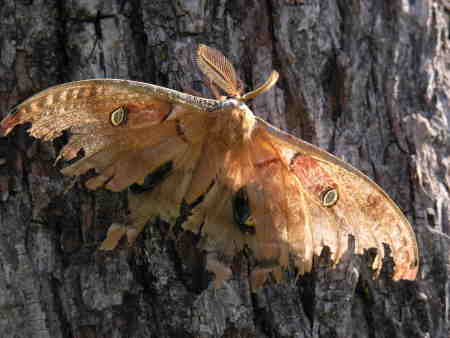
When Retta went out this morning to do her early chores around the barn, she discovered this beautiful large moth on the trunk of a black walnut tree.  She told me to go and get the camera before the moth departed, and fortunately, when I arrived with camera in hand, the moth was still there.

A very large moth on a black walnut tree

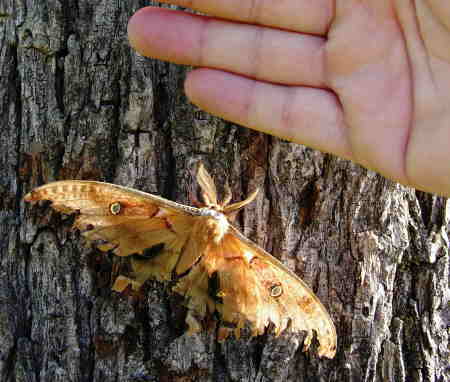
In the following photo, I am not trying to catch the moth, but this was the only “handy” way to indicate scale –

A

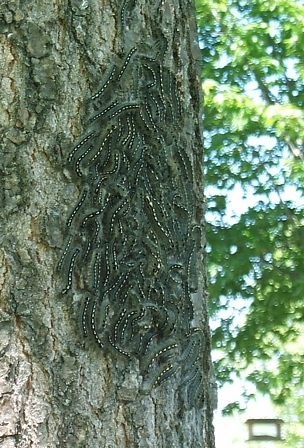
A few years ago Retta again discovered an interesting find on an oak tree in our yard.  I have never encountered this kind of aggregation of caterpillars before, and we haven’t seen it happen since.

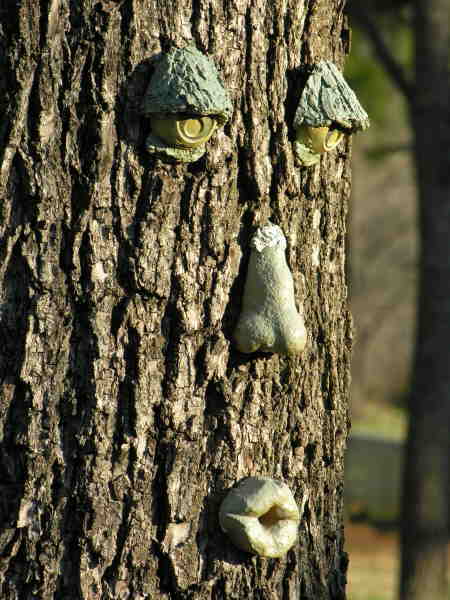
Last, but not least, I cannot forget to include my friend Morton, who keeps constant watch over me as I perform my yard chores.

My landscaping supervisor

AN APPOLOGY TO ALL:  I am sorry for possible slow loading times in the last few posts.  I was working on another project, and forgot that I had tinkered with my JPEG compression settings.  I have reset it to a more appropriate level for the blog.  Photo load times should be quicker from now on, as the file sizes will be much smaller.

A Sunday Morning Constitutional

This morning I read a post on Geek Acres referring to a comment on a post at Roundrock Journal regarding mayapples.  The comment was:

“mayapples and morel mushrooms (when spotted) are frequently in the same area.”

Armed with this information, Retta felt it was our duty to immediately begin a search of the area of our property most likely to have mayapples, in hopes of finding the elusive, yet delectable morel mushrooms that might possibly be nearby.  Off we went, heading towards an area that I knew hosted mayapples.  This spot we were seeking is alongside a small spring-fed creek, and the land in this particular area tends to be boggy for a few months a year.  It seemed to be an ideal habitat in which to find morels.

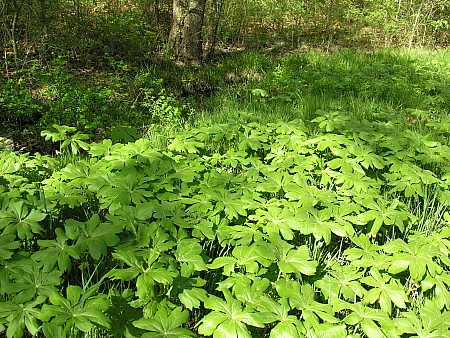
Mayapples along creek

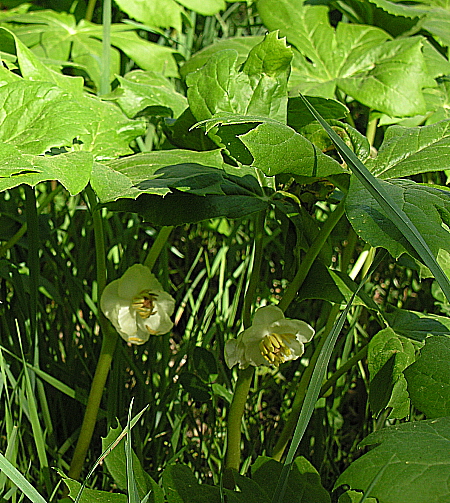
At last we arrived at our destination, and there, in all of their glory, was a group of mayapples.  Our timing was good, as the mayapples are in bloom just now.

Mayapple blooms

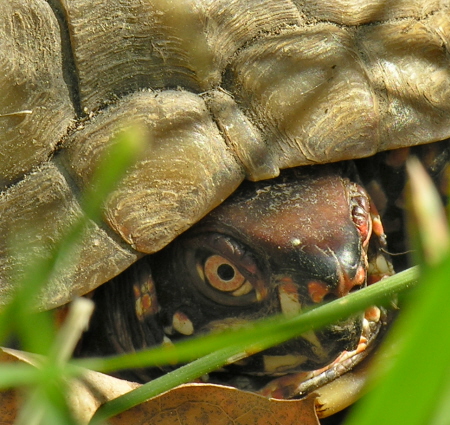
This was a nice find on a beautiful Sunday morning.  Retta and I began to search the surrounding area, looking here and there on our quest for the elusive morels.  My searching was being disrupted, however, by a strange and eerie feeling that I was being watched.  This feeling wouldn’t shake me, and so my thoughts soon drifted away from the sought after morels, and instead focused on finding the source my mysterious trepidation.  After a little time spent looking around, it soon became apparent why I had felt spied upon –

So that's who has been spying on me!

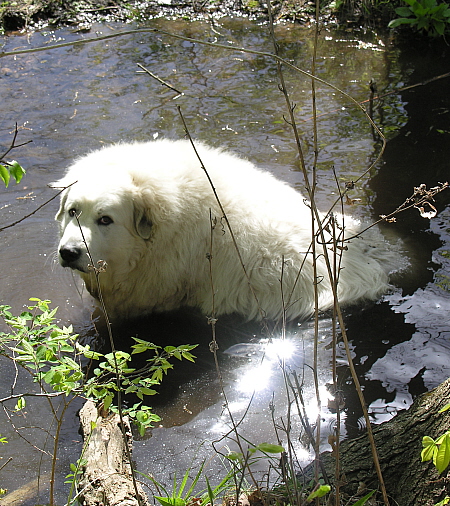
Knowing now that my life was not in any danger, I felt obligated to continue on the quest.  There did not appear to be any morels in this area, so we continued on to another likely spot, along an adjacent creek.  Since it was a warm morning, Gracie decided to take a sitz bath in one of her watering holes within the creek bed –

What a relief from the heat!

And when she was finished with her sitz bath (or should I say mud bath), she now became the focus of my attention.  And to think, Retta and I had just brushed her out earlier this morning!

Oh, no!

After spending some time looking for morels in this location and not finding any, we decided to press on to another spot we thought might be an appropriate environment for these mushrooms.  Along the way, however, we happened to pass a stand of black walnut trees, and decided to spend some time enjoying the beautiful flowers that awaited us there –

A pretty place to relax in the shade.

Search as we might, there was just no locating those very elusive, tantalizingly tasty morel mushrooms.  So I guess this morning wasn’t a success, was it?

What’s a Bush Hog?

In a comment to the previous post “How Can You Not Love A Face Like This?”,  MrC posed the following question:

——-

Earlier, Hal said “…as I bush-hog a field.”

Us city-folk are not so sophisticated.  I don’t know what bush-hogging is, but it sure doesn’t sound like something I would do to my wife.  :-)
———

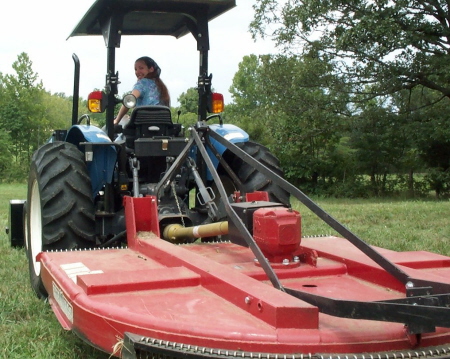
Well, MrC, this is a bush hog.  Actually, Bush Hog, as that is the trademark used by the Bush Hog Company to market their brand of rotary cutter (they were the inventor of this farm implement).  It is also referred to as a brush hog, a rotary cutter, or a shredder.

Bush hog

The implement my daughter is modeling above is a Bush Hog brand 7′ diameter rotary cutter.  Think of it as a lawnmower on a massive dose of steroids.  It will cut through grass, weeds, brush, and saplings up to 3 1/2″ in diameter.

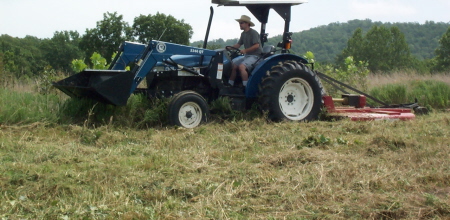
David at the wheel

In this photo, my son is demonstrating the proper technique for bush-hogging.  Notice the height of the grass and brush beyond the tractor?  It was definitely time to cut this field.  We schedule the cutting of our fields and pastures to create a habitat suitable to the needs of the varied wildlife in our midst (which will be the subject of a future post).

When you have finished bush-hogging a pasture, after a week or so it will look like this:

Finished product

When you have finished bush-hogging your wife, after a week or so she might look this:

Sorry dear!

So, in conclusion, I would suggest that MrC and all the other city-slickers out there heed the following advice. DO NOT, under any circumstances, bush-hog your wife!

How Can You Not Love A Face Like This?

What are you looking at, huh?

Duane from Geek Acres (see previous post) had a recent post on his site about ticks and the use of guineas in controlling them.  Duane and Jennifer have considered owning guineas, and a commentator advised them:

———— 

“DON’T DO IT MAN!!!!!

Guineas may look all tiny and cute and helpful – but they are mean!!!

My parents had some on our farm. They constantly attached our sheep and other birds(including fights to the death). On the other hand they are fairly small. Up to you, just be aware I have talked to several other people who have the same sentiment about them. If any of your dogs are timid and are going to be in the same area as the guineas be aware they might get attacked also.”

————-

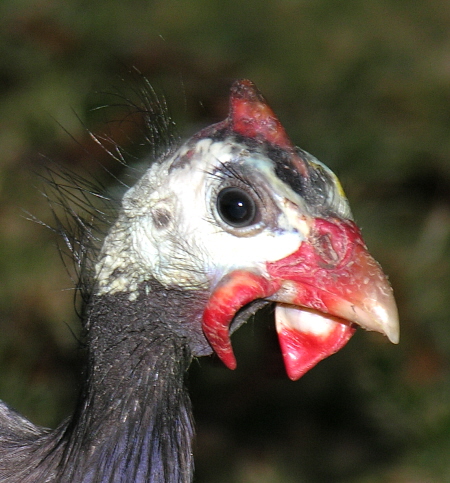
We want to take this opportunity to come to the defense of these poor, misunderstood, lovable creatures.  If you look closely at the first photo (above), you can clearly see the affection in this bird’s eye – not an iota of meanness is apparent in it’s countenance.

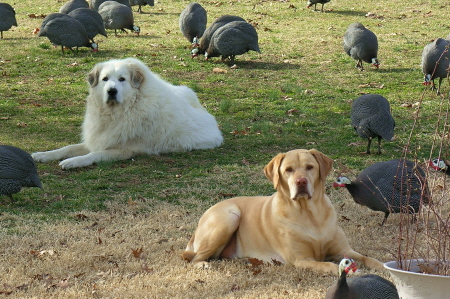
In the photograph below, do the dogs look the least bit disturbed by the presence of the guineas?  They’re not, and for good reason.  The guineas we’ve known have all been gentle creatures, who display a curiosity towards those around them.

Let the fighting begin!

Now, if you are really looking to possess a bird with aggressive tendencies, make sure to get a rooster.  They possess wickedly long, strong and sharp spurs, which they are prone to use at the slightest perceived provocation.  Imagine placing a carpentry nail against your shin.  Now, have a friend(?) whack the nail with a hammer, hard enough to cause the nail to penetrate bone.  Ouch!!!  That is what the spur of a rooster can, and will, do. Retta has a scar or two to prove it, ask her. 

The guineas are pretty smart, in their own way.  For example, they quickly learn that the discharge chute from my lawnmower emits oodles of lush, green grass.  Consequently, when I mow, I have a flock of guineas chasing after me and my mower (I’ll have to ask Retta to photograph this sometime – it is pretty comical, at least it has me grinning as I mow).  They have also learned to chase after the tractor as I bush-hog a field.  They quickly grab the grasshoppers and locusts that scatter in all directions when I pass.  In a fine Pavlovian manner, they come running whenever they hear the sound of the tractor or mower starting.  You can almost see them drooling!

We have seen a marked improvement (IE decline) in the tick population in the areas that the guineas patrol.  They lead a pretty boring life.  Unless nesting, they spend most, if not all, of their waking hours eating ticks (as well as other bugs).  They don’t scratch around everything, as chickens do, so your plantings are pretty much safe from them. 

Guineas play a cute game (at least I think it’s a game) which I call “Guinea Keep-Away”.  The guineas usually travel in flocks.  When one member of the flock finds a grasshopper, say, he will pick it up in his beak and run away with it.  This arouses the suspicion of the rest of the flock, who chase the first guinea to see what it has.  The first guinea, invariably, will drop the grasshopper.  Another guinea will pick it up and also run with it, until such time as he drops it.  Another guinea picks up the grasshopper and runs, and thus the cycle continues.  I don’t really know if this is “sport” or not, but it is consistent behavior, and it certainly appears as a game to me.  Oh yeah, they also perform this exact behavior with mice (that our cat tortures half-to-death) dangling from their beaks – gross!

Guineas help attract wild turkey to your property.  The turkey seem to sense the comfort level that the guineas have around humans and their paraphernalia, and hence are more prone to come around an inhabited site that has guineas.

But lest you think there are no negative traits with guinea fowl, consider this.  They are noisy.  It is said that they make fine “watchdogs”, in the sense of raising an alarm at anything that arouses their suspicion.  The problem is, they suspect almost everything and everyone, so expect to hear a lot from them.  And their grating, squawkish rasp sounds much like an axle that hasn’t seen grease in a long, long time (eeek… eeek… eeek… eeek… eeek… eeek… incessantly when aroused).  At those times, you can forget about taking that much anticipated nap in the patio lounge!  And if you have neighbors that live close by… well, you can imagine.

 Just shut up already, I heard you the first time!

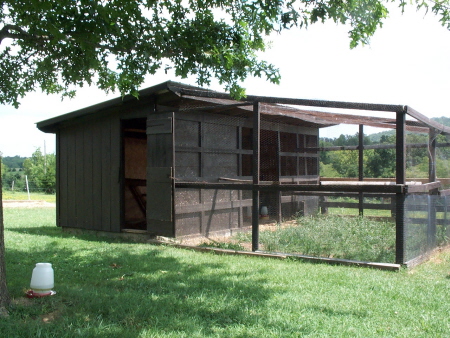
We raise our guineas from keets (chicks), that we usually get shipped from a local hatchery.  We have used Cackle Hatchery, in Lebanon, Missouri, and they have been dependable.  After raising the keets inside the house for several weeks, we transfer them out to the poultry pen pictured below.  It has a concrete footing, an interior portion with roosts, and an exterior “courtyard”. 

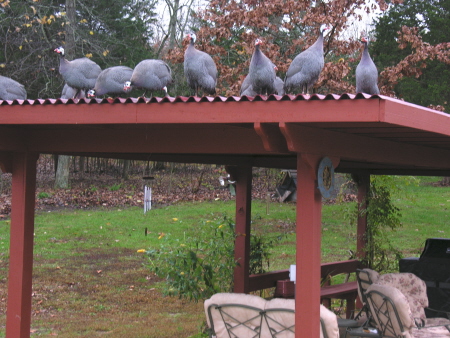
We keep the keets locked up in the coop until they are nearly fully grown.  By waiting until they are grown, the guineas seem to develop a sense of home.  At that time, we release the birds in the morning to roam around the grounds.  In the evening, the loose guineas return to the pen (sometimes with a little coaxing).  As the seasons warm up and summer approaches, some of the guineas decide that they would rather sleep on top of the pen, rather than inside.  There isn’t much we can do about it.  They are safe from ground predators there, but we believe that we lose several a year to owls swooping down on them at night.

Low-income housing

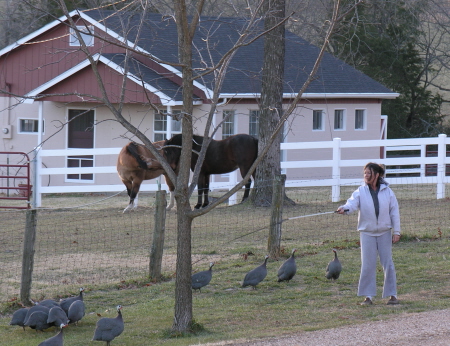
But credit for our success with guineas definitely goes primarily to Retta.  It is Retta who buys and raises the keets, and feeds, waters and generally sees to their well-being. And, as the photo below proves, she spends a lot of time in a rigorous training regimen.  Here, she is training the guineas to walk in single-file  ;>)

Rigorous training techniques are utilized

In conclusion, I’ll offer my advice to Duane and Jennifer:  DO IT MAN!!! You won’t regret your decision.