Flashback Friday #4

Lessons Learned the Hard Way

In the early 1970’s I owned a Toyota Landcruiser (“Toy”) that I came to believe was jinxed.  While this vehicle brought me plenty of pleasure in it’s ability to allow me the freedom to explore rugged terrain, it also had it’s share of tempermental moments.   For instance, once on a trip to Oregon to visit my friends Craig and his lovely wife Linda, the three of us decided to explore a slough off the Willamette river.  Along this slough, there were numerous shallow puddles of standing water that we wound around and motored through.  The shimmering water in the afternoon sunlight was an enchanting sight to behold.  So much so that I lost focus on what I was doing and drove directly into a deep hole filled with water.  Darn jinxed Toy!  “Well, this is no big problem” I thought to myself.  We can just back out of this measly little puddle.  I believe Craig just chuckled to himself as he hopped out of the Landcruiser to snap a picture.  Linda was apparently confident at this point in time, at least as far as I can tell from the picture below:
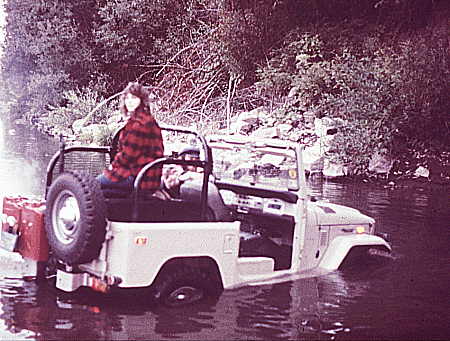
We'll get out of this mess

Putting the transfer case into granny-low gear, I attempted to back the Toy out of the puddle.  We were sitting on a silty surface, however, and the vehicle tires promptly dug themselves into the mud.  Darn jinxed Toy!  “Well, this is no big problem” I thought to myself.  We can just get out the high-lift jack, jack the Toy up very high on the jack, and then push the Toy over to the side, thus putting the tires on a more solid footing.  I believe Craig just chuckled to himself as he hopped into the water to help me along with this scheme.
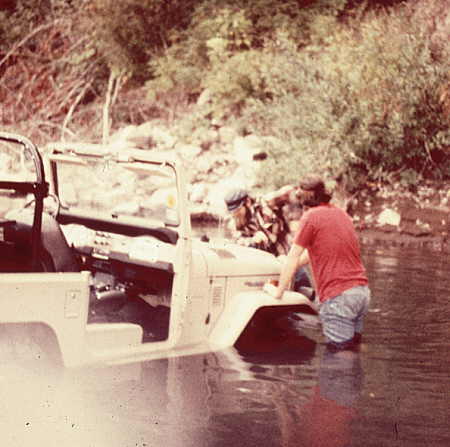
Hmmm - this doesn't seem to be working

This incident occurred over thirty years ago, and so my recollection of the exact events that transpired from here on may be a little rusty, but I think it went something like this.  Craig and I spend hours and hours trying out various schemes and methods in our attempt to free the Toy.  I recall Craig doing a lot of chuckling in the process.  I recall myself uttering a few curses.  And I recall that we were totally unsuccessful in freeing the Toy.  I had managed to flood the engine with water however, and now we had no power.  Darn jinxed Toy!  “Well, this is no big problem”  I thought to myself.  Actually, “this is now a problem” is what I really thought!

In this part of Oregon, at least back at that time, logging was in full swing.  Fortunately for me and the Toy, Craig pointed out that there was a saw mill located nearby.  It was now near midnight, and we figured (actually, Craig figured) that if we hurried on over to the mill, we might find someone to help us out of our predicament, as the mill shift change occurred at midnight.  Sure enough, we found a man with a four-wheel drive pickup sporting a winch (not an unusual sight in Oregon) who agreed to help us.  Soon, he and his winch had the Toy back up on solid ground.  This kind and helpful man even towed my now non-operating vehicle to a local service station, where we parked it for the night.

The following morning, Craig gave me a ride to the service station, where I learned from the mechanic that yes, he could drain and flush the engine, transmission, transfer case, front and rear differentials, but that it would be very costly.  Darn jinxed Toy!

The following year, while out exploring in the California desert with some friends, we had a little competition to see whether my Landcruiser F-40 could outperform their Jeep CJ5 over a rugged desert trail.  Up and down the hills and ravines we drove (in a designated ORV area, I should note) pushing our vehicles to the limit.  My Toy performed admirably in this battle of the 4WD’s, that is, up until the very last hill on the trail.  I was so thrilled over the prospect of a good showing amongst my Jeep driving friends that I lost focus once again, and drove over a large rock that I shouldn’t have.  My vehicle became high-centered on a boulder, and I was once again stuck.  Dang rocks!   Darn jinxed Toy!
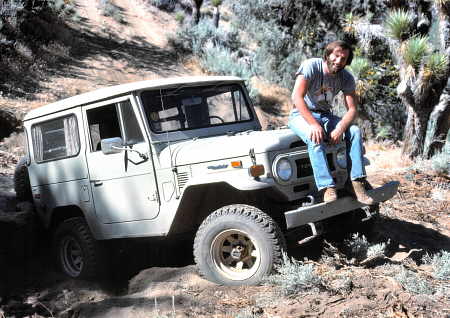
When will I ever learn?

Later that same summer, I again headed up north, this time to the west coast province of British Columbia, where I was keen to do some hiking.  Along the way, in Washington state, I met a nice couple who were very interested in my Landcruiser.   After much discussion about the pros and cons of owning such a vehicle, we decided to do some day hikes together.  When they learned that I was headed towards the Canadian Rockies, they offered me the use of a cabin they owned in BC.  They told me that they had built a bridge over a river that runs alongside the cabin, and that the hiking from that point was excellent.  I took them up on their offer, and so they proceeded to draw a map directing me to their remote cabin in the woods.  When I arrived at the cabin, this is what I found –
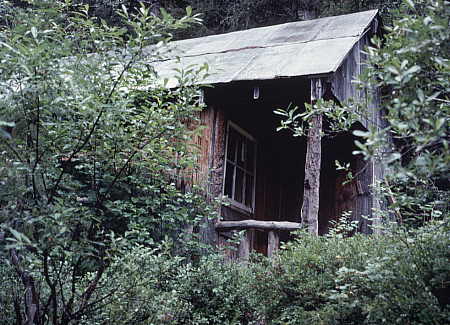
 This is the place I'm supposed to stay in?

Parking the Toy, I investigated this old dilapidated structure.  From inside, you could see rays of daylight streaming through the roof.  There were all manner of creepy-crawlers on the floor and on the walls.  Droppings from vermin was everywhere.  This was not the type of accommodations I had expected, and I refused to stay in such quarters.  Exploring out back, I found what appeared to be some type of old storage structure, or maybe an old hog shed.  Whatever it was, it was clean inside and had a functional roof, so it became the base camp for my hiking.
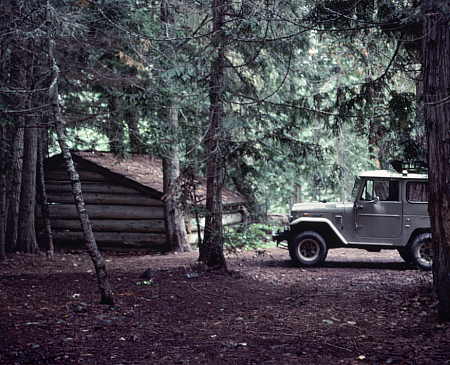
A good place for shelter from the rain

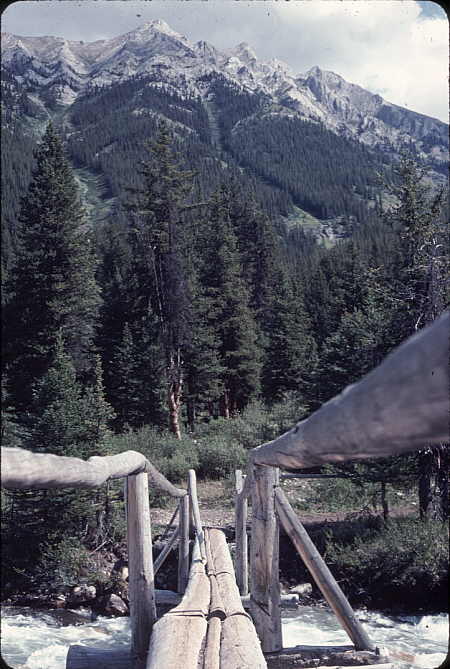
Even though the cabin that the couple had told me about had not lived up to my expectations, the hiking that was available beginning across their bridge was some of the best I have ever encountered. 

A great place to begin hiking

After spending a week hiking and camping out in the hog shed, I decided that it was time to push onward in my journey.  As I loaded up the vehicle with my camping gear, I noticed a large puddle of fluid underneath the front of the Landcruiser.  Getting down on my hands and knees to investigate, I discovered that some critter had chewed through the lower radiator hose, thereby releasing all of the coolant from the radiator.  The vehicle was again non-operational, and I was stuck far from any village or town.  Darn jinxed Toy!  “Well, this is no big problem” I thought to myself.  Having the foresight to pack the always-essential roll of duct tape in the tool box, I proceeded to wrap the damaged hose with tape, fill the radiator with water from the river, and limp on over to the nearest town, where proper repairs were undertaken.

It was not until years later, after I had sold that Landcruiser, that I finally realized what wonderful experiences that Toy had given me.  And looking back, I can now see that I was the cause of most of my travails with that vehicle, not the vehicle itself.  So the lessons learned are A) look to yourself as the cause of your follies, and B) drive a Jeep instead of a Toyota!

Bridging the Generation Gap (Part 1) – 35mm Film/Slide Scanners

Of course, the generation gap that I am referring to is the technological generation gap that exists in the photographic world today.  On one side of the chasm you have new, digital technologies that reduce the visual world to an ordered series of 0’s and 1’s stored within a digital file.  On the other side of the chasm are the traditional photographic technologies that rely on film and emulsion to be the storage media for the image. 

If you are young enough to be a product of the digital era, it is likely that all of your accumulated photographs already reside on your computer, so you will find yourself standing securely on one side of the digital divide.  If you happen to be old enough,  it is likely that all of your accumulated photographs are of the traditional film type, and it may be that you are quite content with the status quo.  If so, then you will find yourself standing equally secure, but on the opposite side of the digital divide.  In between these two extremes, however, are legions of photographers (myself included) who possess both digital images and film images, perhaps numbering into the thousands for each type.  For these photographers, questions often arise as to the best method of moving an image back and forth between film and digital media.

Over the past years, I have struggled with some aspects of the film-to-digital, digital-to-film conversion dance.  Although not an expert in these areas, I have learned a few things from both my successes and failures, so I will share them with you in a seriously serious series entitled “Bridging the Generation Gap”.   Part 1 shall begin where I began my own journey into this brave new world, with 35mm film/slide scanners.

In 1993, there were no consumer digital cameras.  Kodak had just recently announced the DCS 200, based on a Nikon 8008 camera body, but that was a professional 1.5 mega-pixel camera that sold for over $10,000.  Without a lens!  While there might not have been consumer digital cameras, there where plenty of computers around, and plenty of people who wanted to digitize their film-based photographs in order to edit, print, share and archive them. I was one of those people, and so I began my search for a scanner capable of digitizing the thousands of 35mm slides that I had accumulated over the years.

The first scanner I owned was a Nikon Coolscan LS-10e.  This was a 2700 dpi – 8 bit per color channel slide/film scanner that was considered to be of excellent quality in its’ day (1993), and which sold for approximately $2000.  This scanner would produce a 24Mb uncompressed tiff file from a 35mm frame.  I can honestly say that I pushed this scanner system to it’s limit.  I can also say that this system was a nightmare to install and use.  I use the term “scanner system” deliberately, because at the time this scanner was marketed by Nikon, there were three critical components necessary to create a successful scanning environment; the scanner device itself, the computer interface, and the scanner software provided by the scanner manufacturer.

To explain the shortcomings of the Nikon scanner system, I really must take you back in time and refresh your memory as to the state of the graphics world in 1993.  Apple Computer was the name of the game, and a Mac was the machine you needed to have.  Adobe ruled the graphics/imaging software world, and Photoshop Version 2.3 reigned supreme.  In the PC world, the Intel Pentium chip had just been introduced, and this 60 MHz “screamer” could be had for as “little” as $878.  If you were at the cutting edge, you would have been thinking of upgrading your Microsoft MS-DOS Version 6.0 to Windows for Workgroups Version 3.11.  Woe unto the poor, misguided soul who dared venture into the graphics field armed with merely an Intel/Microsoft based PC.

Why was it so difficult for us PC guys to use our computers for digital imaging?  If you examined Photoshop v2.3, for instance, you would find that the software was originally written and optimized for the Mac platform, and then (poorly) ported over to the PC platform.  Ditto with the scanning software provided by Nikon for the LS-10e.  Originally designed for the Mac, it too was a botched port to the PC platform.  Added to this unfortunate mix was the fact that the Nikon LS-10e driver relied upon a specific Adaptec SCSI interface board to communicate with the computer, and that particular Adaptec board had numerous issues with the extended memory managers that were a necessary part of the PC’s configuration back then.  Despite all of the problems, Nikon and other imaging vendors recognized the huge market the PC represented, so it was “off to market” with whatever products they had at hand.

I could write a a very long article about all of the problems I had with the Nikon LS-10e scanner system, but that is not the purpose of this post.  Suffice it to say that for every scanning session, I had to reconfigure autoexec.bat files, config.sys files, reorder the devices attached to the SCSI daisy-chain, reboot the system, say my prayers, and then scan.  If my prayers were answered, the scan would be successfully completed without crashing the computer two or three times.   When finished scanning, the entire process had to be reversed to enable normal use of the computer.  Add to this the problems encountered, and the time consumed when trying to perform digital editing of a 24 Mb image file on a machine that could only “see” 640k of the file at a time, and you had a scenario in which a person had to be pretty motivated (or have had plenty of free time) to do any serious scanning.  Having said that, the results obtained after exerting all this effort in scanning a slide or negative were excellent.  The Nikon scanner was great at rendering an accurate and pleasing image file for those images that I scanned using it.  But because of the enormous time commitment involve in the process, I never even came close to my goal of digitizing all of my old film-based images.

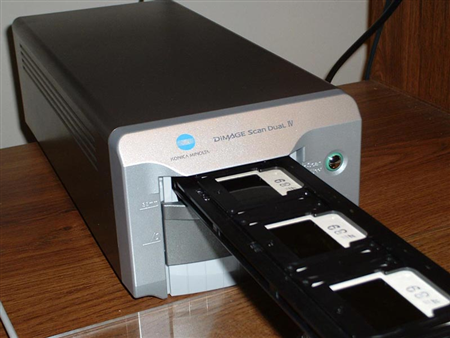
Two years ago, I decided that the time had come to reopen the book on my slide/film scanning escapades, and so I again ventured out into the 35mm slide/film scanner marketplace.  What I discovered was that the slide/film scanning situation had changed very dramatically since my last foray into the arena a decade ago.   After examining the offerings available, I settled on a Konica/Minolta Dimage Scan Dual IV 35mm Slide/Film Scanner (whew… that’s a mouthful). 

Konica/Minolta Dimage Scan Dual IV 35mm Slide/Film Scanner

This scanner is a 3200 dpi – 16 bit per color channel 35mm slide/film scanner that also accommodates APS film.  This scanner will produce a 70Mb uncompressed tiff file from a 35mm frame, or nearly 3 times the information capacity of the Nikon Coolscan produced file.   The scanner connects to the computer via USB 2.0, so it is simple, quick and readily available to most users.  The scanner is supplied with the scanner utility software as well as a copy of Adobe Photoshop Elements.  I paid less than $250 for this scanner in 2004.

My experience with this scanner has been diametrically opposite of my experiences with the Nikon scanner of the 1990’s.  After the initial installation, which involved nothing more than inserting an installation CD into the drive and then plugging the USB cable into the computer, the scanner worked flawlessly.  I have used this scanner to scan hundreds of slides, and it has yet to crash in the midst of the process.  The Nikon Coolscan, on the other hand, would sometimes take two or three rebooting cycles of the computer just to achieve one successful scan.  The slide holder (which can be seen in the photo above) holds four slides at a time.  Now that I have become familiar with the software and have established a usage routine, I can prescan four slides, apply minor image correction and cropping to each image, and complete the final scans on all four images in less than ten minutes.  So at a rate of about 20-25 slides per hour of work, I am slowly making a dent in my digitizing efforts.

Quality of Scan Issues

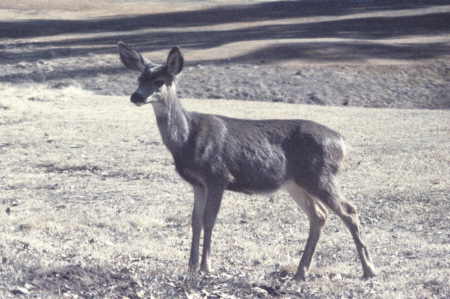
For the type of usage that I have put my scanners through, I can make a few general observations regarding image quality.  The first observation is that the quality of the scanned image is directly related to the type of film that is scanned, regardless of which scanner you use.  The results of both the Nikon and Konica/Minolta scans reflect the fact that grainy films produced poor scans from each.  For example, here is a scan produced by the Konica/Minolta scanner from a GAF color ASA 400 slide film (which is considered a grainy film). 

GAF ASA 400 Film example

This scanned image has lost most of the sharpness that exists on the original slide.  Additionally, if you examine the shadow areas at the top, the grain of the film becomes apparent, much more so than when the film itself is examined under a loupe.

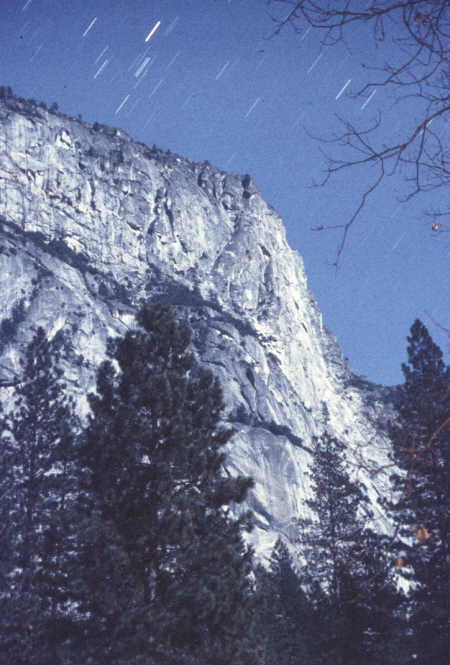
And the following example is also GAF ASA 400 slide film, scanned with the Nikon Coolscan.  This photo was taken in Yosemite National Park at night, using a time exposure (notice the stars in the sky).  You can really see how the grain is exaggerated in the sky with this scan.

GAF ASA 400 Time Exposure

The second observation is that both scanners produced excellent results when the film in question was a good exposure taken on a fine grained film.  Here are two more examples to illustrate this point.  The first is a photograph taken with Fuji Velvia 50, considered to be a highly saturated and fine grained color slide film, and originally scanned with the Nikon Coolscan:

Spanish Shawl Nudibranch

Notice the deep saturation of the resulting scan, and also notice that there are no grain artifacts in either the background, or in the “skin” of the Spanish Shawl nudibranch.  The following photograph of a Corvette fender (everybody has a photo of a Corvette fender, don’t they?) was taken with Kodacolor ISO 100 film, and it was scanned with the Konica/Minolta scanner:

Kodacolor ISO 100 slide film

In examining the photo above, you will see bright saturated color, and no hint at any graininess.  The detail in the images has been retained in the final scan, and artifacts are kept to a minimum.  Overall, I have been very pleased with the quality of the scans that I have made with both of these systems,  but I have been extremely pleased and surprised at the ease of installation and use of the newer generation Konica/Minolta scanner.

As a concluding thought, I would say that the goal of digitizing my collection of slides will probably be accomplished eventually, but not in the near future.  At a rate of 20-25 slides per hour of work, the scanning process is still a slow procedure.  Fortunately, I do not shoot with film anymore, so my collection of film-based photographs will not be growing.  In the meanwhile, it is quite enjoyable to see pictures taken long ago become available for viewing and sharing on a computer platform.

My Boots

Any person who has spent an appreciable amount of time hiking through the hills and hollers of the Ozarks undoubtedly owns and loves a favorite pair of boots.  It does not matter how many pairs of boots one may own, nor for what purpose, there will always be one favored pair among them.  I own few shoes.  But I own many boots.  When your activities revolve around the outdoors, you tend to get that way.  And indeed, I do have a favorite pair of boots.  I just call them “my boots”.

Now in the winter, just after 6″ of snow has fallen and it is 10 degrees outside, I would probably choose to put on my insulated high-top hunting style boots to tromp around in the woods.  If the snow conditions happened to be just right, and I had the energy, and if my back weren’t hurting from lugging diesel fuel, then I might elect to lace up my cross country ski boots, step into my cross country skis, grab the ski poles and pretend that I were still young enough to do these sort of things.  Afterwards, I would probably want to lounge around a warm fire in the fireplace, which means that I would have to trek through the snow to get firewood.  This would call for my lightweight, zip-up insulated snow boots, which are perfectly matched to this task.

When a more formal occasion presents itself, such as an anniversary or birthday dinner at a sit-down restaurant, then the footwear of choice would be a pair of western boots (cowboys wear cowboy boots, and I’m not a cowboy – hence, western boots).  When a less formal occasion presents itself, such as manure management in the paddock, then mucking boots are called for and nothing less will do (note to self: never economize on mucking boots …yuck).

Now that it is springtime, and the spring rains have (fortunately) begun in earnest, the boot I might select during a prolonged rainy period might be my pull-on high top waterproof work boots.  They will keep my feet dry, they have good traction and fair ankle support, but best of all, they can be slipped on and off easily and quickly (a godsend when a chore involves going in and out of the house repeatedly with muddy boots).

In the summertime, I usually reach for my light weight, waterproof lace-up work boots, which are an excellent choice as a general purpose boot, and due to their sturdiness and light weight, perform very well for a hiking boot.

All of the boots that I have just mentioned are specialized boots of one sort or another.  To recap, there were insulated high-top hunting boots, cross country ski boots, insulated snow boots, western boots, mucking boots, high top pull-on work boots, and lightweight waterproof lace-up work boots.  In total, I might wear these boots for a combined total of ten percent of my shod time.

The other ninety percent of the time I simply wear “my boots”.

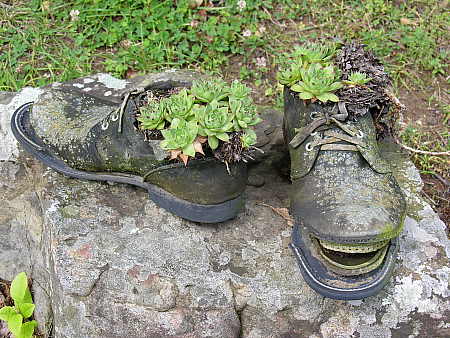
The final resting place for a good pair of boots

Feeling Kittenish?

Just as I clicked on the “publish” button for my last post, Retta pulled up the driveway, back from visiting her parents in Ozark, Missouri.  Along the way home, just off the highway, she noticed what looked to be two tiny kittens.  Not one to look the other way when situations such as this occur, Retta stopped the truck and investigated.  She found the two little kittens, but found no evidence of any siblings or mother cat.  Apparently, these two marvelous creatures were abandoned along the side of the road by some sick, heartless individual who could not think of any other way to handle a new litter of kittens.

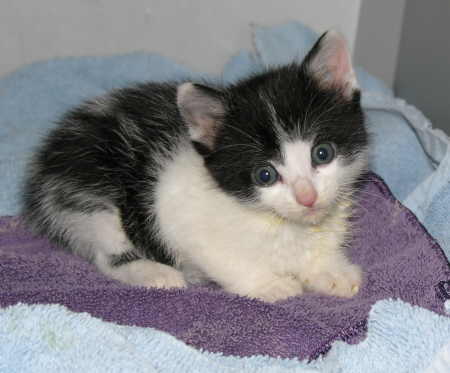
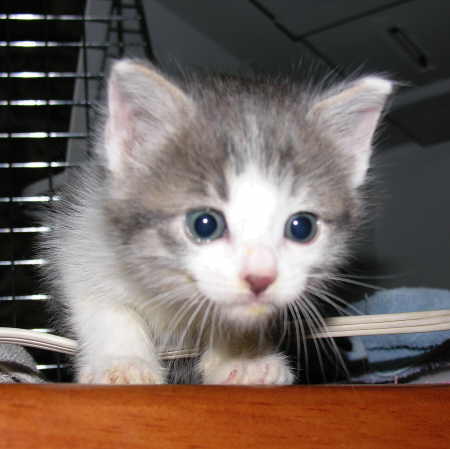
Retta did what most caring, nurturing people would do under the circumstances – she gathered the kittens up and brought them home.  So it looks as if we shall now be a three cat family.  And this is what they look like:

Unnamed kitten #1

Unnamed kitten #2

Hopefully we can teach them to get along with the other cat, the dogs, the horses, the guineas, the chickens, the wild birds and the squirrels.  Anything else is fair game.

Emoticons and Smileys…. Pro, Con or Neutral?

On a recent comment to a recent post that appeared on these pages, I noticed that the commenter ended a tongue-in-cheek sentence with this smiley ;).   Like everyone else who has used a computer lately, I have seen an array of these little faces everywhere on the internet that I visit.   But I was totally surprised to find this little fella living in my blog comments 8-O.   I thought that the person who left that comment must be super-cool (which he is, of course) 8).   Although I know that it is a sin, I couldn’t help but be green with envy over this person’s computing skills :mrgreen:.  

Not long after seeing that a smiley had taken up residence in my blog, I happened to end a sentence with an old-school “;)”, when, much to my chagrin :? this little guy appeared instead ;).   “What the heck is going on here?” I asked myself (as no one else happened to be in the room at the time) :roll:.   And then it dawned on me that Wordpress might be involved in some way :idea:.  It made me very sad that I had no knowledge about the care and feeding of these smiley creatures, so off I went, searching the Wordpress documentation for clues about this feature :(.   The documentation indicated that Wordpress does include a feature that translates old-school emoticons into these little smileys.  This made me very happy indeed :D.

Now that I had learned Wordpress supported smileys, I needed to find a listing of the smileys available for my use.  Off I went to search the internet for answers :arrow:.   A search on “emoticons” eventually led me to a blog with a post regarding emoticons.  The individual who wrote this post was very angry with computer users who use the services of the smiley critters :x.   In the comments that followed this post, there was a very intelligent discussion among the participants involving the use of emoticons in general, and smileys specifically.  Some considered the smileys to be evil :evil:  twisted creatures :twisted: undeserving of life itself.  Others found the smileys to be cute and helpful in expressing nuances of feeling that are hard to put into words.  Some even expressed disdain for anyone who would consider using smileys :P.  And here I was, doing research to find out how to use these little animated dots.  It was almost enough to make me cry :cry:. 

Like many other things that I don’t think about when I’m not thinking, I never thought that emoticons and smileys could arouse so many emotions in so many people:!:   So now I am perplexed as to what to do – utilize smileys, or ignore them and hope that they go away. 

What is your opinion?

Flashback Friday #3

About Bodie California

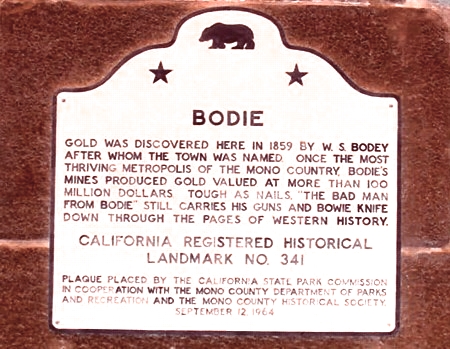
In 1859, nearly 150 years ago, gold was discovered in Mono County, California.  A mill was established in 1861, employing about 20 workers who were the founders of the town of Bodie.  By 1880, Bodie had grown to exceed 10,000 residents.  Like all boom towns that grew up around the gold strikes of the mid 19th century, the were saloons, hotels, brothels, thieves and scoundrels.  But there were also hard working, churchgoing, God-fearing people living in Bodie as well.  Again, as happened in other gold-induced boom towns, eventually the cost of extracting the gold exceeded the dwindling revenues generated by the mining endeavor.  The mine was no longer capable of supporting it’s workers, and this triggered the collapse of Bodie’s economy.  A fire in 1892 sealed the fate of the town of Bodie, and now it joins the ranks of other gold-rush era ghost towns.

Bodie is now operated as part of the California State Park system, and is opened to visitors (although the general public may not enter the buildings, except that select groups are allowed entry after-hours by special arrangement).   Mono County, where Bodie lies, is within the arid rain shadow of the mighty Sierra Nevada mountains.  The resulting dryness is ideal for the preservation of the surviving structures in the ghost town.

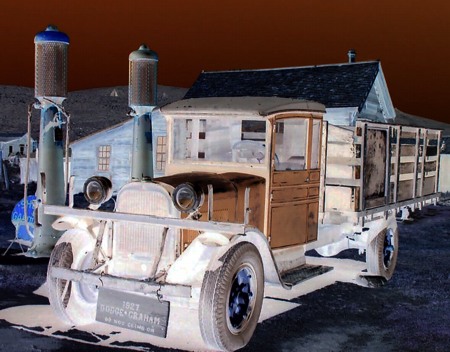
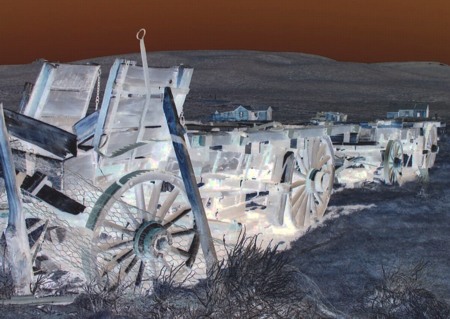
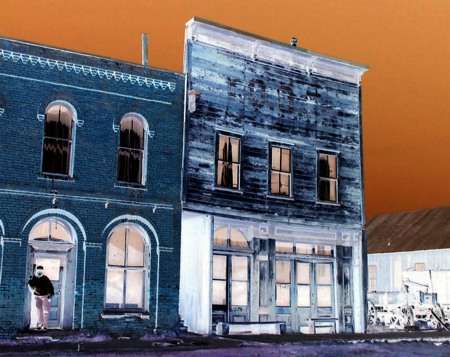
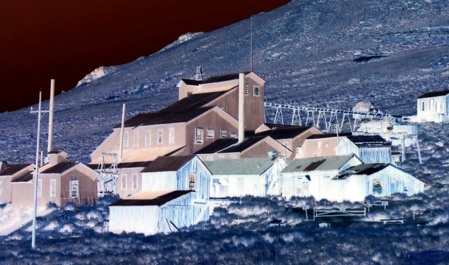
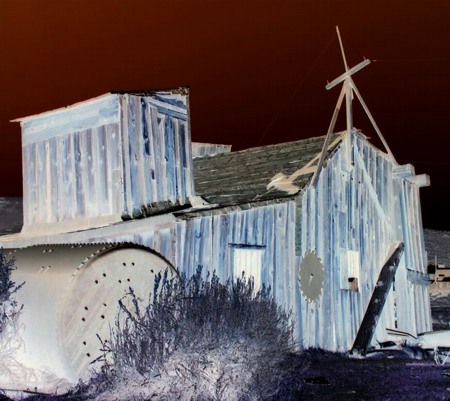
It seem obvious to me that pictures of a ghost town should convey a certain “ghastliness”,  so I have taken the liberty to doctor up the following photos.

Ghostly moon over Bodie

A haunted church?

How much was a gallon of high-test gasoline back then?

Freight wagons

Main Street

The mines at Bodie

Examining the ruins

Abandoned wagons litter the street

Carpentry shop

Giving Credit Where Credit Is Due

In this day and age, when it sometimes seems as if the business community is out of touch with the customers upon whom they depend,  it is refreshing to see one company respond quickly and politely to a customer’s concern over a potential problem.  I am referring to the good people at snapshirts.com, who have earned my respect and praise for their response to my concerns, and more important, for their response to the blogging community at large.

Here is a little background.  If you are a frequent visitor to blogs of any genre, you may remember a period of time earlier in the year when suddenly, it seemed as if every blog in existence posted an image of what is called a “word cloud”.  The clouds that were posted on these blogs were primarily generated from the snapshirts.com website mentioned above.  From comments on the blogs at the time, it became apparent that word clouds were very well accepted by bloggers and their readership.  This generated a lot of traffic at snapshirts.com, who is in the business of selling products utilizing the word cloud concept.

Recently, one of the blogs that I regularly read indicated that there had been a marked increase in comment spam, and the author wondered what could have caused the sudden increase.  As I thought about this, for unknown reasons my mind flashed back to the word cloud I had seen on that site.  Could this be the culprit, I wondered?  By performing a search on “word cloud”, I was able to locate numerous blogs that had posted their own version of a word cloud.  By than searching those blog’s archives for “spam”, it soon became apparent that many of those blogs had also experienced an increase in spam.  Could the increase in comment spam have been caused by the submission of their URLs to the snapshirts.com site?  I am not well versed in this type of thing.  I can’t fathom why spam even exists in the first place, let alone figure out how it is accomplished.  So I thought, “why not ask snapshirts.com directly?”  Here is the correspondence that ensued:

On 5/2/06, Hal Mitzenmacher wrote:

There are many people in the blogging community who have noticed a marked increase in comment spam on their blogs since submitting their URLs to Snapshirts.  Is there more going on here than meets the eye?  If you were to perform a web search on snapshirts + spam, and then examine the result, you will see what I am referring to.  Would you please address this issue on your blog for those of us who may feel doubts about continuing the use of your services?

Thank you.


Response from snapshirts.com:

Mr. Mitzenmacher,

First, I want to thank you.  You have brought a flaw in our old fulfillment methodology to our attention.  Upon receiving your message we immediately took what steps we could to rectify the situation.  In the past, we had included the weblog URL on the T-shirt’s order page to ensure customers received the T-shirt that was directly linked to their blog.  This inadvertently made those URLs available on the Internet for persons with malicious intent.  We have subsequently updated our fulfillment technology to allow instant T-shirt generation and purchase, so we no longer publish any information beyond the image.  After receiving your message yesterday and realized what had likely occurred, we immediately removed all pages from the Internet that were generated using our older methodology.  Those pages are no longer accessible over the Internet.

Second, I assure you that I have NO direct affiliation with ‘sploggers’, comment spammers or spam providers of any sort.  If you want to call, my cellphone number is xxx-xxx-xxxx and if I could afford a ticket to the Ozarks I’d fly out so you could look me in the eye on this one.  Weblog producers are our sole customers and we are very sensitive to the highest standards of customer service that must be maintained in serving this community.  We were taken advantage of but in no way did we collude with anyone to produce this unfortunate result.

Third, you mention other bloggers experiencing this effect and commenting on it.  I searched the “snapshirts + spam” combination on Google, Google Blog Search, IceRocket, Bloglines and Technorati but was unable to find another blog post on this issue.  If you are aware of other blog posts or bloggers with this issue I’d appreciate any link so that I can address this issue personally with them as well. Last, but most certainly not least, I want to apologize for any inconvenience this has caused you.  I will be posting a notice on our blog today with this information and links to free tools and add-ons for various weblog systems which can be installed to combat comment spam.  For wordpress, I use Spam Karma, which has a 100% record on my personal blog for catching comment spam and permitting actual comments.

Sincerely,

Jonah Keegan

snapshirts.com


My reply to snapshirts.com:

Mr. Keegan, 

As I read the original email that I submitted to you, specifically, 

“There are many people in the blogging community who have noticed a marked increase in comment spam on their blogs since submitting their URLs to Snapshirts”  

I can see that I might have been a little vague regarding other bloggers experiences.  I did not mean to imply by this statement that other bloggers necessarily made a connection between the increase in spam they were experiencing and the submitting of their URLs to Snapshirts.  I am the one who made this connection when, while visiting many differing types of blogs on a regular basis, I began to notice a pattern.  There was a short period of time when it seemed as if  every blogger in cyberspace was posting their own word clouds.  Here is a comment I made on one blog’s Word Cloud post:

“A Google search of “word cloud” now produces over 11,200,000 hits, mostly from bloggers! I wonder how many t-shirts Snapshirt will sell? And how long before a Wordpress “Word Cloud” plugin appears?” 

Shortly thereafter, many of these same blogs began reporting an increase (sometimes dramatic) in the volume of comment spam they received.  This can probably best be seen by using the same methodology as I did.  Perform a search to find blogs that posted their word clouds, and then, from within each individual blog, perform a blog search of posts pertaining to comment spam.  When I saw the results obtained with this methodology, my suspicions became aroused.  Whether there is a cause-and-effect relationship, I don’t know, as I know little about comment spam (other than the fact that it is obnoxious and annoying).  It might well be that this same methodology would yield statistically identical results by searching these very same blogs for “sun spots”, for example.  I just do not know.  Which is exactly why I contacted you to inform you of my suspicions.

The tone and speed of your reply indicates your sincerity about this issue.  No need for you to travel out to the Ozarks so I can “look you in the eye”,  however, should you ever get the chance, I’m certain you would find the area a delightful place to visit.

Hal Mitzenmacher


Snapshirts.com response:

Thank you.  I can tell you our sales are far less than 11.2 million, wouldn’t that be something…  :)  We are very grateful to the blogging community however, for providing us such a uniformly positive reception and sending us a steady stream of visitors.

I can also tell you we are working to develop a free word cloud plugin for wordpress or any blog, with some features we hope will appeal to bloggers as much as our t-shirts do.

Thanks again for bringing this to my attention.

Sincerely,

Jonah Keegan


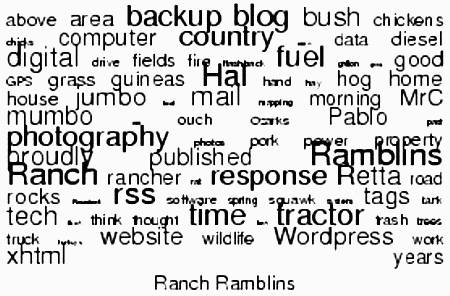
I have checked the snapshirts.com website today and I have found that they have, indeed been hard at work addressing this issue (see post here).  And as a showing of confidence, here is the word cloud that I have just produced from the snapshirts.com website:

Ranch Ramblins word cloud