Introducing “Geek Acres”

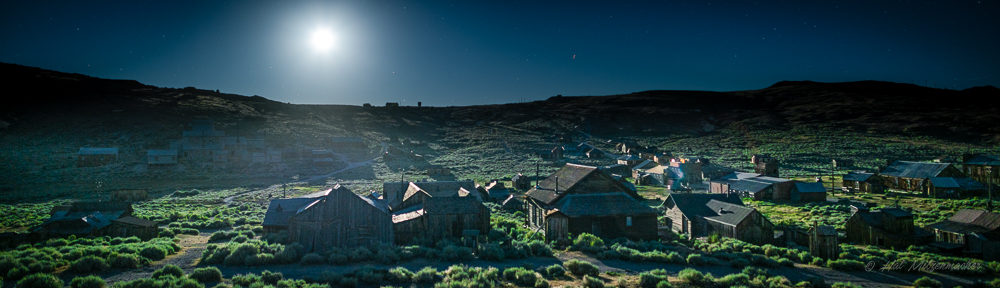
Make way, there is a new blog in the Ozark neighborhood, and it’s called Geek Acres.  Duane (the self-described geek), and his wife Jennifer, have recently purchased a hobby farm outside of Springfield, Mo. as their new residence.  Duane intends to utilize Geek Acres to chronicle their adventures as they transition to a new environment.

Neither Duane or Jennifer are new to blogging.  Duane also publishes Minutia – thoughts of duanekeys, and Jennifer publishes Ramblings of a Flower Addict.  Both are excellent blogs, so I expect that Geek Acres will follow in the same suit.

I’ll be looking for your keen insights and observations as you settle into your new place.  Good luck to you both.

What If …

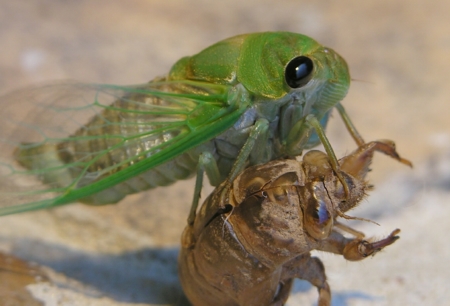
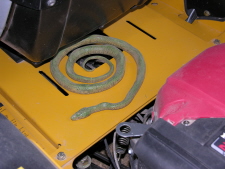
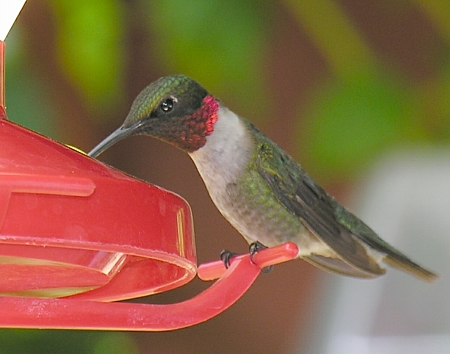
Molt in progress

…we could periodically peel out of our skin, re-emerging a decade younger in appearance?  I’d like to be the one holding the patent on that process, wouldn’t you?

The above photo courtesy of Retta, who always manages to find such neat photographic subjects.  Here is another of her wonderful springtime photos –

Bee careful!

IN THIS CORNER …..

….. is Hal, the defender of the ranch, and a somewhat naive newcomer to the rural scene, in need of plain old experience.  And in the opposing corner, Willard – otherwise known as Rattus, of the order Rodentia.  And the bell rings –

ROUND 1:  Hal is so naive, he doesn’t even know that there is a competition underway.  Day in and day out, blissfully unaware, Hal undertakes his tractor work, and when finished for the day, parks the New Holland back in the equipment barn.  All seems well, until one day, Hal begins his day of bush-hogging, which is rudely interrupted by a cloud of steam billowing out from beneath the hood of the tractor. “Oh oh, this can’t be good” Hal mutters, as he lifts the bonnet to assess the situation.  He soon discovers the cause of the overheated diesel engine.  A rat had built a nest atop the engine intake manifold, which had apparently become dislodged as the tractor was started.  The nest fell down, and became wedged between the fan belt and the belt pulley, thus flipping the belt off the pulley.  With the fan belt gone, the engine eventually overheated, which was the cause of the cloud of steam.  A few gallons of anti-freeze and a new fan belt later, the tractor was good as new and parked back in the equipment barn.

ROUND 2:  Hal is so naive, he doesn’t suspect that this will ever happen again, and he deludes himself into thinking that this was a freak, one-time occurrence.  For a while, fate cooperates with this delusional thinking.  Hal judiciously checks under the bonnet of the tractor prior to each use, under the misguided premise that all rat attacks occur in the same fashion as in ROUND 1. As long as the engine is clear of any debris before being started, Hal reasons, then no problems can possibly arise.  For a year, no problems arose.  Until one day, when Hal checked under the bonnet and found another rat’s nest.  Congratulating himself on being so foresightful as to check the engine compartment prior to starting the tractor, he proceeds to clear away the nest material from the engine.  But much to Hal’s chagrin, he discovers that the rat had chewed through 2 of the tractor’s wiring harnesses.  One week and $500 later, the tractor is back to normal.

ROUND 3:  Hal is so naive, he once again underestimates the determination of the order Rodentia to make life miserable for man.  Now, as a result of the outcomes of ROUND 1 and ROUND 2, Hal figures that besides checking under the bonnet prior to each use of the tractor, he should also store the tractor in the barn with the bonnet wide open.  Hal confidently figures that this will discourage the rat from again nesting upon the engine (which the rat seems to have taken a liking to).  And once again, the brilliance of Hal’s reasoning stands the test of time. A short time.  One day (those “one days” always seem to come about, don’t they?), when Hal turns the ignition key to start the tractor, he is greeted by the sound of silence.  Confident that this was merely a mechanical problem, as the pre-use checkout of the engine compartment revealed nothing unusual, Hal proceeded with the usual troubleshooting procedures called for in this situation. Ruling out the battery as the culprit, and then the starter as well, Hal began the tedious task of tracing the starter circuitry to diagnose the problem.  What Hal eventually found was that the rat had now found an entryway to the area situated between the dashboard and firewall of the tractor.  Removing the instrument cluster from the dashboard, Hal was greeted by the sight of a rat scurrying away from the scene of the crime.  Left behind was the evidence of his unwelcome stay – four wiring harnesses completely chewed to pieces.  Three weeks and $1000 later, the tractor was again good as new.

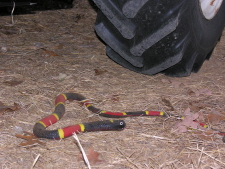
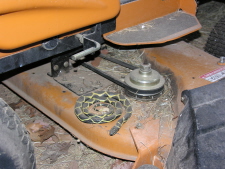
ROUND 4:  What is that old saying?  Fool me once, shame on you; fool me twice, shame on you; fool me three times, shame on you; but fool me four times, and SHAME ON ME (I think it goes something like that).  So as not to be shamed by a rat, I decided it was time to get tough with this guy.  But I also believe in the principal of “live and let live”, so extermination was out of the question.  I could try to trap the rat and relocate it, but that solution would require lots of activity on my part, so I quickly abandoned any further thought along those lines.  And then it dawned on me – snakes – and lots of them!  Snakes would be the ticket to a rat-free tractor ownership experience. So, after some comparison shopping on the internet, I ordered an assortment of snakes.  Not real, live snakes, mind you, but realistic looking rubber snake replicas.

The first line of defenseSecond line of defense

This mower needs protectionThis mower needs protection too!

ROUND 5:  Has not taken place, as the rat has not shown up again since I put the snakes to use last year.  So I guess that I won the bout in the fourth round, due to the disqualification of my worthy opponent!   Or so I hope…….

Wierd Spring Rituals (Part I)

The Grassing of the Carp

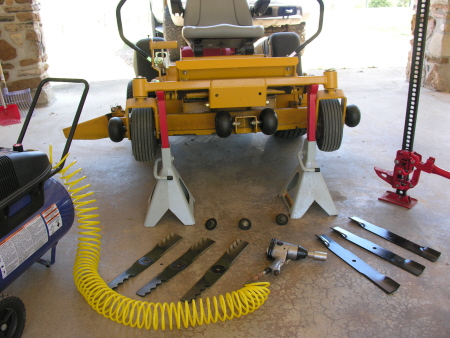
This annual rite begins with the ceremonial “exchanging of the blades“, in which the fall/winter mulching blades are are removed from the lawnmower, and replaced with spring/summer high-lift blades.

Exchanging of the blades

Next, all interested parties are invited to gather in the specified viewing area, beside a ranch pond, in a rite called “the assembly of the plebes“. They come from far and wide to witness this impending spectacle.

 The excitement builds!

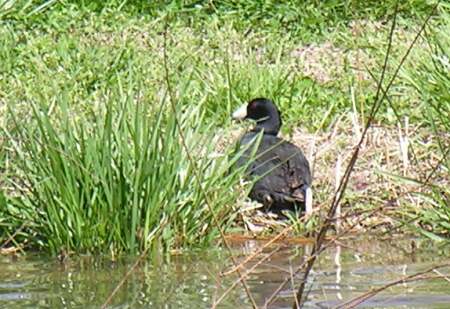
A lone coot arrives on the scene, attracted by the commotion taking place before him.

What's going on here?

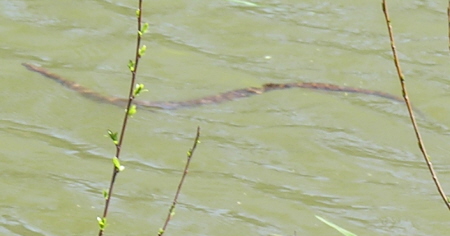
Soon, Retta spots a reptilian guest, who just wanted to know what all the fuss was, and why did we disturb his nap in the spring warmth?  I just wanted to know if it was safe to go into the water.

 Oh oh - better be careful!

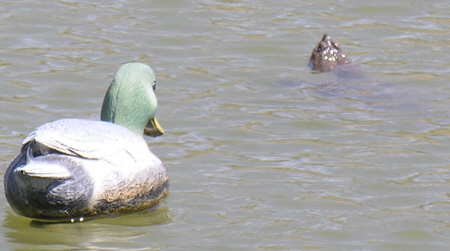
It soon becomes apparent that the reptiles don’t want to be too outnumbered by the mammals, and reinforcements begin to arrive, in the form of a snapping turtle. The duck?  He just sits there, always with the same blank look in his eye.

A snapping turtle also drops by

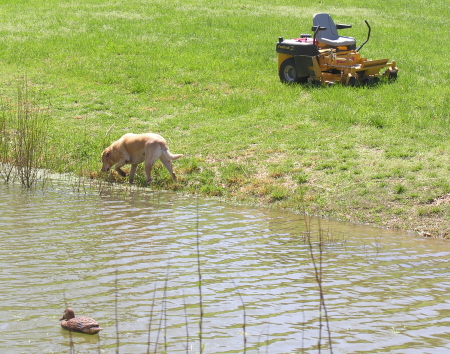
You can sense the excitement in the air, in anticipation of the of the impending “rites of the first swath“.  In this rite, the previously prepared lawnmower (see “the exchanging of the blades“, above) is called into service.  By maneuvering it into just the right position along the pond bank, a steady stream of long grass cuttings can be sprayed onto the surface of the pond water –

Grassing of the carp

At last, in a grand culmination to all of the pomp and circumstance that has taken place, the subjects for whom this ceremony has been created, finally arrive.  They are the Grass Carps, who, after dreaming of this moment throughout their long winter hibernation, begin their sumptuous feast!

The carp are here! The carp are here!

And thus goes “The Grassing of the Carp

Birds of a Feather …

Over the past several years we have maintained wildlife feeders on our ranch, for the benefit of the deer and the turkeys, but primarily for the benefit of ourselves.  Twice a day, at precisely 7:00am and 4:00pm, we enjoy the sight of turkeys or deer at the feeders within sight of the house.  Thanks to Roundrock Journal’s pablo, and his pangs of conscience (detailed here), we now must give serious thought to the ethics involved in such activities.  What once seemed to be such a simple personal pleasure will now require the type of soul searching heretofore reserved for matters of much greater significance.  While we ponder the issues involved, and consult with others wiser than ourselves for their sage consul, we offer up the following, merely as food for thought.

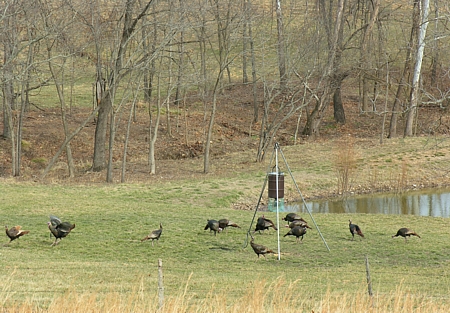
Turkeys at the feeder

The turkeys at the feeder above are typical of what we see for a few minutes each morning, and then the scene is repeated again each afternoon.  The turkeys (or deer) will usually hang around the feeder for 5-10 minutes, and then off they go, returning to the foraging that they do so well in our pastures, fields, and food plots.  When they leave the feeders, there is still corn remaining on the ground, which indicates to me that they are successfully obtaining nourishment from their natural habitat.

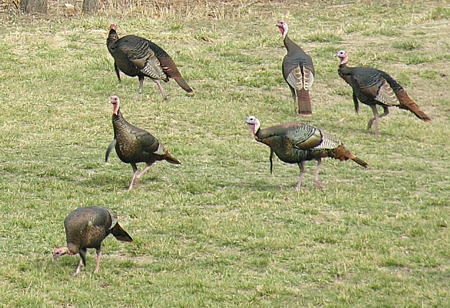
Turkeys grazing

This is where the turkeys spend the bulk of their time.  They are away from the feeders, and from what I have been able to observe, they spend the better part of the day foraging for whatever the natural foods are that turkeys eat.

Two observations from all of this:

A)  We have feeders on our property to attract the wildlife so that we may observe them, and if we are lucky, shoot them with our cameras.  Our neighbors have feeders on their property so that they can attract wildlife so that they may observe them, just prior to shooting them with their hunting firearms.  If we are more successful in attracting the wildlife than our neighbors, I believe this accrues to the benefit of the wildlife.

B)  While we subscribe to the notion that we are but the temporary caretakers of the land and it’s inhabitants, we also realize that it is our name on the deed to the ranch.  We are the ones who keep the water supplies clean and abundant, we are the ones who keep poachers at bay, we are the ones who avoid the use of all manner of pesticides and herbicides, all for the benefit of the wildlife.  All this, and what do we ask in return?  Just the simple pleasure of regular visits from those who reside here.

We will definitely ponder the ethical issues of the activities we undertake here at the ranch, but in the meantime, the catfish are calling out to be fed!

If They Can Do It, So Can I

Back in 2001, the local telephone company in our area (Northern Arkansas Telephone Co) undertook a project whereby each and every telephone pole was identified and mapped using GPS technology.  To accomplish this task, a small group of NATCO employees were equipped with ATVs and GPS units.  After spending each day following the telephone lines and entering each pole as a way point on their GPS units, the team would then upload this information into the NATCO computers, and thus an accurate survey of NATCO’s telephone poles was completed.

When the NATCO ATV showed up on our ranch to survey our poles, I took the opportunity to talk to the technician, and I became intrigued by the notion of mapping out the features of our ranch.  I saw that the equipment that he used was fairly simple stuff, which gave me the necessary impetus to undertake a mapping project of my own.

Back when Retta and I were cruising among the Channel Islands off the California coastline, GPS navigation was a necessity, so I was quite familiar with GPS units and their capabilities.  Our GPS unit was tied in to our laptop computer.  The end result was that we could do our chart work in real-time, with the location of our vessel accurately depicted on our electronic maritime charts.  When we sold the vessel, the GPS unit went with it, but now, here was my excuse to justify the purchase of an inexpensive hand-held GPS unit (I confess to a personal weakness that prompts me to try and find any justification for acquiring new technological gadgets).  So I purchased a Magellan GPS device, and soon had it wired to my laptop computer.  I also needed some type of mapping software, and settled on Delorme 3-D TopoQuads.  This software is fairly full-featured and inexpensive, and while it is accomplishing all that I want it to do, it seems somewhat cumbersome to use, as if it were designed in a prior software era.  Now, all I had to do was tie this all together into a package that could actually be used on the ranch. Here is what eventually evolved from my efforts.
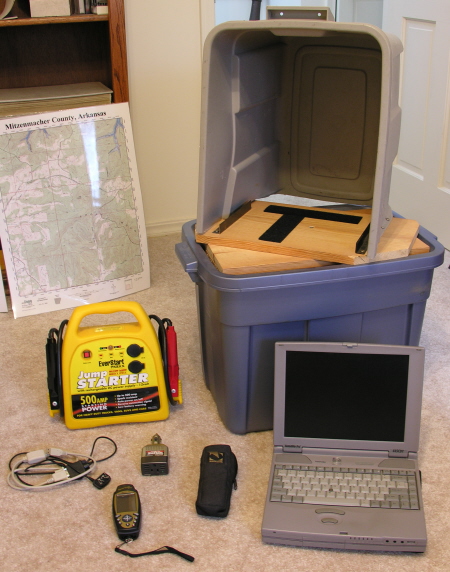
Mapping System Components

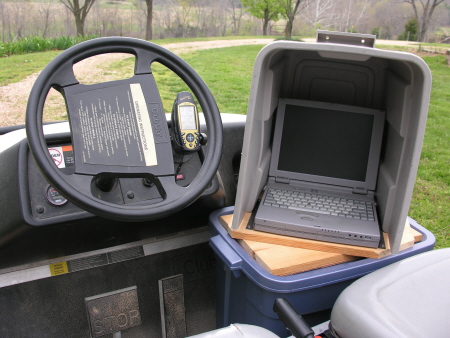
Notice the following features of my “super-duper, multi-purpose, portable cartographic data collection machine”  (SDMPPCDCM).

A) High-tech Rubbermaid containers are utilized to house the necessary components, as well as providing sun-shading capabilities for daytime use.  These are inexpensive, readily available, and coincidentally, just the right dimensions to fit snugly into our utility vehicle.

B) This application for a laptop computer consumes lots of power.  The computer cannot use any power saving modes while mapping, the screen must be set for full power to be visible in the daylight, and the hard disk drive and CDrom are always busy performing mapping chores. Rather than trying to create a properly conditioned power supply from the utility vehicle’s electrical system, which would have been a project unto itself, I opted to power the system with an automotive rechargeable booster pack, available (of course) from our local Wal-Mart.  By adding a simple and inexpensive power inverter, this system can be operated at full power for a lot more hours than I care to work in a day.

C) The laptop is affixed to the turntable by a pair of stabilizing rails on the side of the turntable, and secured with industrial Velcro attached to the bottom of the computer.  The turntable swivels on a simple pivot, allowing me to easily adjust the viewing angle.  The entire package is secured to the vehicle with a heavy duty bungee cord.

D) The GPS unit, which feeds data to the computer via a data cable, is mounted on the dashboard of the vehicle with a quick-release mount built especially for this particular GPS unit.  This allows for excellent visibility while driving, and allows me to easily pop off the GPS and use it on foot when necessary.

When mounted in the utility vehicle, the entire contraption appears as below:
Mapping system in place

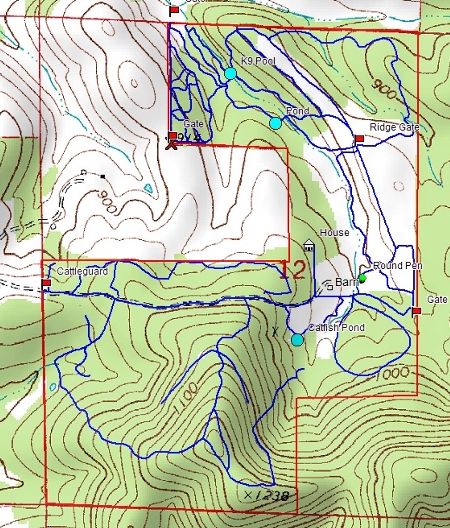
An example of the results obtained with this system can be seen in the following map printout, which is a screen shot from the Delorme mapping software.  This particular map layer that is pictured shows the trail network as it exists on the ranch.  There are unlimited layers available, and I have used them for many purposes.
Mapping results

You may ask, “Hal, what prompts you to spend so much time rambling on about computerized mapping systems and such?”   Pablo, editor of the Roundrock Journal, a fine and highly popular Missouri blog, recently mused about solitary shag bark hickory and walnut trees on his property.  The question arose as to weather solitary trees of this type would produce nuts.  I suppose a normal person who is motivated to find an answer to this question would, with a few well-defined queries to Google, come up with an answer in short order.  But I am (thankfully) not normal!

Three years ago, I began a long-term project of mapping the approximately 150 black walnut trees that exist on the ranch.  Each year, I use my GPS data to locate each of these trees, and I note their status as being either “nut-bearing” or not, as the case may be.  I then use this data to plan my bush-hogging schedule, so that the trees are accessible to my friend Jasper when he comes around in the fall to gather our black walnuts.  It is my thought that I can utilize the data that I am collecting to answer the pressing question of solitary nut trees (if I should be fortunate to live long enough to collect a meaningful amount of data).  I am also attempting to see if I can find any direct correlation between nut production and weather patterns.  This may be grist for a future post (if I can find any results worth posting).

DRM Rears Its’ Ugly Head Once Again

I cannot resist ranting about Digital Rights Management (or other copy protection schemes) whenever I run across negative issues associated with them.  When will the holders of intellectual property rights ever learn the basic lessons that seem to arise again and again?

Recently, Sony Music and other music publishers tried to institute a boneheaded copy protection scheme that met with such resounding protests that they immediately backed off on its’ implementation.  This scheme relied on a technique that utilizes what is known as a “root kit” to do its’ duties.  When copying music from these CDs onto your computer, bits of coding would insinuate itself deep into your computers file system.  If you are at all familiar with Unix, Linux, or any of their derivatives, you will recognize that any user that has what is known as “root access” has virtually total control over the machine in question.  Granting root access is thus a potentially dangerous situation.  Root access techniques have become the “method de jour” for modern day hacking, and is a major security issue, particularly as employees shuttle laptops back and forth between home and office networks.  No wonder there was an immediate and loud outcry about this technique (see previous post here).

Today, I ran across this article from cdfreaks.com (I love the monikers you run across on the web)   “Tests find DRM shortens player battery life by up to ~25%” .

Basic lesson that is ignored at the publishers peril – “Do NO HARM unto those who legitimately purchase a license to utilize your intellectual property.”  The revenue stream of any publisher depends entirely on the continued purchases made by these customers.  Cripple them in any way, deprive them of the full use of the media that they have legitimately paid for, and they will abandon you at their very first opportunity.  History proves me right on this issue (although we seem to be in a period where the lessons of history are often ignored).  The pirates who blatantly disregard intellectual property rights always find a way to circumvent copy protection schemes anyhow, so why risk alienating your proven (and hopefully loyal) customer base.  Your financial future depends upon them.

End of rant (for the moment).