The Catfish Pond

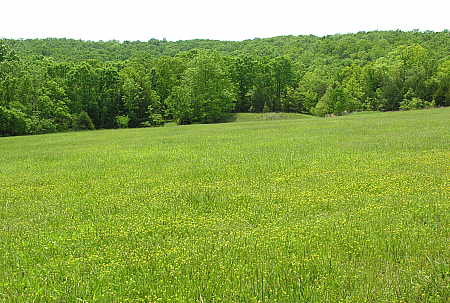
Catfish pond at back of pasture 

We have several ponds here at the ranch, each with it’s own character, and each with it’s own set of problems and pleasures. This post is about our small catfish pond, which is located in a margin between grassland and woods. In the picture above you can see the berm which creates one bank of the pond, at the far end of this field.

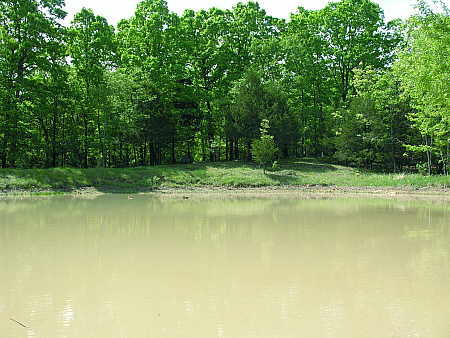
Catfish pond view from berm

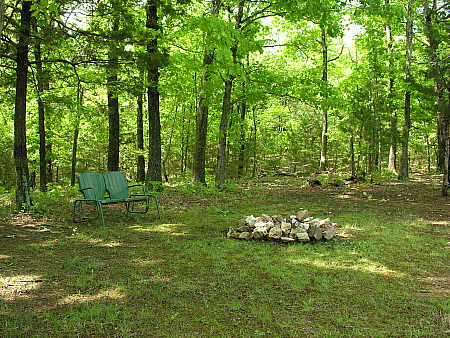
This is what the pond looks like, viewed from the berm which was constructed to contain the pond water.  Across the pond, in the woods, is an area I cleared of brush and set up a fire ring and glider.  It has become an area where Retta and I like to sit and contemplate the world around us, and sometimes have a picnic.  This is what the area looks like –

Picnic area

When seated at the picnic area, the view looks across the field towards our barns and paddock facilities.  It is a lovely spot, and I always like to sit here to take a little break during my work day, surveying my little domain and enjoying the peace and quiet (country quiet, which is sometimes not all that quiet, but I digress).

View from picnic area

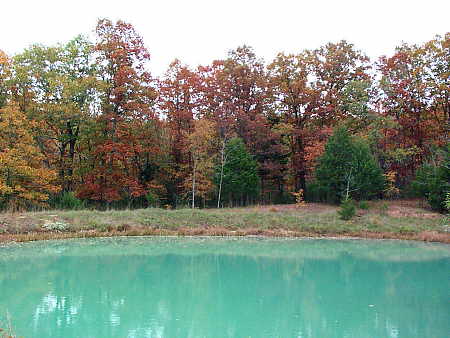
As you can plainly see from the pictures, this is not a clear pond.  It is designed to catch the runoff from a clay based gully which drains about a forty acre watershed.  Every time it rains, clay is washed into the pond along with the rain water.  From the time we first acquired this property, I have been dissatisfied with the lack of water clarity in this pond.  I mentioned this problem to an employee of the local farm store, and he told me he had just the solution.  He sold me a gallon container of a liquid, which I proceeded to apply to the pond per the directions.  I should have done more homework than I had, because this is what I ended up with –

Oh my!  What happened here?

Now, I don’t know about you, but I prefer the natural silty brown over this obviously artificial looking turquoise dyed pond.  Fortunately, the pond returned to it’s former natural state after a few rains.  Unfortunately, the pond was bright turquoise when NASA flew over us on their latest photography mission.  In the space imagery that was produced from this mission, our pond color stands out like a beacon in the night.  I even received a comment about this from the Arkansas Forestry Commission forester who came out to assess our property.  He said he had to stop and scratch his head a few times trying to figure out what that bright turquoise spot was on the image!

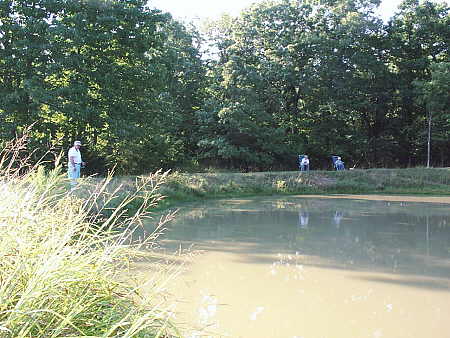
I have since been told that there is some kind of chemical product that can be added to the water that affects the ionization of the suspended particulate matter, causing it to sink to the bottom of the pond.  I have not been able to locate any such product, except for certain solutions meant to be used in tiny backyard ponds.  And if I can find this product, I suppose that it would have to be used whenever the rains washed more clay silt into the pond.  So I will instead try to accept the pond as it is.  After all, there are plenty of healthy catfish and minnows living in it, so why should I care?  And most important, guests who come to visit us here at the ranch always seem to enjoy throwing in a line, even if the water is silty.

Out at the fishing hole

Flashback Friday #6

 Mount Gould Sojourn

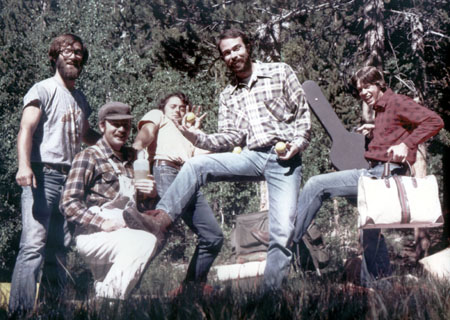
Mofo Five

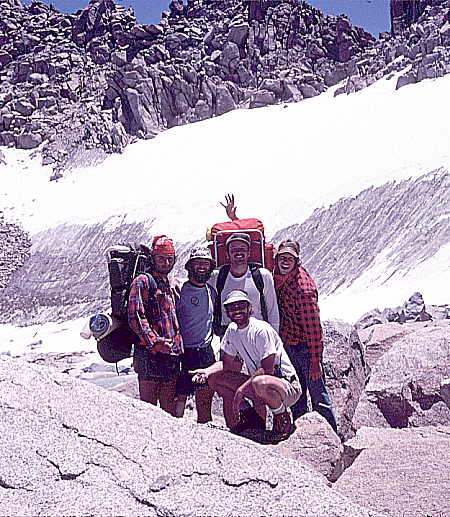
Would you be brave (or foolish) enough to take a journey with this motley crew?  If so, than follow us on our journey to the top of Mount Gould, which occurred over thirty years ago.  The humble author of this blog is the character on the extreme left, in his more *vibrant* days.  Actually, these fellows turned out in later life to be a veterinarian, a physician, a respected music producer, an architect, and some fellow that I heard was last seen furiously writing blog posts somewhere in the Ozarks ;)

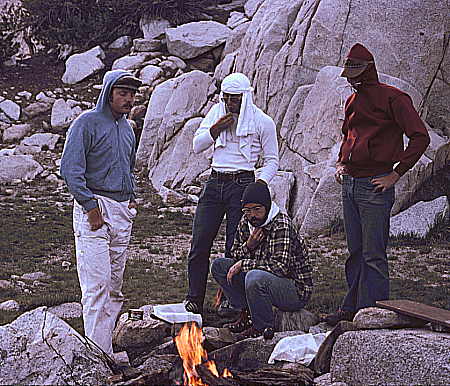
Mount Gould is a moderately high (13005′ elevation) peak in the John Muir Wilderness area of the Sierra Nevada mountain range.  It lies within the bounds of Kings Canyon National Park in California.  The route to the top of Mount Gould takes you from the trail head area in Onion Valley on the eastern flank of the Sierras, through beautiful mountain scenery on your way along the Kearsarge Pinnacles, and ultimately to the craggy peak called Mount Gould.  Here is a photo of our group gathered around the campfire in Onion Valley as we acclimate to the elevation change and prepare for our climb to come.

Keeping the mosquitos at bay

If you thought that we were huddled by the fire for warmth, you would be wrong.  It turned out that the mosquitoes were extremely pesky that evening, and the only comfort was to cover up from head to toe and stay close to the smokey, sooty fire for protection.  The next day we hiked along the rugged Kearsarge Pinnacles area on our way to the base of the ridge leading up to Mount Gould. 

Setting off for the base camp

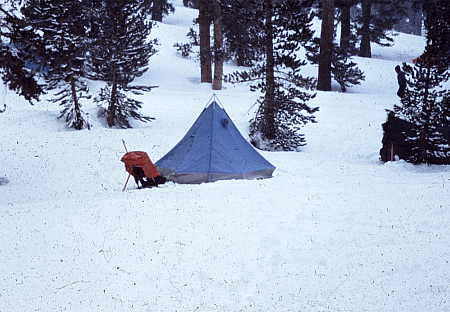
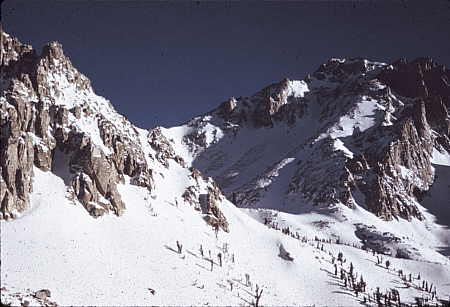
As we gained elevation and ventured further into the High Sierras, we began to encounter snow on the ground and in the trees.  Finding a spot to set up camp was pretty easy – you certainly didn’t need to worry about where to pitch your tent, as the entire surrounding landscape was blanketed by a soft carpet of snow.  As long as you stay out of any avalanche pathway you are safe and secure.  It is off to bed early in the evening, as we have a strenuous hike awaiting us in the morning.

Base camp

When we arise early the next morning, we assess the first leg of the hike.

First leg up the mountain

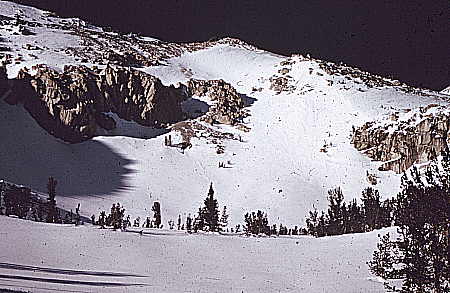
We will begin our ascent by following the ridge you see in the photo above.  We plan to switchback across the snow-covered slope before us, ending up on the crest of the ridge at the far left in the photo above.  From there the plan is to follow the ridge line as much as possible on our way up to Mount Gould.

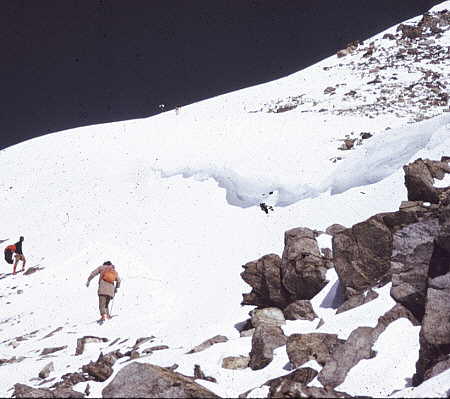
Making our way up the slopes

Here you can see what is involved in this trek.  The climbing is not technical at all, just a slow but steady plodding up the snow covered slope toward the first goal we had set, which was the ridge line above us.  Eventually, we arrived at the top of the ridge, and were greeted by the following sight –  

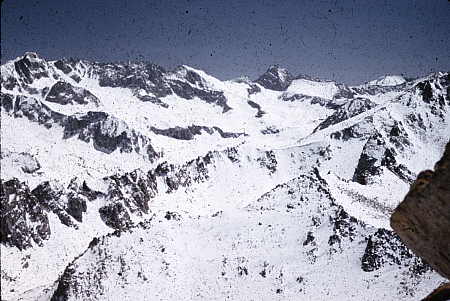
Mount Gould behind Kearsarge Pinnacles

In this photo you can see Mount Gould, just to the right of center.  We are still quite a distance away from our goal, and we have lots of snow and rock to traverse before we arrive at our intended destination.  It is a test of fortitude and desire more than skill or daring to climb this sort of peak in the winter, but if you plan properly, and stick to your plans, than you will eventually reach the top, as we did here –

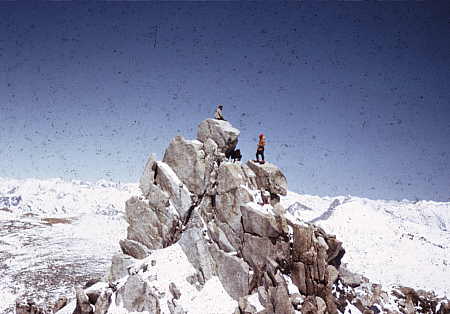
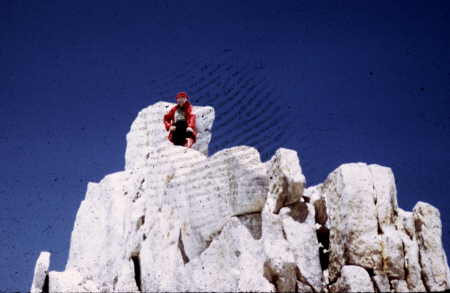
Conquering the peak

That is your humble (and tired) author you see at the top of Mount Gould.  And how did he obtain this picture?  By sending fellow mountaineer Chris up an adjacent rock to snap some photos, as seen here (hiding behind a nasty fingerprint) –

Chris on a rock (not Chris Rock)

So now we have been successful in our attempt to scale Mount Gould, but the REAL fun is just about to begin.  It has taken us well over 6 hours to make our ascent of Mount Gould, and now we plan to make it back to base camp in less than 1 hour.  And just how do we intend to do this?  By using a technique called the “Glissade”.  The first step in a glissade descent is to don your trusty nylon rain suit.  This will act as a slick surface for your body, which you are soon to propel down the snow-covered slopes as fast as you can, using only your ice axe as a rudder and your ice axe as your brakes (via a technique called an ice-axe arrest).

Glissade chute

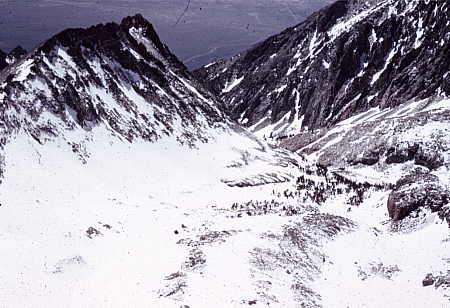
In this photo you can see the chute that we chose to glissade down the mountain crest.  On the way up, this section might have taken 1-2 hours to climb.  On the way down, thanks to the glissade technique, it took just a few fun and wild minutes.  From this point we can turn around, and now looking down the mountain again, this is what we saw.

Final glissade down to base camp

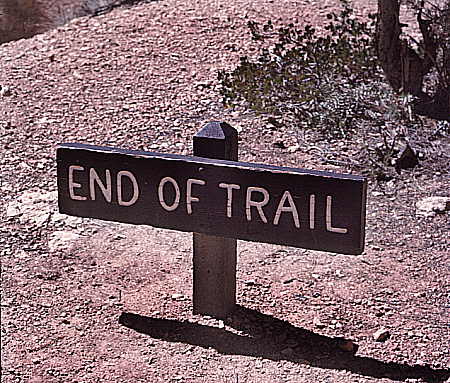
All that remained between us and our base camp was this long, steep, snowy section of mountain that was just ideal for a joyous glissade.  We made it back to base camp, tired, a little wet, and very happy campers.  After a good nights sleep, we hiked back down to Onion Valley where we encountered –

All good things come to an end


How Can This Happen?

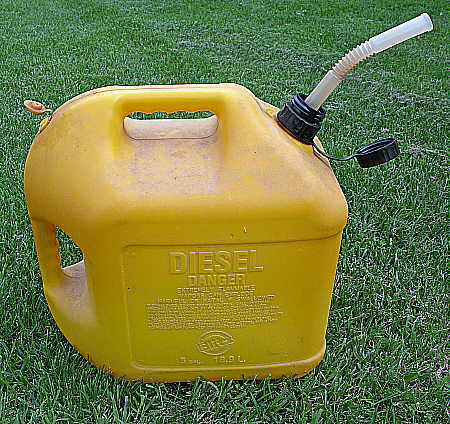
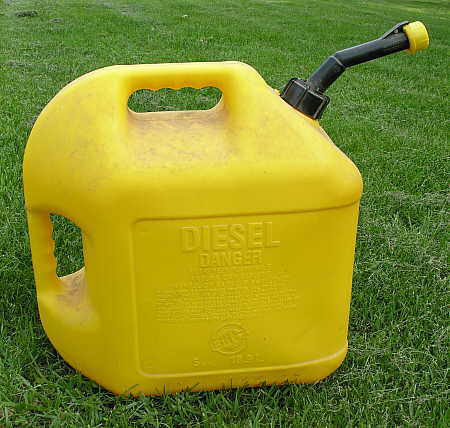
Original fuel canister

This is a picture of a five gallon diesel fuel canister that was purchased from Wal-Mart in 2001.  There is nothing particularly special about this container, except for the fact that it is a mature and fairly well evolved product that has been sold across the continent for many years.  You have probably used a canister like this one, or perhaps it’s red gasoline sibling, many times in the past.  It is a useful and inexpensive product that has stood the test of time.  When I open the spout assembly and begin pouring the fuel into my tractor’s fuel tank, it sounds something like this:

GLUB gla GLUB,  GLUB gla GLUB,  GLUB gla GLUB,  GLUB gla GLUB,  GLUB gla GLUB,  GLUB gla GLUB,  GLUB gla GLUB,  GLUB gla GLUB,  GLUB gla GLUB ……..

….. and so-on and so-forth until the canister is empty, which takes slightly less than two minutes.

Perhaps you remember a past post entitled The “Ouch” Factor that dealt with seeking an improved method of fueling my tractor, so as to minimize back strain.  In that post, you can see a picture of this author fueling the tractor with a similar fuel container. 

Redesigned fuel canister

It is similar, but not identical to the canister in the first picture.  If you compare the two containers, you will see that the second canister, purchased from the same Wal-Mart store in 2005, lacks a vent on the upper left-hand side of the container body.  When I lift this container up and try to fill the tractor’s fuel tank, this is what I hear:

GLUB gla GLUB,  GLUB gla GLUB, GLUB gla …. silence!

Remove the container from the filler neck, turn the canister upright to allow air back into the container to equalize the air pressure, lift the container back up to the filler neck, and begin the fueling operation:

GLUB gla GLUB,  GLUB gla GLUB, GLUB gla …. silence!

Remove the container from the filler neck, turn the canister upright to allow air back into the container to equalize the air pressure, lift the container back up to the filler neck, and begin the fueling operation:

GLUB gla GLUB,  GLUB gla GLUB, GLUB gla …. silence!

Remove the container from the filler neck, turn the canister upright to allow air back into the container to equalize the air pressure, lift the container back up to the filler neck, and begin the fueling operation:

You get the idea by now I hope!

It now takes me over 7 minutes to drain one of these new fuel containers, but worse than the time involved is the fact that I have to lift/lower the heavy fuel container repeatedly in order to accomplish this formerly simple task.

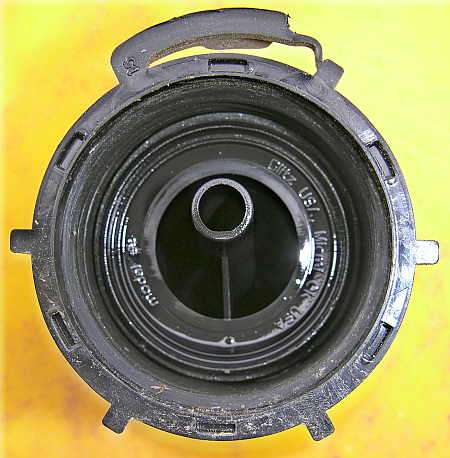
When I first used this fuel container and noticed that it wasn’t working the way I thought it should, my initial reaction was that the company must have inadvertently neglected to install a vent in the container’s body, as was included in the previous style.   But upon further examination I discovered the cause of the problem to be an ill-conceived and poorly executed attempt at including the vent mechanism within the actual spout itself.  The following photo shows the underside of the new style spout:

Underside view of spout

In this photo you can clearly see a small vent tube molded within the larger fuel spout opening.  I do not claim to have any special knowledge of hydrodynamics or hydraulic engineering, but it seems contrary to my intuition that this could possibly work.  How can the fuel flowing through this spout possibly be offset by an equal airflow through a vent tube 1/5 the size of the fuel opening, particularly when the fuel surrounds the vent (top and bottom) while it is flowing?

Let us assume for a moment, just for the sake of argument, that the designer of this spout assembly drafted the concept in a CAD program, calculated the appropriate calculations necessary to arrive at a workable design that resembled what we see here.  Wouldn’t somebody in the design team have looked at this and had the same intuitive sense about this design that I had, and nixed the design as unworkable, or at least ordered a prototype to be produced to test the concept?  And if they had tested this hypothetical prototype, wouldn’t they have gotten the same results as I did?

Let us now move on to manufacturing.  The tool and die makers create the molds necessary to produce the spout assemble, which they pass on to the shop floor.  The molds are installed on an injection molding machine, and out pop spout assemblies by the score.  At some point, doesn’t the shop foreman, his/her supervisor, the product manager, or the plant manager think to fill a container with water and see if the new spout assembly works?  Are there no curious souls left?  Does anybody care enough about the product they produce to try it out?

The factory, content in the fact that they have the injection moulding machines now spitting out spouts (no pun intended), provide samples and specifications to the marketing department, so now the ball is in their court.  Marketing is tasked to sell, and sell they do (obviously, as I purchased this canister at Wal-Mart).  Did the marketing manager at this company, after spending long hours dreaming up wonderful prose extolling the virtues of this new fuel can model, ever have the desire to fill up one of these containers with an actual liquid, and try out the “New & Improved” spout?  And how about the sales representative who flew to Bentonville, Arkansas to speak with the automotive buyer at Wal-Mart, carrying with him samples of his companies new fuel cans?  This was the man/woman charged with the responsibility of knowing everything there is to know about his product, in order to accurately inform and educate the buyer about this item.  Shouldn’t this person have once thought to actually put the fuel can through it’s paces?

The fact that I purchased this fuel canister at Wal-Mart indicates that the item passed whatever product screening the Wal-Mart buyers thought necessary for inclusion in the automotive department of the store.  The operational specifications for a fuel container of this type should be fairly simple and straightforward.  One should be able to fill it with liquid, and one should be able to pour out the liquid.  Nothing should happen in between these two events.  It is really that simple.  Didn’t anyone on the buying staff at Wal-Mart think to perform even the simplest test of this item, particularly since they were aware of the re-design of the spout assembly?

Last, but not least in this unfortunate chain of neglect is the owner of the company that produced this fuel canister.  I believe that Mr. Gates has an obligation to himself and his company to sit down in front of a Windows computer and use the software his company produces.  Similarly, I believe that Mr. Ford has a duty to get behind the wheel of the automobiles that bear his family’s name.  Along the same line of reasoning, I believe that it is also the responsibility of the owner of the fuel canister company that produced this item to have actually tried to use it, if even once.

What Is This Creature?

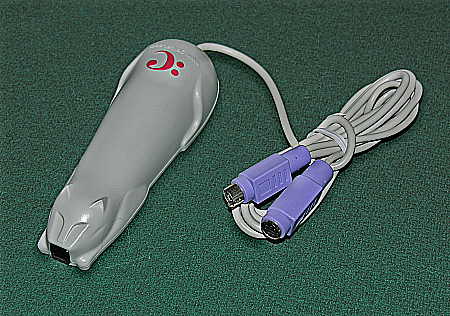
I found this curious looking creature nesting in the back recesses of a little used file cabinet in the basement.  I know what it is, but can you identify it?

Mystery creature

(Hint: it never caught on, and is now extinct)

UPDATE WITH SOLUTION

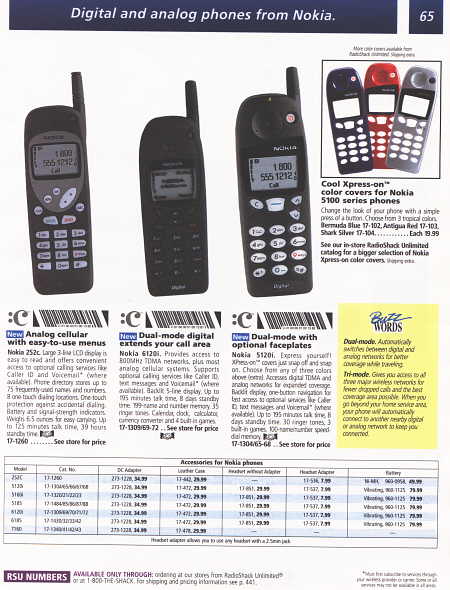
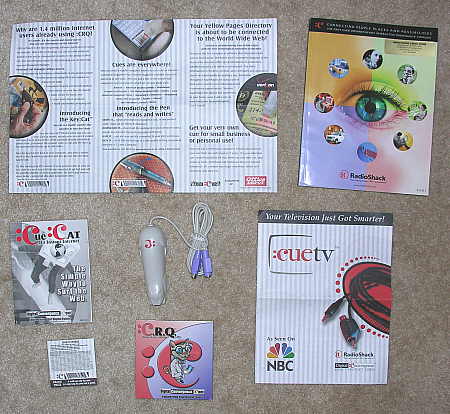
The item above, as pointed out by David, is known as a :Cue:Cat.  This device was produced by a company called DigitalConvergence.:Com Inc.  The idea was to provide every computer with this modified bar code reader, and convince business partners to include special :Cue codes in various printed matter which would then lead to a specific web page on the internet.  The :Cue:Cat was distributed by Radio Shack stores for free, and in the year 2000, Radio Shack supplied their Master Catalog with the special :Cue barcodes, as shown here –

Radio Shack catalog page

The entire installation and promotion kit that was distributed by Radio Shack stores is pictured below, which included various teaser promises of wonderful applications to come.

:Cue:Cat promotional package

Three of the more noteworthy uses that DigitalConvergence was hoping to implement with this device were 1) a link between television and the computer using a special :CueTV cable.  This was an audio cable with a RCA type pass-through connector at the television end, and sound card connector at the other end.  When properly configured, the audio system on the TV was supposed to feed web-page links directly to a connected computer, via specially encoded transmissions contained in the audio signal.  So, while watching TV, one could theoretically view unlimited program information simultaneously on the computer screen.  Instead of the hard-wired connection, one could also opt to purchase a Wireless Audio-Link from Radio Shack.  2) a web-based, consumer accessible UPC code database linked directly to a unique web-page for each UPC code in existence.  The idea behind this was simple – by simply scanning the bar-code from any commonly available product, one would be instantly transported to a web-page relevant to the individual product.  3)  a personal :CueCode available to any consumer who wanted to register for one.  This would allow any individual the ability to direct someone to their personal web site by including the personal :CueCode on business cards, letterheads, invitions, etc.  The personal :CueCode was to be marketed exclusively by Office Depot stores.

For those people on the go, DigitalConvergence had two mobile solutions as well, one in the form of a keychain fob code reader and the other in the form of a Cross pen with a built in reader.  Each of these readers could store up to 300 :Cue:Codes, and by simply touching the reader to a device called an OptiLink (sold seperately), the information would be uploaded to the computer.

My own experience with the :Cue:Cat was not quit as rosy as DigialConvergence would have had me believe.  After installing the driver software and hardware, I took the Radio Shack catalog and tested some of the links I found within it.  Most of the links returned a 404 File not found) error message.  Of the links that worked, I found that most of them simply parroted the information I had before me on the printed page.  Similarly, when attempting to scan the UPC code of various products, I experienced mostly failure.  It might well be that this was a result of rushing the concept to market before all of the required pieces were in place.  Regardless as to the reasons, it left such a poor impression on me that I uninstalled the software, and all of the materials that you see here have sat dormant in the recesses of my file cabinet until now.

The First Sport Utility Vehicles

This post could be considered an update to the previous Flashback Friday post.  Over at Pure Florida there is a surfer guy who expressed an interest in the woody shown in the background of a couple of the pictures I had posted.  Had I known, I would have featured a good photo of the vehicle, so Florida Cracker, this is for you.

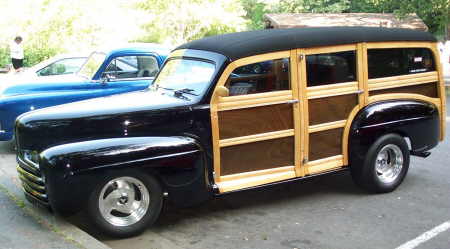
1946 Ford Super Deluxe Woody Station Wagon

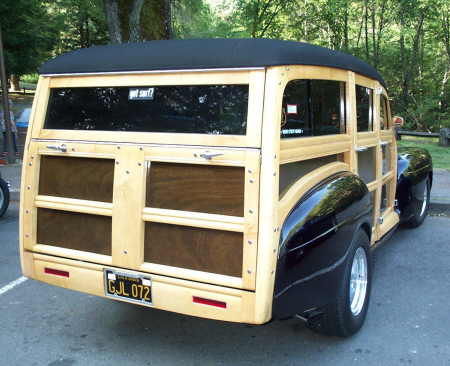
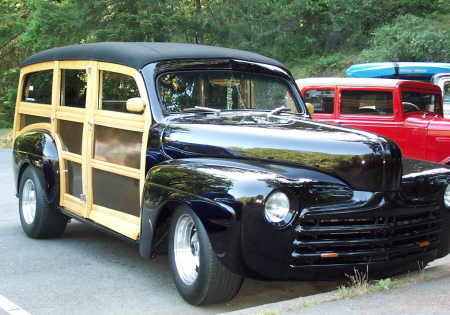
This is a 1946 Ford Super Deluxe Woody Station Wagon.  To be more accurate, it is a highly modified 1946 Ford Super Deluxe Woody Station Wagon, unlike what you would have purchased from your local Ford dealer back in 1946. This was one of the finest regularly driven customized woodies I have ever seen.

Prior to the mid 1930’s, wood was a more economical material to use in the fabrication of automobiles than steel.  Many vehicles utilized wood in the chassis framework as a structural component, upon which steel body assemblies would be built.  Eventually, a small number of automobiles began to shed portions of the steel body in favor of all wood exposed body panels.  Besides the material cost considerations, there was another dynamic at work.  Prior to common adaptation of the automobile as our standard mode of transportation, this country traveled by horse-drawn carriage.  As the automobile gained in affordability and popularity, there were many craftsmen skilled in the methods of woodworking used to manufacture the carriages that lost their livelihood.  By transferring their skills to the automobile industry, many regained employment building the wooden body parts for this new breed of vehicle which we now call a woody.

The original derivation of the term station wagon has interesting roots.  Prior to World War 2, there was no such thing as common commercial air travel.  Substantially all long distance travel in America was done by train.  Passengers needed transportation from hotels and private residences to the local train station to embark on their journeys.  Cabbies, or hacks, began to alter regular automobiles by rebuilding and extending the rear trunk sections to hold the large amounts of baggage that was being hauled to the train station.  This is where the term “station wagon” comes from.  They were also referred to as “depot hacks”, but this term did not stick, so we are left with today’s usage of station wagon.

1946 Ford Super Deluxe Woody

There is much nostalgia regarding the woody as THE wheels for surfers in America.  Contrary to common recollection, the woody was originally chosen by surfers for two simple reasons.  First, they were cheap in the late fifties and early sixties.  While some authentic wood paneled vehicles were produced after WWII (including this 1946 Ford), it was increasingly more economical to produce vehicles entirely from steel.  Since domestic automobile production came to a virtual standstill during the war years, it can be inferred that most woodies were produced prior to 1941.  Therefore, by the late fifties and early sixties, most of the wooden autos still in existence were at least 20 years old.  If you have ever seen an unmaintained woody, you will understand that in 1960, prior to their nostalgia induced popularity, a woody could be purchased for a paltry sum of money.

The second reason that the woody became popular amongst surfers was the space available in the rear to transport their surfboards.  For those familiar with the surf culture, you will know that surfing is a nomadic sport, in the sense that gung-ho surfers are always venturing to different spots seeking the “perfect wave”.  It is not uncommon for a surfer to start his surfing day at one location, and through the course of the day, travel up and down the coast searching for the most challenging wave sets to tackle (and the prettiest surfer girls to flirt with).  The large space in the rear of the woody station wagon was perfectly suited to the task of hauling surfboards.  The flip up tailgates associated with the woodies allow the surfer to quickly throw many boards in the back of the vehicle and travel to the next venue.  It is interesting to note that the second most popular surfer vehicle of the past was the Volkswagen bus, for just the same reasons; they were inexpensive and they could hold many surfboards easily.

1946 Ford Super Deluxe Woody

It is just a guess, but from my observations along the California coastline during the course of many years, it would seem that very few woodies are still being used by surfers.  The nostalgic popularity of these vehicles has probably made the cost of a classic woody prohibitive to most surfers today.

Flashback Friday #5

In the summer of 2000 Retta and I took a road trip to see the old growth redwoods along the northern California coastline.  In this northwestern part of the state there is an abundance of protected lands including Redwood National Park,  Prairie Creek Redwoods State Park, Del Norte Coast Redwoods SP, and Jedediah Smith Redwoods SP.  These parks are all managed cooperatively by the National Park Service and the California Department of Parks and Recreation.

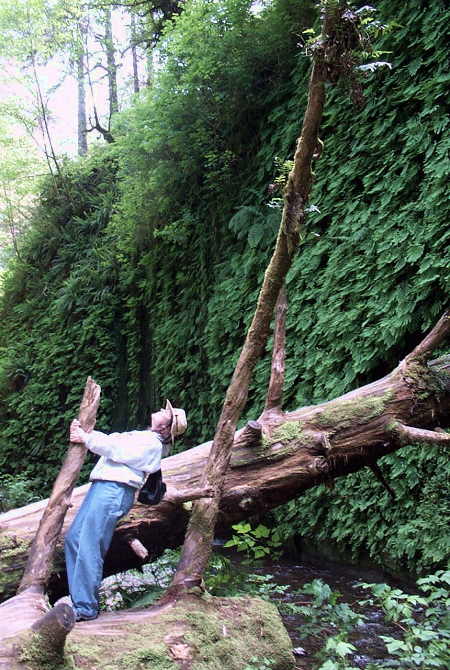
One treasure that lies within this region is the  under-visited Prairie Creek Redwood State Park.  Besides the majestic coastal redwoods (the tallest living organism), this park contains two gems.  The first is a place called Fern Canyon, which is a lush, green canyon filled with ferns (aren’t I perceptive?).

Enjoying Fern Canyon

Fern Canyon is a beautiful place to spend a morning or afternoon enjoying the ambiance that only a fern canyon can provide.  As an added treat, in order to get to the trail head that takes you into the canyon, you have to drive along a stretch of land called Gold Bluffs Beach, which offers absolutely spectacular vistas of the coast and ocean.  But the real draw for photographers and nature lovers are the elk which inhabit the beach area.

Elk at Prairie Creek Redwoods SP

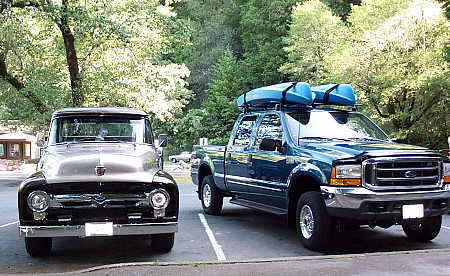
It’s funny how you can travel to a destination in order to see the expected sights, only to find something else entirely unique and unexpected.  This is what happened to us on this particular trip.  As we were driving along the Redwood Highway, we found an unoccupied rest area along a beautiful river. Pulling into the rest area for a some R&R, Retta and I got out our folding chairs and settled in to enjoy a little snack.  Not long after, we noticed a truck parking next to ours.  At the time, our truck was a 2000 Ford, shiny and brand new, looking as if it had just come off the showroom floor (which it had).  The Ford truck which had pulled in beside ours was about a half-century older than our truck, but it looked shinier and newer than ours did!

Which is the new truck?

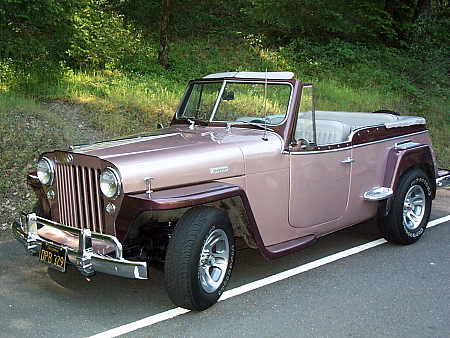
Before long another vehicle enter the rest area, this time a sparkling Willys.  I believe it was a 1950 Willys Jeepster Phaeton, and it was immaculate.

1950 Willys Jeepster Phaeton

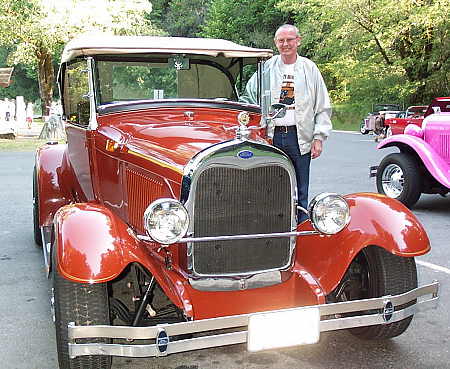
Being a car-guy at heart, I had to investigate these vehicles.  As I got up from my chair to walk on over to the parking lot, I saw several more vehicles enter the lot, each one more exotic than the last.  I talked to a gentleman who had just jumped out of this set of wheels –

Old Ford roadster

He explained to me that this was a vintage and customized car club out for their monthly weekend excursion.  Part of the rules of the club are that all members (which in this case are the cars, and not the people) must be ambulatory, and that to remain in the club, each vehicle must participate in at least 6 such outings per year, or be put on probation (whatever that entailed).

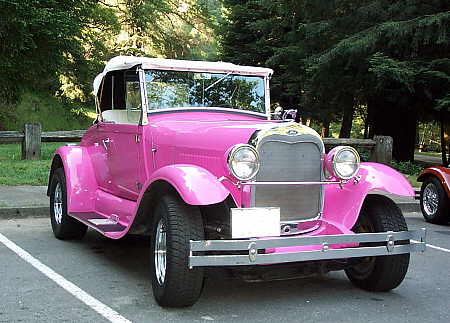
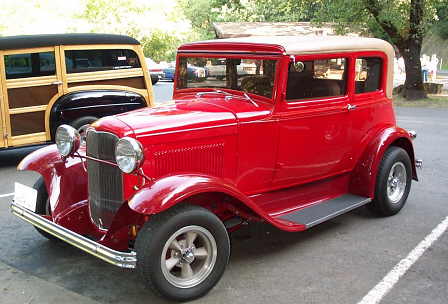
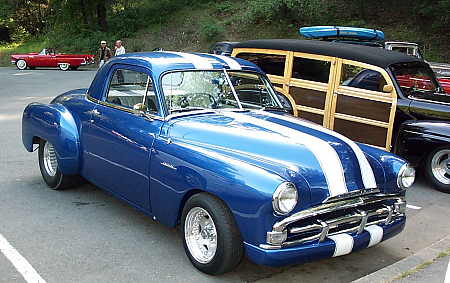
Before long, the entire lot was filled with all manner of unique and interesting vehicles, most of which I cannot identify with any precision, so I will not attempt to.  But here are some more of them.

Nice ride!

Gangsta sled

Big wheeled baddie

You can’t see it in the last picture, but the entire rear of this vehicle (I think a modified business coupe) has been altered to accommodate the massive 20″ wide rear tires!  There were probably about 40 vehicles in total that day, and the best part of it all was that Retta and I were treated to a “personal” car show.  As you may well imagine, each vehicle owner was eager to talk about their buggy, and there were many interesting tales that were told.  Alas, I only wish that I had taken notes, so I could remember all of the details.

What to Title This Post?

First, I thought of something like “Paranoia Run Amok”.  Why?  The purpose of this post originally was to serve to clarify what my opinions are (at the moment, anyhow) regarding the origin of spam and computer viruses.  In a previous post I raised the issue that possible blog comment spam might have originated from the “Word Cloud phenomena that propagated (memed?) through the blogosphere a few months ago.  In the comments that ensued from this post, I expressed a pretty strong opinion about the relationship between spam/viruses and the companies that profit from defeating the same.  Here is what I wrote:

 In my more paranoid moments, I can’t help but think that there is a connection between the growth of spamming, and the companies that profit from “defeating” it. If my paranoiac reasoning is correct, than there never has to be any sales closures for the product being hawked, as this is not the motive for the spam in the first place, but merely a pretext for the sale of anti-spam products.

Similarly, I sometimes feel the same paranoid suspicions regarding the source and motivations behind virus outbreaks. It seems that if one wanted to “follow the money trail” of these activities, one should not overlook the fact that many companies have built their entire business model on selling annual subscriptions to products and services designed to “defeat” these ever-growing threats.

Microsoft has built an empire on a simple premise: Provide a product that every computer owner perceives that they need (Windows), and then create a managed version update program to get these same owners to upgrade to the latest, greatest OS (witness Windows, Win95, Win98, WinMe, WinXP, and Vista, not to mention all the flavors of WinNT that have come down the pike). If companies such as Symantec, McAfee and others can persuade everyone that they must not only buy their products, but also constantly renew their subscriptions, than they will have effectively “one-upped” the Microsoft business model. I guess only time will tell if I am being paranoid, or if I am simply being prescient.

As I thought about this comment, I began to feel as if I might have been overreacting, even though I had so clearly peppered my remarks with words like paranoid, suspicious, and paranoiac.  And so my original intent was to somehow soften the tone of my opinion on this issue a little bit with this post.  And then something happened.

I read a computer magazine which referenced an article titled “The Antispyware Conspiracy“, which addressed a portion of this issue in a direct manner.  After reading this article, I began to feel that maybe I wasn’t being so paranoid after all.  But the author of the article began with the following statement:

“Since the release of the first antivirus products many people have believed in a conspiracy theory where antivirus companies generate their own market by paying virus writers to develop and release viruses. I don’t subscribe to that theory and trust the major security vendors, but recent trends show that there’s a fuzzy line between second-tier antispyware vendors and the malware they clean.”

This article seems to point a finger at some second-tier antispyware vendors, but is quick to absolve the major security vendors of any complicity.  And as I thought about this more, one thing kept popping to mind – maybe the major players ARE paying virus writers to develop and release viruses!  Not directly, of course.  I am not suggesting that executives within Symantec or McAfee direct any campaign to unleash viruses on the computing world.  In fact, I would be the first to suggest that the executives within these companies realize that any involvement in such schemes would be fatal to their own best interests, and I further believe that the intentions and motivations of these executives are pure.

This apparent contradiction on my part can be explained by considering the following simple observation.  Name any other industry that contains this unique dynamic – any individual employee within the “malware prevention industry” can guarantee his very own job security by propagating the malware they are hired to defeat.  Imagine this employee spending just 1 hour per week developing his malware, and you can imagine the havoc he/she could inflict.  Now multiply this dynamic by the number of employees in this industry (hundreds? thousands? tens-of-thousands?).

If you think I am too suspicious, let me tell you a true story.  Some years ago, I was called upon to render a professional opinion regarding a computer system and associated software programming for a client who owned a chain of glass companies.  The logo of this company was a little boy at play.  If you looked closely at the logo, you would see that the little boy had a slingshot hanging from his back pocket.  I asked my client about this, and he replied with the following tale.  He (I’ll call him Mr.X) began his career as an employee of a glass company.  In 1971 Southern California experienced a large earthquake, and there was more glass replacement business to go around than anyone could handle.  Mr.X decided to go into business for himself, and for a while, all was good.  Eventually, the earthquake damage in the area was repaired, and Mr.X found himself wanting for business.  Arming his son with a slingshot, ammunition, and instructions to shoot up windows in a neighborhood, Mr.X would than saturate the same neighborhood with fliers advertising his glass repair company.  No wonder I am now suspicious of business by nature!

So I now face three questions –

A) Are there any other industries that contain the same dynamics that are at play with the malware industry?

B) Am I being overly paranoid with respect to the malware industry?

C) What should I have entitled this post?

A Decal That Could Save Your Life

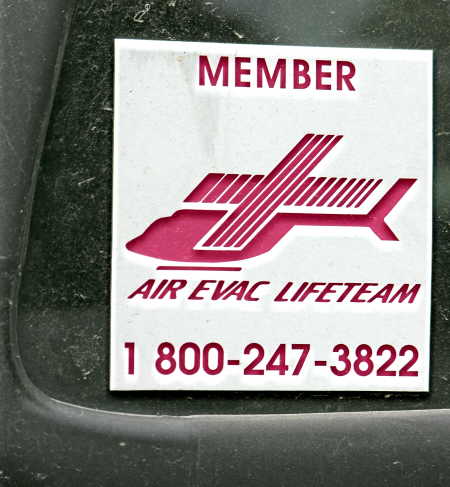
AirEvac Lifeteam window decal 

I generally avoid recommending any specific product or service to others.  I will offer my personal experiences with a product, whether good or bad, and let the listener judge for themselves as to the suitability of a particular product for their specific use.  But in the case of AirEvac Lifeteam, I will not hesitate to urge anyone who happens to live in the state of Missouri, Arkansas, Oklahoma, Kansas, Tennessee, Mississippi, Illinois, Kentucky, Iowa, Alabama, Indiana or Texas to click on the following link to see whether AirEvac Lifeteam operates in your area, or in areas that you frequently visit.

AirEvac Lifeteam

Living in rural America has a great many advantages over life in the big city.  Speed of emergency medical response time is not one of them.  When confronted with the prospect of accidental injury or a medical emergency in remote rural areas, we must do all within our powers to stack the deck in our favor any way we can.  Perhaps you do not live in a rural area, but travel through rural areas often.  If so, then there is always the terrible possibility that emergency medical transportation may become necessary due to an automobile accident.  AirEvac Lifeteam is an organization with a fleet of Medivac helicoptors stationed in strategic rural points to address these needs.  Hopefully, the need will never arise for their services, but if it should be required, then the modest annual dues would seem a trivial expense ($50 self, $55 self + spouse, $60 household of 3+ persons).

From the AirEvac Lifeteam website –

Air Evac Lifeteam was founded in 1985 in West Plains, Missouri by a group of private citizens who wanted to give the people in their community better access to emergency medical care. West Plains had a population of less than 9000, and the closest major hospital was more than 100 miles away by ground transport. The road system in this hilly, remote region of the Ozarks often made it difficult to reach people in a timely manner.

At that time, air ambulances typically were based in metropolitan areas. The company founders believed that the people who need air ambulance transport the most are the ones who live far away from a hospital. They thought that having a helicopter based in West Plains could be of great benefit to patients requiring transport during critical situations. Their goal was to provide a quality service that was affordable to the public.

They knew that for the service to survive in this rural area, they would need other sources of funding, besides traditional fee-for-service billing. They discovered the REGA Foundation in Switzerland, which supported a nationwide air ambulance system by a membership program, similar to the ground ambulance and rural fire department programs here in the United States. After meeting with the head of REGA, Air Evac Lifeteam adopted this idea, and became the first air ambulance service in the United States to offer a membership program.

Air Evac EMS, Inc. was incorporated in June of 1985, and placed its first helicopter into service at Ozarks Medical Center in August of that year. During the following year, more than 5,000 area residents became members, and Air Evac Lifeteam flew hundreds of patients during their times of critical need.

Company founders knew that other rural areas would benefit from air ambulance care, and began expanding the concept. Air Evac Lifeteam’s network of bases now extends throughout the central United States. Air Evac is licensed as an air ambulance provider in Missouri, Arkansas, Oklahoma, Kansas, Tennessee, Mississippi, Illinois, Kentucky, Iowa, Alabama, Indiana and Texas.

In addition, Air Evac Lifeteam operates Regional Offices, with maintenance and fueling centers in Oklahoma City, Nashville, St. Louis and West Plains, Missouri.

Flashback Friday #4

Lessons Learned the Hard Way

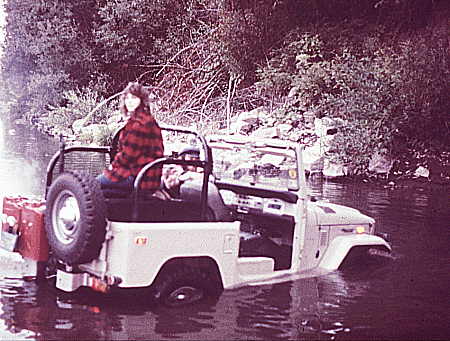
In the early 1970’s I owned a Toyota Landcruiser (“Toy”) that I came to believe was jinxed.  While this vehicle brought me plenty of pleasure in it’s ability to allow me the freedom to explore rugged terrain, it also had it’s share of tempermental moments.   For instance, once on a trip to Oregon to visit my friends Craig and his lovely wife Linda, the three of us decided to explore a slough off the Willamette river.  Along this slough, there were numerous shallow puddles of standing water that we wound around and motored through.  The shimmering water in the afternoon sunlight was an enchanting sight to behold.  So much so that I lost focus on what I was doing and drove directly into a deep hole filled with water.  Darn jinxed Toy!  “Well, this is no big problem” I thought to myself.  We can just back out of this measly little puddle.  I believe Craig just chuckled to himself as he hopped out of the Landcruiser to snap a picture.  Linda was apparently confident at this point in time, at least as far as I can tell from the picture below:

We'll get out of this mess

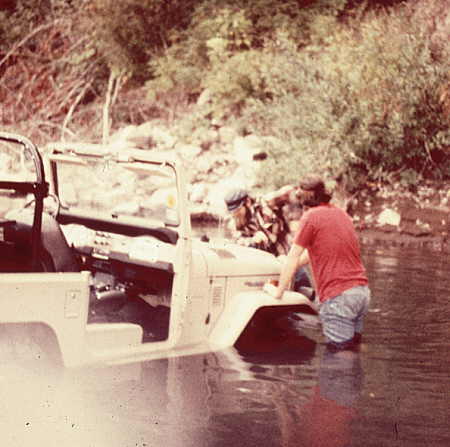
Putting the transfer case into granny-low gear, I attempted to back the Toy out of the puddle.  We were sitting on a silty surface, however, and the vehicle tires promptly dug themselves into the mud.  Darn jinxed Toy!  “Well, this is no big problem” I thought to myself.  We can just get out the high-lift jack, jack the Toy up very high on the jack, and then push the Toy over to the side, thus putting the tires on a more solid footing.  I believe Craig just chuckled to himself as he hopped into the water to help me along with this scheme.

Hmmm - this doesn't seem to be working

This incident occurred over thirty years ago, and so my recollection of the exact events that transpired from here on may be a little rusty, but I think it went something like this.  Craig and I spend hours and hours trying out various schemes and methods in our attempt to free the Toy.  I recall Craig doing a lot of chuckling in the process.  I recall myself uttering a few curses.  And I recall that we were totally unsuccessful in freeing the Toy.  I had managed to flood the engine with water however, and now we had no power.  Darn jinxed Toy!  “Well, this is no big problem”  I thought to myself.  Actually, “this is now a problem” is what I really thought!

In this part of Oregon, at least back at that time, logging was in full swing.  Fortunately for me and the Toy, Craig pointed out that there was a saw mill located nearby.  It was now near midnight, and we figured (actually, Craig figured) that if we hurried on over to the mill, we might find someone to help us out of our predicament, as the mill shift change occurred at midnight.  Sure enough, we found a man with a four-wheel drive pickup sporting a winch (not an unusual sight in Oregon) who agreed to help us.  Soon, he and his winch had the Toy back up on solid ground.  This kind and helpful man even towed my now non-operating vehicle to a local service station, where we parked it for the night.

The following morning, Craig gave me a ride to the service station, where I learned from the mechanic that yes, he could drain and flush the engine, transmission, transfer case, front and rear differentials, but that it would be very costly.  Darn jinxed Toy!

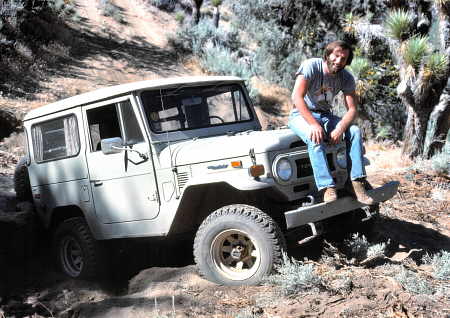
The following year, while out exploring in the California desert with some friends, we had a little competition to see whether my Landcruiser F-40 could outperform their Jeep CJ5 over a rugged desert trail.  Up and down the hills and ravines we drove (in a designated ORV area, I should note) pushing our vehicles to the limit.  My Toy performed admirably in this battle of the 4WD’s, that is, up until the very last hill on the trail.  I was so thrilled over the prospect of a good showing amongst my Jeep driving friends that I lost focus once again, and drove over a large rock that I shouldn’t have.  My vehicle became high-centered on a boulder, and I was once again stuck.  Dang rocks!   Darn jinxed Toy!

When will I ever learn?

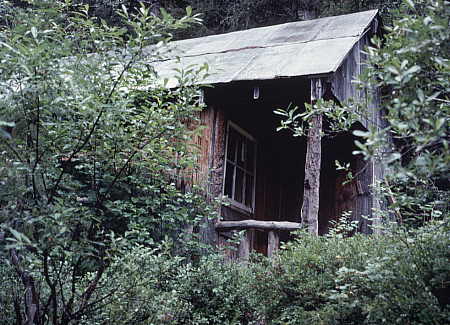
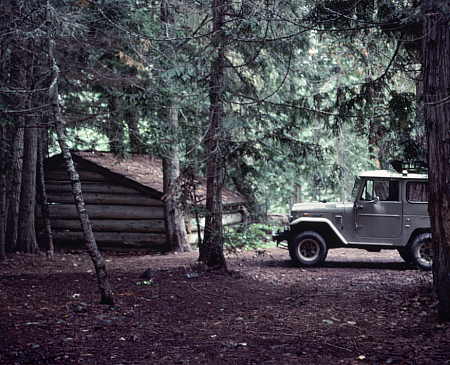
Later that same summer, I again headed up north, this time to the west coast province of British Columbia, where I was keen to do some hiking.  Along the way, in Washington state, I met a nice couple who were very interested in my Landcruiser.   After much discussion about the pros and cons of owning such a vehicle, we decided to do some day hikes together.  When they learned that I was headed towards the Canadian Rockies, they offered me the use of a cabin they owned in BC.  They told me that they had built a bridge over a river that runs alongside the cabin, and that the hiking from that point was excellent.  I took them up on their offer, and so they proceeded to draw a map directing me to their remote cabin in the woods.  When I arrived at the cabin, this is what I found –

 This is the place I'm supposed to stay in?

Parking the Toy, I investigated this old dilapidated structure.  From inside, you could see rays of daylight streaming through the roof.  There were all manner of creepy-crawlers on the floor and on the walls.  Droppings from vermin was everywhere.  This was not the type of accommodations I had expected, and I refused to stay in such quarters.  Exploring out back, I found what appeared to be some type of old storage structure, or maybe an old hog shed.  Whatever it was, it was clean inside and had a functional roof, so it became the base camp for my hiking.

A good place for shelter from the rain

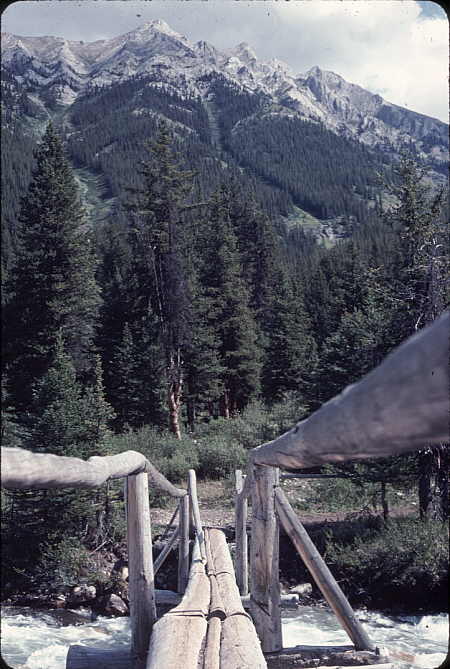
Even though the cabin that the couple had told me about had not lived up to my expectations, the hiking that was available beginning across their bridge was some of the best I have ever encountered. 

A great place to begin hiking

After spending a week hiking and camping out in the hog shed, I decided that it was time to push onward in my journey.  As I loaded up the vehicle with my camping gear, I noticed a large puddle of fluid underneath the front of the Landcruiser.  Getting down on my hands and knees to investigate, I discovered that some critter had chewed through the lower radiator hose, thereby releasing all of the coolant from the radiator.  The vehicle was again non-operational, and I was stuck far from any village or town.  Darn jinxed Toy!  “Well, this is no big problem” I thought to myself.  Having the foresight to pack the always-essential roll of duct tape in the tool box, I proceeded to wrap the damaged hose with tape, fill the radiator with water from the river, and limp on over to the nearest town, where proper repairs were undertaken.

It was not until years later, after I had sold that Landcruiser, that I finally realized what wonderful experiences that Toy had given me.  And looking back, I can now see that I was the cause of most of my travails with that vehicle, not the vehicle itself.  So the lessons learned are A) look to yourself as the cause of your follies, and B) drive a Jeep instead of a Toyota!

Bridging the Generation Gap (Part 1) – 35mm Film/Slide Scanners

Of course, the generation gap that I am referring to is the technological generation gap that exists in the photographic world today.  On one side of the chasm you have new, digital technologies that reduce the visual world to an ordered series of 0’s and 1’s stored within a digital file.  On the other side of the chasm are the traditional photographic technologies that rely on film and emulsion to be the storage media for the image. 

If you are young enough to be a product of the digital era, it is likely that all of your accumulated photographs already reside on your computer, so you will find yourself standing securely on one side of the digital divide.  If you happen to be old enough,  it is likely that all of your accumulated photographs are of the traditional film type, and it may be that you are quite content with the status quo.  If so, then you will find yourself standing equally secure, but on the opposite side of the digital divide.  In between these two extremes, however, are legions of photographers (myself included) who possess both digital images and film images, perhaps numbering into the thousands for each type.  For these photographers, questions often arise as to the best method of moving an image back and forth between film and digital media.

Over the past years, I have struggled with some aspects of the film-to-digital, digital-to-film conversion dance.  Although not an expert in these areas, I have learned a few things from both my successes and failures, so I will share them with you in a seriously serious series entitled “Bridging the Generation Gap”.   Part 1 shall begin where I began my own journey into this brave new world, with 35mm film/slide scanners.

In 1993, there were no consumer digital cameras.  Kodak had just recently announced the DCS 200, based on a Nikon 8008 camera body, but that was a professional 1.5 mega-pixel camera that sold for over $10,000.  Without a lens!  While there might not have been consumer digital cameras, there where plenty of computers around, and plenty of people who wanted to digitize their film-based photographs in order to edit, print, share and archive them. I was one of those people, and so I began my search for a scanner capable of digitizing the thousands of 35mm slides that I had accumulated over the years.

The first scanner I owned was a Nikon Coolscan LS-10e.  This was a 2700 dpi – 8 bit per color channel slide/film scanner that was considered to be of excellent quality in its’ day (1993), and which sold for approximately $2000.  This scanner would produce a 24Mb uncompressed tiff file from a 35mm frame.  I can honestly say that I pushed this scanner system to it’s limit.  I can also say that this system was a nightmare to install and use.  I use the term “scanner system” deliberately, because at the time this scanner was marketed by Nikon, there were three critical components necessary to create a successful scanning environment; the scanner device itself, the computer interface, and the scanner software provided by the scanner manufacturer.

To explain the shortcomings of the Nikon scanner system, I really must take you back in time and refresh your memory as to the state of the graphics world in 1993.  Apple Computer was the name of the game, and a Mac was the machine you needed to have.  Adobe ruled the graphics/imaging software world, and Photoshop Version 2.3 reigned supreme.  In the PC world, the Intel Pentium chip had just been introduced, and this 60 MHz “screamer” could be had for as “little” as $878.  If you were at the cutting edge, you would have been thinking of upgrading your Microsoft MS-DOS Version 6.0 to Windows for Workgroups Version 3.11.  Woe unto the poor, misguided soul who dared venture into the graphics field armed with merely an Intel/Microsoft based PC.

Why was it so difficult for us PC guys to use our computers for digital imaging?  If you examined Photoshop v2.3, for instance, you would find that the software was originally written and optimized for the Mac platform, and then (poorly) ported over to the PC platform.  Ditto with the scanning software provided by Nikon for the LS-10e.  Originally designed for the Mac, it too was a botched port to the PC platform.  Added to this unfortunate mix was the fact that the Nikon LS-10e driver relied upon a specific Adaptec SCSI interface board to communicate with the computer, and that particular Adaptec board had numerous issues with the extended memory managers that were a necessary part of the PC’s configuration back then.  Despite all of the problems, Nikon and other imaging vendors recognized the huge market the PC represented, so it was “off to market” with whatever products they had at hand.

I could write a a very long article about all of the problems I had with the Nikon LS-10e scanner system, but that is not the purpose of this post.  Suffice it to say that for every scanning session, I had to reconfigure autoexec.bat files, config.sys files, reorder the devices attached to the SCSI daisy-chain, reboot the system, say my prayers, and then scan.  If my prayers were answered, the scan would be successfully completed without crashing the computer two or three times.   When finished scanning, the entire process had to be reversed to enable normal use of the computer.  Add to this the problems encountered, and the time consumed when trying to perform digital editing of a 24 Mb image file on a machine that could only “see” 640k of the file at a time, and you had a scenario in which a person had to be pretty motivated (or have had plenty of free time) to do any serious scanning.  Having said that, the results obtained after exerting all this effort in scanning a slide or negative were excellent.  The Nikon scanner was great at rendering an accurate and pleasing image file for those images that I scanned using it.  But because of the enormous time commitment involve in the process, I never even came close to my goal of digitizing all of my old film-based images.

Two years ago, I decided that the time had come to reopen the book on my slide/film scanning escapades, and so I again ventured out into the 35mm slide/film scanner marketplace.  What I discovered was that the slide/film scanning situation had changed very dramatically since my last foray into the arena a decade ago.   After examining the offerings available, I settled on a Konica/Minolta Dimage Scan Dual IV 35mm Slide/Film Scanner (whew… that’s a mouthful). 

Konica/Minolta Dimage Scan Dual IV 35mm Slide/Film Scanner

This scanner is a 3200 dpi – 16 bit per color channel 35mm slide/film scanner that also accommodates APS film.  This scanner will produce a 70Mb uncompressed tiff file from a 35mm frame, or nearly 3 times the information capacity of the Nikon Coolscan produced file.   The scanner connects to the computer via USB 2.0, so it is simple, quick and readily available to most users.  The scanner is supplied with the scanner utility software as well as a copy of Adobe Photoshop Elements.  I paid less than $250 for this scanner in 2004.

My experience with this scanner has been diametrically opposite of my experiences with the Nikon scanner of the 1990’s.  After the initial installation, which involved nothing more than inserting an installation CD into the drive and then plugging the USB cable into the computer, the scanner worked flawlessly.  I have used this scanner to scan hundreds of slides, and it has yet to crash in the midst of the process.  The Nikon Coolscan, on the other hand, would sometimes take two or three rebooting cycles of the computer just to achieve one successful scan.  The slide holder (which can be seen in the photo above) holds four slides at a time.  Now that I have become familiar with the software and have established a usage routine, I can prescan four slides, apply minor image correction and cropping to each image, and complete the final scans on all four images in less than ten minutes.  So at a rate of about 20-25 slides per hour of work, I am slowly making a dent in my digitizing efforts.

Quality of Scan Issues

For the type of usage that I have put my scanners through, I can make a few general observations regarding image quality.  The first observation is that the quality of the scanned image is directly related to the type of film that is scanned, regardless of which scanner you use.  The results of both the Nikon and Konica/Minolta scans reflect the fact that grainy films produced poor scans from each.  For example, here is a scan produced by the Konica/Minolta scanner from a GAF color ASA 400 slide film (which is considered a grainy film). 

GAF ASA 400 Film example

This scanned image has lost most of the sharpness that exists on the original slide.  Additionally, if you examine the shadow areas at the top, the grain of the film becomes apparent, much more so than when the film itself is examined under a loupe.

And the following example is also GAF ASA 400 slide film, scanned with the Nikon Coolscan.  This photo was taken in Yosemite National Park at night, using a time exposure (notice the stars in the sky).  You can really see how the grain is exaggerated in the sky with this scan.
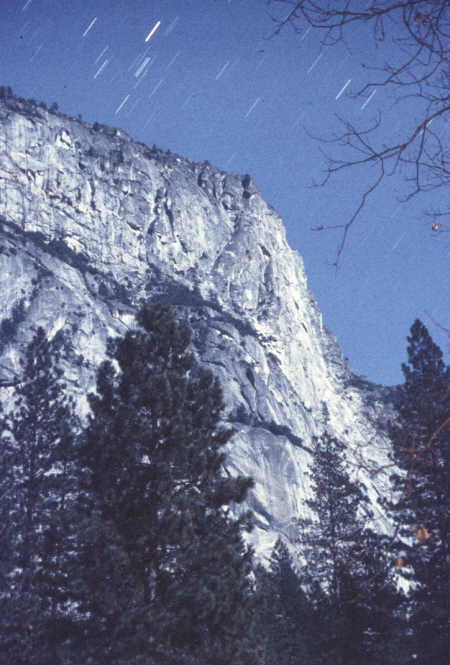
GAF ASA 400 Time Exposure

The second observation is that both scanners produced excellent results when the film in question was a good exposure taken on a fine grained film.  Here are two more examples to illustrate this point.  The first is a photograph taken with Fuji Velvia 50, considered to be a highly saturated and fine grained color slide film, and originally scanned with the Nikon Coolscan:

Spanish Shawl Nudibranch

Notice the deep saturation of the resulting scan, and also notice that there are no grain artifacts in either the background, or in the “skin” of the Spanish Shawl nudibranch.  The following photograph of a Corvette fender (everybody has a photo of a Corvette fender, don’t they?) was taken with Kodacolor ISO 100 film, and it was scanned with the Konica/Minolta scanner:

Kodacolor ISO 100 slide film

In examining the photo above, you will see bright saturated color, and no hint at any graininess.  The detail in the images has been retained in the final scan, and artifacts are kept to a minimum.  Overall, I have been very pleased with the quality of the scans that I have made with both of these systems,  but I have been extremely pleased and surprised at the ease of installation and use of the newer generation Konica/Minolta scanner.

As a concluding thought, I would say that the goal of digitizing my collection of slides will probably be accomplished eventually, but not in the near future.  At a rate of 20-25 slides per hour of work, the scanning process is still a slow procedure.  Fortunately, I do not shoot with film anymore, so my collection of film-based photographs will not be growing.  In the meanwhile, it is quite enjoyable to see pictures taken long ago become available for viewing and sharing on a computer platform.