It’s Time For Another Try

With beef prices fluctuating around all time highs over the past several years, there has been an economic incentive for farmers to increase production, sometimes by pushing the grazing capacity of their pastures to the point that supplemental feed becomes a necessity.  This, along with drought conditions that persist in a number of beef producing states, and substantially increased fuel costs, has pushed the price of baled hay up dramatically in recent years.  Under these circumstances, you would think that it would be easy to find a local farmer who would jump at the chance to cut, bale, and haul away all the fescue and clover hay our hayfields have to offer, especially since I ask for nothing in return.  Alas, as of now my batting average stands at a mere .500.   Here is the breakdown (names disguised to protect the guilty!)-

2001 – Farmer A accepted offer.  He cut, baled, and removed the hay promptly.  He also gave us a side of corn-fed beef in exchange.

2002 – Farmer A passed away prior to harvest.  Farmer B cut, baled, and removed 1/2 the available hay, long after it had lost any nutrient value.  The rest went to waste.

2003 – Farmer B committed to cut and bale the hay, but never showed up.  The hay again went to waste.

2004 – Farmer C asked us for the hay.  He cut, baled and removed the hay promptly.  He also filled our barn with square bales of hay for our horses.

2005 – Farmer C asked us for the hay.  He cut, baled and removed 1/2 of the available hay, but due to equipment failure, 1/2 of the hay went to waste.

2006 – Farmer C again asked us for the hay, but when it came time to harvest, his health precluded his doing the work.  All of the hay went to waste.

You can see that in the past six seasons, we only had three complete harvests, which accounts for the .500 batting average.

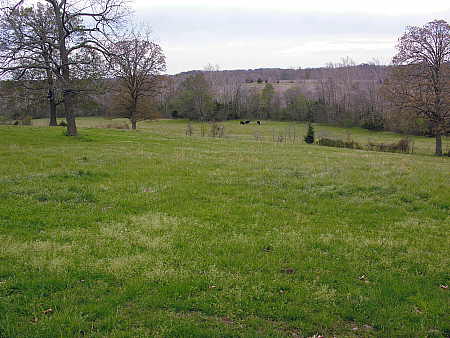
2007 – Hey, that’s now!  And this is what some of the hay fields look like today-

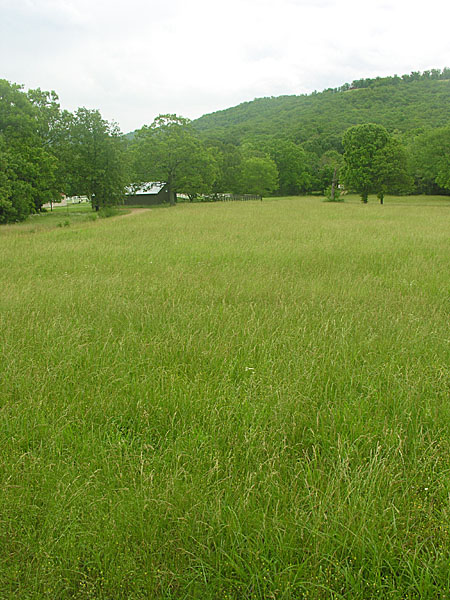
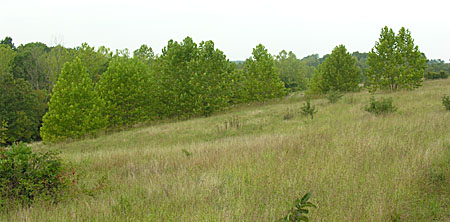
Fescue and clover

The grass is tall and the seed is developed to the point that it is ready for harvest.  It has probably reached the peak of it’s nutrient value, and enough of the seed will be shed in the processing of the hay to allow for natural reseeding of the hayfield (for a previous look at this process, see Fescue to the Rescue).

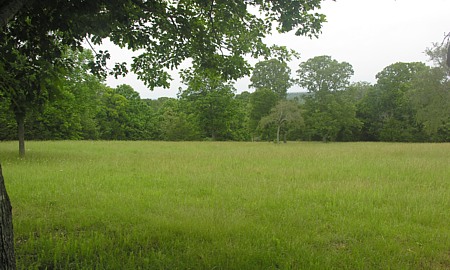
Another field

The road that leads to our home runs along side the hay field pictured above, so there is no benefit to maintaining a trail through the grass.

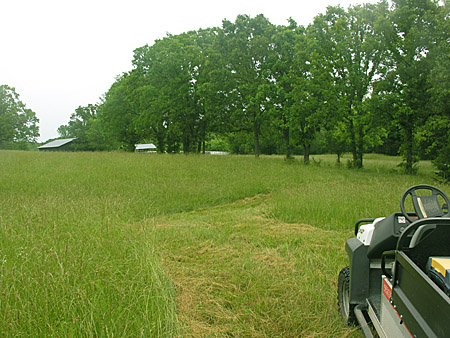
Trail through the hay

In places that we want to maintain easy walking and riding trails, I will use the bush hog to create paths, like the one shown above.  This path leads from our catfish pond over to the barn and paddock areas.

For this 2007 season, however, I think that the hay situation is well taken care of.  Remember the cattle that breeched an old barbed wire fence, raided a hayfield and destroyed a game feeder, from a previous post entitled Invasion of the Corn Snatchers?  Well, it turns out that the rancher who owns those cattle was renting a pasture from my neighbor.  He and his son were out here daily, working on the fencing.  When it became apparent to him that the fences were not up to snuff, he voluntarily trailered his cattle back to their former pastures, and our problem disappeared.  He (I’ll call him Mr. Rancher) was very gentlemanly about the entire situation.

Mr. Rancher recently stopped by and inquired about the wonderful hayfields we have, and asked if we would like to make a deal with him to have the hay cut and baled.  I told him he was welcome to take all the hay he wanted, as I hated to see it go to waste.  He graciously accepted the offer, and I’m close to certain that he will actually harvest and bale our hay.  Why?  First, he’s a young man, so I doubt that health concerns will keep him from baling the hay.  Second, he happens to be the service manager for our local Ford dealership, so I suspect that he knows the value and necessity of keeping his machinery well maintained.

As an aside, it can never be a bad idea to give the service manager at your local Ford dealer free hay – especially if you happen to own two Ford vehicles!

You may wonder why I am only “close to certain” the hay will get baled?  Because, it seems that Mother Nature sometimes has a say in these matters, as well.

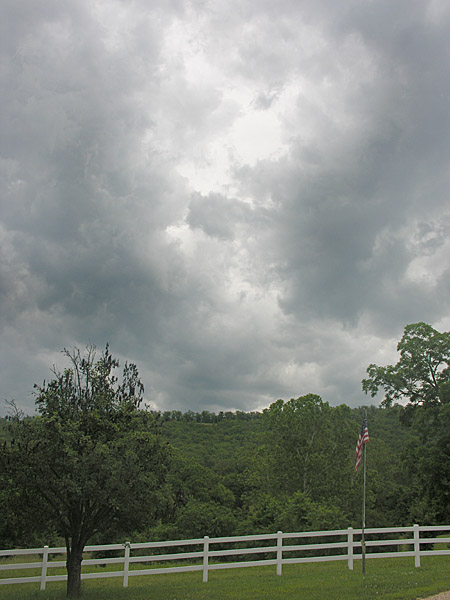
Threatening weather

These are the skies we have been seeing on and off this past week.  When processing hay, it is necessary to have several dry days in a row so that the grasses have a chance to dry a bit.  If the grass is baled with too high a moisture content, then the heat that is generated within the bales as a result of the natural drying processes causes bad things to happen.  Such as reduced nutritional value, formation of molds and fungi, and in some cases, spontaneous combustion.  Barns have been known to burn to the ground as a result of storing bales of improperly cured hay.

So, Mr. Rancher and I both keep our watchful eyes looking toward the heavens above, waiting for that golden sun to shine down upon us with all it’s glory.  Or else how will I ever be able to write a blog post with pictures of hay baled from these fields?  Tell me, how will I?

A Field Trip to the Reagan Presidential Library

The hills that overlook Simi Valley, California host the Presidential Library and Museum of Ronald Reagan, the 40th President of the United States.  On a recent trip to California, I decided to stop in for a return visit to the library, this time with camera in hand.  As long as I took pictures, I thought I might share them, along with a few of my observations about the library and museum. 

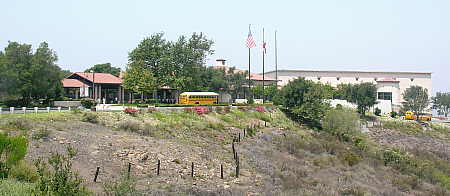
 Vantage of the Reagan Presidential Library from the parking lot

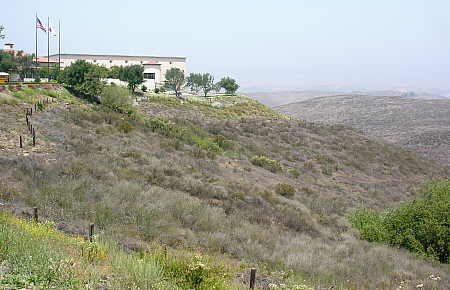
The first thing you might notice about the library is how hard it is to actually see the architecture and styling of the buildings from afar.  The complex is built on a hilltop, and there are scant few vantage points from which to see the structures as you make your approach to the parking lot.

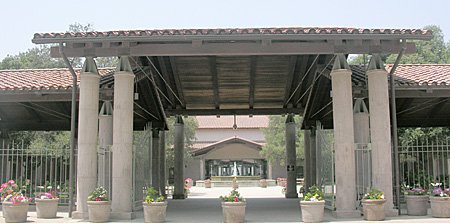
Entrance to library grounds

Soon, however, you will come to the entrance of the library, where you will start to see details of a gorgeous building, designed with a modern interpretation of classic early California architecture.

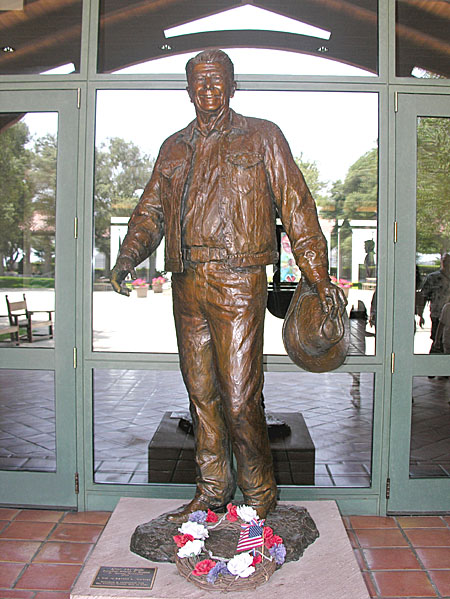
Statue of Ronald Reagan

A larger-than-life sized statue of President Reagan greets you as you make your way into the lobby of the building, where you will find a gift shop and the ticket counter for purchasing admission to the museum.

Portrait of Ronald Reagan

One thing becomes abundantly clear as you begin your tour of the museum – if you weren’t sure what President Reagan looked like at the start of your tour, you memory will be thoroughly refreshed by the end of your visit.  Portraits and photographs of President Reagan are on prominent display virtually everywhere you turn.

Ronald Reagan Portrait

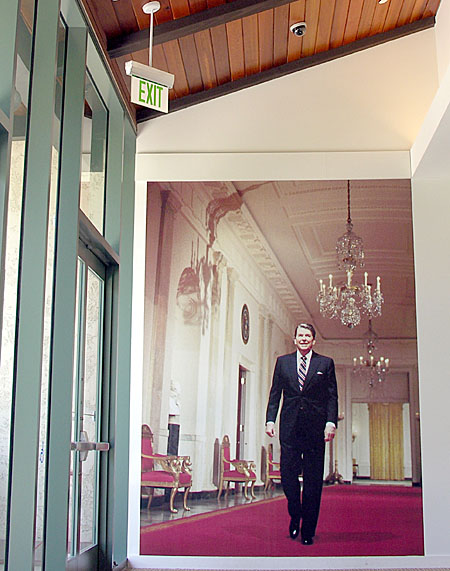
This portrait of President Reagan is painted on a wall at the end of one of the long hallways within the library.

Likenesses of the President appear frequently throughout the building

The museum is divided into a series of small individual galleries, with hallways, aisles, and corridors leading between the galleries covered with images of President Reagan, as in the example pictured above.

Movie, anyone?

A fair amount of exhibit space is devoted to Ronald Reagan, the actor.  In the photo above, you can see a visitor watching a Ronald Reagan film in the mini-theater replica located behind the ticket booth.  In fact, viewing short information films is the “technology de jour” for the Reagan Presidential Library, as you shall see further along in this post.

Reagan, the actor

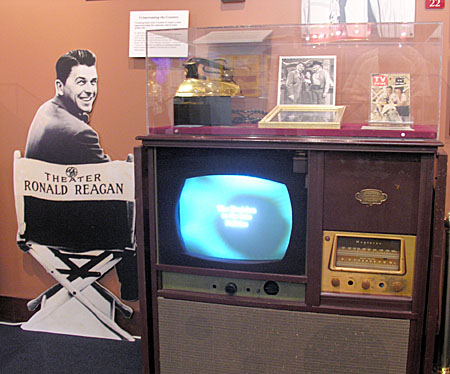
Again, Ronald Reagan, the actor, is depicted in this display highlighting his television career.  A small amount of museum space is devoted to Reagan’s two terms as Governor of the State of California, and a bit of space is devoted to the campaign leading to Reagan’s election as President of the United States.

Campaign paraphenalia

The caricature shown above, and other display exhibits serve to convey some of the conservative political philosophies Ronald Reagan was noted for.

 Symbols of the Cold War

The Presidential Libraries that I have visited all seek to impart a narrative of the subject presidency.  In the case of the Reagan Presidential Library, the narrative that seems to unfold is one of a president, who through sheer force of will,  ended the cold war and brought the Soviet Union to it’s knees.  Throughout the museum, exhibits highlight the tensions of the cold war, and there are constant reminders of President Reagan’s role in the demise of the Soviet Union, as in this display of opposing soldiers guarding Checkpoint Charlie along the former Berlin wall.

Indoor display of a Berlin wall segment

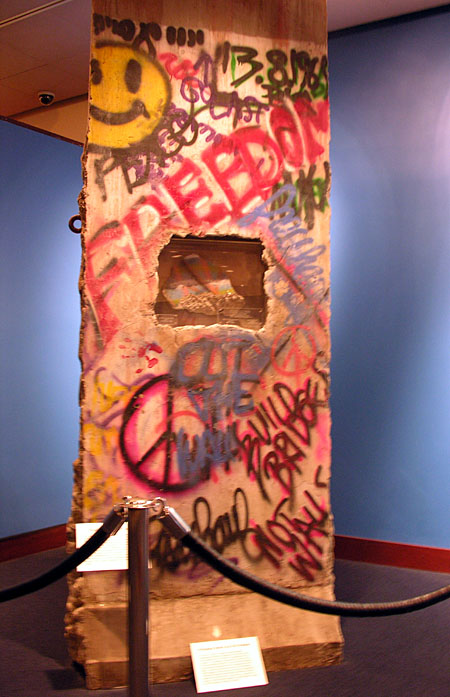
In another gallery within the library, a similar section of the former Berlin wall is on display, just in case you didn’t catch the first one.

Reminders of the Cold War on display

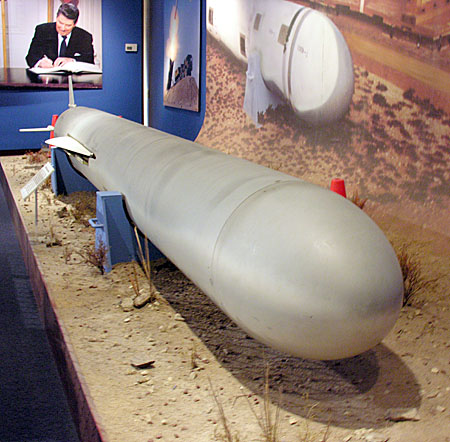
Another exhibit illustrating the cold war narrative of this presidency is this mock up of a nuclear cruise missile, shown along side a photograph of President Reagan signing an arms reduction treaty with the Soviet Union.

Another segment of the Berlin wall

In the event you may have missed the theme inside, there is yet a third segment of the former Berlin wall on display, this time outside of the museum, in the area of the White House South Lawn replica.

One of several A/V displays in the library

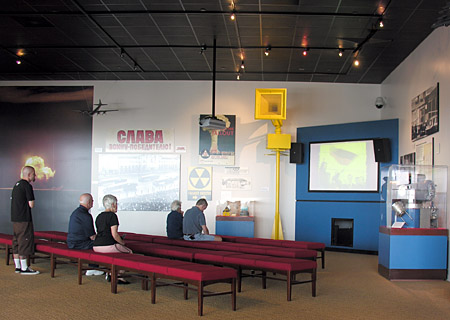
As I mentioned previously, several mini-theater screening rooms present the visitor with a concise summary of the issues of the time.  Here, again following the narrative of this presidency, a film and related displays remind the visitor that the world was on “the brink of disaster” during the cold war years and the years of the Reagan presidency.

Another A/V display in the Reagan Library

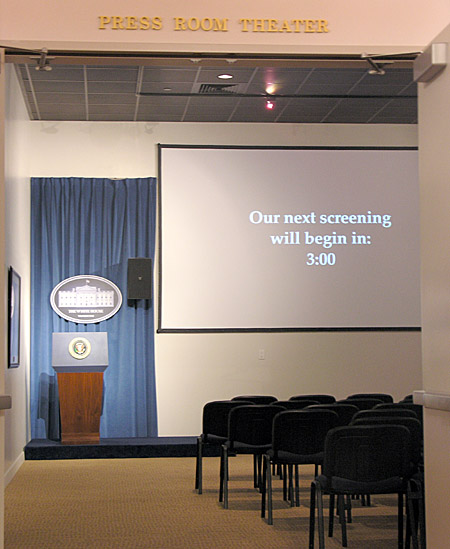
Here is yet another mini-theater used to present the visitor with information.  I was amused at the sign over the entrance which reads “Press Room Theater.”  Appropriate terminology,  indeed!

Air Force One

Midway through the tour, you will arrive at the enormous hanger-like structure that houses Air Force One, the retired Boeing 707 presidential aircraft that has recently been replaced with a new Boeing 747 jet aircraft.  There, before your eyes, sits Air Force One, just as clean and polished as the day she was first commissioned.  This plane has flown seven U.S. Presidents – Nixon, Ford, Carter, Reagan, H.W. Bush, Clinton, and G.W. Bush.  Security concerns do not allow for the taking of photographs aboard Air Force One, but the public can walk through the plane and view it with “eyes” only.

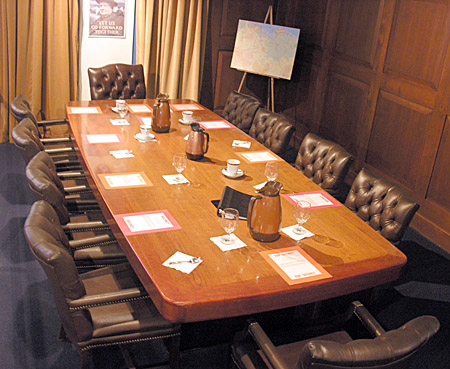
The Republican party recently conducted a pre-primary presidential debate that was held at the Reagan Presidential Library, beneath Air Force One in the room pictured above.  I happened to watch news sound bites of this event from the four major broadcast networks (ABC, NBC, CBS and Fox).   Surprisingly, each network anchor referred to the debate as being held underneath Air Force One,  which they all claimed was suspended from the roof of the building.

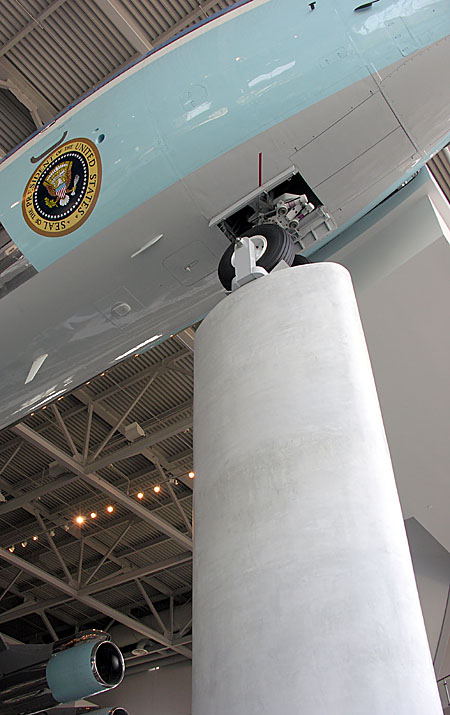
Support column for front landing gear

Let me put this vicious rumor to rest, once and for all.  The airplane is NOT suspended from the ceiling of the building, but is supported on three massive columns constructed specifically for their intended purpose.  The photograph above clearly shows the front landing gear resting on the tallest of the three support columns.

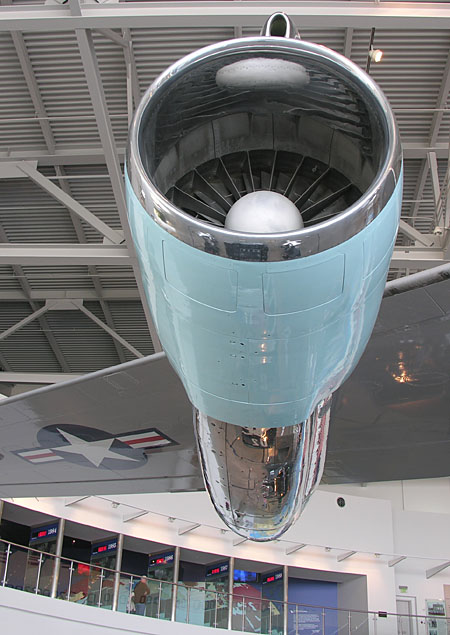
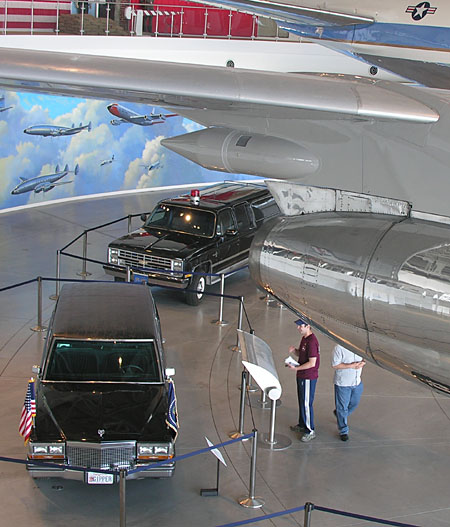
Jet engine pod of Air Force One

Getting to walk around underneath the aircraft gave me a good sense of just how large each individual engine pod actually is.

Presidential motorcade

Beneath Air Force One is an exhibit displaying a presidential motorcade.  Not shown in the picture above are police escort vehicles and motorcycles.

Marine One helicoptor

Also on display in this section of the Presidential Library and Museum is a retired Marine One helicopter, used to shuttle the President between various locations.  This one on display is a Johnson-era Marine One helicopter.

Oval Office replica

After touring the aircraft in the Air Force One pavilion, your visit continues back in the main wing of the building, where you can see replicas of the Oval Office as decorated during the Reagan years, and the Situation Room, as seen in the picture below.

Replica of Situation Room

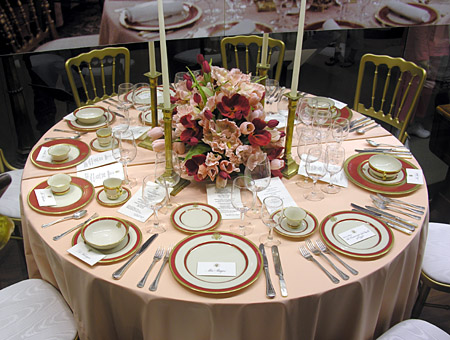
It has become a tradition for each First Lady to personalize their White House environment in certain respects.  One area where this is evident is in the selection of the White House china, flatware and stemware.

White House china and table settings

The table that you see here might await you if you were fortunate enough to be invited to a state dinner at the White House during the Reagan presidency.  As you may recall from my previous post about the Clinton Presidential Library, I don’t expect to be receiving a White House dinner invitation any time soon, so I am happy to see what the table would look like if I were to somehow be invited.

Burial site of President Ronald Reagan

Visitors who wish to pay their respects to President Reagan can do so at the Ronald Reagan Memorial,  where the late President was interred upon his death in 2004.  The Memorial is on the grounds of the Presidential Library and Museum, and is open to the public.

I have set a personal goal of visiting all 14 of the Presidential Libraries.  To date, I have only visited three (Hoover, Clinton, and Reagan).  Only 11 more to go, and perhaps you’ll get to see them with me as I write about them on this blog.  Or maybe not….

Day Excursion to Santa Cruz Island

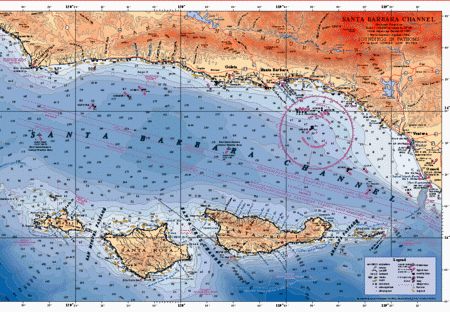
Santa Barbara Channel 

The Channel Islands consists of eight island masses off the coast of Southern California.  In 1980 the United States Congress established Channel Islands National Park, which includes the northernmost five of these islands, in order to study, protect and preserve the unique resources of these remarkable islands.  Along with the National Park, the Channel Islands National Marine Sanctuary (administered by the National Oceanographic and Atmospheric Administration (NOAA), was also established in 1980 to protect the marine resources of the waters surrounding the islands.

I have been a frequent visitor to the Channel Islands over the past 32 years, starting with my involvement in the sport of scuba diving in 1975.  My wife and I also spent some five years living aboard our diesel-powered trawler, with nearly two of those years spent “on the hook” (otherwise known as being anchored) in the lee of the various anchorages scattered around the Channel Islands.  The love I have for these islands runs deep, and the degree to which I miss them is palpable at times.

Since my involvement predates the establishment of Channel Islands National Park, I have seen many, many changes that have occurred in the ownership and use patterns on these islands.  Now that it has been 7 years since relocating to the Ozarks, you can imaging how much of a longing I have felt to return to the islands for a visit.  On a recent trip to California, I decided to devote a day to reacquainting myself with the largest of the Channel Islands, which is Santa Cruz Island.

Numerous commercial dive and sport fishing boats frequent the islands from their home ports on the mainland, but to actually land on the islands requires either access to a private, seaworthy vessel, or the utilization of the services provided by Island Packers, the exclusive concessionaire to the NPS for the Channel Islands.
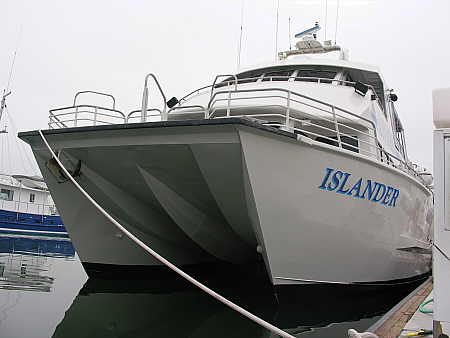
Island Packers “Islander”

Round trip fare to Santa Cruz Island runs $46, and it entitles you to passage aboard the Islander, a 64 foot X 24 foot, 149 passenger catamaran built by All American Marine, as seen in the photograph above.  This vessel was commissioned in 2001, is equipped with super-low emission diesel engines, burns bio-diesel fuel, and can operate at approximately 20 knots, offering a quick and comfortable ride across the Santa Barbara Channel.

Channel Islands National Park HQ building in Ventura Harbor, California

As the Islander heads for the breakwater, you will see the Channel Islands National Park headquarters and visitor center, located in the heart of Ventura Harbor.  As with all National Parks, the center is a valuable resource for visitors to the park, providing information, interpretive programs and expertise to make your visit both safe and enjoyable.
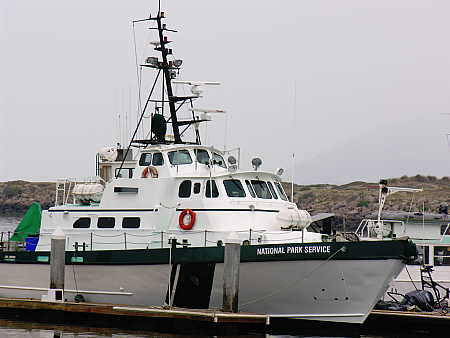
National Park Service utility vessel

Since the islands are only accessible by boat, the Park Service operates several vessels used in the management of the park resources.  The vessel seen above is the largest in the CINPS fleet.  The CINPS also operates a landing ship craft (LSC) which is used to transport materials and equipment to and from the islands.
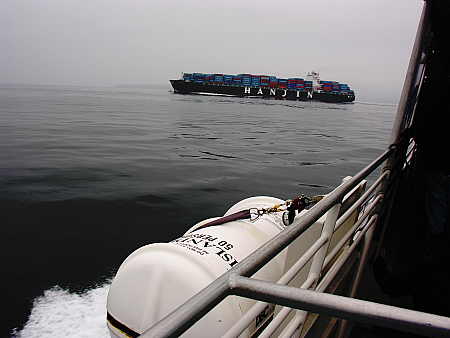
Crossing the path of a container ship in the Santa Barbara Channel

Any transit from the mainland of California to any one of the northern Channel Islands requires crossing the Santa Barbara Channel.  If you examine the nautical chart at the top of this post, you may see that this entails crossing both a northbound and a southbound designated shipping channel.  For those unfamiliar with what a designated shipping channel is, it is basically a pair of sea lanes, separated from each other by a defined separation zone, which is used by large commercial vessels and controlled by specific rules and regulations.   One of the rules states that a vessel, properly navigating within a shipping channel, has absolute right-of-way over any other vessel crossing the shipping lanes.  The shipping channel that exists within the Santa Barbara Channel is a very busy place, as it is a primary route for the entire west coast maritime shipping trade.  You can see from the photograph above that we crossed paths with at least one large container ship as we worked our way over to Santa Cruz Island.

Scorpion Rock

When we arrived at Santa Cruz Island, the captain cruised past Scorpion Rock (shown above), which has become a favorite roosting spot for the California brown pelican, which is listed as an endangered species resulting from the DDT fiasco of the mid-20th century that threatened the survival of many different bird species prior to the eventual ban on it’s use.  The brown pelican, happily, is making a fine recovery at this time.
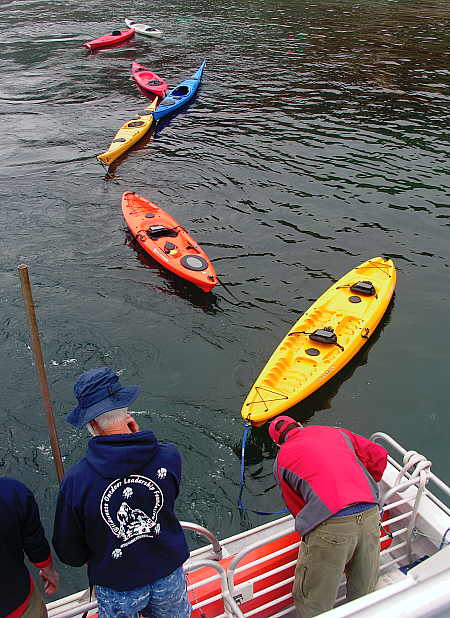
 Unloading kayaks off the stern of the “Islander”

After unloading passengers (mostly school children) at Scorpion, the crew of the Islander offload the kayaks that they have transported to Santa Cruz Island.  Santa Cruz is a sea kayaker’s paradise, with kelp beds and sea caves as the primary attraction.  The sea caves of Santa Cruz Island are known internationally, and Painted Cave, located on the north side of the island, is the largest known navigable sea cave in the world.  I have been aboard dive boats that have pulled into this cave, which is a feat that can only be accomplished on the calmest of days.
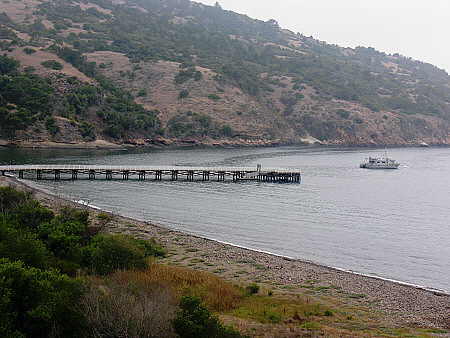
Scorpion anchorage and pier

After dropping off most of the passengers at the Scorpion ranch area, the Islander continued on to a spot called Prisoners Harbor.  There were only a half-dozen people landing at Prisoners, including myself.  All of the other passengers headed off to the west, into land owned by The Nature Conservancy, guided by a biologist from Island Packers.  Anyone who knows me would not be surprised that I chose to head in another direction – eastward towards Potato Harbor.  There’s something to be said for getting away from the crowds!
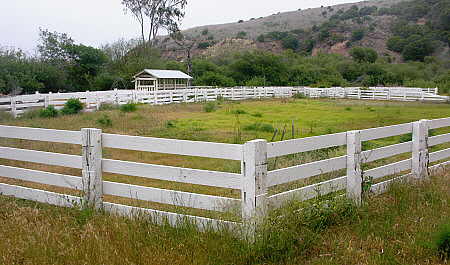
Remnants of the island’s ranching past abound on Santa Cruz Island

Along the way, I passed many relics from Santa Cruz Island’s ranching past.  The island had been owned by a Dr. Stanton prior to the establishment of the National Park, and was used as an active cattle ranch.  In 1978, The Nature Conservancy bought approximately 90% of the western portion of Santa Cruz Island from Dr. Stanton, who was permitted to continue ranching operations for a limited time.  On Dr. Stanton’s passing in 1987, the ranching operations were halted, and the cattle were removed to the mainland.
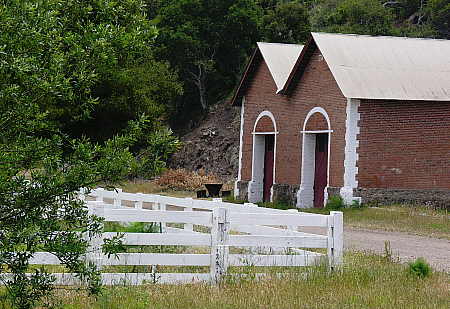
More remnants of the islands ranching past on Santa Cruz Island

Here, in the Prisoners ranch area, are additional remains of Dr. Stanton’s ranching operation.  This brick building was constructed in the late 19th century, giving some indication of how far back ranching had been a part of this island’s heritage.
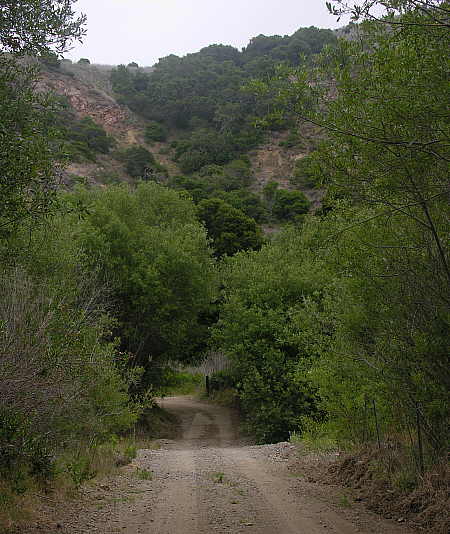
Road leading away from Scorpion ranch area into island interior

Past the cattle facilities of Prisoners Harbor one can find a nice roadbed on which to begin exploring the eastern end of Santa Cruz Island.  In the photograph above, you can just get a hint as to the ruggedness of the terrain on Santa Cruz Island.
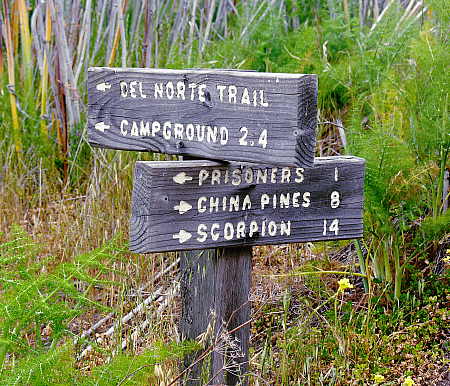
Trail signage on  Santa Cruz Island

Along with the dirt roadbed, which was established to aid ranching operations, there is a wonderful network of hiking trails on the island.  The graded roadbed gives way to less developed trails, as shown below.
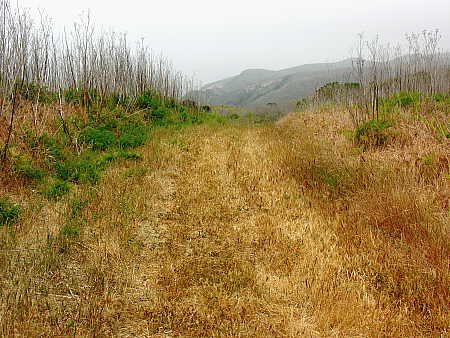
Interior trail on Santa Cruz Island

I will digress for a moment to tell you about a creature unique to these islands, the Island Fox.  At one time, when sea levels were lower than they are today, fox from the mainland found their way to some of the Channel Islands.  The sea levels eventually rose, thus stranding the fox on the islands.  As with many other species throughout the world who become isolated in an area of limited food resources, the fox began to exhibit the trait of dwarfism, so that today the Island Fox has become an extremely diminutive animal, approximating the size of a house cat. 

Within the past decade, there has been a drastic decline in the number of Island Fox at the Channel Islands.  On Santa Cruz, past numbers were believed to be in excess of one thousand animals.  Since the decline, the number is believed to be less than 100 animals.  The causes of the decline are believed to be a chain of events that looks something like this:  early ranchers introduced pigs to the island as a food source.  Domestic pigs, being difficult to confine in pens, escaped captivity and eventually established a feral pig population on the island.  Hunters on the island did a pretty good job of controlling the feral pig population.  The National Park was established, and hunting was eventually banned on the island.  With no natural predators, the feral pig population exploded.  The supply of feral piglets attracted predatory Golden Eagles to the islands, whose numbers had previously been limited by competition from Bald Eagles.  However, the DDT problem, previously referred to in this post, eliminated the Bald Eagle from the island, and the Golden Eagle was free to reign supreme.  The Golden Eagles found the Island Fox to be easy prey, and thus the rapid decline in their numbers.  A detailed and accurate discussion of the plight of the Island Fox can be found at the NPS Island Fox homepage.  I have never been fortunate enough to see an Island Fox in person, even though it has been one of my aspirations for a long, long time.

But, as they say, I digress, so now, back to my day excursion.   After hiking to a remote little corner of the island, I felt the pang of hunger setting in, so I decided that it would be a good time to take a lunch break.  Setting my day pack down beside me, I proceeded to enjoy the delectable ham and cheese sandwich that I had prepared for lunch.  About half-way through eating the sandwich, I looked up, and what do you know, there, not five feet in front of me, was an Island Fox, standing dead-still and staring at me, as if trying to determine whether I were friend or foe.  I immediately froze every muscle in my body, hoping not to startle the fox, lest he/she turn and depart in a hasty retreat.  After what seemed like an eternity (but was probably only a minute or so),  I realized that I NEEDED to get a picture of this fox, otherwise my tale of encounter would be accepted with the same credibility as is afforded to those with tales (but no evidence) of Bigfoot or Loch Ness monster sightings.

Photographers among you may see this coming, but here goes anyway.  My camera was turned off, with lens cap covering the lens.  The camera was safely stowed in it’s carrying case, with the snap fastener securely engaged.  This was all stuffed into the day pack laying on the ground next to me, and of course, the day pack was zipped shut.  Lowering the sandwich to my lap, I slowly reached one hand over to my pack, where I tried to open the zipper of the pack as silently as I could.  Quietly and with deliberate care, I extracted the camera out of the pack, all the while maintaining eye contact with the fox.  As I fumbled with the camera case, and then the lens cap, I realized that I would probably spook the fox before I could compose a shot the way I normally try to do when taking a picture.  Keeping this in mind, I decided to slowly turn the camera to face the fox, thinking that I might only get one chance to squeeze the shutter.  So with the camera down by my left shin, I pointed the lens toward the fox and depressed the shutter button.   The camera fired off a shot, and the fox immediately bolted.
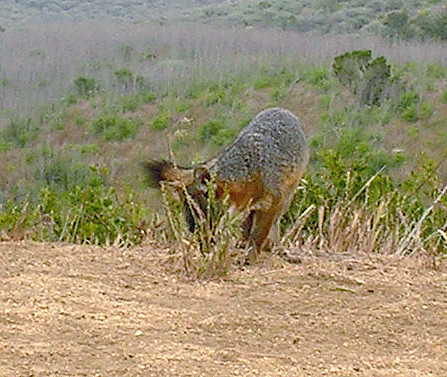
Island fox 

The picture I obtained is not one that I would consider entering into a photographic competition.  In fact, it doesn’t even qualify as a decent animal ID type photo, but it certainly captures a sufficient image to verify that my story is not a tall tale, but indeed is an actual sighting.  Believe me when I tell you that this encounter absolutely MADE MY DAY.
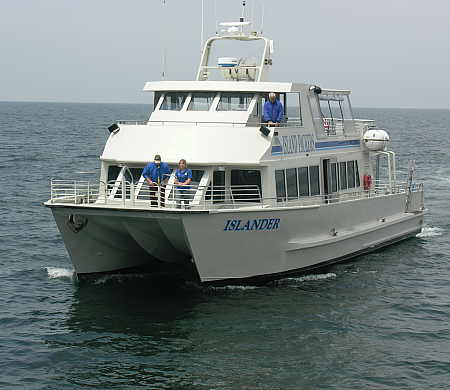
“Islander” arriving to pick up visitors from Santa Cruz Island

Finishing my sandwich, I noticed that it was probably time for me to start heading back towards Prisoners Harbor so that I would not miss the boat for my return to the mainland.  Sure enough, the Islander could be seen pulling up to the pier at precisely the scheduled time.  Boarding the boat, I found a comfortable spot to enjoy the trip back to Ventura Harbor.
Picking up passengers from Anacapa Island

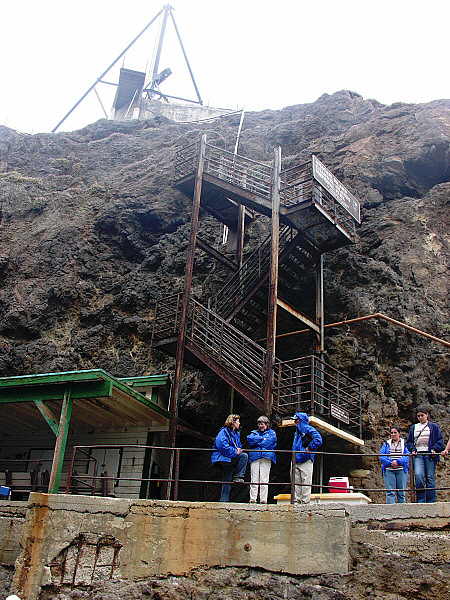
After picking up passengers at the Scorpion ranch, where we had deposited them earlier in the day, we now headed over to Anacapa Island, which is the smallest of the Channel Islands included in the National Park.  Here we picked up passengers who also wanted to return to the mainland.  Above, you can see the steep staircase at Anacapa’s Landing Cove, which must be negotiated to explore the island.  After picking up these remaining passengers, we headed back across the Santa Barbara Channel towards the home port of Ventura Harbor, but not before cruising along in the channel amongst a large pod of Pacific white-sided dolphin, who took advantage of the superb bow and stern wakes to partake in a little bit of surfing, a sport that they invented long before Hawaiians ever caught on to the concept.

Many books have been written about the Channel Islands in general, and Santa Cruz Island specifically.  Although this small post does not do the subject justice, I have provided enough links to get you started in your research should you decide to visit these islands.  Although the location of Channel Islands National Park ensures that it remains the least visited of all the National Parks, those who are familiar with these islands will tell you that Channel Islands National Park is the gem among gems in our park system. 

Do plan on being one of the few who gets the opportunity to experience this wonderful resource that we are fortunate to have available to us.  I can assure you, you won’t be disappointed.

BIG, BIG, BIG

Approaching Amarillo, Texas on Interstate 40, one can’t help but notice BIG signs urging motorists to stop in for a meal at the BIG Texan Steak Ranch.  The BIG Texan has been operating in Amarillo since 1960.  Even if you haven’t been to Amarillo, you may have heard the BIG stories about this restaurant, as it’s renown has grown in a BIG way over the past 47 years.  The first time that I visited Amarillo, I wondered what the BIG deal was all about, so I stopped by the BIG Texan to sample their cuisine.

Big Texan Steak Ranch signage

The first indication that you are approaching the BIG Texan Steak Ranch is the appearance of the BIG sign that rises to meet the sky outside the restaurant.  The BIG cowboy on the sign is a stereotype of the long, tall Texan we have come to know in the Western movies of the past.

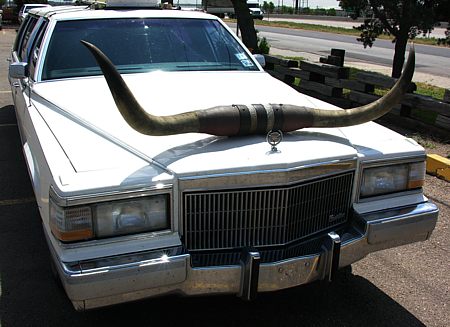
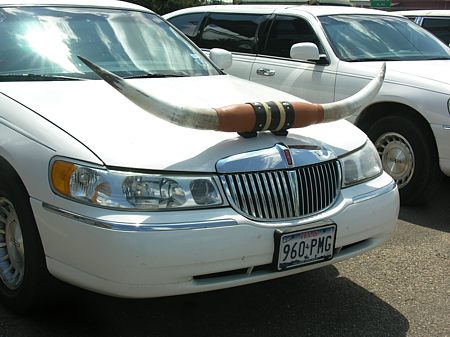
Big Cadillac longhorn limousine

As soon as you pull into the parking lot, you become aware that something is a little different with this restaurant compared to others you have patronized.  Exiting your vehicle brings you face-to-face with a BIG Cadillac limousine, adorned with the obligatory BIG Texas longhorn hood ornament.
Big Lincoln longhorn limousine

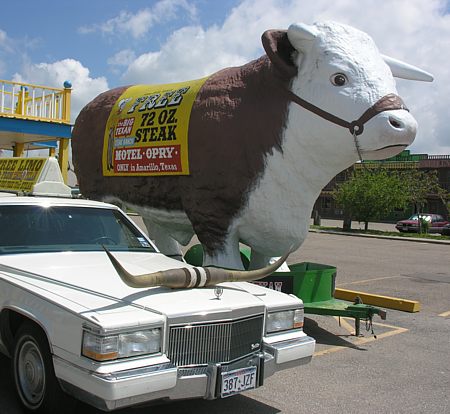
Careful not to show favoritism for any one automobile company, the BIG Texan Steak Ranch also owns BIG Lincoln Continental limousines to compliment the Cadillac limousines.  I counted six BIG white, Texas longhorn equipped limousines sitting in the parking lot, which are used to shuttle customers back and forth between area hotels and the restaurant.

Big Cadillac longhorn limousine and big model steer

In front of the BIG porch leading up to the restaurant you will encounter a BIG steer replica, which is mounted to a trailer and sits next to one of the BIG Cadillac limousines.  OK, I’ll agree that this place is getting a little weird, but amusing never the less.  Eventually, you will make your way into the restaurant, where you will see an old-fashioned shooting gallery, a gift shop, token-only slot machines, a rocking chair BIG enough to seat both Paul Bunyan and his BIG blue ox Babe, and a western style saloon area.

Big display of free steak meal

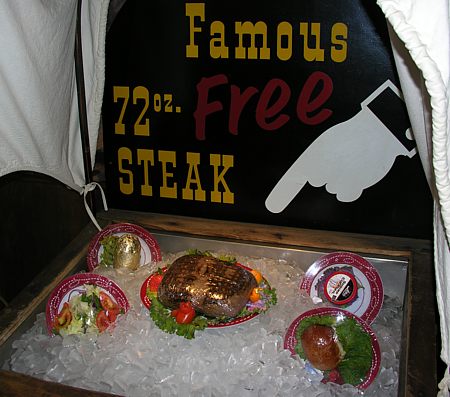
Finally, just before arriving at the maitre d’ station,  the reason for the notoriety of the BIG Texan Steak Ranch becomes clear.   Almost legendary by now, the BIG Texan presents an amazing offer:  finish eating a BIG complete 72 ounce steak dinner in less than 1 hour, and the meal is on the house.  Fail the challenge, and it will set you back a BIG $72.00, plus possible additional medical expenses to repair your now abused innards!

There are conditions attached to the offer.  First, you are required to pay for the meal prior to taking the BIG eating challenge.  I guess the theory is that if an ambulance has to cart you away after attempting this bizarre feat, the staff will not have to worry about trying to settle the tab with an incapacitated diner laying on a stretcher.  Successful diners will have their money refunded at the completion of the challenge.  Second, the diner must consume the entire meal, which consists of a dinner salad, a shrimp cocktail, a BIG 72 ounce (4.5 pound) top sirloin steak, a BIG baked potato, and a dinner roll.   Fat or gristle need not be consumed, but the staff reserves the right to be the judge in this matter.  Third, don’t expect this to be a private affair.  Should you undertake this challenge, you will be escorted to a table set on top of a stage located in the center of the dining room.  You will be the BIG focal point for the next hour, as other diners gawk, take pictures and video of you eating, and the staff provides running commentary regarding your progress.  Behind you, a digital timer ticks down the time that remains, and by your side sits a lined trash can, in the (all too often) event that you can’t hold down the last bites of your dinner.

Big 72 ounce top sirloin steak

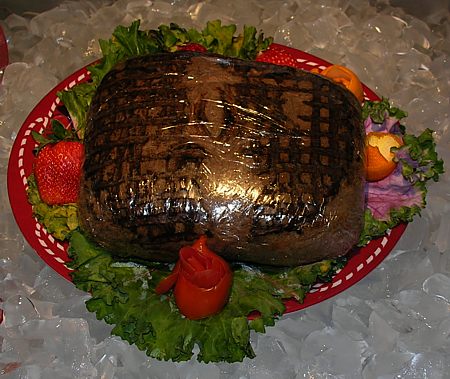
This is what a BIG 72 ounce top sirloin steak looks like.  Let’s put this in some perspective.  The newest USDA food pyramid suggests that the proper serving size for lean beef is 3 ounces.  Therefore, to complete the BIG Texan eating challenge, one would have to eat a portion of beef that is 24 times greater that the USDA recommends!  This steak contains about the same amount of beef as 45 McDonald’s hamburgers,  or 18 McDonald’s Quarter Pounders.  Within the information contained in their on-line store,  even the BIG Texan Steak Ranch admits that the 72 ounce top sirloin steak can be expected to serve 8-10 ordinary diners (or one hungry Texan).

Here are a few interesting tidbits of BIG Texan trivia:

Over 42,000 people have attempted the BIG Texan Steak Ranch challenge.

Over 7,000 diners have been successful in completing the meal.

The challenge was completed in 9.5 minutes by former Cincinnati Reds pitcher and BIG eater, Frank Pastore, one of his seven successful attempts!

The challenge is successfully completed by an average of two women per year.

The oldest person to successfully complete the challenge was a 69 year old grandmother.

The youngest – an 11 year old boy.

In the ’60’s, professional wrestler Klondike Bill consumed two of the dinners in the allotted one-hour time.

A couple from Henderson, Nevada have completed the meal at least ten times since 1995, usually finishing in less than 30 minutes.

If you happen to be passing through Amarillo, consider stopping by the BIG Texan Steak Ranch for a meal.  If I happen to be there at the time, you can share a table with me as I attempt to consume a more sensible 12 ounce rib-eye steak.  And I’ll take as much time as I need, thank you.

Landscaping My Way – Installment #3

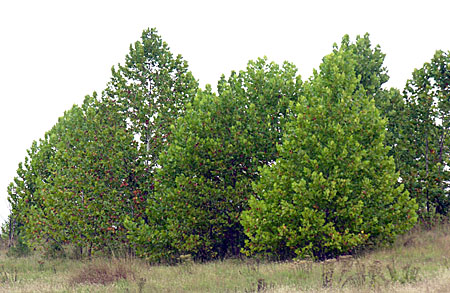
American Sycamore

American Sycamore

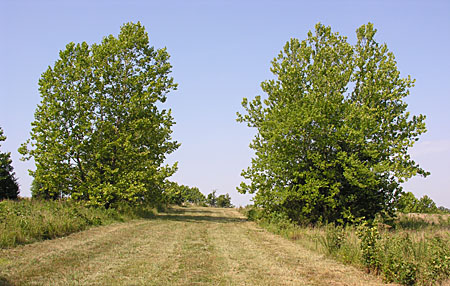
The trees that you can see on either side of this trail are semi-mature American Sycamores.  The American Sycamore is a massive hardwood tree native to portions of the eastern United States.   The sycamore has the largest trunk diameter of the American eastern hardwoods,  and reaches a height of 100 feet during a lifespan that may approach 500-600 years.

American Sycamore

The American Sycamore has a reputation among some as being an undesirable tree, primarily due to the characteristics of the tree which make it somewhat unsuitable to the urban environment.   The massive root system tends to uplift sidewalks and roadbeds, and many decry the constant mess of twigs and leaves that surround the sycamore.  On the plus side of the equation, the sycamore is draught tolerant, flood tolerant, and can grow in a variety of soil conditions, including both alkaline and acidic, as well as compacted soils.  Additionally, the American Sycamore is a very rapidly growing species, which will be evident as you examine the photographs in this post.

American Sycamore

There is a section of land on our property we call “the ridge.”   Formerly used to graze cattle, this area contains about 40 acres of what used to be exclusively forage grasses.  The ridge falls away to creek beds on either side, and because we do not raise cattle, the ridge has been a prime candidate for reforestation of some sort.

American Sycamore

The district forester with the Arkansas Department of Forestry conducted a field survey for us in 2001, and prepared a  management plan which included the suggestion that we plant this ridge area with Loblolly Pine trees.  Naturally, I had other ideas.   It isn’t that I have anything against Loblolly Pines, it’s just that I have an aversion to shovels, watering cans, and building protective cages to protect the young trees from the marauding deer which inhabit the area.  But the ridge needed trees, so what’s a man to do?

American Sycamore

The first year that we resided on this property, I noticed that the pastures of this ridge were inundated with young plants, which I was inclined to shred with the bush hog to promote lush grasslands.  On further examination, and with a little research, I determined that these small plants were tiny sycamores that were popping up in abundance on the ridge.  As long as the ridge needed reforestation, and being as these sycamore trees seemed intent on making the ridge their home, I decided to oblige them by sparing their lives and allowing them the opportunity to grow, unmolested by my tractor.

American Sycamore

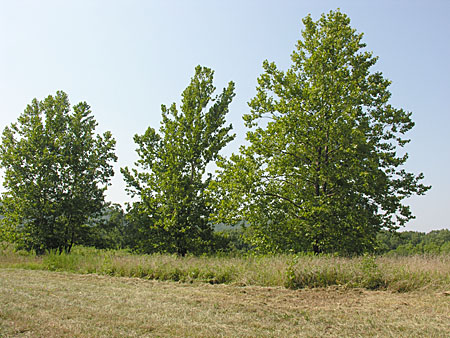
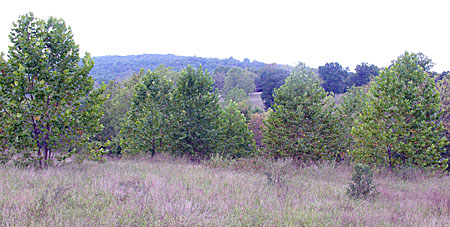
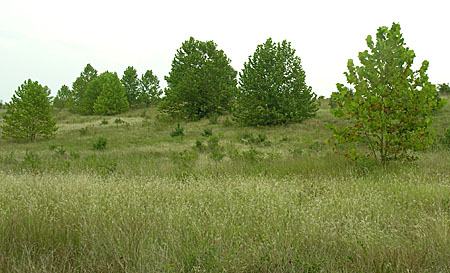
In the short time (6 years) that the sycamores have been allowed to grow on the ridge, they have thrived.  Each year I allow additional sycamore saplings to take a foothold on the ridge, and the trees that have been growing since 2001 are now in the 15-20 foot range, perhaps taller.   In the photographs above, you can see sycamore trees of various ages, and how they are gradually taking over the ridge that had previously contained nothing but grasses.  I have not taken the time to try and count the American Sycamores that now make the ridge their home, but I would guesstimate the number to be around 150-200 trees.
This is the third installment of Landscaping, My Way.  The first installment covered the Dwarf Sumac that I am encouraging to grow in selected clearings.  The second installment dealt with the Silver Poplar grove that is spreading within a portion of our woods.  In the first installment, I suggested that you might see a pattern develop regarding what I call “Landscaping, My Way.”  Do you see the pattern yet?

Thirsty Fish?

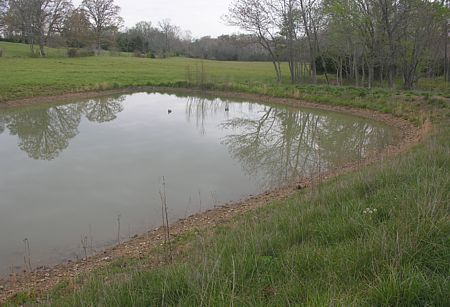
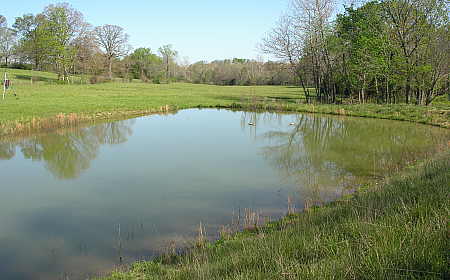
Pond at low tide

When I noticed that the water level was down in one of our ponds, I began to wonder if the fish were drinking it all.   But after some reflection I realized that 6 grass carp, even aided by a couple of thousand minnows, couldn’t ever drink that much water ;) 

Actually, the water level in this pond is affected by neither the tides nor the voracious thirst of it’s resident fish populations, but by the slow, unrelenting process of evaporation.  Now, if this were a deep pond, I wouldn’t be concerned about the seasonal changes in it’s water level.  But due to some problems encountered during the construction of this pond, the pond is temporarily destined to remain in it’s present shallow state (until such time as budget constraints allow for remedial construction work).

Because this is a shallow pond, it is prone to develop masses of aquatic plant and algae life.  The algae that has formed in this pond in the past was the bright green, unsightly gunk that one does not want to view from the kitchen window constantly, so some kind of action was required to prevent the aquatic growth.  Not wanting to utilize chemical treatments (for a variety of reasons), we have opted to stock this pond with a small number (6) of grass carp, also known as the white amur.  This species of fish is commonly used for the purpose of controlling aquatic vegetative matter, and they have been successfully accomplishing that function in this pond.

The white amur is a herbivorous fresh water fish that is native to the orient.  Because this is a non-native species that tends to want to follow the flow of water, many states have certain requirements that must be met in order to legally stock them in a private pond.  Arkansas does not have such a requirement, but a listing of southern state permit requirements can be found at the Southern Regional Aquaculture Center.

Always curious, but they never lend a hand!

Back to my problem,  which is the low water level in the pond.  Something needed to be done to raise the water level, and since mother nature has not been all that cooperative in the rain department, I had to take matters into my own hands (OK – I’ll acknowledge I had a little help from my friends here.

Temporary solution to low water level

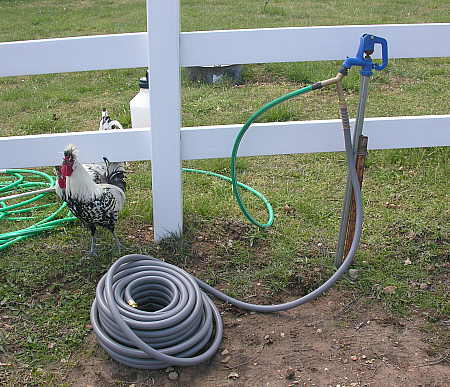
The temporary solution to the low water level was to simply attach enough garden hose to the closest freeze-proof hydrant and run it on down to the pond.  After a few days of running the hose, the pond was again full.

Pond at high tide

Now, when the rains are insufficient to replenish the water that has evaporated, I can simply turn on the hydrant for a few hours per week to keep the pond level up.  This keeps both me, and the grass carp happy.

Oh no! - not more arrows…

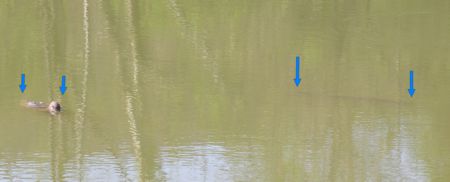
On the left-hand side this photograph you can see a half-submerged decoy duck (which I admittedly need to fish out of the pond, clean, and re-float).  On the right you can just barely see one of the grass carp.  The decoy measures 12″ in length, so I am guessing that the length of the carp is over 24″.  The adult grass carp will reach a length of about 4 feet, and weigh in at around 40 pounds.

We’ll be hearing from these fellas sometime soon..

Besides the grass carp to control the algae, and minnows to help control insect larva, you can see that this pond supports a health population of tadpoles.  That’s a good thing, because summer wouldn’t be the same without the chorus of a thousand frogs to listen to each evening.

Just Horsing Around

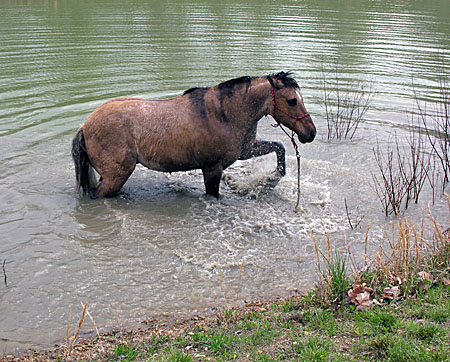
Chipper pawing the water

On occasion, we allow our horses the opportunity to swim in one of our ponds.  Chipper, our middle-aged gelding, really enjoys the water.  For some reason, he always likes to paw at the pond water, as you can see above.

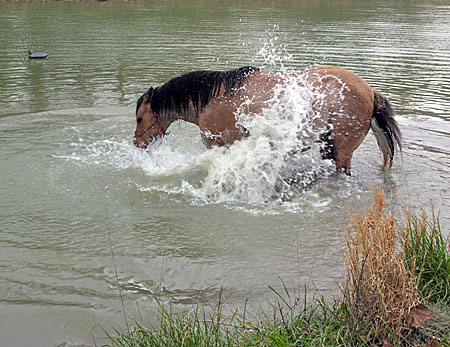
Pawing becomes more frantic

The pawing starts off with gentle strokes of his front leg, but before long, the activity becomes more frantic, splashing water all over the place.

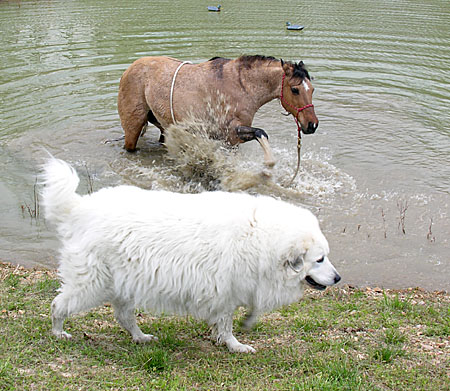
The commotion attracts others to the pond

Soon, all of this commotion draws the attention of Gracie, who feels compelled to check out the activity going on at the pond.

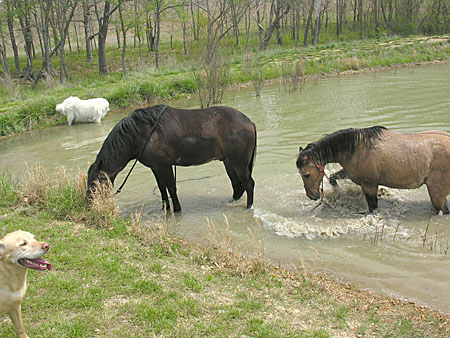
Pretty soon, the whole gang’s involved

Eventually, the whole gang gets involved.  Chipper, meanwhile, continues non-stop with the odd water pawing behavior.  He wants to be sure that every fish in the pond knows of his presence, I guess.

Just one more bite, please

Content in the knowledge that he has successfully sullied the pond for the next few days, Chipper grabs a few bites of grass before heading back to his grazing pasture (located away from the pond, of course).

Invasion of the Corn Snatchers

Black deer in Arkansas?

“Look honey, more deer at the far game feeder.

Wait a minute, deer aren’t black!

These animals aren’t deer, they’re cattle!

“Hey y’all, look what I just did over here.”

Well, as long as we’re already here…

“Well, as long as we’re already here…”

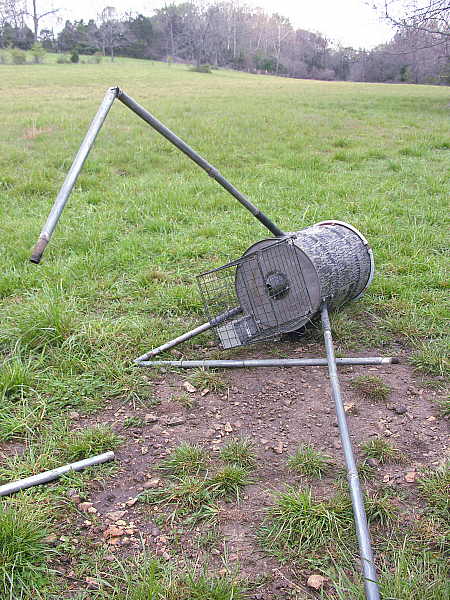
Well, just when I thought that I had pretty much solved the problem of critters molesting the game feeders by the judicious use of appropriate varmint guards, I find I may have to figure out a way to make them cattle-proof, as well.

Another one bites the dust!

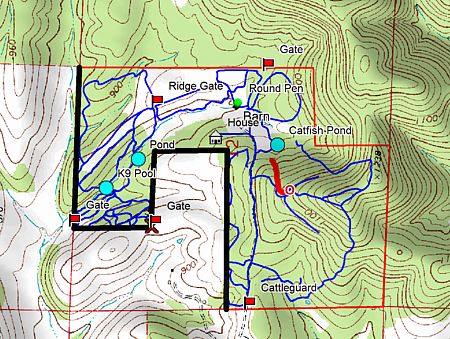
You see, we share 1.75 miles of barbed wire fence with one of our neighbors (who has holdings of about 500 acres), as shown on this map, in the form of a bold black line.

Existing common fence

There is a .25 mile long section of this fence that I rigorously maintain to pen our horses.  Unfortunately, the remaining 1.5 miles of existing fencing between us is old and in pretty sorry shape.  This neighbor has recently rented out pasture to a local rancher, and over the past several days his cattle have been testing and challenging the old barbed wire fence.  Each day, try as it might, the fence ends up losing the battle, as two dozen bovines make their way into our early spring hayfields, eagerly dining on the succulent fresh fescue and red clover.

Each afternoon, a telephone call brings the rancher over to our place, to round up his errant cattle.  Yesterday the cattle discovered that not only do we have the best grass in the area, but there’s corn for dessert as well!  So, even though the neighboring rancher is apologetic and is working daily on mending the fence, I’m guessing we’ll be seeing the cattle here again soon.  But I really hope I’m wrong.  Besides the damaged feeder, there are other concerns that the encroaching cattle bring about.  Whereas I have been working to maintain healthy banks along our creeks, the cattle trample the banks, causing erosion of the soils and decimation of the filtering vegetation along the creek sides.

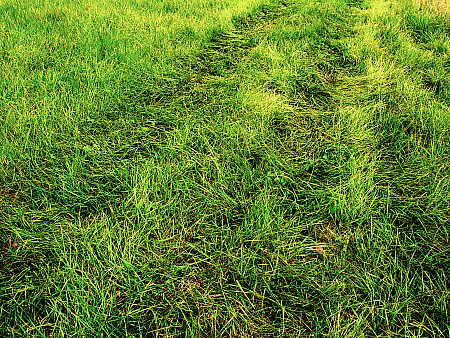
If this were twenty or thirty years ago, my neighbor would have come over to round up the cattle mounted atop his trusty steed.  Alas, cowboys don’t ride horses anymore, but are experts at herding cattle as they sit astride ninety horsepower ATVs equipped with aggressive off-road tires.  As you can see below, vehicle traffic and emerging hay fields don’t mix well. 

Modern “hoof prints”

Hopefully, the repairs that our neighbor made to the fence will hold the cattle.  I plan to walk this portion of the fence line tomorrow to make a current assessment of the situation.  I’d rather not have to share in the expense of having a new, sturdy fence built along this great a distance, but I am not prepared to try and keep an old brittle fence cattle-tight as a do-it-yourself project.  As they say, “I’ve been there and done that, and I ain’t doin’ it again.”

A Quaint Remnant of the Past

Perhaps you recall from a post back in July (Welcome to Our Hen Houses) that we have two structures for housing our fowl.  The guineas are housed in a free standing hen house, with  indoor and outdoor areas.  The chickens are housed in an enclosure within our equipment barn.  Locating the chickens within the equipment barn has proven to be a BIG mistake.   We like to release our chickens each morning and pen them back up at night, which means that there are times during the day that they congregate in the barn and on the equipment.  I’ll spare you any photographs, but you can imagine the mess they create on the equipment, which, I’m sure you’ll agree, is totally unacceptable.  I suppose I should have anticipated this occurrence.  I mean, it is called an equipment barn, is it not?

As it happens, our chicken flock has been reduced in number by predation, and there are only three remaining at this time.  We have ordered chicks from a hatchery to augment our shrunken flock, and expect them to arrive in a few weeks. (if this cycle does NOT seem like deja vu to you, see the post To Free, or Not to Free (range your chickens, that is).   Prior to their arrival, we thought this would be a good time to relocate the chickens to housing located some distance away from the equipment barn.  We have tried housing the chickens in a chicken tractor (see A Tractor for Chickens?) without much success, and have decided that another free standing chicken structure would be appropriate for our needs.

Having settled on the type of chicken housing we wanted, the next step was to choose between buying a prefab chicken structure or building one ourselves.  When attending a HorseFest in Springfield last year, Retta brought home a catalog from an Amish owned company in Seymour, Missouri that produces a variety of livestock shelters.  Within the catalog were several structures that could possibly suit our needs, so we thought we would take a ride to Seymour and look them over so that we could make an informed build-buy decision.  Only one thing stood in the way of our plan to drive to Seymour – Bull Shoals Lake.

Bull Shoals Lake

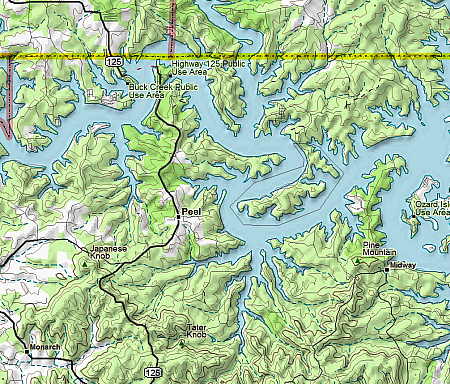
This topographic map depicts a portion of Bull Shoals Lake.  It is a lake about 40-50 miles long created by the (some would say the damn) damming of the White River, which formed a lake with a multitude of fingers and a shoreline exceeding 1000 miles!  You can see a yellow boundary line in the map, which represents the Missouri-Arkansas border.

We reside on the south side of Bull Shoals Lake, while Seymour, Missouri lies well north of the lake.  Driving all the way around Bull Shoals Lake is a long detour for someone heading due north, and there are no bridges spanning the lake at any point.  So what’s a person to do?

Peel Ferry

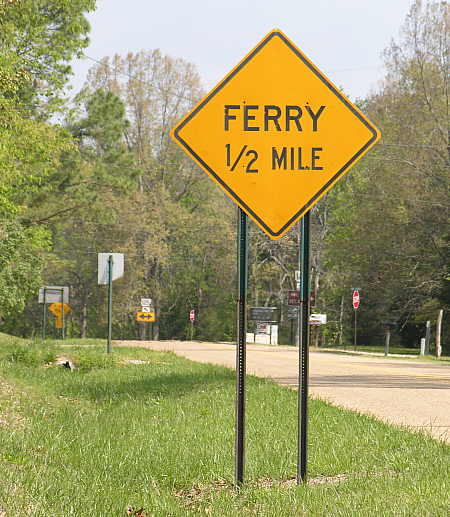
That’s right – hop on board a ferry to be shuttled across the lake!  The Ozarks is an area that is blessed with an abundance of surface water in the form of creeks, streams and rivers.  In earlier times, there was a large number of private and public ferries in operation that transported people, wagons and livestock across the many waterways that occur in this region.  One by one, the ferries halted operation as bridges were built to span the rivers of the area.  In Arkansas, by 1968 the hundreds of ferries that had served the state were reduced in number to 17.  By 1986, there were only 4 ferries remaining in operation, and today, there is only 1 ferry that continues to serve the public in Arkansas – the Peel Ferry.  And so our journey to Seymour, Missouri would take us on a minor, but quaint adventure across Bull Shoals Lake on the last surviving Arkansas ferry.

I have had the good fortune to travel around the Puget Sound and Strait of Juan de Fuca in the Pacific Northwest on many occasions.  Ferry travel is common in that area, and I have ridden those ferries a number of times.  Big ferries, with multiple automobile decks, passenger lounges, food and beverage service, and some (for longer journeys) with sleeping accommodations.  The Peel Ferry has none of these amenities, as is obvious from the following photograph-

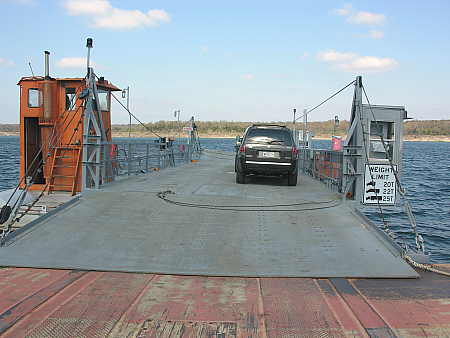
The Peel Ferry

The Peel Ferry is about as simple as a ferry can get.  It is no more than a barge with ramps on each end, powered by a small tug lashed to the side of the auto barge.  It will only hold about six vehicles, and has no passenger amenities at all.  Simply a way across the lake.  But the price is right – the ferry is free for all to use.

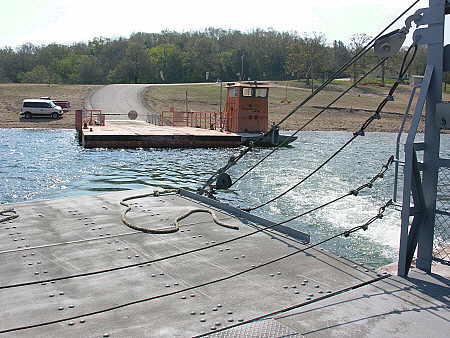
Peel Ferry departing the dock

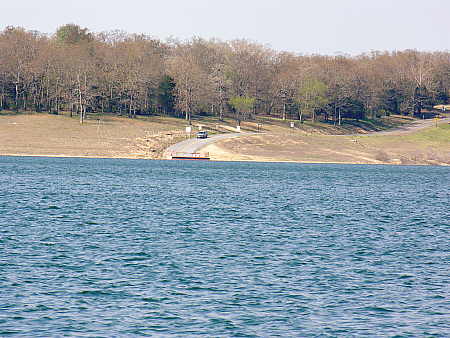
Here is a photograph of the ferry leaving the the dock on the south side of Bull Shoals Lake, as it begins it’s short journey to the opposite side of the lake.

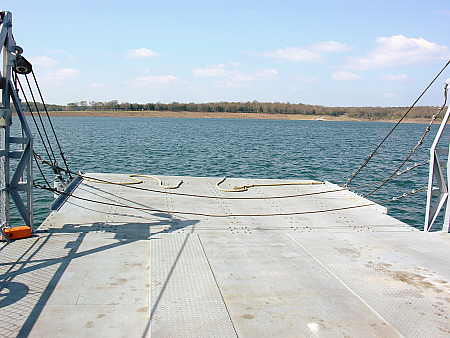
What if there is a wave?

Unlike the ferries of the Pacific Northwest, which ply ocean like waters, this ferry only traverses a short section of placid lake water.  The loading ramps do not even need to be elevated for the trip across the lake.

Destination straight ahead!

Eventually, the ferry approaches the dock on the opposite shore of the lake.  Notice the massive lineup of cars awaiting the ferry at it’s terminus?  The question might arise, “why does this ferry continue to run, especially at no charge, when all the others have discontinued operation”?  The answer lies in a close examination of the topographic map that appears at the beginning of this post.  You will notice that below the Missouri border, but north of the lake the is a large chunk of land protruding down into the lake area.  This land area is too small to form it’s own political jurisdiction, but large enough to contain roads, and probably several hundred residents, all of whom need the services that are typically provided by a county government.  Lacking a costly bridge, the county would be faced with the daunting prospect of having to provide services to this portion of the county by routing vehicles and road equipment all the way around the lake, into Missouri, and then back down into Arkansas again.  Instead, the Arkansas Department of Highways and Transportation has opted to maintain the services of the Peel Ferry, primarily for the benefit of the county, but available for all motorists to use.

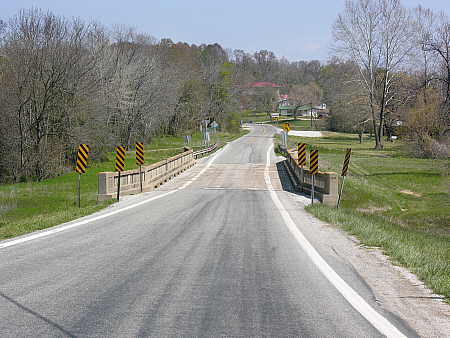
One lane bridge

After leaving the ferry, the small highway that services the area winds through the beautiful landscape of the Ozarks.  The picture above shows one of the two one-lane bridges that are located shortly beyond the north terminus of the ferry.  All-in-all, the Peel Ferry adds a quaint charm to what would otherwise be merely a bucolic and picturesque drive in the countryside.  If you are ever in the area, make it a point to be one of the few people who gets the opportunity to ride the last remaining ferry in Arkansas.

Signing Your Blog Post

I recently ran across an article which explains how one can incorporate an automatic signature line at the end of all WordPress posts.  I created this post to test the functionality of the WordPress plugin that is used to accomplish this task, and to provide the links that are necessary if you would like to add a signature to your own WordPress blog posts.

An explanation of the procedure involved can be found at Lorelle on WordPress, which is a most impressive and thoughtful blog about blogging in general, and WordPress specifically as a blogging tool.

Now, let’s press the publish button to see if this works the way it is supposed to.