Should He, or Shouldn’t He? Would You?

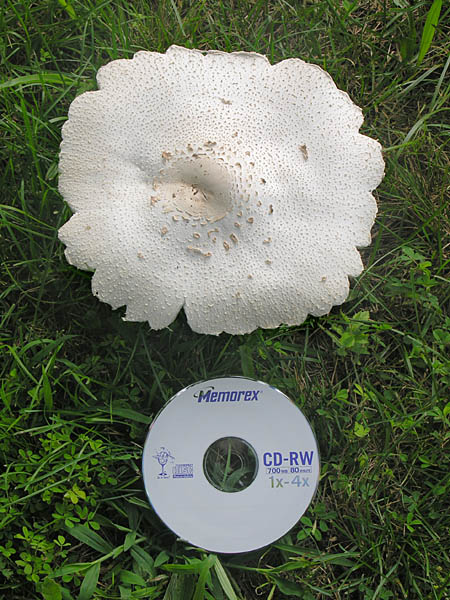
Mushroom found in the lawn

While preparing to cut the grass today, I ran across this gigantic mushroom.  In order to provide a sense of scale, I placed a CD on the ground next to the huge blob of fungus before snapping the photo.

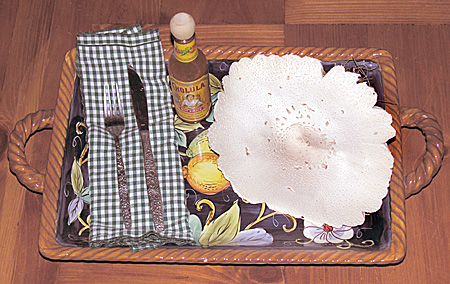
I am not familiar with the various members of the mushroom family, so I cannot identify this particular specimen, and hence, cannot tell you if this is edible or not.  But there is certainly one way to tell:

Should he, or shouldn’t he?

If you don’t hear from me for a little while,  I’m sure you’ll have an inkling as to why!

The People Pond

We are fortunate to have several ponds scattered around our property.  Previously, I had written about three of them: the catfish pond (remember the discussion about flocculant?),  the carp pond (recall “The Grassing of the Carp”),  and the spring-fed pond (which shrank dramatically during the dryness of last year).

There is another pond on the property, which is the subject of this post.  I call it the “people pond.”  As caretakers of the land and stewards of the animals, we strive to provide an aquatic environment conducive to the well-being of all the wildlife that reside at this location – so why not the human inhabitants, as well?

Unlike the other ponds on the property that automatically adjust themselves to exist in all seasons throughout the year, the people pond needs a little extra effort and management.  In the fall, the people pond needs to undergo the process of winterizing.  The people pond must be cleaned, and the water chemistry adjusted for the long winter to come.  Pipes, pumps, filters and other equipment must be drained of all water, to prevent expansion damage that would occur if water were allowed to freeze inside of the equipment.  The water level is drawn down, and the people pond is covered for the duration of the cold season.

In the late spring, usually around Memorial Day weekend, we anxiously undertake the annual ritual of opening up the people pond for the summer.

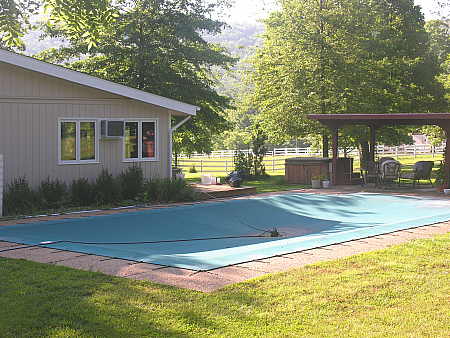
Winterized people pond

The winter safety cover shown in the photograph above serves two purposes.  First, it serves to protect against accidental people pond incidents, and second, it keeps dirt, leaves and debris out of the people pond during the winter months.  In the center of the cover sits a sump pump, equipped with an automatic sensor switch, which keeps the cover drained of water from rain and melting snow.

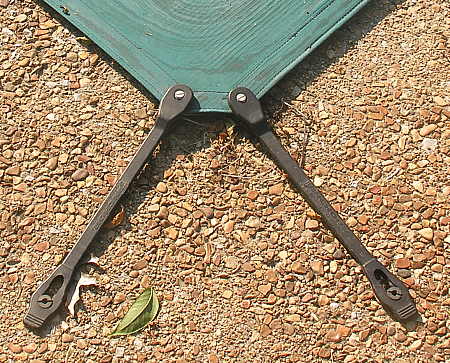
People pond winter safety cover fastening system

The cover is attached to the decking that surrounds the people pond by a series of heavy elastic straps, which are held in place by bronze retractable anchors embedded in the deck.

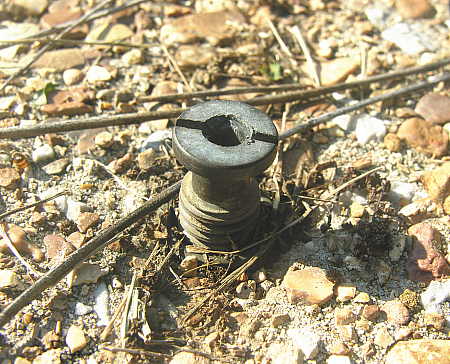
Telescoping strap anchors

The retractable anchor tend to accumulate debris over the course of the winter, so it is necessary to wash them off with a strong stream of water from the garden hose.

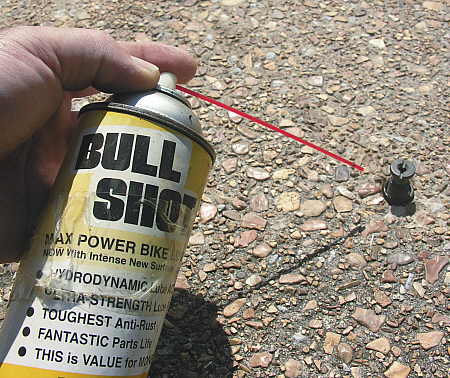
Protectant applied to anchors

Before screwing the anchors flush into the deck, I find it helpful to spray them with a little lubricant first.  The product that I like to use for this purpose is either Bull Shot, shown above, or Boeshield T-9, developed by Boeing Aircraft Corporation.  Either one of these products contain a wax-like ingredient, which assures that the protectent will adhere to the anchor even in wet conditions.

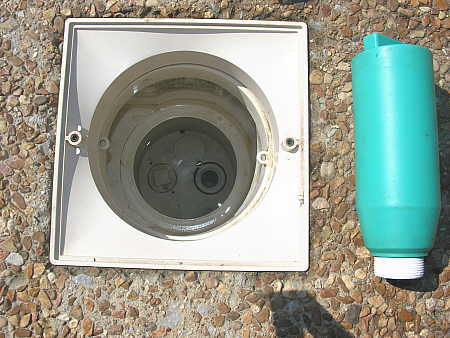
Gizmo for winterizing the people pond skimmer

The turquoise gizmo that you see beside the skimmer assembly is just that – a Gizmo ™.  This device is used to seal the water return lines in the winter, after they have been cleared of water.  If you look closely at the photograph above, you can see the hole down at the bottom of the skimmer that the Gizmo screws into.  With the Gizmo properly in place, any rain water that manages to get into the skimmer and freeze will not ruin the equipment.  As the freezing water expands, it will cause the Gizmo to collapse in on itself, thus sparing the skimmer from damage.

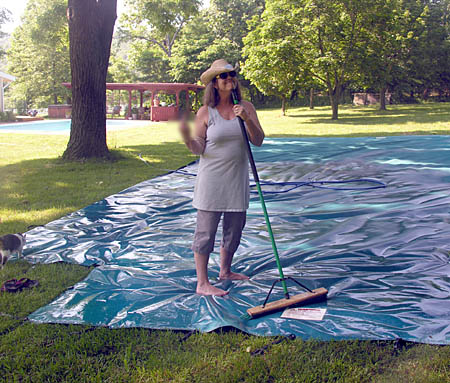
Cleaning the people pond cover

The people pond cover needs to be cleaned and thoroughly dried prior to summer storage.  As you can see from the photograph above, it is not particularly good form to be standing around taking pictures as your better-half does all the work!  Thank goodness for the blur function of my image editing software, or you might see the “salute” I received for my blunder.

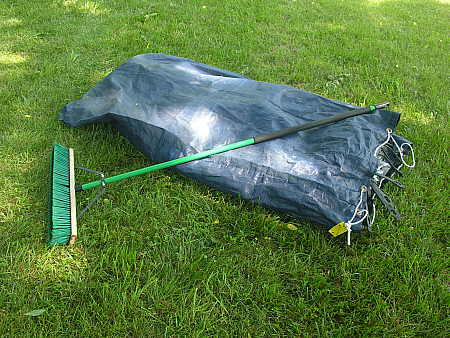
Storage bag for people pond safety cover

The people pond cover folds nicely into a breathable nylon storage bag, which will find it’s way into the equipment barn for the summer.

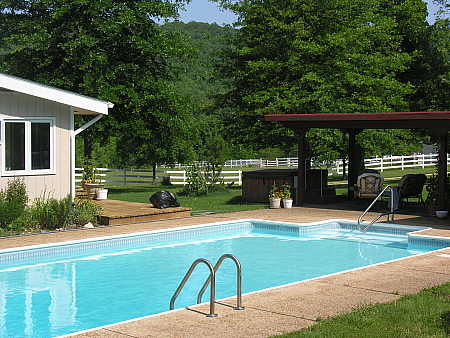
People pond now open for the summer

Now that the cover is off the people pond, all that remains is to raise the water level, adjust the water chemistry, prime the pump and filter units, and install the hand rails and exit ladder.  Notice the clarity of the water in this picture.  This is what the water should look like immediately upon removing the people pond cover.  If the water does NOT look like this, then somebody did not properly adjust the water chemistry prior to winterizing the people pond the previous fall.

Our people pond has been quite a project.  Compare the photograph above with the picture that is shown below.

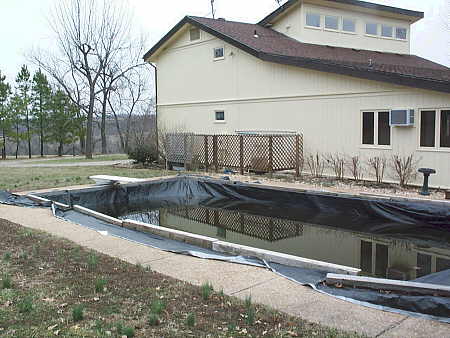
People pond in it’s less glamorous days

This is what the people pond looked like when we bought this house.  It was in dire need of some TLC, needing a new liner, winter safety cover, pump and other necessary equipment.  The water was filthy and gross, containing slime, algae and assorted creatures.  It did not deserve to be called a people pond.  Now it does.

A Project Long Delayed

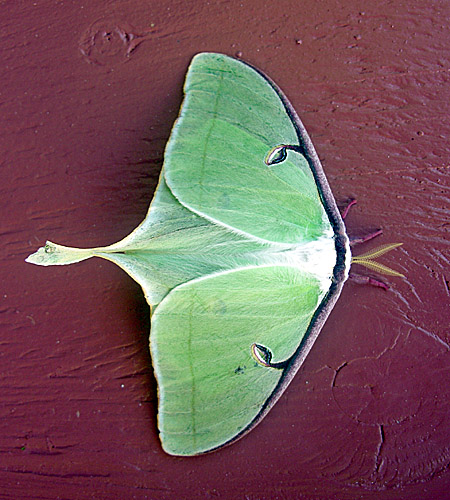
Luna Moth

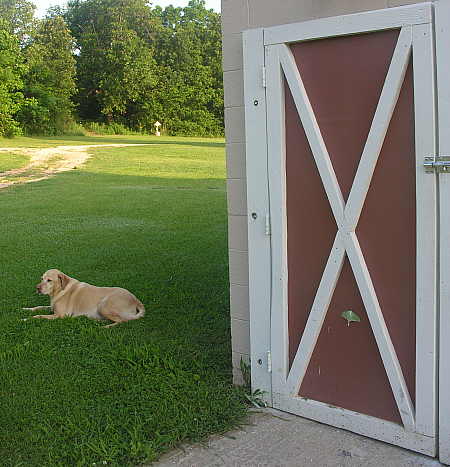
This morning, after finishing my cup of coffee, I headed outside to begin my chores.  George (our faithful yellow lab) accompanied me as I made my way over to the milking barn, where I spotted this lovely Luna moth that you see in the photograph above.

Luna moth resting on shop door

The Luna moth was resting on the back door of the milking barn, and seemed to be completely oblivious to my presence.  He ended up spending most of the morning clinging to the door, perhaps taking advantage of the shade on that side of the building.

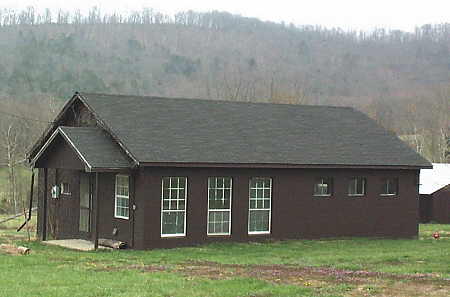
Milking barn before repairs were made

This is what the milking barn looked like when we first bought this property.  It was in pretty poor shape, and was being used to store mostly junk.  Step-by-step, we have been undertaking a renovation of this building. 

We are now converting the front room into a tack room ( a room where we will store saddles, pads, blankets, bridles, halters, leads, crops, carrot sticks, reins, bits, farrier tools, brushes and combs, fly spray, medications, and all the hundreds of other things you find are necessary to keep horses).

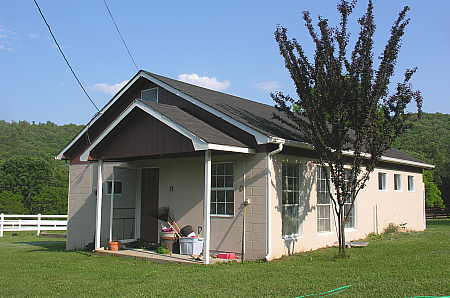
One-time dairy barn

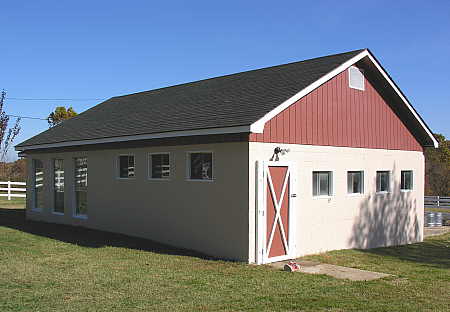
Here is the front of the milking barn as it looks today.  We call this the “milking barn” because it was built and used as dairy barn in the past.  This 36′ x 25’ building is constructed from cinder block, and is comprised of two equally sized 18′ x 25′ rooms.  The room toward the front of the building (with the full-length windows) formerly contained a stainless steel milk storage tank, and was thus called the “tank” room.  The milk was picked up every other day by a dairy wholesaler, who transported the product to a major milk processor.

Rear of former dairy barn building

This is the rear portion of the building, which is where the cows would be milked daily.  The room on this side of the barn was obviously called the “milking” room.  Inside the milking room were eight stalls arranged in a herring-bone pattern on either side of the room.  In the center of the room was a four foot deep milking pit, where the person doing the milking would stand to work, much like the pits that are used in an oil-change garage for the mechanic to position himself under the vehicle.  Grain was stored in hoppers located in the attic above the milking room, and a system of chutes would automatically supply strategically placed feed troughs with grain for the eight cows being milked.

We are in the process of converting this room into a workshop, so that I will have no excuse to not get my equipment maintenance and repairs done in a timely manner.

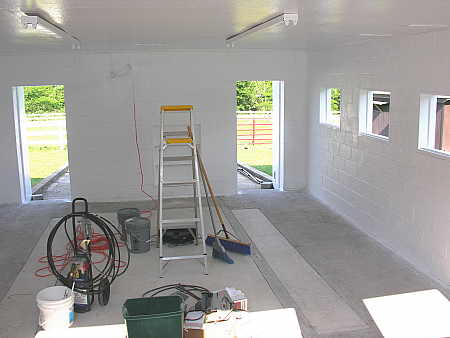
Interior of shop side of barn

Excuse all the things laying around on the floor, but I just completed the painting of the inside of the new “shop” this morning.  In the picture above, you can see where the 4′ deep milking pit used to be located.  We have filled in the pit with tons of gravel, and topped it off with a 5″ reinforced concrete slab.  Now that the shop has been painted, I will install work benches and storage shelving.  After that, I will plan out and install conduit for 110v/220v electrical service to locations around the shop, where I will place my compressor, drill press, etc.

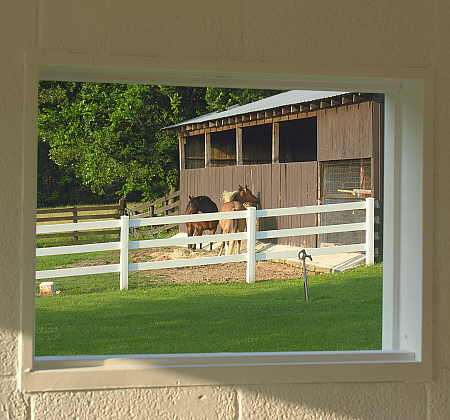
Looking out a window of the new shop

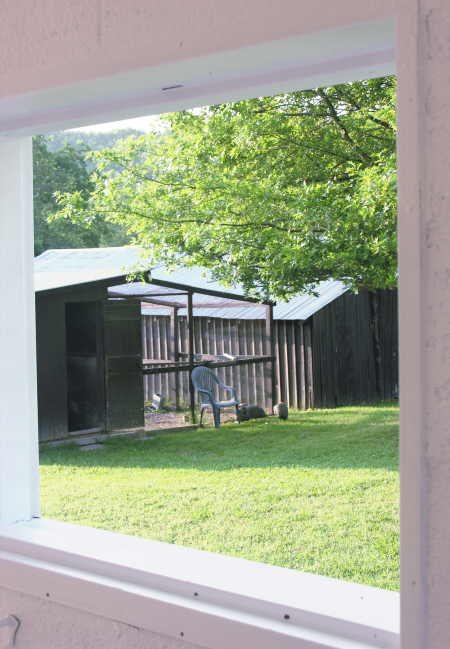
The shop is in a great location far from the house, so noise from power tools and equipment will not be a bother to residents in the house.  The horses, which I can keep an eye on through the many windows in the shop, may not like the noise, but they can always stroll over to another pasture if it is bothersome to them.

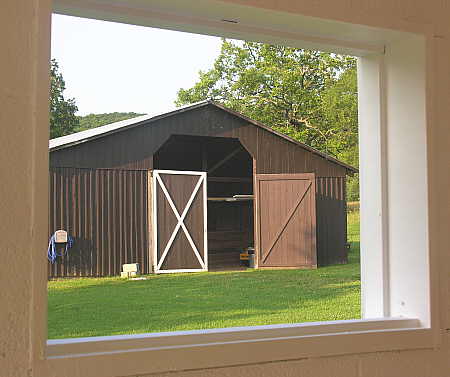
Looking out another shop window

I can also keep an eye on the equipment barn, which is located out another of the shop windows.

Looking out yet another shop window

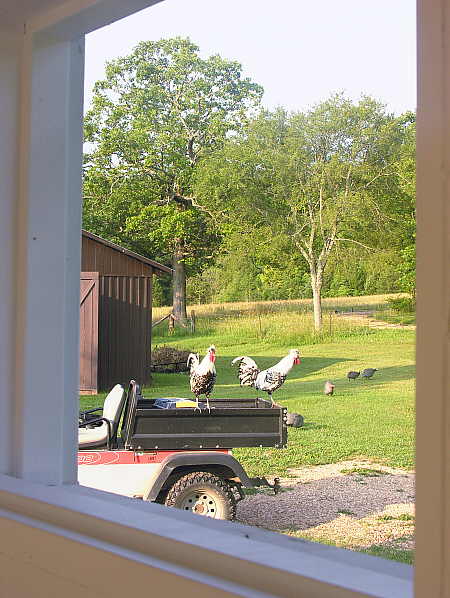
The hen house (sorry, it’s still not repainted yet) is in view of the shop, so I can keep a watchful eye on things over there, as well.

My helpers are waiting for me outside this shop window

And all the while, my trusty “helpers” can keep a keen eye out for me, too.  They certainly wouldn’t want to miss any of my foibles, as I run amok in my new shop!

It’s Time For Another Try

With beef prices fluctuating around all time highs over the past several years, there has been an economic incentive for farmers to increase production, sometimes by pushing the grazing capacity of their pastures to the point that supplemental feed becomes a necessity.  This, along with drought conditions that persist in a number of beef producing states, and substantially increased fuel costs, has pushed the price of baled hay up dramatically in recent years.  Under these circumstances, you would think that it would be easy to find a local farmer who would jump at the chance to cut, bale, and haul away all the fescue and clover hay our hayfields have to offer, especially since I ask for nothing in return.  Alas, as of now my batting average stands at a mere .500.   Here is the breakdown (names disguised to protect the guilty!)-

2001 – Farmer A accepted offer.  He cut, baled, and removed the hay promptly.  He also gave us a side of corn-fed beef in exchange.

2002 – Farmer A passed away prior to harvest.  Farmer B cut, baled, and removed 1/2 the available hay, long after it had lost any nutrient value.  The rest went to waste.

2003 – Farmer B committed to cut and bale the hay, but never showed up.  The hay again went to waste.

2004 – Farmer C asked us for the hay.  He cut, baled and removed the hay promptly.  He also filled our barn with square bales of hay for our horses.

2005 – Farmer C asked us for the hay.  He cut, baled and removed 1/2 of the available hay, but due to equipment failure, 1/2 of the hay went to waste.

2006 – Farmer C again asked us for the hay, but when it came time to harvest, his health precluded his doing the work.  All of the hay went to waste.

You can see that in the past six seasons, we only had three complete harvests, which accounts for the .500 batting average.

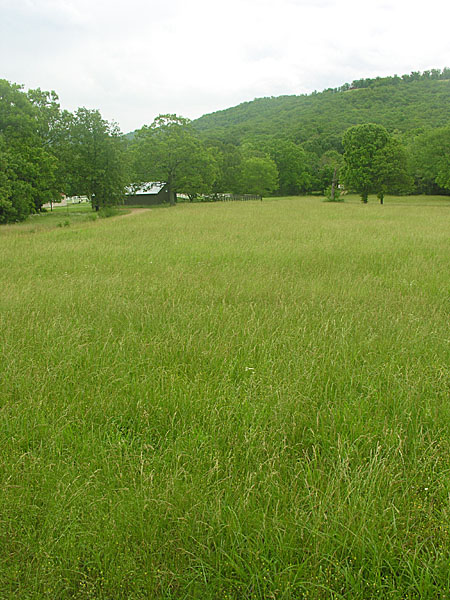
2007 – Hey, that’s now!  And this is what some of the hay fields look like today-
Fescue and clover

The grass is tall and the seed is developed to the point that it is ready for harvest.  It has probably reached the peak of it’s nutrient value, and enough of the seed will be shed in the processing of the hay to allow for natural reseeding of the hayfield (for a previous look at this process, see Fescue to the Rescue).
Another field

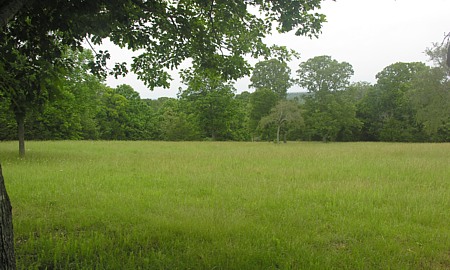
The road that leads to our home runs along side the hay field pictured above, so there is no benefit to maintaining a trail through the grass.
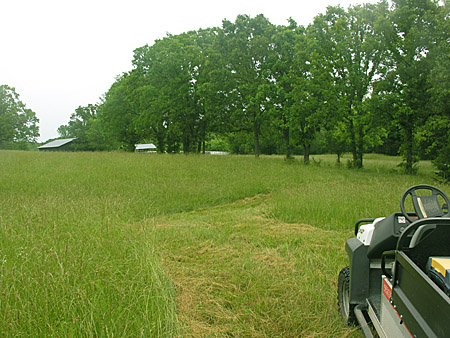
Trail through the hay

In places that we want to maintain easy walking and riding trails, I will use the bush hog to create paths, like the one shown above.  This path leads from our catfish pond over to the barn and paddock areas.

For this 2007 season, however, I think that the hay situation is well taken care of.  Remember the cattle that breeched an old barbed wire fence, raided a hayfield and destroyed a game feeder, from a previous post entitled Invasion of the Corn Snatchers?  Well, it turns out that the rancher who owns those cattle was renting a pasture from my neighbor.  He and his son were out here daily, working on the fencing.  When it became apparent to him that the fences were not up to snuff, he voluntarily trailered his cattle back to their former pastures, and our problem disappeared.  He (I’ll call him Mr. Rancher) was very gentlemanly about the entire situation.

Mr. Rancher recently stopped by and inquired about the wonderful hayfields we have, and asked if we would like to make a deal with him to have the hay cut and baled.  I told him he was welcome to take all the hay he wanted, as I hated to see it go to waste.  He graciously accepted the offer, and I’m close to certain that he will actually harvest and bale our hay.  Why?  First, he’s a young man, so I doubt that health concerns will keep him from baling the hay.  Second, he happens to be the service manager for our local Ford dealership, so I suspect that he knows the value and necessity of keeping his machinery well maintained.

As an aside, it can never be a bad idea to give the service manager at your local Ford dealer free hay – especially if you happen to own two Ford vehicles!

You may wonder why I am only “close to certain” the hay will get baled?  Because, it seems that Mother Nature sometimes has a say in these matters, as well.
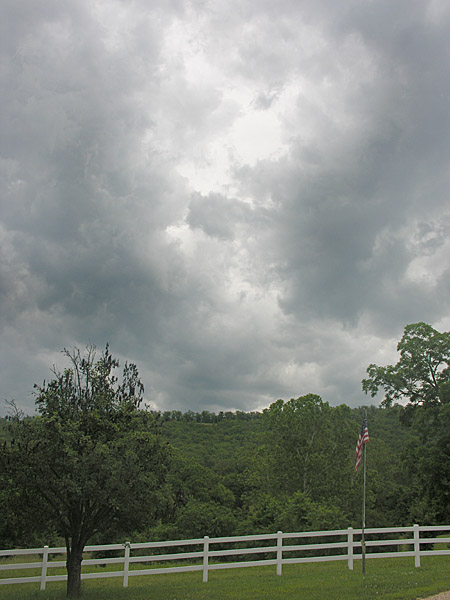
Threatening weather

These are the skies we have been seeing on and off this past week.  When processing hay, it is necessary to have several dry days in a row so that the grasses have a chance to dry a bit.  If the grass is baled with too high a moisture content, then the heat that is generated within the bales as a result of the natural drying processes causes bad things to happen.  Such as reduced nutritional value, formation of molds and fungi, and in some cases, spontaneous combustion.  Barns have been known to burn to the ground as a result of storing bales of improperly cured hay.

So, Mr. Rancher and I both keep our watchful eyes looking toward the heavens above, waiting for that golden sun to shine down upon us with all it’s glory.  Or else how will I ever be able to write a blog post with pictures of hay baled from these fields?  Tell me, how will I?

Landscaping My Way – Installment #3

American Sycamore

American Sycamore

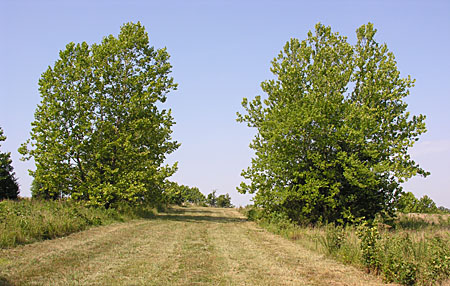
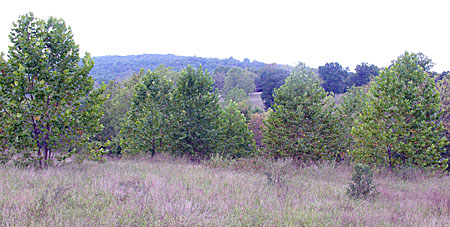
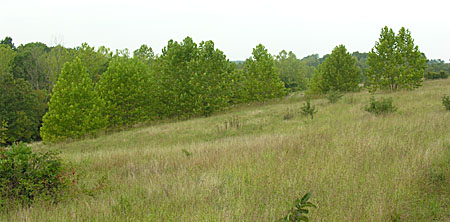
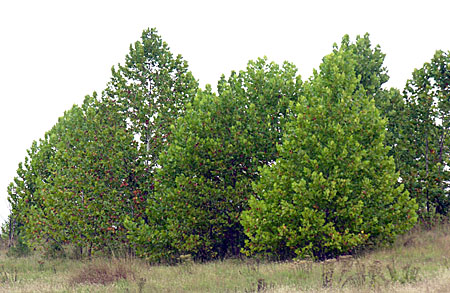
The trees that you can see on either side of this trail are semi-mature American Sycamores.  The American Sycamore is a massive hardwood tree native to portions of the eastern United States.   The sycamore has the largest trunk diameter of the American eastern hardwoods,  and reaches a height of 100 feet during a lifespan that may approach 500-600 years.

American Sycamore

The American Sycamore has a reputation among some as being an undesirable tree, primarily due to the characteristics of the tree which make it somewhat unsuitable to the urban environment.   The massive root system tends to uplift sidewalks and roadbeds, and many decry the constant mess of twigs and leaves that surround the sycamore.  On the plus side of the equation, the sycamore is draught tolerant, flood tolerant, and can grow in a variety of soil conditions, including both alkaline and acidic, as well as compacted soils.  Additionally, the American Sycamore is a very rapidly growing species, which will be evident as you examine the photographs in this post.

American Sycamore

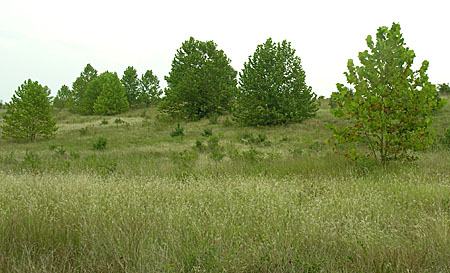
There is a section of land on our property we call “the ridge.”   Formerly used to graze cattle, this area contains about 40 acres of what used to be exclusively forage grasses.  The ridge falls away to creek beds on either side, and because we do not raise cattle, the ridge has been a prime candidate for reforestation of some sort.

American Sycamore

The district forester with the Arkansas Department of Forestry conducted a field survey for us in 2001, and prepared a  management plan which included the suggestion that we plant this ridge area with Loblolly Pine trees.  Naturally, I had other ideas.   It isn’t that I have anything against Loblolly Pines, it’s just that I have an aversion to shovels, watering cans, and building protective cages to protect the young trees from the marauding deer which inhabit the area.  But the ridge needed trees, so what’s a man to do?
American Sycamore

The first year that we resided on this property, I noticed that the pastures of this ridge were inundated with young plants, which I was inclined to shred with the bush hog to promote lush grasslands.  On further examination, and with a little research, I determined that these small plants were tiny sycamores that were popping up in abundance on the ridge.  As long as the ridge needed reforestation, and being as these sycamore trees seemed intent on making the ridge their home, I decided to oblige them by sparing their lives and allowing them the opportunity to grow, unmolested by my tractor.

American Sycamore

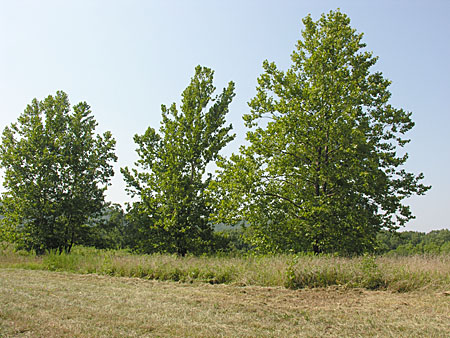
In the short time (6 years) that the sycamores have been allowed to grow on the ridge, they have thrived.  Each year I allow additional sycamore saplings to take a foothold on the ridge, and the trees that have been growing since 2001 are now in the 15-20 foot range, perhaps taller.   In the photographs above, you can see sycamore trees of various ages, and how they are gradually taking over the ridge that had previously contained nothing but grasses.  I have not taken the time to try and count the American Sycamores that now make the ridge their home, but I would guesstimate the number to be around 150-200 trees.

This is the third installment of Landscaping, My Way.  The first installment covered the Dwarf Sumac that I am encouraging to grow in selected clearings.  The second installment dealt with the Silver Poplar grove that is spreading within a portion of our woods.  In the first installment, I suggested that you might see a pattern develop regarding what I call “Landscaping, My Way.”  Do you see the pattern yet?

Thirsty Fish?

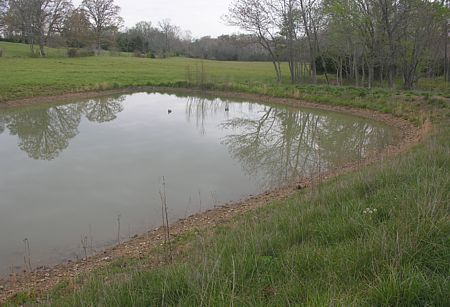
Pond at low tide

When I noticed that the water level was down in one of our ponds, I began to wonder if the fish were drinking it all.   But after some reflection I realized that 6 grass carp, even aided by a couple of thousand minnows, couldn’t ever drink that much water ;) 

Actually, the water level in this pond is affected by neither the tides nor the voracious thirst of it’s resident fish populations, but by the slow, unrelenting process of evaporation.  Now, if this were a deep pond, I wouldn’t be concerned about the seasonal changes in it’s water level.  But due to some problems encountered during the construction of this pond, the pond is temporarily destined to remain in it’s present shallow state (until such time as budget constraints allow for remedial construction work).

Because this is a shallow pond, it is prone to develop masses of aquatic plant and algae life.  The algae that has formed in this pond in the past was the bright green, unsightly gunk that one does not want to view from the kitchen window constantly, so some kind of action was required to prevent the aquatic growth.  Not wanting to utilize chemical treatments (for a variety of reasons), we have opted to stock this pond with a small number (6) of grass carp, also known as the white amur.  This species of fish is commonly used for the purpose of controlling aquatic vegetative matter, and they have been successfully accomplishing that function in this pond.

The white amur is a herbivorous fresh water fish that is native to the orient.  Because this is a non-native species that tends to want to follow the flow of water, many states have certain requirements that must be met in order to legally stock them in a private pond.  Arkansas does not have such a requirement, but a listing of southern state permit requirements can be found at the Southern Regional Aquaculture Center.

Always curious, but they never lend a hand!

Back to my problem,  which is the low water level in the pond.  Something needed to be done to raise the water level, and since mother nature has not been all that cooperative in the rain department, I had to take matters into my own hands (OK – I’ll acknowledge I had a little help from my friends here.

Temporary solution to low water level

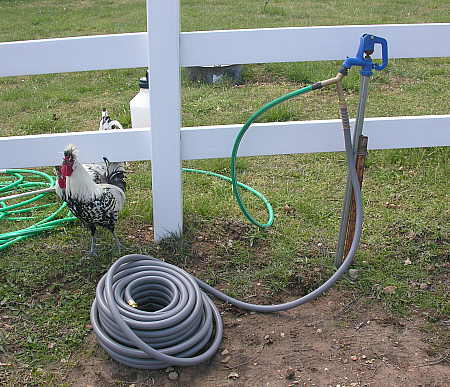
The temporary solution to the low water level was to simply attach enough garden hose to the closest freeze-proof hydrant and run it on down to the pond.  After a few days of running the hose, the pond was again full.

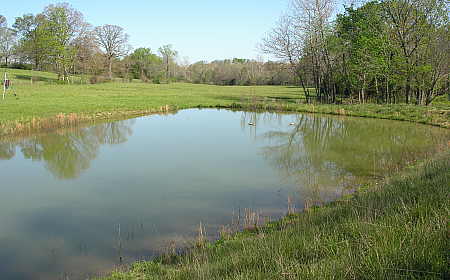
Pond at high tide

Now, when the rains are insufficient to replenish the water that has evaporated, I can simply turn on the hydrant for a few hours per week to keep the pond level up.  This keeps both me, and the grass carp happy.

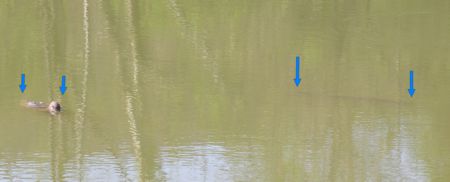
Oh no! - not more arrows…

On the left-hand side this photograph you can see a half-submerged decoy duck (which I admittedly need to fish out of the pond, clean, and re-float).  On the right you can just barely see one of the grass carp.  The decoy measures 12″ in length, so I am guessing that the length of the carp is over 24″.  The adult grass carp will reach a length of about 4 feet, and weigh in at around 40 pounds.

We’ll be hearing from these fellas sometime soon..

Besides the grass carp to control the algae, and minnows to help control insect larva, you can see that this pond supports a health population of tadpoles.  That’s a good thing, because summer wouldn’t be the same without the chorus of a thousand frogs to listen to each evening.

Just Horsing Around

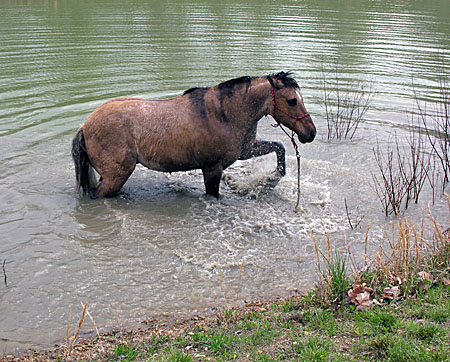
Chipper pawing the water

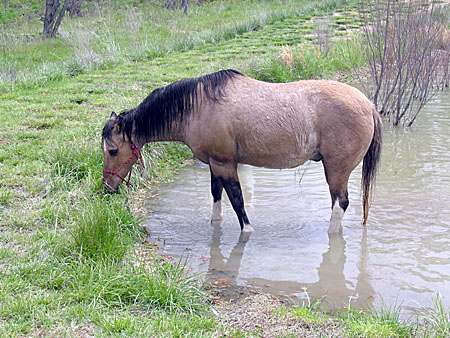
On occasion, we allow our horses the opportunity to swim in one of our ponds.  Chipper, our middle-aged gelding, really enjoys the water.  For some reason, he always likes to paw at the pond water, as you can see above.

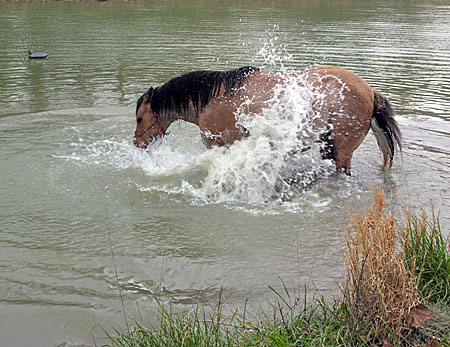
Pawing becomes more frantic

The pawing starts off with gentle strokes of his front leg, but before long, the activity becomes more frantic, splashing water all over the place.

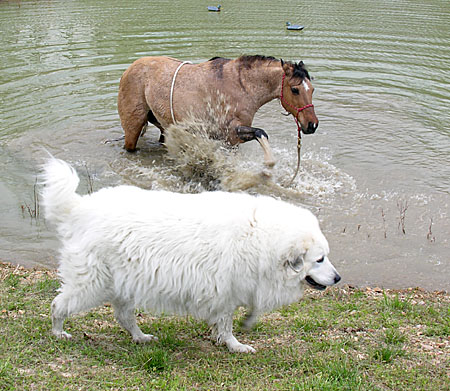
The commotion attracts others to the pond

Soon, all of this commotion draws the attention of Gracie, who feels compelled to check out the activity going on at the pond.

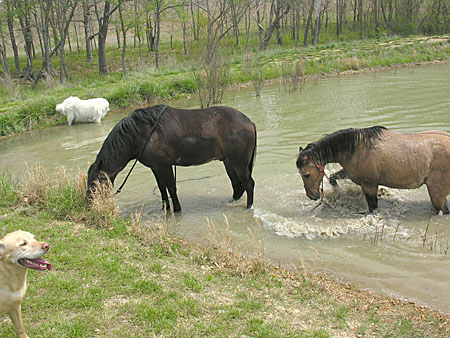
Pretty soon, the whole gang’s involved

Eventually, the whole gang gets involved.  Chipper, meanwhile, continues non-stop with the odd water pawing behavior.  He wants to be sure that every fish in the pond knows of his presence, I guess.

Just one more bite, please

Content in the knowledge that he has successfully sullied the pond for the next few days, Chipper grabs a few bites of grass before heading back to his grazing pasture (located away from the pond, of course).

Invasion of the Corn Snatchers

Black deer in Arkansas?

“Look honey, more deer at the far game feeder.

Wait a minute, deer aren’t black!

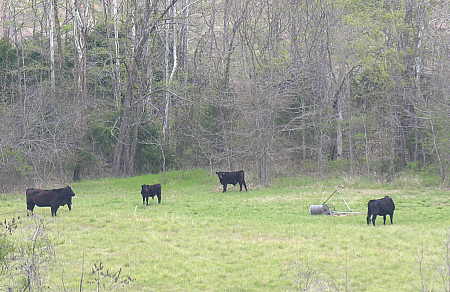
These animals aren’t deer, they’re cattle!

“Hey y’all, look what I just did over here.”

Well, as long as we’re already here…

“Well, as long as we’re already here…”

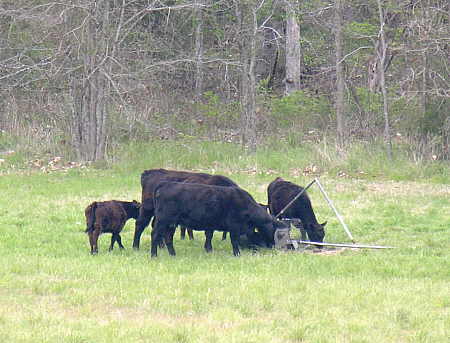
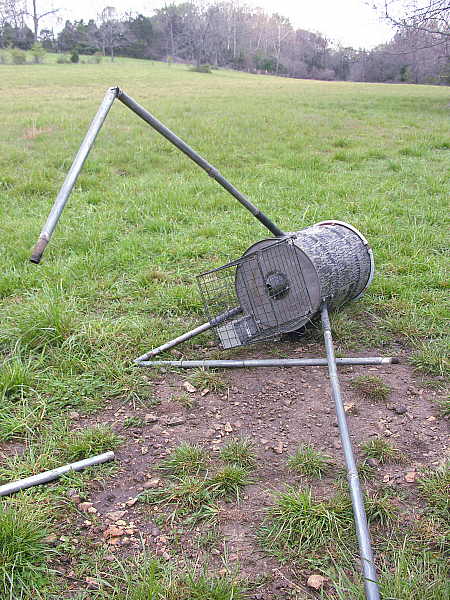
Well, just when I thought that I had pretty much solved the problem of critters molesting the game feeders by the judicious use of appropriate varmint guards, I find I may have to figure out a way to make them cattle-proof, as well.

Another one bites the dust!

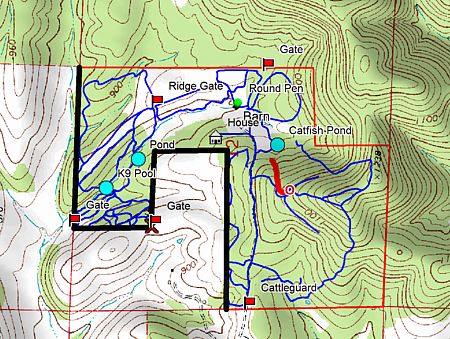
You see, we share 1.75 miles of barbed wire fence with one of our neighbors (who has holdings of about 500 acres), as shown on this map, in the form of a bold black line.

Existing common fence

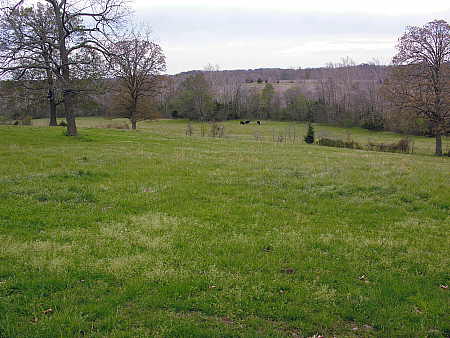
There is a .25 mile long section of this fence that I rigorously maintain to pen our horses.  Unfortunately, the remaining 1.5 miles of existing fencing between us is old and in pretty sorry shape.  This neighbor has recently rented out pasture to a local rancher, and over the past several days his cattle have been testing and challenging the old barbed wire fence.  Each day, try as it might, the fence ends up losing the battle, as two dozen bovines make their way into our early spring hayfields, eagerly dining on the succulent fresh fescue and red clover.

Each afternoon, a telephone call brings the rancher over to our place, to round up his errant cattle.  Yesterday the cattle discovered that not only do we have the best grass in the area, but there’s corn for dessert as well!  So, even though the neighboring rancher is apologetic and is working daily on mending the fence, I’m guessing we’ll be seeing the cattle here again soon.  But I really hope I’m wrong.  Besides the damaged feeder, there are other concerns that the encroaching cattle bring about.  Whereas I have been working to maintain healthy banks along our creeks, the cattle trample the banks, causing erosion of the soils and decimation of the filtering vegetation along the creek sides.

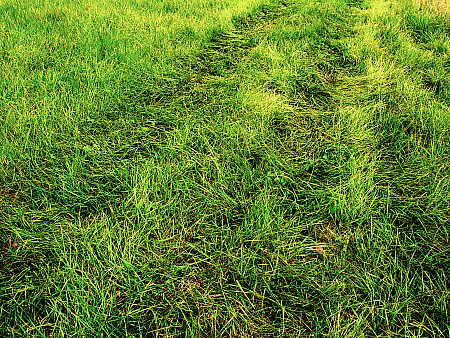
If this were twenty or thirty years ago, my neighbor would have come over to round up the cattle mounted atop his trusty steed.  Alas, cowboys don’t ride horses anymore, but are experts at herding cattle as they sit astride ninety horsepower ATVs equipped with aggressive off-road tires.  As you can see below, vehicle traffic and emerging hay fields don’t mix well. 

Modern “hoof prints”

Hopefully, the repairs that our neighbor made to the fence will hold the cattle.  I plan to walk this portion of the fence line tomorrow to make a current assessment of the situation.  I’d rather not have to share in the expense of having a new, sturdy fence built along this great a distance, but I am not prepared to try and keep an old brittle fence cattle-tight as a do-it-yourself project.  As they say, “I’ve been there and done that, and I ain’t doin’ it again.”

Seven at a Time

Food and water abound

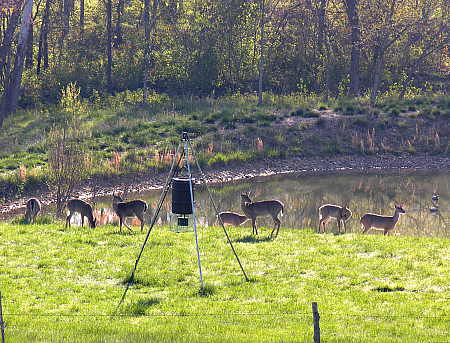
First, I apologize for the poor lighting conditions exemplified in this photograph, but sometimes you have to abide by the conditions imposed upon you by nature.  Having said that, it is still enjoyable to look down at the feeders from the kitchen and see seven deer partaking of breakfast while you sip your morning coffee, regardless of lighting conditions.

As you may notice in the picture, we have had sufficient rain so far this season to allow the grasses to grow into a thick green carpet, but not enough precipitation to top off the ponds.  Therefore, I’ll join in with the usual chorus heard around here this time of year – we could use some more rain!

If I had my way, we would receive about 1 inch of rain per week, preferably delivered in the form of a steady (but gentle) shower that occurs between the hours of 11:00pm and 6:00am every Tuesday.  In reality, however, although we receive an average of about an inch of rain per week, it may come in the form of a torrential downpour that drops 4 inches of rain at once, and then a dry spell for the next month.

Adaptation

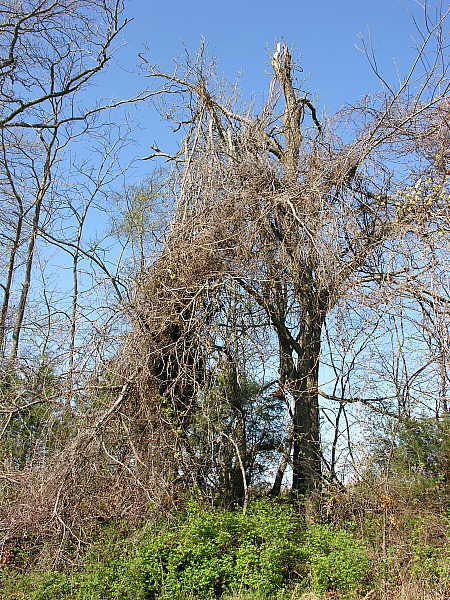
Greenbriers!!!  Grapevines!!!  I shudder at the mere mention of these two plants.  Silently, slowly, and with an undeterred relentlessness, these vines spread themselves out among the branches of nearby trees, and the ensuing battle usually results in the destruction of the host tree within a few seasons.  

Grapevine encrusted oak tree

In the photo above, you can see how the vines envelop the limbs of the host tree.  As the seasonal winds blow through the trees, and as winter snow and ice accumulate on the branches, the limbs eventually snap, resulting in the gradual destruction of the tree.  Even the mighty oak succumbs to the tenacity of the vines.

I do not get too concerned about this process in general as it occurs on our property, however there are times when it cannot be ignored.  In the photo above, the tree that is being destroyed by the vines happens to be situated next to the barbed wire fence that separates one of our horse pastures from a neighbor’s cattle grazing area.  Just as the vines bring down the mighty oak limbs, the falling limbs bring down the sturdy barbed wire fence.  So to keep our horses, as well as our neighbor’s cattle happy and in their proper pastures, it is necessary to try to clear out this tangled, thorny mess in order to keep the fence in working order. 

When vines pull down tree limbs,  as in the example above, or when other forces of nature conspire to fell a tree, I sometimes want to clear the debris.  In other instances, I may wish to clear a specific area for recreational or aesthetic reasons.  

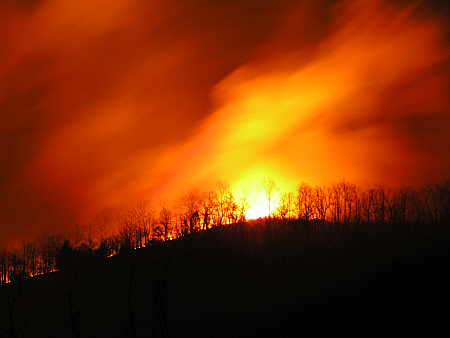
What to do with all the limbs?  The chainsaw reduces the larger diameter limbs into firewood sized lengths, but this still leaves a lot of smaller branches and saplings to deal with.  Many landowners, where not prohibited,  choose to burn their land clearing debris.   I do not burn, and I am not particularly fond of the practice, because it all too often winds up resulting in the following types of photo ops from my front door:

Never-ending fire danger

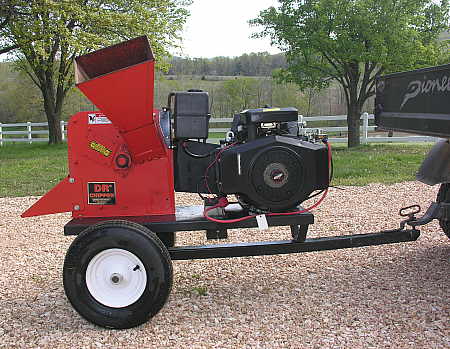
When first confronted with the problem of what to do with tree refuse, given my reluctance to burn, I opted for a heavy-duty wood chipper.  After researching the equipment that was available in the price range that my budget allowed, I settled on the following product:

DR 18hp Towable Chipper

This is a Country Home Products 18hp DR Wood Chipper.  It has an electric starter, and can be towed behind my utility vehicle, allowing me to do the chipping anywhere the need arises.  It has been a great piece of equipment that has helped me out quite a bit around here.  But sadly, it will soon be put up for sale.  On eBay, that great resting place for all things no longer needed!

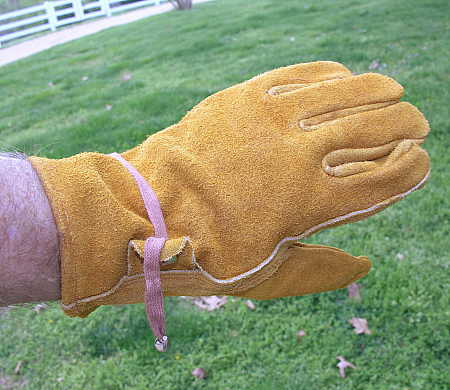
Some gloves are inappropriate

When working with a chipper, it is necessary to wear gloves in order to handle the limbs.  The gloves in the photo above are similar to gloves I donned to do a bit of limb chipping a few years ago.  There is a cord on the back that allows the wearer to tighten the glove firmly in place.  Unfortunately, the cord on the back of my glove managed to get snagged by a limb being drawn into the chipper, and my hand went along for the ride!

Oops!

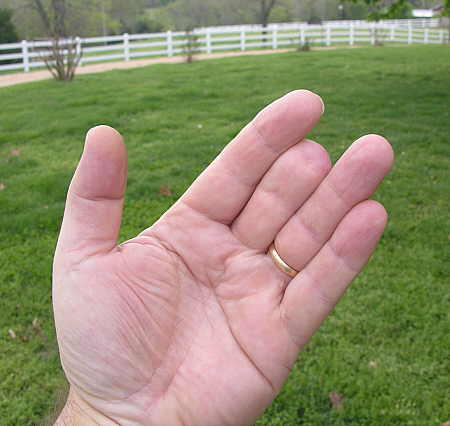
Oops-  that sure ruined what started out to be a perfectly good day!  One lesson to be learned is never wear anything that could possible get caught up in the machinery you choose to operate.  After this accident, I used the chipper a few more times, but had to abandon it because the “finger that was” became too sensitive to the vibrations transmitted from the branch being chipped.

OK, we’ve established that I’m paranoid about fires and burning, so that’s out of the question, and operating a chipper is no longer a possibility,  so how do I now handle all of the downed limbs and debris that continues to be generated each season?

Critter habitat

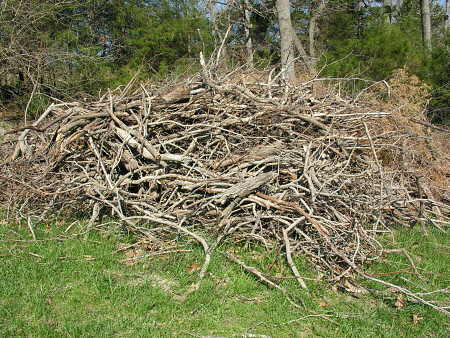
I now have brush piles scattered in selected locations around the property.  By hitching a trailer to the back of the utility vehicle, I gather whatever plant debris accumulates and transport it to these piles.  Sure, they’re a bit unsightly, but I don’t have to burn and I don’t have to use a chipper any longer.  As an added benefit, the brush piles become coveted habitat for any number of ground dwelling creatures.  It seems to be a win-win situation, doesn’t it?