My Boots

Any person who has spent an appreciable amount of time hiking through the hills and hollers of the Ozarks undoubtedly owns and loves a favorite pair of boots.  It does not matter how many pairs of boots one may own, nor for what purpose, there will always be one favored pair among them.  I own few shoes.  But I own many boots.  When your activities revolve around the outdoors, you tend to get that way.  And indeed, I do have a favorite pair of boots.  I just call them “my boots”.

Now in the winter, just after 6″ of snow has fallen and it is 10 degrees outside, I would probably choose to put on my insulated high-top hunting style boots to tromp around in the woods.  If the snow conditions happened to be just right, and I had the energy, and if my back weren’t hurting from lugging diesel fuel, then I might elect to lace up my cross country ski boots, step into my cross country skis, grab the ski poles and pretend that I were still young enough to do these sort of things.  Afterwards, I would probably want to lounge around a warm fire in the fireplace, which means that I would have to trek through the snow to get firewood.  This would call for my lightweight, zip-up insulated snow boots, which are perfectly matched to this task.

When a more formal occasion presents itself, such as an anniversary or birthday dinner at a sit-down restaurant, then the footwear of choice would be a pair of western boots (cowboys wear cowboy boots, and I’m not a cowboy – hence, western boots).  When a less formal occasion presents itself, such as manure management in the paddock, then mucking boots are called for and nothing less will do (note to self: never economize on mucking boots …yuck).

Now that it is springtime, and the spring rains have (fortunately) begun in earnest, the boot I might select during a prolonged rainy period might be my pull-on high top waterproof work boots.  They will keep my feet dry, they have good traction and fair ankle support, but best of all, they can be slipped on and off easily and quickly (a godsend when a chore involves going in and out of the house repeatedly with muddy boots).

In the summertime, I usually reach for my light weight, waterproof lace-up work boots, which are an excellent choice as a general purpose boot, and due to their sturdiness and light weight, perform very well for a hiking boot.

All of the boots that I have just mentioned are specialized boots of one sort or another.  To recap, there were insulated high-top hunting boots, cross country ski boots, insulated snow boots, western boots, mucking boots, high top pull-on work boots, and lightweight waterproof lace-up work boots.  In total, I might wear these boots for a combined total of ten percent of my shod time.

The other ninety percent of the time I simply wear “my boots”.

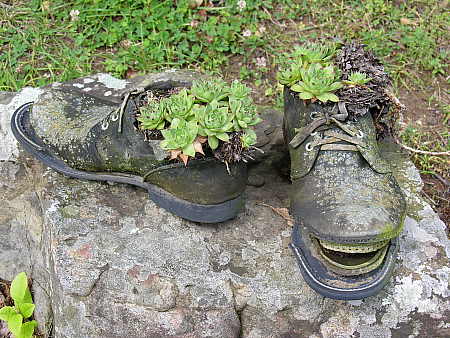
The final resting place for a good pair of boots

Feeling Kittenish?

Just as I clicked on the “publish” button for my last post, Retta pulled up the driveway, back from visiting her parents in Ozark, Missouri.  Along the way home, just off the highway, she noticed what looked to be two tiny kittens.  Not one to look the other way when situations such as this occur, Retta stopped the truck and investigated.  She found the two little kittens, but found no evidence of any siblings or mother cat.  Apparently, these two marvelous creatures were abandoned along the side of the road by some sick, heartless individual who could not think of any other way to handle a new litter of kittens.

Retta did what most caring, nurturing people would do under the circumstances – she gathered the kittens up and brought them home.  So it looks as if we shall now be a three cat family.  And this is what they look like:

Unnamed kitten #1

Unnamed kitten #2

Hopefully we can teach them to get along with the other cat, the dogs, the horses, the guineas, the chickens, the wild birds and the squirrels.  Anything else is fair game.

Emoticons and Smileys…. Pro, Con or Neutral?

On a recent comment to a recent post that appeared on these pages, I noticed that the commenter ended a tongue-in-cheek sentence with this smiley ;).   Like everyone else who has used a computer lately, I have seen an array of these little faces everywhere on the internet that I visit.   But I was totally surprised to find this little fella living in my blog comments 8-O.   I thought that the person who left that comment must be super-cool (which he is, of course) 8).   Although I know that it is a sin, I couldn’t help but be green with envy over this person’s computing skills :mrgreen:.  

Not long after seeing that a smiley had taken up residence in my blog, I happened to end a sentence with an old-school “;)”, when, much to my chagrin :? this little guy appeared instead ;).   “What the heck is going on here?” I asked myself (as no one else happened to be in the room at the time) :roll:.   And then it dawned on me that Wordpress might be involved in some way :idea:.  It made me very sad that I had no knowledge about the care and feeding of these smiley creatures, so off I went, searching the Wordpress documentation for clues about this feature :(.   The documentation indicated that Wordpress does include a feature that translates old-school emoticons into these little smileys.  This made me very happy indeed :D.

Now that I had learned Wordpress supported smileys, I needed to find a listing of the smileys available for my use.  Off I went to search the internet for answers :arrow:.   A search on “emoticons” eventually led me to a blog with a post regarding emoticons.  The individual who wrote this post was very angry with computer users who use the services of the smiley critters :x.   In the comments that followed this post, there was a very intelligent discussion among the participants involving the use of emoticons in general, and smileys specifically.  Some considered the smileys to be evil :evil:  twisted creatures :twisted: undeserving of life itself.  Others found the smileys to be cute and helpful in expressing nuances of feeling that are hard to put into words.  Some even expressed disdain for anyone who would consider using smileys :P.  And here I was, doing research to find out how to use these little animated dots.  It was almost enough to make me cry :cry:. 

Like many other things that I don’t think about when I’m not thinking, I never thought that emoticons and smileys could arouse so many emotions in so many people:!:   So now I am perplexed as to what to do – utilize smileys, or ignore them and hope that they go away. 

What is your opinion?

Flashback Friday #3

About Bodie California

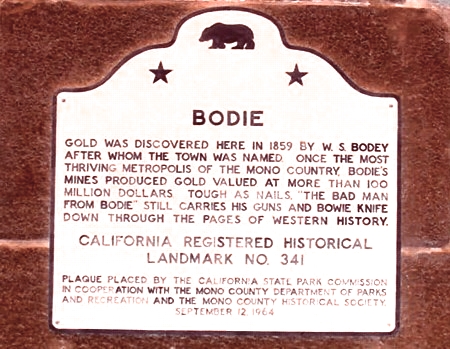
In 1859, nearly 150 years ago, gold was discovered in Mono County, California.  A mill was established in 1861, employing about 20 workers who were the founders of the town of Bodie.  By 1880, Bodie had grown to exceed 10,000 residents.  Like all boom towns that grew up around the gold strikes of the mid 19th century, the were saloons, hotels, brothels, thieves and scoundrels.  But there were also hard working, churchgoing, God-fearing people living in Bodie as well.  Again, as happened in other gold-induced boom towns, eventually the cost of extracting the gold exceeded the dwindling revenues generated by the mining endeavor.  The mine was no longer capable of supporting it’s workers, and this triggered the collapse of Bodie’s economy.  A fire in 1892 sealed the fate of the town of Bodie, and now it joins the ranks of other gold-rush era ghost towns.

Bodie is now operated as part of the California State Park system, and is opened to visitors (although the general public may not enter the buildings, except that select groups are allowed entry after-hours by special arrangement).   Mono County, where Bodie lies, is within the arid rain shadow of the mighty Sierra Nevada mountains.  The resulting dryness is ideal for the preservation of the surviving structures in the ghost town.

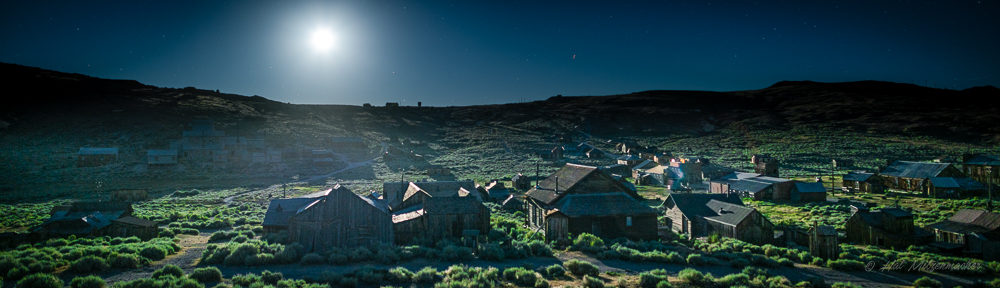
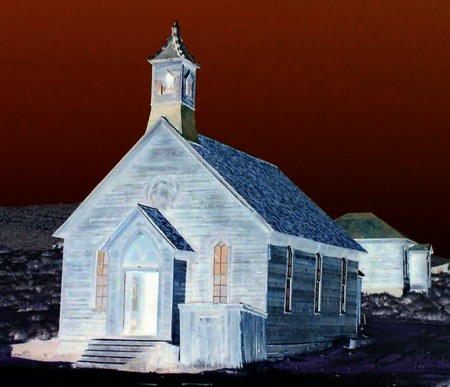
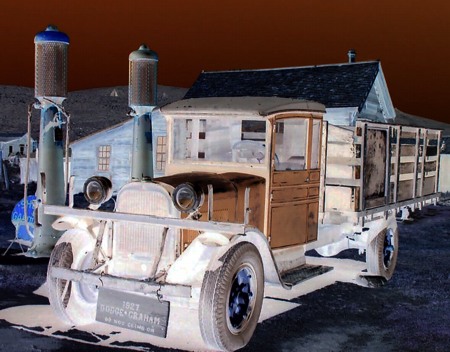
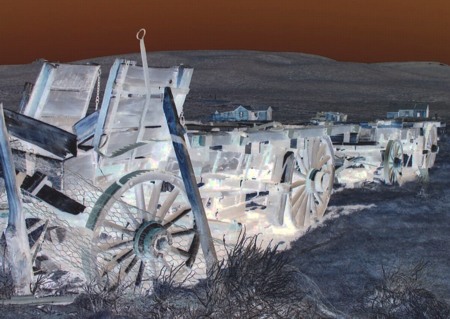
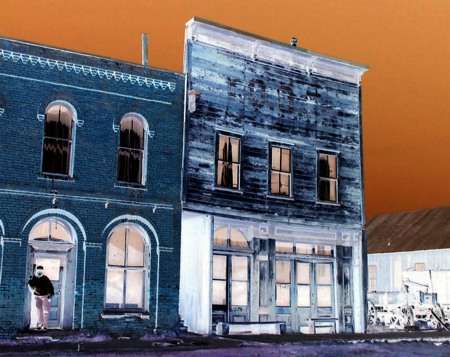
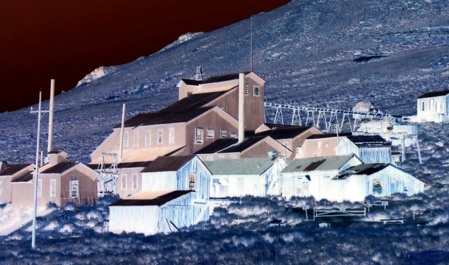
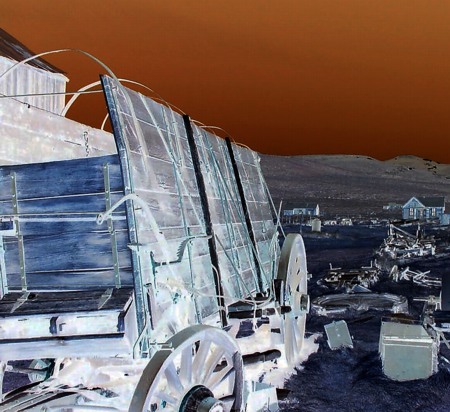
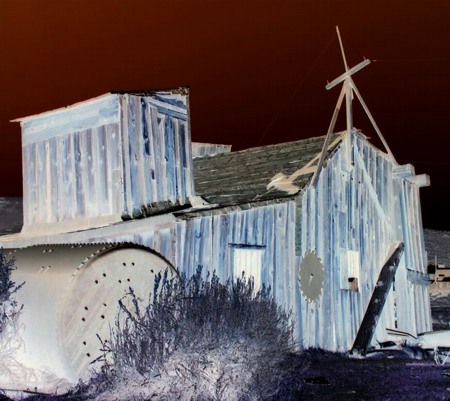
It seem obvious to me that pictures of a ghost town should convey a certain “ghastliness”,  so I have taken the liberty to doctor up the following photos.

Ghostly moon over Bodie

A haunted church?

How much was a gallon of high-test gasoline back then?

Freight wagons

Main Street

The mines at Bodie

Examining the ruins

Abandoned wagons litter the street

Carpentry shop

Giving Credit Where Credit Is Due

In this day and age, when it sometimes seems as if the business community is out of touch with the customers upon whom they depend,  it is refreshing to see one company respond quickly and politely to a customer’s concern over a potential problem.  I am referring to the good people at snapshirts.com, who have earned my respect and praise for their response to my concerns, and more important, for their response to the blogging community at large.

Here is a little background.  If you are a frequent visitor to blogs of any genre, you may remember a period of time earlier in the year when suddenly, it seemed as if every blog in existence posted an image of what is called a “word cloud”.  The clouds that were posted on these blogs were primarily generated from the snapshirts.com website mentioned above.  From comments on the blogs at the time, it became apparent that word clouds were very well accepted by bloggers and their readership.  This generated a lot of traffic at snapshirts.com, who is in the business of selling products utilizing the word cloud concept.

Recently, one of the blogs that I regularly read indicated that there had been a marked increase in comment spam, and the author wondered what could have caused the sudden increase.  As I thought about this, for unknown reasons my mind flashed back to the word cloud I had seen on that site.  Could this be the culprit, I wondered?  By performing a search on “word cloud”, I was able to locate numerous blogs that had posted their own version of a word cloud.  By than searching those blog’s archives for “spam”, it soon became apparent that many of those blogs had also experienced an increase in spam.  Could the increase in comment spam have been caused by the submission of their URLs to the snapshirts.com site?  I am not well versed in this type of thing.  I can’t fathom why spam even exists in the first place, let alone figure out how it is accomplished.  So I thought, “why not ask snapshirts.com directly?”  Here is the correspondence that ensued:

On 5/2/06, Hal Mitzenmacher wrote:

There are many people in the blogging community who have noticed a marked increase in comment spam on their blogs since submitting their URLs to Snapshirts.  Is there more going on here than meets the eye?  If you were to perform a web search on snapshirts + spam, and then examine the result, you will see what I am referring to.  Would you please address this issue on your blog for those of us who may feel doubts about continuing the use of your services?

Thank you.


Response from snapshirts.com:

Mr. Mitzenmacher,

First, I want to thank you.  You have brought a flaw in our old fulfillment methodology to our attention.  Upon receiving your message we immediately took what steps we could to rectify the situation.  In the past, we had included the weblog URL on the T-shirt’s order page to ensure customers received the T-shirt that was directly linked to their blog.  This inadvertently made those URLs available on the Internet for persons with malicious intent.  We have subsequently updated our fulfillment technology to allow instant T-shirt generation and purchase, so we no longer publish any information beyond the image.  After receiving your message yesterday and realized what had likely occurred, we immediately removed all pages from the Internet that were generated using our older methodology.  Those pages are no longer accessible over the Internet.

Second, I assure you that I have NO direct affiliation with ‘sploggers’, comment spammers or spam providers of any sort.  If you want to call, my cellphone number is xxx-xxx-xxxx and if I could afford a ticket to the Ozarks I’d fly out so you could look me in the eye on this one.  Weblog producers are our sole customers and we are very sensitive to the highest standards of customer service that must be maintained in serving this community.  We were taken advantage of but in no way did we collude with anyone to produce this unfortunate result.

Third, you mention other bloggers experiencing this effect and commenting on it.  I searched the “snapshirts + spam” combination on Google, Google Blog Search, IceRocket, Bloglines and Technorati but was unable to find another blog post on this issue.  If you are aware of other blog posts or bloggers with this issue I’d appreciate any link so that I can address this issue personally with them as well. Last, but most certainly not least, I want to apologize for any inconvenience this has caused you.  I will be posting a notice on our blog today with this information and links to free tools and add-ons for various weblog systems which can be installed to combat comment spam.  For wordpress, I use Spam Karma, which has a 100% record on my personal blog for catching comment spam and permitting actual comments.

Sincerely,

Jonah Keegan

snapshirts.com


My reply to snapshirts.com:

Mr. Keegan, 

As I read the original email that I submitted to you, specifically, 

“There are many people in the blogging community who have noticed a marked increase in comment spam on their blogs since submitting their URLs to Snapshirts”  

I can see that I might have been a little vague regarding other bloggers experiences.  I did not mean to imply by this statement that other bloggers necessarily made a connection between the increase in spam they were experiencing and the submitting of their URLs to Snapshirts.  I am the one who made this connection when, while visiting many differing types of blogs on a regular basis, I began to notice a pattern.  There was a short period of time when it seemed as if  every blogger in cyberspace was posting their own word clouds.  Here is a comment I made on one blog’s Word Cloud post:

“A Google search of “word cloud” now produces over 11,200,000 hits, mostly from bloggers! I wonder how many t-shirts Snapshirt will sell? And how long before a Wordpress “Word Cloud” plugin appears?” 

Shortly thereafter, many of these same blogs began reporting an increase (sometimes dramatic) in the volume of comment spam they received.  This can probably best be seen by using the same methodology as I did.  Perform a search to find blogs that posted their word clouds, and then, from within each individual blog, perform a blog search of posts pertaining to comment spam.  When I saw the results obtained with this methodology, my suspicions became aroused.  Whether there is a cause-and-effect relationship, I don’t know, as I know little about comment spam (other than the fact that it is obnoxious and annoying).  It might well be that this same methodology would yield statistically identical results by searching these very same blogs for “sun spots”, for example.  I just do not know.  Which is exactly why I contacted you to inform you of my suspicions.

The tone and speed of your reply indicates your sincerity about this issue.  No need for you to travel out to the Ozarks so I can “look you in the eye”,  however, should you ever get the chance, I’m certain you would find the area a delightful place to visit.

Hal Mitzenmacher


Snapshirts.com response:

Thank you.  I can tell you our sales are far less than 11.2 million, wouldn’t that be something…  :)  We are very grateful to the blogging community however, for providing us such a uniformly positive reception and sending us a steady stream of visitors.

I can also tell you we are working to develop a free word cloud plugin for wordpress or any blog, with some features we hope will appeal to bloggers as much as our t-shirts do.

Thanks again for bringing this to my attention.

Sincerely,

Jonah Keegan


I have checked the snapshirts.com website today and I have found that they have, indeed been hard at work addressing this issue (see post here).  And as a showing of confidence, here is the word cloud that I have just produced from the snapshirts.com website:
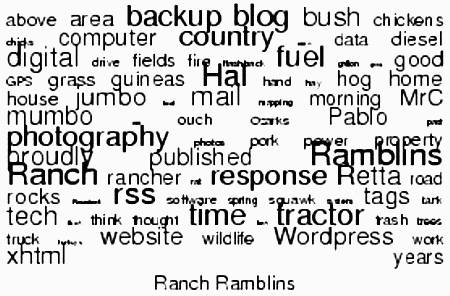
Ranch Ramblins word cloud

I Don’t Care Who You Are, This Is A Pretty Sight…

Where's the pot of gold?

The WildBlue satellite spot beam 35 was out for most of the day, so I have not had access to the internet until this afternoon.  So this photo is being posted a day later than I would have liked.

We were fortunate enough to receive 2 inches of rain Friday and into Saturday.  With the 2 1/2 inches we received the prior week, it looks as if our pastures and fields will be growing like gangbusters.  Once dry creeks are now flowing again, and the catfish pond will regain it’s previous glorious fullness soon, which is a big relief to me (not to mention the catfish).

After the rain stopped, we were again fortunate enough to be presented with a superbly brilliant rainbow.  I figured that, no matter how you happened upon this page, you would appreciate a moment to enjoy a beautiful rainbow with us.

PS – In case you were wondering, I raced over to this pasture to find the pot of gold, but somebody must have beat me to it!

The “Ouch” Factor

Diesel fuel containers

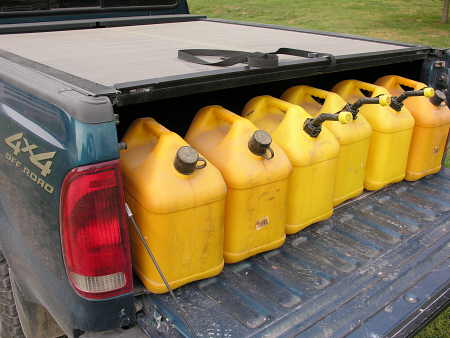
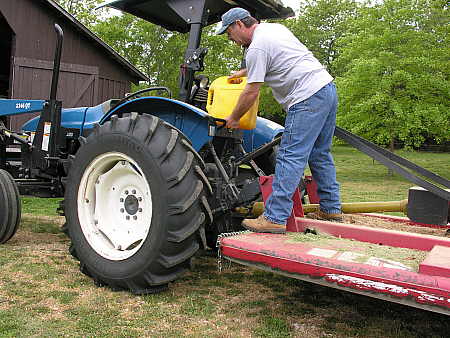
The photo above shows how we obtain our off-road diesel fuel to supply the needs of our tractor.  In order to purchase off-road diesel (which is devoid of state road taxes), we must travel 16 miles each way to the nearest supplier.  Safe fuel handling practices dictate that fuel containers be removed from the bed of the truck before filling, so we place the cans on the ground to pump fuel into them.  The containers are then lifted back into the bed of the truck for the journey home, where they are off-loaded from the truck and carried into the barn for storage.  When it is time to fuel the tractor, a container is carried from the barn out to the tractor, where it is emptied by hand into the tractor’s fuel tank. If I were to attempt this feat while standing on the ground, then the fuel filler neck would be at eye-level, which is not a particularly safe way to fill a tank with hazardous liquids!  As you can see from the photo below, by elevating the bush-hog into the uppermost position, I can accomplish the refueling from a position that affords eye safety.  On the other hand, it isn’t a position that is easy on the back!   Ouch!!!

Fueling the tractor

Now let us do some math.  Ouch!!!  Okay, I’ll do the math, you just follow along with my reasoning.  This tractor burns 1 gallon of fuel per hour.  According to the tractor’s hour meter, I have run the tractor for a total of 1200 hours in the past 5 years.  That amounts to 1200 gallons of diesel fuel.  There seems to be some controversy over the weight of diesel fuel, but assuming a conservative 7 pounds per gallon as the factor, that translates into 8400 pounds of diesel fuel that the tractor has consumed.  Each gallon of fuel had to be handled several times; 1) loaded onto the truck for the ride home, 2) transferred from the truck to the barn 3) carried from the barn to the tractor 4) lifted and poured into the tractor’s fuel tank.  So now we have determined that I have handled a total of 33,600 pounds, or nearly 17 TONS of fuel!  Ouch!!!  No wonder my back sometimes hurts.

Now for some more math.  Ouch!!!  As you can see from the first photo, I fill 6 fuel cans at a time, because that is the number that will fit across the back of the pickup bed, affording lateral stability as I wind my way around the Ozarks landscape on my way to the filling station.  I fill each container with 4.5 gallons of fuel, therefore each round trip to the station yields 27 gallons of fuel (4.5 X 6).  We know from the paragraph above that we have used a total of 1200 gallons of diesel fuel, therefore we can conclude that there has been a total of 44 round trips made to obtain this fuel (1200/27=44.44).  Now if we multiply the 44 round trips by 32 miles, we obtain 1408 miles traveled to fetch diesel fuel.  Dividing by the abysmal 16 miles/gallon that my truck manages to achieve (he admits, covering his face in shame), and then multiplying by an average fuel price of, say, $2.00/gallon, we can determine that I have spent close to $200 just to fetch the fuel!  Ouch!!!  No wonder my wallet sometimes hurts.

As an aside, well, I’m almost too embarrassed to share it with you, but here goes.  Over the years, I have been purchasing off-road diesel fuel for use in my tractor.  As mentioned previously, off-road diesel fuel is devoid of road taxes.  Sometime in the past (I don’t know when), the state legislature decided that off-road diesel should be subject to the state sales tax of 7%.  So now, using today’s fuel prices, the calculus (ouch!!!) goes something like this:

Off-road diesel (16 miles away)= $2.65/gal + 7% sales tax = $2.84/gallon

On-road diesel (available locally) = $2.79/gallon

Price of my embarrassment = ???   Ouch!!! 

But I digress.

My father used to frequently say “Son, the legs go first!”  But then, he spent the better part of his life running a factory.  He put many miles on the soles of his shoes, so one would expect the legs to go first.  While I do lots of hiking around the property here, I find that I am called upon to perform heavy lifting much more than I recall doing since my younger days.  And so I would have to say “Dad, the back goes first!”

So the question that nags at me is this – is there a better way to accomplish this task of fueling the tractor, which, while seeming to be a trivial task, can wreak havoc on the backs of those of us who don’t feel as young as we once were?

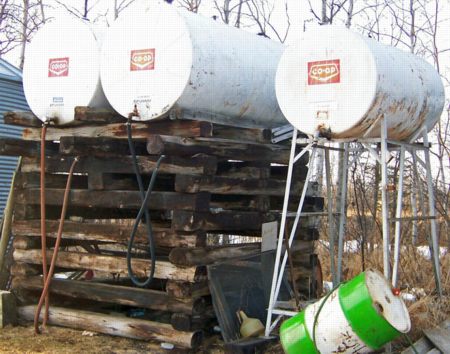
One popular option that many farmers turn to involves the installation of an elevated, above-ground fuel storage tank, which is periodically replenished by a local fuel distributor.  These systems are gravity driven, which is both a blessing and a bane.  A blessing, because pumping equipment is not required.  A bane, because gravity cannot be shut off.  There are many potential points of leakage in a fueling system.  With gravity continuously at work, any leakage, no matter how slight, will eventually empty the tank.  There was an incident that occurred about 5 years ago in an area around Beaver Lake, about 75 miles away.  A fishing resort owner had a 300 gallon elevated tank installed for the convenience of his guests.  The tank valve developed a leak sometime during the night, and approximately 200 gallons of fuel seeped into the water table.  To make a long story short, 5 years later there are about 100 households with contaminated wells.  Their water has to be delivered weekly by truck and pumped into plastic holding tanks placed on their property.  The owners of the resort had to declare bankruptcy when their insurance policy reached the limit of the insurance company’s contracted liability.  Ouch!!! 

And this scenario, with some slight variations, is played out repeatedly across the country.  As I was driving down the road this winter, I saw these tanks on a neighbors  farm, so I stopped to take a picture.  To me, this looks like a disaster waiting to happen. 

Elevated fuel tank

Were I to install a fuel tank, it would have to be built of quality parts.  I would have to keep the tank, fittings, hose, valve and nozzle in tip-top condition.  And the entire assembly would have have a seepage-proof containment system with capacity at least equal to the capacity of the tank.  All-in-all, this would be a safe and effective system, which would certainly relieve the pains in my back, but man, would it be costly!

So it’s off to the station to fill those darn fuel cans.  Ouch!!!  Ouch!!!  Ouch!!!

Flashback Friday #2

Let’s turn the clock back to the year 1966.  If you were around in 1966, you would have found the following to be true:
Lyndon Johnson was President of the United States.  The new Medicare act was implemented.  The Supreme Court issued the the well-known Miranda decision.  It was a bad year for Los Angeles sports fans, as the Baltimore Orioles swept the LA Dodgers in 4 games, and the Boston Celtics bested the LA Lakers in an extremely competitive 7 game series.  The Oscar for Best Picture went to “Sound of Music”, and Frank Sinatra walked away with the Grammy award for Best Album of the Year.  On the economic front, you could buy first-class postage for a nickel.

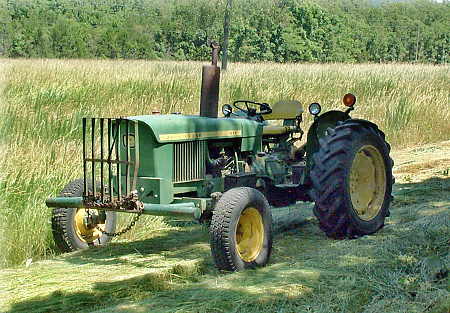
But the most important 1966 event in the agricultural world was the introduction of the John Deere model 1020 industrial tractor.  The significance of this tractor is that it signaled to the tractor world John Deere’s intention to compete vigorously in the low cost utility tractor market.  To be price competitive, John Deere needed to cut production costs, and to that end, they developed a three-cylinder gasoline engine, which was put into their new model 1020 tractor in 1966.  This tractor is credited with starting the 3-cylinder utility-tractor engine configuration, which is so popular  among tractor manufacturers today.  Here is a picture of the John Deere model 1020 tractor, which sold for $4500 back in 1966-

John Deere 1020

This is a 1966 John Deere model 1020 tractor that is owned by my neighbor Jimmy.  This is not a “coddled” tractor restoration by any stretch of the imagination.  This is a work-a-day tractor that is put into hay production and bush-hogging use regularly.  Periodically, this tractor needs to be “convinced” as to who’s the boss.  Jimmy stores a large, heavy hammer in the tractor’s tool box for just such occasions!

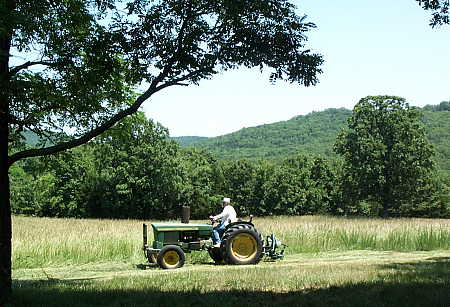
Our late neighbor Boots used to cut, rake, ted, and bale the grass in our hay fields until he passed away several years ago.  Now, Jimmy is doing this for us on a share basis.  Here is Jimmy hard at work cutting the hay in preparation for baling this past season-

Jimmy cutting hay with a sickle-bar mower

The hay field pictured above is one of the fields that Retta and I have decided to take out of hay production this year.  It is our hope that by keeping the fields that are close in proximity to the house and barn areas short, we will reduce the effects of predation on our fowl (see previous post).  It is also our hope that the short grass will help to create a fire-defensible zone in the areas around our house.  You may already know that we have been plagued by a spate of wildfires recently (see posts here and here).  I have read claims on other farming and ranching related blogs that tall grasses will not burn, as long as they are lush and green.  I have seen otherwise,  and until the firebug that is running around in our area is apprehended, I will rest easier with short grass surrounding the house and paddock areas.

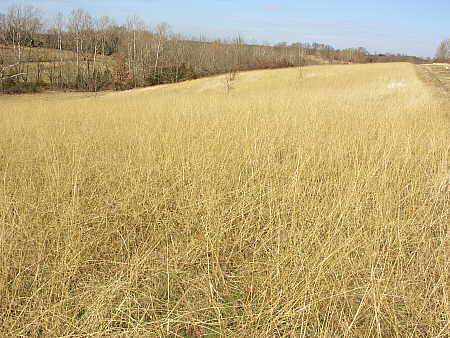
Like all other land-use decisions a property owner faces, this decision involves various trade offs. Short grass means less cover for predators, which is our goal.  But it also means less cover for the wildlife that have learned to make effective use of the tall grass.  Birds of various species use the grasses to nest in.  Deer use the grasses for browse and for cover.  Grassy areas along the forest-field transition are used by the deer to give birth to their young.  Wildlife of all types will use the tall grasses to bed down in.  And who hasn’t heard of the proverbial “snake-in-the-grass?  The long grasses, which the wildlife have utilized up until now, will no longer be available in these fields.  Not to mention the production of several hundred square bales of hay that will be lost.

Wildlife cover

In conjunction with our decision to take several hay fields out of production, we will be compensating by allowing several other fields, such as the field shown in the photograph above, to grow to their full extent and remain tall throughout the year.  These fields will be cut on a rotating basis, such that, at any given time, long grasses will be available for the wildlife to utilize.

Some crazy, eccentric people will sure go through a great deal of trouble just to raise chickens and guinea fowl, won’t they?

The Power of 10X Optically Zoomed VR Mega-pixels

The latest crop of prosumer EVF (electronic viewfinder) digital cameras feature 8 mega-pixel images, coupled with a 10X optical zoom lens.  Some feature VR (vibration reduction) lenses.  If you have never seen a demonstration of the power of this combination of features, you may be interested in these photos.

If you peer at this first photo closely, you will see a group of purple flowers (irises, I believe) that are growing at a distance of 100 feet from where I stood to take the photo.

Purple irises from 100 feet away

In the next photo, I have remained in the same location, but now I have zoomed in fully on the iris bushes.  In 35mm camera equivalency, I have zoomed from a 35mm (moderately wide-angle) shot to a 350mm (long telephoto) shot.

Here are the irises shot from the same location, but zoomed to 350mm

The photo above demonstrates the power that a 10X-optical zoom lens brings to the photographer.  Now, if you again look closely at the photo just above, you will see towards the bottom, just slightly off-center to the right, deep purple petals and a very dark iris bud.  Here, let me help you to see it-

Cropped photo, pixel-for-pixel screen representation

What you are looking at here is simply a cropped portion of the second photo, but there has been no enlarging or interpolation involved whatsoever.  It is merely a pixel-for-pixel depiction of what the camera captured on it’s sensor, and is a good indication of the power that 8 mega-pixel images bring to the photographer.

I will exhort you to think this through as you look at these photos again.  In the last photo you can see the pistols of the iris. You can see the detail of the veins on the petals of the irises.  And the image you are viewing was captured by a point-and-shoot camera from 100 feet away, on an overcast day, at 1/48th second shutter speed, without the aid of a tripod!  Think of all the possibilities with these kinds of cameras!

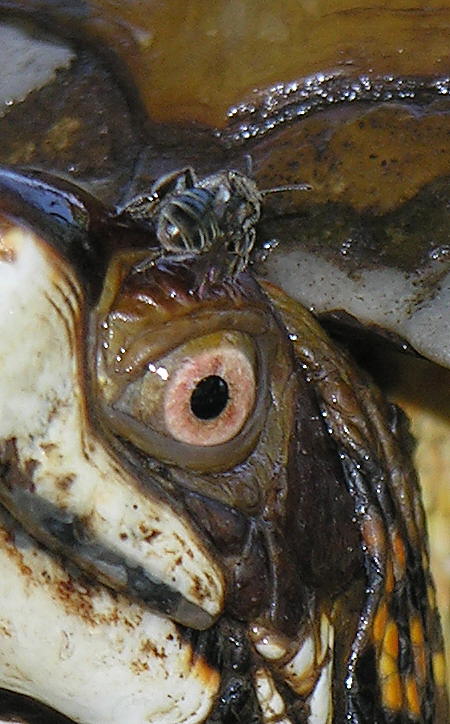
Another quick example.  Retta found this turtle on our patio last week, and so she grabbed the camera and snapped a few pictures of this fellow.

Say hello to this guy, please.

Or should I say, these fellows, because when Retta examined the photo on the computer, she discovered that the turtle had a passenger!

Ooops, I mean say hello to these guys!

These photos were taken with a Nikon Coolpix 8800, but the point of the post is to plug the capabilities of this breed of camera, and not necessarily this specific make or model.


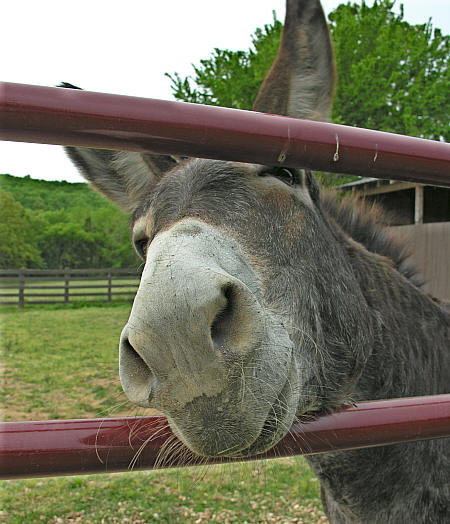
Pedro

Hello everybody, I'm Pedro.  Who are you?  Will you please leave a comment for me?

This fine looking fellow is Pedro.  Pedro dropped by this morning for a visit.  Pedro didn’t tell our neighbors next door that he was going out for a walk.  He just found a way out of his pasture, and wandered on over to chat with our horses, Chipper and Tojo.  Pedro’s owners will be mad at him for misbehaving.  Retta would like to keep him.  Hmmm, maybe I can broker some kind of deal…..