I Don’t Care Who You Are, This Is A Pretty Sight…

Where's the pot of gold?

The WildBlue satellite spot beam 35 was out for most of the day, so I have not had access to the internet until this afternoon.  So this photo is being posted a day later than I would have liked.

We were fortunate enough to receive 2 inches of rain Friday and into Saturday.  With the 2 1/2 inches we received the prior week, it looks as if our pastures and fields will be growing like gangbusters.  Once dry creeks are now flowing again, and the catfish pond will regain it’s previous glorious fullness soon, which is a big relief to me (not to mention the catfish).

After the rain stopped, we were again fortunate enough to be presented with a superbly brilliant rainbow.  I figured that, no matter how you happened upon this page, you would appreciate a moment to enjoy a beautiful rainbow with us.

PS – In case you were wondering, I raced over to this pasture to find the pot of gold, but somebody must have beat me to it!

The “Ouch” Factor

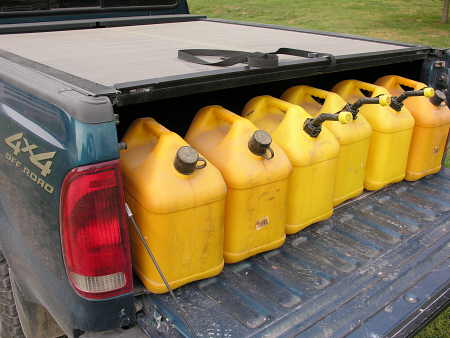
Diesel fuel containers

The photo above shows how we obtain our off-road diesel fuel to supply the needs of our tractor.  In order to purchase off-road diesel (which is devoid of state road taxes), we must travel 16 miles each way to the nearest supplier.  Safe fuel handling practices dictate that fuel containers be removed from the bed of the truck before filling, so we place the cans on the ground to pump fuel into them.  The containers are then lifted back into the bed of the truck for the journey home, where they are off-loaded from the truck and carried into the barn for storage.  When it is time to fuel the tractor, a container is carried from the barn out to the tractor, where it is emptied by hand into the tractor’s fuel tank. If I were to attempt this feat while standing on the ground, then the fuel filler neck would be at eye-level, which is not a particularly safe way to fill a tank with hazardous liquids!  As you can see from the photo below, by elevating the bush-hog into the uppermost position, I can accomplish the refueling from a position that affords eye safety.  On the other hand, it isn’t a position that is easy on the back!   Ouch!!!
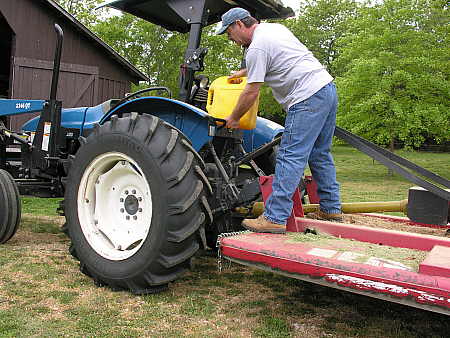
Fueling the tractor

Now let us do some math.  Ouch!!!  Okay, I’ll do the math, you just follow along with my reasoning.  This tractor burns 1 gallon of fuel per hour.  According to the tractor’s hour meter, I have run the tractor for a total of 1200 hours in the past 5 years.  That amounts to 1200 gallons of diesel fuel.  There seems to be some controversy over the weight of diesel fuel, but assuming a conservative 7 pounds per gallon as the factor, that translates into 8400 pounds of diesel fuel that the tractor has consumed.  Each gallon of fuel had to be handled several times; 1) loaded onto the truck for the ride home, 2) transferred from the truck to the barn 3) carried from the barn to the tractor 4) lifted and poured into the tractor’s fuel tank.  So now we have determined that I have handled a total of 33,600 pounds, or nearly 17 TONS of fuel!  Ouch!!!  No wonder my back sometimes hurts.

Now for some more math.  Ouch!!!  As you can see from the first photo, I fill 6 fuel cans at a time, because that is the number that will fit across the back of the pickup bed, affording lateral stability as I wind my way around the Ozarks landscape on my way to the filling station.  I fill each container with 4.5 gallons of fuel, therefore each round trip to the station yields 27 gallons of fuel (4.5 X 6).  We know from the paragraph above that we have used a total of 1200 gallons of diesel fuel, therefore we can conclude that there has been a total of 44 round trips made to obtain this fuel (1200/27=44.44).  Now if we multiply the 44 round trips by 32 miles, we obtain 1408 miles traveled to fetch diesel fuel.  Dividing by the abysmal 16 miles/gallon that my truck manages to achieve (he admits, covering his face in shame), and then multiplying by an average fuel price of, say, $2.00/gallon, we can determine that I have spent close to $200 just to fetch the fuel!  Ouch!!!  No wonder my wallet sometimes hurts.

As an aside, well, I’m almost too embarrassed to share it with you, but here goes.  Over the years, I have been purchasing off-road diesel fuel for use in my tractor.  As mentioned previously, off-road diesel fuel is devoid of road taxes.  Sometime in the past (I don’t know when), the state legislature decided that off-road diesel should be subject to the state sales tax of 7%.  So now, using today’s fuel prices, the calculus (ouch!!!) goes something like this:

Off-road diesel (16 miles away)= $2.65/gal + 7% sales tax = $2.84/gallon

On-road diesel (available locally) = $2.79/gallon

Price of my embarrassment = ???   Ouch!!! 

But I digress.

My father used to frequently say “Son, the legs go first!”  But then, he spent the better part of his life running a factory.  He put many miles on the soles of his shoes, so one would expect the legs to go first.  While I do lots of hiking around the property here, I find that I am called upon to perform heavy lifting much more than I recall doing since my younger days.  And so I would have to say “Dad, the back goes first!”

So the question that nags at me is this – is there a better way to accomplish this task of fueling the tractor, which, while seeming to be a trivial task, can wreak havoc on the backs of those of us who don’t feel as young as we once were?

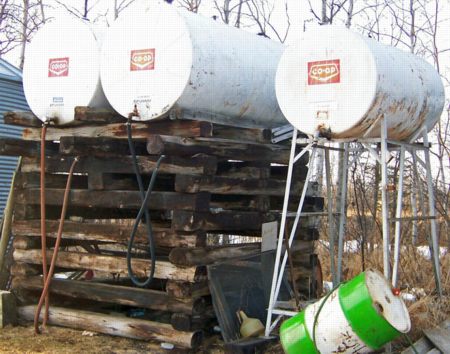
One popular option that many farmers turn to involves the installation of an elevated, above-ground fuel storage tank, which is periodically replenished by a local fuel distributor.  These systems are gravity driven, which is both a blessing and a bane.  A blessing, because pumping equipment is not required.  A bane, because gravity cannot be shut off.  There are many potential points of leakage in a fueling system.  With gravity continuously at work, any leakage, no matter how slight, will eventually empty the tank.  There was an incident that occurred about 5 years ago in an area around Beaver Lake, about 75 miles away.  A fishing resort owner had a 300 gallon elevated tank installed for the convenience of his guests.  The tank valve developed a leak sometime during the night, and approximately 200 gallons of fuel seeped into the water table.  To make a long story short, 5 years later there are about 100 households with contaminated wells.  Their water has to be delivered weekly by truck and pumped into plastic holding tanks placed on their property.  The owners of the resort had to declare bankruptcy when their insurance policy reached the limit of the insurance company’s contracted liability.  Ouch!!! 

And this scenario, with some slight variations, is played out repeatedly across the country.  As I was driving down the road this winter, I saw these tanks on a neighbors  farm, so I stopped to take a picture.  To me, this looks like a disaster waiting to happen. 

Elevated fuel tank

Were I to install a fuel tank, it would have to be built of quality parts.  I would have to keep the tank, fittings, hose, valve and nozzle in tip-top condition.  And the entire assembly would have have a seepage-proof containment system with capacity at least equal to the capacity of the tank.  All-in-all, this would be a safe and effective system, which would certainly relieve the pains in my back, but man, would it be costly!

So it’s off to the station to fill those darn fuel cans.  Ouch!!!  Ouch!!!  Ouch!!!

Flashback Friday #2

Let’s turn the clock back to the year 1966.  If you were around in 1966, you would have found the following to be true:

Lyndon Johnson was President of the United States.  The new Medicare act was implemented.  The Supreme Court issued the the well-known Miranda decision.  It was a bad year for Los Angeles sports fans, as the Baltimore Orioles swept the LA Dodgers in 4 games, and the Boston Celtics bested the LA Lakers in an extremely competitive 7 game series.  The Oscar for Best Picture went to “Sound of Music”, and Frank Sinatra walked away with the Grammy award for Best Album of the Year.  On the economic front, you could buy first-class postage for a nickel.

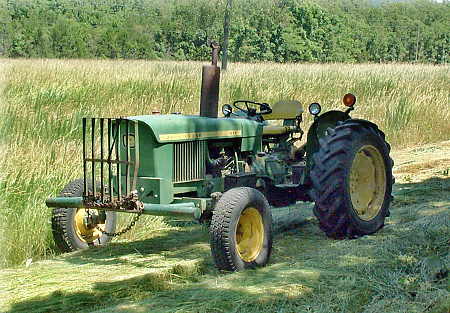
But the most important 1966 event in the agricultural world was the introduction of the John Deere model 1020 industrial tractor.  The significance of this tractor is that it signaled to the tractor world John Deere’s intention to compete vigorously in the low cost utility tractor market.  To be price competitive, John Deere needed to cut production costs, and to that end, they developed a three-cylinder gasoline engine, which was put into their new model 1020 tractor in 1966.  This tractor is credited with starting the 3-cylinder utility-tractor engine configuration, which is so popular  among tractor manufacturers today.  Here is a picture of the John Deere model 1020 tractor, which sold for $4500 back in 1966-

John Deere 1020

This is a 1966 John Deere model 1020 tractor that is owned by my neighbor Jimmy.  This is not a “coddled” tractor restoration by any stretch of the imagination.  This is a work-a-day tractor that is put into hay production and bush-hogging use regularly.  Periodically, this tractor needs to be “convinced” as to who’s the boss.  Jimmy stores a large, heavy hammer in the tractor’s tool box for just such occasions!

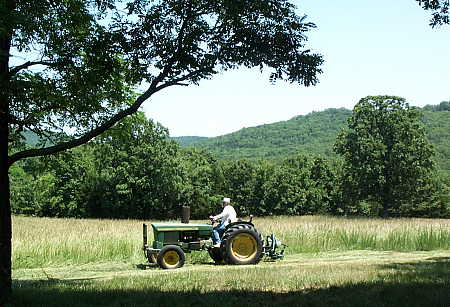
Our late neighbor Boots used to cut, rake, ted, and bale the grass in our hay fields until he passed away several years ago.  Now, Jimmy is doing this for us on a share basis.  Here is Jimmy hard at work cutting the hay in preparation for baling this past season-

Jimmy cutting hay with a sickle-bar mower

The hay field pictured above is one of the fields that Retta and I have decided to take out of hay production this year.  It is our hope that by keeping the fields that are close in proximity to the house and barn areas short, we will reduce the effects of predation on our fowl (see previous post).  It is also our hope that the short grass will help to create a fire-defensible zone in the areas around our house.  You may already know that we have been plagued by a spate of wildfires recently (see posts here and here).  I have read claims on other farming and ranching related blogs that tall grasses will not burn, as long as they are lush and green.  I have seen otherwise,  and until the firebug that is running around in our area is apprehended, I will rest easier with short grass surrounding the house and paddock areas.

Like all other land-use decisions a property owner faces, this decision involves various trade offs. Short grass means less cover for predators, which is our goal.  But it also means less cover for the wildlife that have learned to make effective use of the tall grass.  Birds of various species use the grasses to nest in.  Deer use the grasses for browse and for cover.  Grassy areas along the forest-field transition are used by the deer to give birth to their young.  Wildlife of all types will use the tall grasses to bed down in.  And who hasn’t heard of the proverbial “snake-in-the-grass?  The long grasses, which the wildlife have utilized up until now, will no longer be available in these fields.  Not to mention the production of several hundred square bales of hay that will be lost.

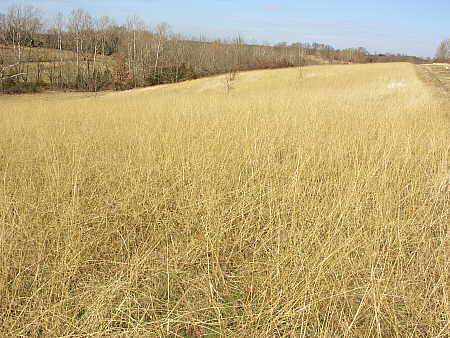
Wildlife cover

In conjunction with our decision to take several hay fields out of production, we will be compensating by allowing several other fields, such as the field shown in the photograph above, to grow to their full extent and remain tall throughout the year.  These fields will be cut on a rotating basis, such that, at any given time, long grasses will be available for the wildlife to utilize.

Some crazy, eccentric people will sure go through a great deal of trouble just to raise chickens and guinea fowl, won’t they?

The Power of 10X Optically Zoomed VR Mega-pixels

The latest crop of prosumer EVF (electronic viewfinder) digital cameras feature 8 mega-pixel images, coupled with a 10X optical zoom lens.  Some feature VR (vibration reduction) lenses.  If you have never seen a demonstration of the power of this combination of features, you may be interested in these photos.

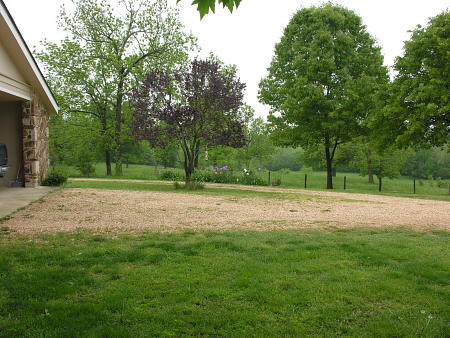
If you peer at this first photo closely, you will see a group of purple flowers (irises, I believe) that are growing at a distance of 100 feet from where I stood to take the photo.

Purple irises from 100 feet away

In the next photo, I have remained in the same location, but now I have zoomed in fully on the iris bushes.  In 35mm camera equivalency, I have zoomed from a 35mm (moderately wide-angle) shot to a 350mm (long telephoto) shot.

Here are the irises shot from the same location, but zoomed to 350mm

The photo above demonstrates the power that a 10X-optical zoom lens brings to the photographer.  Now, if you again look closely at the photo just above, you will see towards the bottom, just slightly off-center to the right, deep purple petals and a very dark iris bud.  Here, let me help you to see it-

Cropped photo, pixel-for-pixel screen representation

What you are looking at here is simply a cropped portion of the second photo, but there has been no enlarging or interpolation involved whatsoever.  It is merely a pixel-for-pixel depiction of what the camera captured on it’s sensor, and is a good indication of the power that 8 mega-pixel images bring to the photographer.

I will exhort you to think this through as you look at these photos again.  In the last photo you can see the pistols of the iris. You can see the detail of the veins on the petals of the irises.  And the image you are viewing was captured by a point-and-shoot camera from 100 feet away, on an overcast day, at 1/48th second shutter speed, without the aid of a tripod!  Think of all the possibilities with these kinds of cameras!

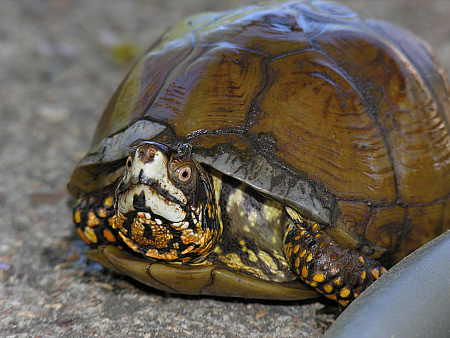
Another quick example.  Retta found this turtle on our patio last week, and so she grabbed the camera and snapped a few pictures of this fellow.

Say hello to this guy, please.

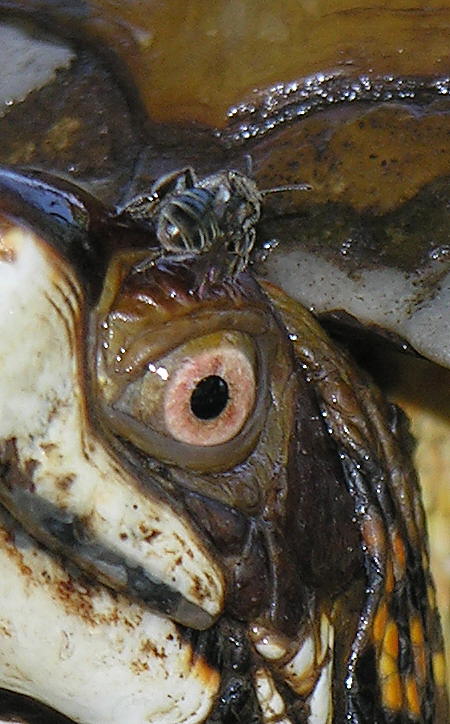
Or should I say, these fellows, because when Retta examined the photo on the computer, she discovered that the turtle had a passenger!

Ooops, I mean say hello to these guys!

These photos were taken with a Nikon Coolpix 8800, but the point of the post is to plug the capabilities of this breed of camera, and not necessarily this specific make or model.


Pedro

Hello everybody, I'm Pedro.  Who are you?  Will you please leave a comment for me?

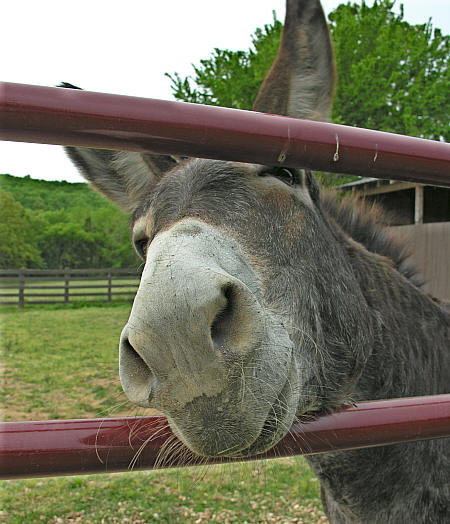
This fine looking fellow is Pedro.  Pedro dropped by this morning for a visit.  Pedro didn’t tell our neighbors next door that he was going out for a walk.  He just found a way out of his pasture, and wandered on over to chat with our horses, Chipper and Tojo.  Pedro’s owners will be mad at him for misbehaving.  Retta would like to keep him.  Hmmm, maybe I can broker some kind of deal…..

A Tractor for Chickens?

Prior to buying the ranch we are at, Retta and I took the opportunity to visit the property several times, doing the due-diligence inspections all property purchasers should undertake (including, I should note, the all important survey).  During these visits, we noticed, behind the former milking barn, an odd looking contraption, half-buried amongst the odds and ends that always seems to accumulate behind old milking barns. As neither of us recognized what this object was, it soon disappeared into the deepest recesses of our memory banks.  On our last visit prior to closing escrow, while watching television at the Comfort Inn we were staying at, we saw an episode of the P. Allen Smith gardening show.  One particular segment of the show featured something called a chicken tractor.  And what the show portrayed on the screen looked very similar to the contraption sitting behind the milking barn.  Now we knew what that thing was – a chicken tractor.  I had previously heard of lawn tractors, garden tractors, farm tractors, and even tractor-trailers, but I had never heard of a chicken tractor! 

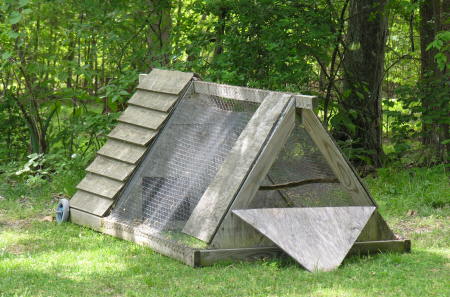
When Retta and I found that we had become the proud owners of chickens (see previous post), we faced the problem of deciding where to house them, and we needed to learn the basics of caring for them.  While looking for information at the local farm store, we ran across a book entitled “Chicken Tractor – The Permaculture Guide to Happy Hens and Healthy Soil”.  That caught my attention instantly, as I never want to be accused of having unhealthy soil, and heaven forbid, unhappy chickens!  Consequently, I purchased that book and learned everything one could possibly know about chicken tractors.  Everything.  Including the information I shall now share with you.  First, here is what one chicken tractor looks like:

Chicken tractor from behind the milking barn

From this picture you can see that this tractor has an enclosed shelter area, which includes a nesting box elevated off the ground.  There is also an outside pen.  Both areas of the tractor are exposed to the ground.  Here is how the chicken tractor is operated.  Put the chickens inside.  Close the door.  Feed and water the chickens daily.  Move the tractor daily.  Clean out the nesting box periodically.  And that is all there is to it.

There are several advantages to utilizing a chicken tractor to house your fowl.  Because the chickens have access to your lawn at all times, they will help control insect populations.  The chicken droppings will help fertilize the lawn.  Most important, the chicken tractor should protect your birds from predators.

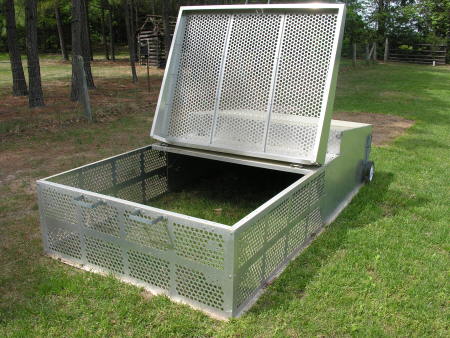
There are disadvantages to the chicken tractor as well.  The tractor has to be heavy enough to stay put in heavy winds. The weight makes it difficult to move unless it is designed with an efficient wheel mechanism (which the one above does not have).  In the photograph below, you can see another type of chicken tractor.  This is a commercial chicken tractor, manufactured in Missouri, that is designed to be both lightweight and strong.

Aluminum chicken tractor

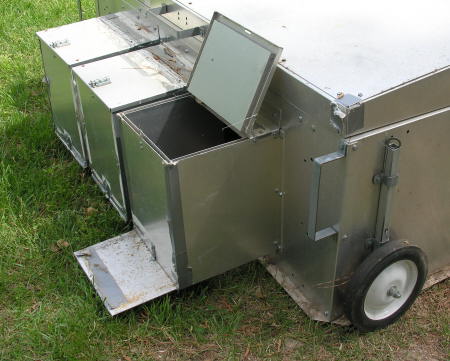
In this style of chicken tractor, the lighter weight is offset by the improved stability that the low, wide profile provides.  Varmints cannot overturn a tractor of this type, and it’s light weight make it fairly easy to move around your lawn.  In the following photograph, you can see the design of the three nesting boxes that are a part of this tractor.  The boxes have exterior lids, making it easy to collect eggs and add litter.  The slide-out floor at the bottom allows for easy litter removal.

Well designed nesting boxes

Now for the bad news about chicken tractors.  The biggest drawback to the use of a chicken tractor is that, no matter how heavy and sturdy you construct it, varmints can burrow into it easily, simply by digging a hole in the ground anywhere along it’s sides.  We once lost a whole batch of chickens in one night alone, after some unknown critter dug its way underneath the sides of the tractor.

We now utilize permanent coops for our fowl, with concrete footings at the base.  This prevents critters from taking the underground route to our birds.  And what has become of our two chicken tractors?  The wooden tractor has become an infirmary and isolation ward for any bird that might happen to need that type of TLC.  And the aluminum chicken tractor is just the right size to store a pickup-truck size load of trash.  When it fills up with trash bags, I load the truck and take it over to the county transfer station to dispose of it.  But that is another story.

Dang Rocks!

Some people have all the luck. Take Pablo at Roundrock Journal, for instance.  Not only does Pablo have cute, cuddly, nameable rocks at Roundrock, such as Stoneman, he is also blessed with the good fortune to possess other memorable specimens.  Specimens with names like “Craters o’the Moon” and “Orange Rock”.  It almost makes you want to go out and adopt the first piece of orphaned schist you can find.  Don’t do it!

Rocks are evil. Evil, I tell you.  And how do I know this to be true?  Ladies and gentlemen, I grow rocks.  Real rocks.  Big rocks.  And I harvest these rocks.  Before you click away from this page, muttering something like “I know rocks, and Hal must be off of his”, let me tell you a little (true) anecdote.

During our first season of owning this place we call home, I spent a great deal of time picking up rocks from our various pastures and fields.  In two fields next to the house, I took extra pains to be certain I picked up all of the rocks, because I intended to add these fields into hay production, and hay equipment and rocks don’t mix.  Using the front-end loader on the tractor, a rock bar, and lots of stoop-labor, I eventually managed to strip these two fields clean of any rocks.

Winter came and went, then spring arrived, and the grass was growing tall.  When June rolled around the grass was just about in it’s prime to be baled.  Now it doesn’t make economic sense for me to cut and bale my own hay, so I usually have a neighbor do it for me on a share basis.  In this particular year, a neighbor named Boots came around with his tractor to cut the hay.  After just a short time cutting grass – BANG.  The sickle-bar mower had hit a rock, damaging several of it’s cutting teeth.  Boots replaced the damaged parts and began cutting again, when another loud BANG could be heard.  More damage to the sickle-bar mower.  And more time spent repairing the mower.  When this happened a third time, Boots came over to have a talk with me.

Boots:  “I thought ya said ya picked up all them rocks”

Hal:       “I did.  I picked up every rock in sight for nearly a month last summer” 

Boots:   “Yeah, but yer field growed more of them rocks this winter”   

Hal:        “My field grew WHAT this winter?”

Boots:    “It growed more rocks.   Didn’t ya harvest ’em this spring?”

Hal:        “Harvest WHAT?”

Boots:    “The rocks.  Ya gotta harvest ’em each spring”.

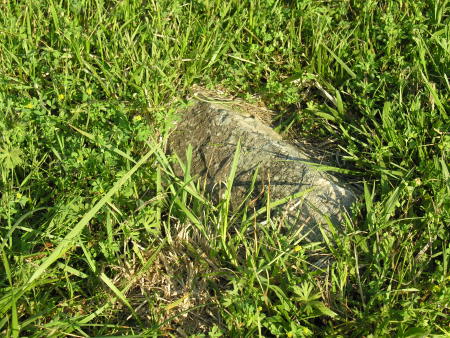
Now I thought that old Boots had been out in the sun too long or something, but you know what?  He was absolutely right.  These fields do grow rocks.  It is apparently part of a geological process that is normal in the Ozarks.  The best way that I can explain the process that is going on in my fields is to have you picture a batch of chocolate-chip cookie dough spread out in a pan.  This would represent my field – an amalgam of soil and rock.  If you were to pick out all of the chips that appear on the surface of the dough, leaving no more chips visible, that would be analogous to my picking up the rocks in my field during the summertime.  Whenever the soil expands and contracts, such as in a freeze/thaw cycle, or a wet/dry cycle, the resulting dynamics that ensue create an up-force to the rocks below the surface.  Eventually, they will rise to the surface, waiting for just the right moment to inflict their havoc on the unsuspecting, as seen here:

Lurking, always lurking!

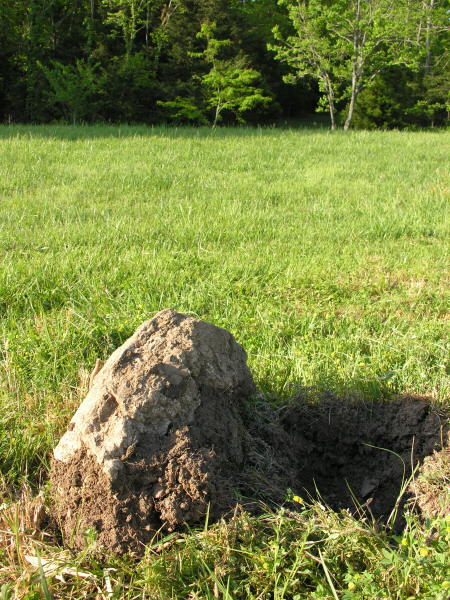
If you recall from a previous post, we suffer the loss of chickens and guineas due mostly to daytime predation.  In an effort to stem the tide of such losses, Retta and I have decided to take these two fields (closest to the house) out of hay production.  We intend to keep the grass short this year in these areas, in the hope that our fowl will stand a better chance of survival.  To that end, I was busy with the tractor this morning cutting the grass in these fields, when – BANG – the bush-hog hit a rock.  It was a sneaky rock, hiding like the one in the previous photo, barely above the surface of the soil, but extending out just enough to get snagged by the corner of my bush-hog:

Gotcha!!

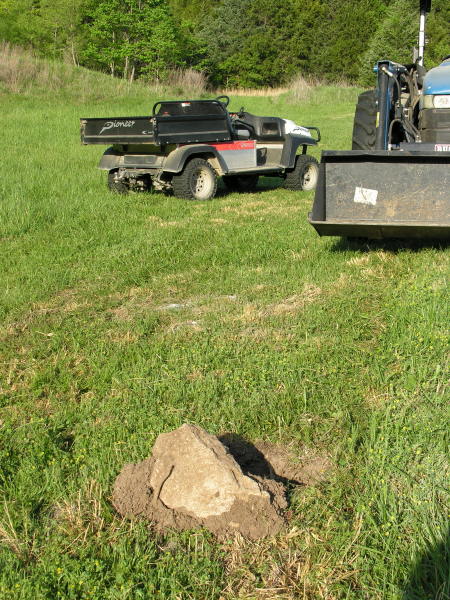
And here you see that, in addition to finishing up the mowing, Hal now has to haul away a big rock, fill in and compact a big hole, and fix the broken blade on the bush-hog:

DANG ROCKS !!!  DANG ROCKS !!!

These are the kind of evil, good-for-nothing rocks I have to deal with out here.  None that are cute, none that are cuddly – just DANG ROCKS!


Flashback Friday #1

Since this is the first installment of Flashback Friday, I thought it would be fitting to search for something to post that also related to a first of some kind.  When I came across these photos, my searching immediately ended.

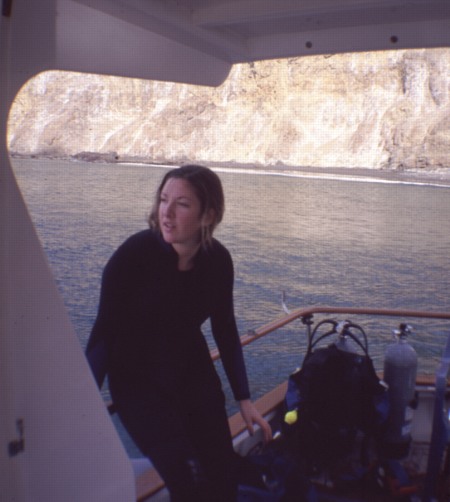
Some years ago,  my daughter expressed an interest in learning to scuba dive.  Having a few dives under my weight-belt, I was totally thrilled at the news.  Sara enrolled in a basic open-water certification course (taught by her cousin Bruce), and after thorough training involving classroom work, pool training, beach dives, and open-water dives off of a commercial dive boat, she proudly had her C-card in hand.  Retta and I were living on a boat at that time, a trawler named Lorelei, so we said “Hey Sara, how about going out to the Channel Islands with us for some diving?”  “Sure”, she replied.  And so we did.

Gearing up for a dive

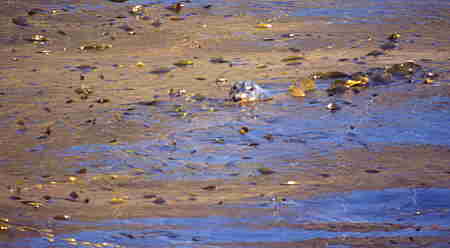
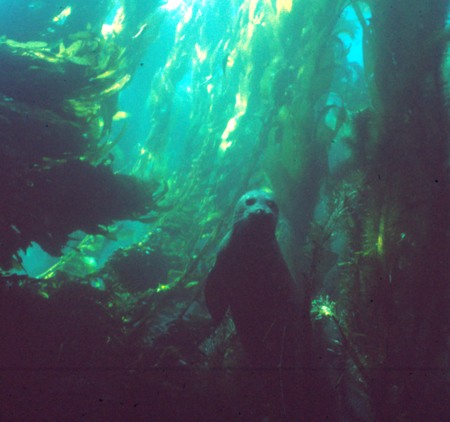
While we were gearing up for a dive along a shallow reef in the vicinity of the sea lion rookery on the south side of Anacapa Island, we spotted a harbor seal peeking out from the floating kelp fronds, apparently spying on us.

Who just dropped an anchor on my fin?

After finishing the ritual of gearing up and performing buddy checks on each other, Sara and I took turns entering the cool waters of the Pacific ocean with the finest back-rolls off the starboard bulwark that we could muster up.

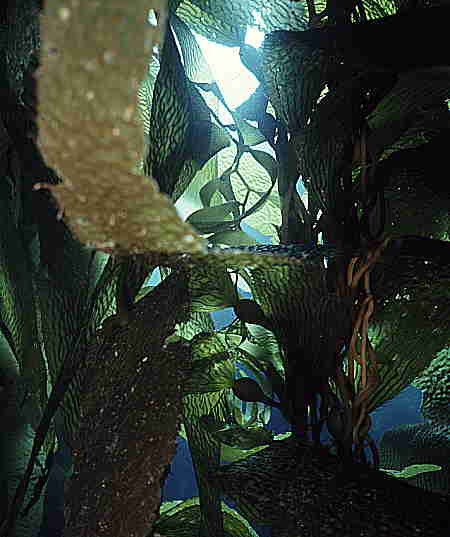
As we descended down the water column, we could not help but be entranced by the sight of the giant kelp, which sways to and fro in the gentle surge of the sea.

Descending into the kelp forest

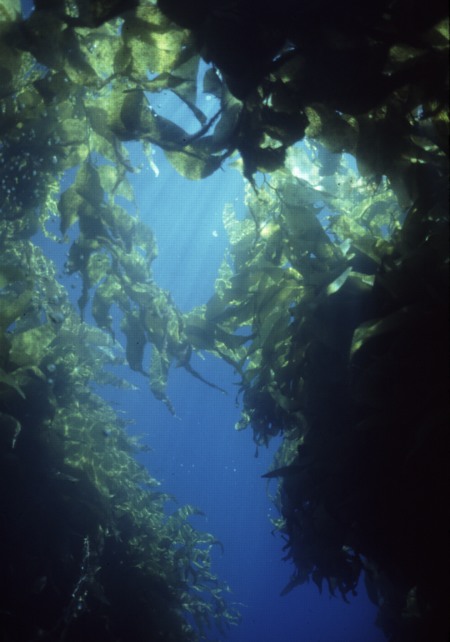
As we continue our descent to the bottom, so that I can check to be certain that the anchor is securely set, we both continue to admire the surreal seascape that unfolds before our eyes.

The kelp forest is enchanting

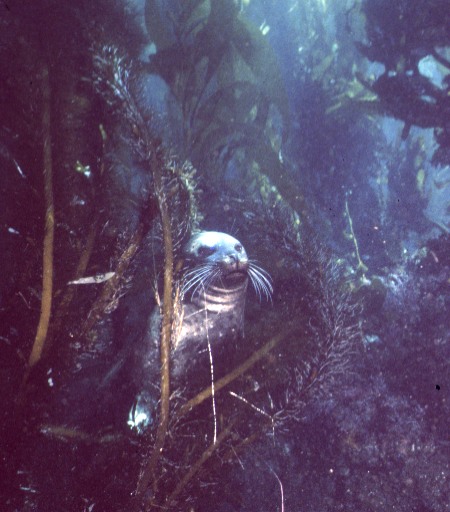
As you gaze up at the sight of the sunlight, watching as the rays dance between kelp fronds, you can become so entranced with the moment that you don’t notice other things that surround you.  Like the harbor seal that Sara and I saw from the deck of the boat.

Who dropped an anchor on my fin? I want to know who dropped that anchor?

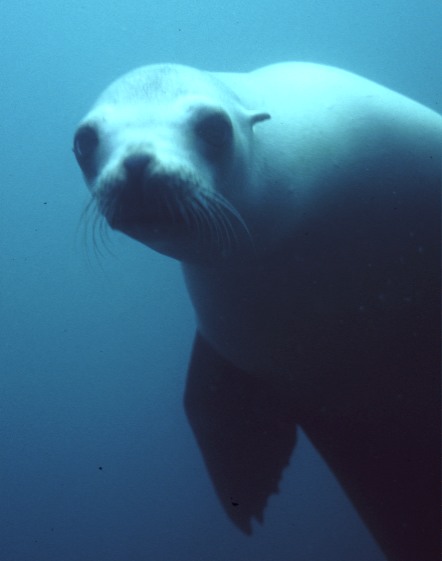
Because we had been so intent in our focus on the kelp, this harbor seal felt secure enough to approach us.  After spending a little while with us, the seal lazily swam off into the kelp forest.  Sara and I continued our dive, examining the various creatures that one is likely to encounter in the area, including a curious California sea lion.

Did someone mention an anchor?  There's one down to the left.

They say that all good things must come to an end, and so it was with this dive.  Sara and I made our way back towards the boat.  Locating our anchor line, we were about to begin our ascent when we spotted another harbor seal, apparently their to bid us adieu!

Please come back - but leave your anchor at home next time!

Slowly ascending along the anchor chain, we made a safety decompression stop at a depth of 15 feet.  When the required time had elapsed, we both made our way over to the swim platform, where we boarded Lorelei and stripped off our gear.  This had turned out to be a wonderful day.  The sun was shining.  The seas were calm.  The visibility underwater was excellent.  The marine life had been exceptionally cooperative.  But most important, Sara’s maiden dive as a certified diver turned out to be a great one!

Congratulations Sara - a job well done!

And Sara’s papa was proud.

A Little Tweaking Here and There

After three months of blogging, I thought it was time to pause and assess this site.  This has pretty much been a play-it-by-ear endeavor.  Since I had not planned on having a blog (see new page – “A Little About This Blog“), it stands to reason that I also did not have a clue as to what direction this blog should take.  I still don’t.  But no matter, I’ll press on anyway.  I have decided to make a few minor changes.

First, I have eliminated the category “Media Center Ramblins”.  I still like Windows XP Media Center, and I still use it daily.  But now that Microsoft has decided to incorporate the Media Center functionality into the upcoming Vista OS, I don’t think I will have too much to be saying about it in the future.  If I do, it will be included in “Computer Ramblins”.

Second, I will be increasing the frequency of posts in the “Photography Ramblins” category.  Having had dozens of cameras over the years, and photographic images numbering in the thousands (both terrestrial and underwater), I think that I can find something to say on the subject.

Third, I have included a new category entitled “Flashbacks in Time”.  Included in this category will be those things that I might have included in a blog 10, 20, or 30 years ago, had the technology existed at that time.

The fourth, and most significant change is the addition of a new feature, which I shall call “Flashback Fridays”.  Friday will be the designated day that I post items into the “Flashbacks in Time” category.  These posts will draw on my photographic collection, and will undoubtedly be quite varied in nature.

Considering my expectation was that I would be the only person reading my words and looking at my pictures, I am pleased to see that my web host reports the following:

Average successful requests per day: 2,660
Now if only I knew what that statistic means!

Now, What Was I Saying Before I Became Distracted?

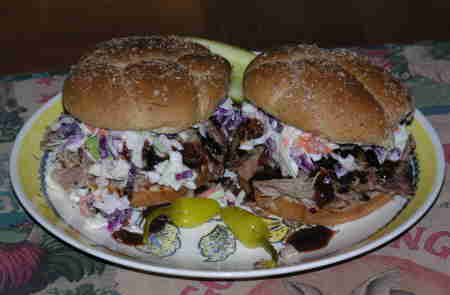
Oh yeah, I remember.  I was out smoking a pork butt yesterday, thinking about what I might write about in Ranch Ramblins, when I was so pleasantly distracted by those turkeys (see previous post).  When an opportunity like that presents itself, you run with it.  So the turkeys became the subject of the post.  Which left me wondering afterwards, as I again basted the pork and added wood to the fire, “what should I write about tomorrow?”  And then it struck me – write about dinner.  Not just any dinner, but one of my favorites.  Smoked pulled-pork sandwiches, a traditional southeastern BBQ staple, but with an Arkansas twist to it.

Start with a pork butt (also called a pork shoulder) roast, about an 8-10 pounder will do.  Thoroughly massage your favorite BBQ rub into the meat.  Cover and refrigerate overnight, giving the rub time to permeate the roast.

Make a batch of cole slaw, using your own favorite recipe.  If you like it tangy, make it tangy.  If you want it creamy, then by all means, make it creamy – after all, you are the one who will be eatin’ the sandwich, so it’s your choice!  Cover and refrigerate overnight, to give the cole slaw a chance to season (“fester” is what I usually say, but Retta thinks that’s gross).

Early the next morning, preheat whatever type of smoker system you use, and allow the meat to come to room temperature.  Use any of the common smoking woods you prefer.  I like a strong smokey flavor to this dish, so I use mesquite, but it is equally good with any of the others, such as hickory or oak.  Some people swear by peach wood for smoked pork.  The point is, whatever your preference, do it!  You’re eatin’ the sandwich, so it’s your choice. 

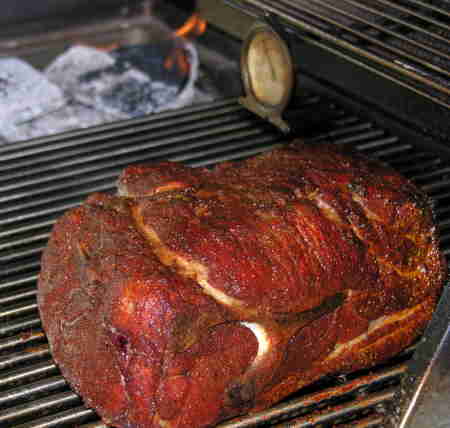
Maintain a smoker temperature between 240-260 degrees.  Place the pork butt (with fat cap facing up) in the smoker.   Smoke until a meat thermometer reads 190 degrees.  Spray the meat occasionally with your favorite basting liquid.  I use apple cider mixed with a little cider vinegar.  You use what you want, because……  you’re the one who will be eatin’ the sandwich, so it’s your choice!  After about 12-14 hours of TLC, it should look something like this –

Pork butt smokin' away!

Be careful removing the pork from the grill, because it’ll tend to want to fall apart.  That’s how tender it should be.  After the pork butt rests for a while, pull it apart with a couple of forks.  Try not to eat it all while you are shredding it apart!

Place a heaping mound of the shredded pork on a bun of your choice.  I like cracked wheat buns, but use what you want, because……  you’re the one who will be eatin’ the sandwich, so it’s your choice!  Drizzle your favorite BBQ sauce over the shredded pork – careful, not too much.  I like to experiment with all different kinds of BBQ sauces, because, like snowflakes, no two are alike.

Now, for the Arkansas twist.  Take a generous portion of cole slaw, and pile it on top of the shredded pork.  Serve the pulled-pork sandwich with a dill pickle spear and some hot peppers, and you’ve got yourself some good eatin’!

Yummy!

A Pleasant Distraction

Around noon today, as I was feeding mesquite chunks into the firebox of the smoker and wondering what I might post in Ranch Ramblins today,  I heard the unmistakable sound of a gobbler in the distance.  Springing into action, I grabbed the spray bottle and quickly gave the pork butt a liberal basting of apple cider to keep it moist.  Striding into the house, I grabbed the camera and went out front, and there I saw these two guys.

Struttin' their stuff

These wild tom turkeys were in the process of courting a hen, who was situated across the creek.  It is always a joy to watch their antics, as they try to outdo one another in their quest to attract the hen.  Much like teenagers.

Things Found on Trees

When Retta went out this morning to do her early chores around the barn, she discovered this beautiful large moth on the trunk of a black walnut tree.  She told me to go and get the camera before the moth departed, and fortunately, when I arrived with camera in hand, the moth was still there.

A very large moth on a black walnut tree

In the following photo, I am not trying to catch the moth, but this was the only “handy” way to indicate scale –

A

A few years ago Retta again discovered an interesting find on an oak tree in our yard.  I have never encountered this kind of aggregation of caterpillars before, and we haven’t seen it happen since.

Last, but not least, I cannot forget to include my friend Morton, who keeps constant watch over me as I perform my yard chores.

My landscaping supervisor

AN APPOLOGY TO ALL:  I am sorry for possible slow loading times in the last few posts.  I was working on another project, and forgot that I had tinkered with my JPEG compression settings.  I have reset it to a more appropriate level for the blog.  Photo load times should be quicker from now on, as the file sizes will be much smaller.

A Sunday Morning Constitutional

This morning I read a post on Geek Acres referring to a comment on a post at Roundrock Journal regarding mayapples.  The comment was:

“mayapples and morel mushrooms (when spotted) are frequently in the same area.”

Armed with this information, Retta felt it was our duty to immediately begin a search of the area of our property most likely to have mayapples, in hopes of finding the elusive, yet delectable morel mushrooms that might possibly be nearby.  Off we went, heading towards an area that I knew hosted mayapples.  This spot we were seeking is alongside a small spring-fed creek, and the land in this particular area tends to be boggy for a few months a year.  It seemed to be an ideal habitat in which to find morels.

Mayapples along creek

At last we arrived at our destination, and there, in all of their glory, was a group of mayapples.  Our timing was good, as the mayapples are in bloom just now.

Mayapple blooms

This was a nice find on a beautiful Sunday morning.  Retta and I began to search the surrounding area, looking here and there on our quest for the elusive morels.  My searching was being disrupted, however, by a strange and eerie feeling that I was being watched.  This feeling wouldn’t shake me, and so my thoughts soon drifted away from the sought after morels, and instead focused on finding the source my mysterious trepidation.  After a little time spent looking around, it soon became apparent why I had felt spied upon –

So that's who has been spying on me!

Knowing now that my life was not in any danger, I felt obligated to continue on the quest.  There did not appear to be any morels in this area, so we continued on to another likely spot, along an adjacent creek.  Since it was a warm morning, Gracie decided to take a sitz bath in one of her watering holes within the creek bed –

What a relief from the heat!

And when she was finished with her sitz bath (or should I say mud bath), she now became the focus of my attention.  And to think, Retta and I had just brushed her out earlier this morning!

Oh, no!

After spending some time looking for morels in this location and not finding any, we decided to press on to another spot we thought might be an appropriate environment for these mushrooms.  Along the way, however, we happened to pass a stand of black walnut trees, and decided to spend some time enjoying the beautiful flowers that awaited us there –

A pretty place to relax in the shade.

Search as we might, there was just no locating those very elusive, tantalizingly tasty morel mushrooms.  So I guess this morning wasn’t a success, was it?

What’s a Bush Hog?

In a comment to the previous post “How Can You Not Love A Face Like This?”,  MrC posed the following question:

——-

Earlier, Hal said “…as I bush-hog a field.”

Us city-folk are not so sophisticated.  I don’t know what bush-hogging is, but it sure doesn’t sound like something I would do to my wife.  :-)
———

Well, MrC, this is a bush hog.  Actually, Bush Hog, as that is the trademark used by the Bush Hog Company to market their brand of rotary cutter (they were the inventor of this farm implement).  It is also referred to as a brush hog, a rotary cutter, or a shredder.

Bush hog

The implement my daughter is modeling above is a Bush Hog brand 7′ diameter rotary cutter.  Think of it as a lawnmower on a massive dose of steroids.  It will cut through grass, weeds, brush, and saplings up to 3 1/2″ in diameter.

David at the wheel

In this photo, my son is demonstrating the proper technique for bush-hogging.  Notice the height of the grass and brush beyond the tractor?  It was definitely time to cut this field.  We schedule the cutting of our fields and pastures to create a habitat suitable to the needs of the varied wildlife in our midst (which will be the subject of a future post).

When you have finished bush-hogging a pasture, after a week or so it will look like this:

Finished product

When you have finished bush-hogging your wife, after a week or so she might look this:

Sorry dear!

So, in conclusion, I would suggest that MrC and all the other city-slickers out there heed the following advice. DO NOT, under any circumstances, bush-hog your wife!

How Can You Not Love A Face Like This?

What are you looking at, huh?

Duane from Geek Acres (see previous post) had a recent post on his site about ticks and the use of guineas in controlling them.  Duane and Jennifer have considered owning guineas, and a commentator advised them:

———— 

“DON’T DO IT MAN!!!!!

Guineas may look all tiny and cute and helpful – but they are mean!!!

My parents had some on our farm. They constantly attached our sheep and other birds(including fights to the death). On the other hand they are fairly small. Up to you, just be aware I have talked to several other people who have the same sentiment about them. If any of your dogs are timid and are going to be in the same area as the guineas be aware they might get attacked also.”

————-

We want to take this opportunity to come to the defense of these poor, misunderstood, lovable creatures.  If you look closely at the first photo (above), you can clearly see the affection in this bird’s eye – not an iota of meanness is apparent in it’s countenance.

In the photograph below, do the dogs look the least bit disturbed by the presence of the guineas?  They’re not, and for good reason.  The guineas we’ve known have all been gentle creatures, who display a curiosity towards those around them.

Let the fighting begin!

Now, if you are really looking to possess a bird with aggressive tendencies, make sure to get a rooster.  They possess wickedly long, strong and sharp spurs, which they are prone to use at the slightest perceived provocation.  Imagine placing a carpentry nail against your shin.  Now, have a friend(?) whack the nail with a hammer, hard enough to cause the nail to penetrate bone.  Ouch!!!  That is what the spur of a rooster can, and will, do. Retta has a scar or two to prove it, ask her. 
The guineas are pretty smart, in their own way.  For example, they quickly learn that the discharge chute from my lawnmower emits oodles of lush, green grass.  Consequently, when I mow, I have a flock of guineas chasing after me and my mower (I’ll have to ask Retta to photograph this sometime – it is pretty comical, at least it has me grinning as I mow).  They have also learned to chase after the tractor as I bush-hog a field.  They quickly grab the grasshoppers and locusts that scatter in all directions when I pass.  In a fine Pavlovian manner, they come running whenever they hear the sound of the tractor or mower starting.  You can almost see them drooling!

We have seen a marked improvement (IE decline) in the tick population in the areas that the guineas patrol.  They lead a pretty boring life.  Unless nesting, they spend most, if not all, of their waking hours eating ticks (as well as other bugs).  They don’t scratch around everything, as chickens do, so your plantings are pretty much safe from them. 

Guineas play a cute game (at least I think it’s a game) which I call “Guinea Keep-Away”.  The guineas usually travel in flocks.  When one member of the flock finds a grasshopper, say, he will pick it up in his beak and run away with it.  This arouses the suspicion of the rest of the flock, who chase the first guinea to see what it has.  The first guinea, invariably, will drop the grasshopper.  Another guinea will pick it up and also run with it, until such time as he drops it.  Another guinea picks up the grasshopper and runs, and thus the cycle continues.  I don’t really know if this is “sport” or not, but it is consistent behavior, and it certainly appears as a game to me.  Oh yeah, they also perform this exact behavior with mice (that our cat tortures half-to-death) dangling from their beaks – gross!

Guineas help attract wild turkey to your property.  The turkey seem to sense the comfort level that the guineas have around humans and their paraphernalia, and hence are more prone to come around an inhabited site that has guineas.

But lest you think there are no negative traits with guinea fowl, consider this.  They are noisy.  It is said that they make fine “watchdogs”, in the sense of raising an alarm at anything that arouses their suspicion.  The problem is, they suspect almost everything and everyone, so expect to hear a lot from them.  And their grating, squawkish rasp sounds much like an axle that hasn’t seen grease in a long, long time (eeek… eeek… eeek… eeek… eeek… eeek… incessantly when aroused).  At those times, you can forget about taking that much anticipated nap in the patio lounge!  And if you have neighbors that live close by… well, you can imagine.

 Just shut up already, I heard you the first time!

We raise our guineas from keets (chicks), that we usually get shipped from a local hatchery.  We have used Cackle Hatchery, in Lebanon, Missouri, and they have been dependable.  After raising the keets inside the house for several weeks, we transfer them out to the poultry pen pictured below.  It has a concrete footing, an interior portion with roosts, and an exterior “courtyard”. 

We keep the keets locked up in the coop until they are nearly fully grown.  By waiting until they are grown, the guineas seem to develop a sense of home.  At that time, we release the birds in the morning to roam around the grounds.  In the evening, the loose guineas return to the pen (sometimes with a little coaxing).  As the seasons warm up and summer approaches, some of the guineas decide that they would rather sleep on top of the pen, rather than inside.  There isn’t much we can do about it.  They are safe from ground predators there, but we believe that we lose several a year to owls swooping down on them at night.

Low-income housing

But credit for our success with guineas definitely goes primarily to Retta.  It is Retta who buys and raises the keets, and feeds, waters and generally sees to their well-being. And, as the photo below proves, she spends a lot of time in a rigorous training regimen.  Here, she is training the guineas to walk in single-file  ;>)

Rigorous training techniques are utilized

In conclusion, I’ll offer my advice to Duane and Jennifer:  DO IT MAN!!! You won’t regret your decision.
Introducing “Geek Acres”

Make way, there is a new blog in the Ozark neighborhood, and it’s called Geek Acres.  Duane (the self-described geek), and his wife Jennifer, have recently purchased a hobby farm outside of Springfield, Mo. as their new residence.  Duane intends to utilize Geek Acres to chronicle their adventures as they transition to a new environment.

Neither Duane or Jennifer are new to blogging.  Duane also publishes Minutia – thoughts of duanekeys, and Jennifer publishes Ramblings of a Flower Addict.  Both are excellent blogs, so I expect that Geek Acres will follow in the same suit.

I’ll be looking for your keen insights and observations as you settle into your new place.  Good luck to you both.

What If …

Molt in progress

…we could periodically peel out of our skin, re-emerging a decade younger in appearance?  I’d like to be the one holding the patent on that process, wouldn’t you?

The above photo courtesy of Retta, who always manages to find such neat photographic subjects.  Here is another of her wonderful springtime photos –

Bee careful!

IN THIS CORNER …..

….. is Hal, the defender of the ranch, and a somewhat naive newcomer to the rural scene, in need of plain old experience.  And in the opposing corner, Willard – otherwise known as Rattus, of the order Rodentia.  And the bell rings –

ROUND 1:  Hal is so naive, he doesn’t even know that there is a competition underway.  Day in and day out, blissfully unaware, Hal undertakes his tractor work, and when finished for the day, parks the New Holland back in the equipment barn.  All seems well, until one day, Hal begins his day of bush-hogging, which is rudely interrupted by a cloud of steam billowing out from beneath the hood of the tractor. “Oh oh, this can’t be good” Hal mutters, as he lifts the bonnet to assess the situation.  He soon discovers the cause of the overheated diesel engine.  A rat had built a nest atop the engine intake manifold, which had apparently become dislodged as the tractor was started.  The nest fell down, and became wedged between the fan belt and the belt pulley, thus flipping the belt off the pulley.  With the fan belt gone, the engine eventually overheated, which was the cause of the cloud of steam.  A few gallons of anti-freeze and a new fan belt later, the tractor was good as new and parked back in the equipment barn.

ROUND 2:  Hal is so naive, he doesn’t suspect that this will ever happen again, and he deludes himself into thinking that this was a freak, one-time occurrence.  For a while, fate cooperates with this delusional thinking.  Hal judiciously checks under the bonnet of the tractor prior to each use, under the misguided premise that all rat attacks occur in the same fashion as in ROUND 1. As long as the engine is clear of any debris before being started, Hal reasons, then no problems can possibly arise.  For a year, no problems arose.  Until one day, when Hal checked under the bonnet and found another rat’s nest.  Congratulating himself on being so foresightful as to check the engine compartment prior to starting the tractor, he proceeds to clear away the nest material from the engine.  But much to Hal’s chagrin, he discovers that the rat had chewed through 2 of the tractor’s wiring harnesses.  One week and $500 later, the tractor is back to normal.

ROUND 3:  Hal is so naive, he once again underestimates the determination of the order Rodentia to make life miserable for man.  Now, as a result of the outcomes of ROUND 1 and ROUND 2, Hal figures that besides checking under the bonnet prior to each use of the tractor, he should also store the tractor in the barn with the bonnet wide open.  Hal confidently figures that this will discourage the rat from again nesting upon the engine (which the rat seems to have taken a liking to).  And once again, the brilliance of Hal’s reasoning stands the test of time. A short time.  One day (those “one days” always seem to come about, don’t they?), when Hal turns the ignition key to start the tractor, he is greeted by the sound of silence.  Confident that this was merely a mechanical problem, as the pre-use checkout of the engine compartment revealed nothing unusual, Hal proceeded with the usual troubleshooting procedures called for in this situation. Ruling out the battery as the culprit, and then the starter as well, Hal began the tedious task of tracing the starter circuitry to diagnose the problem.  What Hal eventually found was that the rat had now found an entryway to the area situated between the dashboard and firewall of the tractor.  Removing the instrument cluster from the dashboard, Hal was greeted by the sight of a rat scurrying away from the scene of the crime.  Left behind was the evidence of his unwelcome stay – four wiring harnesses completely chewed to pieces.  Three weeks and $1000 later, the tractor was again good as new.

ROUND 4:  What is that old saying?  Fool me once, shame on you; fool me twice, shame on you; fool me three times, shame on you; but fool me four times, and SHAME ON ME (I think it goes something like that).  So as not to be shamed by a rat, I decided it was time to get tough with this guy.  But I also believe in the principal of “live and let live”, so extermination was out of the question.  I could try to trap the rat and relocate it, but that solution would require lots of activity on my part, so I quickly abandoned any further thought along those lines.  And then it dawned on me – snakes – and lots of them!  Snakes would be the ticket to a rat-free tractor ownership experience. So, after some comparison shopping on the internet, I ordered an assortment of snakes.  Not real, live snakes, mind you, but realistic looking rubber snake replicas.

The first line of defenseSecond line of defense

This mower needs protectionThis mower needs protection too!

ROUND 5:  Has not taken place, as the rat has not shown up again since I put the snakes to use last year.  So I guess that I won the bout in the fourth round, due to the disqualification of my worthy opponent!   Or so I hope…….

Wierd Spring Rituals (Part I)

The Grassing of the Carp

This annual rite begins with the ceremonial “exchanging of the blades“, in which the fall/winter mulching blades are are removed from the lawnmower, and replaced with spring/summer high-lift blades.

Exchanging of the blades

Next, all interested parties are invited to gather in the specified viewing area, beside a ranch pond, in a rite called “the assembly of the plebes“. They come from far and wide to witness this impending spectacle.

 The excitement builds!

A lone coot arrives on the scene, attracted by the commotion taking place before him.

What's going on here?

Soon, Retta spots a reptilian guest, who just wanted to know what all the fuss was, and why did we disturb his nap in the spring warmth?  I just wanted to know if it was safe to go into the water.

 Oh oh - better be careful!

It soon becomes apparent that the reptiles don’t want to be too outnumbered by the mammals, and reinforcements begin to arrive, in the form of a snapping turtle. The duck?  He just sits there, always with the same blank look in his eye.

A snapping turtle also drops by

You can sense the excitement in the air, in anticipation of the of the impending “rites of the first swath“.  In this rite, the previously prepared lawnmower (see “the exchanging of the blades“, above) is called into service.  By maneuvering it into just the right position along the pond bank, a steady stream of long grass cuttings can be sprayed onto the surface of the pond water –

Grassing of the carp

At last, in a grand culmination to all of the pomp and circumstance that has taken place, the subjects for whom this ceremony has been created, finally arrive.  They are the Grass Carps, who, after dreaming of this moment throughout their long winter hibernation, begin their sumptuous feast!

The carp are here! The carp are here!

And thus goes “The Grassing of the Carp

Birds of a Feather …

Over the past several years we have maintained wildlife feeders on our ranch, for the benefit of the deer and the turkeys, but primarily for the benefit of ourselves.  Twice a day, at precisely 7:00am and 4:00pm, we enjoy the sight of turkeys or deer at the feeders within sight of the house.  Thanks to Roundrock Journal’s pablo, and his pangs of conscience (detailed here), we now must give serious thought to the ethics involved in such activities.  What once seemed to be such a simple personal pleasure will now require the type of soul searching heretofore reserved for matters of much greater significance.  While we ponder the issues involved, and consult with others wiser than ourselves for their sage consul, we offer up the following, merely as food for thought.

Turkeys at the feeder

The turkeys at the feeder above are typical of what we see for a few minutes each morning, and then the scene is repeated again each afternoon.  The turkeys (or deer) will usually hang around the feeder for 5-10 minutes, and then off they go, returning to the foraging that they do so well in our pastures, fields, and food plots.  When they leave the feeders, there is still corn remaining on the ground, which indicates to me that they are successfully obtaining nourishment from their natural habitat.

Turkeys grazing

This is where the turkeys spend the bulk of their time.  They are away from the feeders, and from what I have been able to observe, they spend the better part of the day foraging for whatever the natural foods are that turkeys eat.

Two observations from all of this:

A)  We have feeders on our property to attract the wildlife so that we may observe them, and if we are lucky, shoot them with our cameras.  Our neighbors have feeders on their property so that they can attract wildlife so that they may observe them, just prior to shooting them with their hunting firearms.  If we are more successful in attracting the wildlife than our neighbors, I believe this accrues to the benefit of the wildlife.

B)  While we subscribe to the notion that we are but the temporary caretakers of the land and it’s inhabitants, we also realize that it is our name on the deed to the ranch.  We are the ones who keep the water supplies clean and abundant, we are the ones who keep poachers at bay, we are the ones who avoid the use of all manner of pesticides and herbicides, all for the benefit of the wildlife.  All this, and what do we ask in return?  Just the simple pleasure of regular visits from those who reside here.

We will definitely ponder the ethical issues of the activities we undertake here at the ranch, but in the meantime, the catfish are calling out to be fed!

If They Can Do It, So Can I

Back in 2001, the local telephone company in our area (Northern Arkansas Telephone Co) undertook a project whereby each and every telephone pole was identified and mapped using GPS technology.  To accomplish this task, a small group of NATCO employees were equipped with ATVs and GPS units.  After spending each day following the telephone lines and entering each pole as a way point on their GPS units, the team would then upload this information into the NATCO computers, and thus an accurate survey of NATCO’s telephone poles was completed.

When the NATCO ATV showed up on our ranch to survey our poles, I took the opportunity to talk to the technician, and I became intrigued by the notion of mapping out the features of our ranch.  I saw that the equipment that he used was fairly simple stuff, which gave me the necessary impetus to undertake a mapping project of my own.

Back when Retta and I were cruising among the Channel Islands off the California coastline, GPS navigation was a necessity, so I was quite familiar with GPS units and their capabilities.  Our GPS unit was tied in to our laptop computer.  The end result was that we could do our chart work in real-time, with the location of our vessel accurately depicted on our electronic maritime charts.  When we sold the vessel, the GPS unit went with it, but now, here was my excuse to justify the purchase of an inexpensive hand-held GPS unit (I confess to a personal weakness that prompts me to try and find any justification for acquiring new technological gadgets).  So I purchased a Magellan GPS device, and soon had it wired to my laptop computer.  I also needed some type of mapping software, and settled on Delorme 3-D TopoQuads.  This software is fairly full-featured and inexpensive, and while it is accomplishing all that I want it to do, it seems somewhat cumbersome to use, as if it were designed in a prior software era.  Now, all I had to do was tie this all together into a package that could actually be used on the ranch. Here is what eventually evolved from my efforts.

Mapping System Components

Notice the following features of my “super-duper, multi-purpose, portable cartographic data collection machine”  (SDMPPCDCM).

A) High-tech Rubbermaid containers are utilized to house the necessary components, as well as providing sun-shading capabilities for daytime use.  These are inexpensive, readily available, and coincidentally, just the right dimensions to fit snugly into our utility vehicle.

B) This application for a laptop computer consumes lots of power.  The computer cannot use any power saving modes while mapping, the screen must be set for full power to be visible in the daylight, and the hard disk drive and CDrom are always busy performing mapping chores. Rather than trying to create a properly conditioned power supply from the utility vehicle’s electrical system, which would have been a project unto itself, I opted to power the system with an automotive rechargeable booster pack, available (of course) from our local Wal-Mart.  By adding a simple and inexpensive power inverter, this system can be operated at full power for a lot more hours than I care to work in a day.

C) The laptop is affixed to the turntable by a pair of stabilizing rails on the side of the turntable, and secured with industrial Velcro attached to the bottom of the computer.  The turntable swivels on a simple pivot, allowing me to easily adjust the viewing angle.  The entire package is secured to the vehicle with a heavy duty bungee cord.

D) The GPS unit, which feeds data to the computer via a data cable, is mounted on the dashboard of the vehicle with a quick-release mount built especially for this particular GPS unit.  This allows for excellent visibility while driving, and allows me to easily pop off the GPS and use it on foot when necessary.

When mounted in the utility vehicle, the entire contraption appears as below:

Mapping system in place

An example of the results obtained with this system can be seen in the following map printout, which is a screen shot from the Delorme mapping software.  This particular map layer that is pictured shows the trail network as it exists on the ranch.  There are unlimited layers available, and I have used them for many purposes.

Mapping results

You may ask, “Hal, what prompts you to spend so much time rambling on about computerized mapping systems and such?”   Pablo, editor of the Roundrock Journal, a fine and highly popular Missouri blog, recently mused about solitary shag bark hickory and walnut trees on his property.  The question arose as to weather solitary trees of this type would produce nuts.  I suppose a normal person who is motivated to find an answer to this question would, with a few well-defined queries to Google, come up with an answer in short order.  But I am (thankfully) not normal!

Three years ago, I began a long-term project of mapping the approximately 150 black walnut trees that exist on the ranch.  Each year, I use my GPS data to locate each of these trees, and I note their status as being either “nut-bearing” or not, as the case may be.  I then use this data to plan my bush-hogging schedule, so that the trees are accessible to my friend Jasper when he comes around in the fall to gather our black walnuts.  It is my thought that I can utilize the data that I am collecting to answer the pressing question of solitary nut trees (if I should be fortunate to live long enough to collect a meaningful amount of data).  I am also attempting to see if I can find any direct correlation between nut production and weather patterns.  This may be grist for a future post (if I can find any results worth posting).

DRM Rears Its’ Ugly Head Once Again

I cannot resist ranting about Digital Rights Management (or other copy protection schemes) whenever I run across negative issues associated with them.  When will the holders of intellectual property rights ever learn the basic lessons that seem to arise again and again?

Recently, Sony Music and other music publishers tried to institute a boneheaded copy protection scheme that met with such resounding protests that they immediately backed off on its’ implementation.  This scheme relied on a technique that utilizes what is known as a “root kit” to do its’ duties.  When copying music from these CDs onto your computer, bits of coding would insinuate itself deep into your computers file system.  If you are at all familiar with Unix, Linux, or any of their derivatives, you will recognize that any user that has what is known as “root access” has virtually total control over the machine in question.  Granting root access is thus a potentially dangerous situation.  Root access techniques have become the “method de jour” for modern day hacking, and is a major security issue, particularly as employees shuttle laptops back and forth between home and office networks.  No wonder there was an immediate and loud outcry about this technique (see previous post here).

Today, I ran across this article from cdfreaks.com (I love the monikers you run across on the web)   “Tests find DRM shortens player battery life by up to ~25%” .

Basic lesson that is ignored at the publishers peril – “Do NO HARM unto those who legitimately purchase a license to utilize your intellectual property.”  The revenue stream of any publisher depends entirely on the continued purchases made by these customers.  Cripple them in any way, deprive them of the full use of the media that they have legitimately paid for, and they will abandon you at their very first opportunity.  History proves me right on this issue (although we seem to be in a period where the lessons of history are often ignored).  The pirates who blatantly disregard intellectual property rights always find a way to circumvent copy protection schemes anyhow, so why risk alienating your proven (and hopefully loyal) customer base.  Your financial future depends upon them.

End of rant (for the moment).